
On this page
Start here
Quick answer
If an Amana furnace will not start, first confirm the thermostat is calling for heat, the system has normal visible power indications, the filter and registers are not obviously restricted, and the status light or display is recorded without opening the cabinet. Then note the last safe stage: no response, blower or inducer only, ignition attempt without flame, brief flame followed by shutdown, or a normal fan-only response. Amana directs HVAC owners to its model-specific manuals and support, and Amana HVAC systems are manufactured under license by Goodman, whose official troubleshooting material identifies power, low-voltage, pressure-switch, ignition, flame-sense, limit, airflow, and control paths. Do not remove panels, test live voltage or gas pressure, jumper thermostat terminals, bypass a safety device, or repeatedly reset a lockout. Stop for gas odor, a carbon-monoxide alarm, smoke, flame outside the burner area, scorching, or unsafe venting and obtain appropriate emergency or qualified help.
Before you begin
Safety first
- Owner checks are limited to normal thermostat controls, safe external power and status observation, accessible filter and register checks, visible exterior vent observation, model identification, and documentation. A qualified professional must handle cabinet access, live electrical or gas measurements, combustion and vent tests, ignition, flame sensing, pressure and limit circuits, wiring, and part replacement.
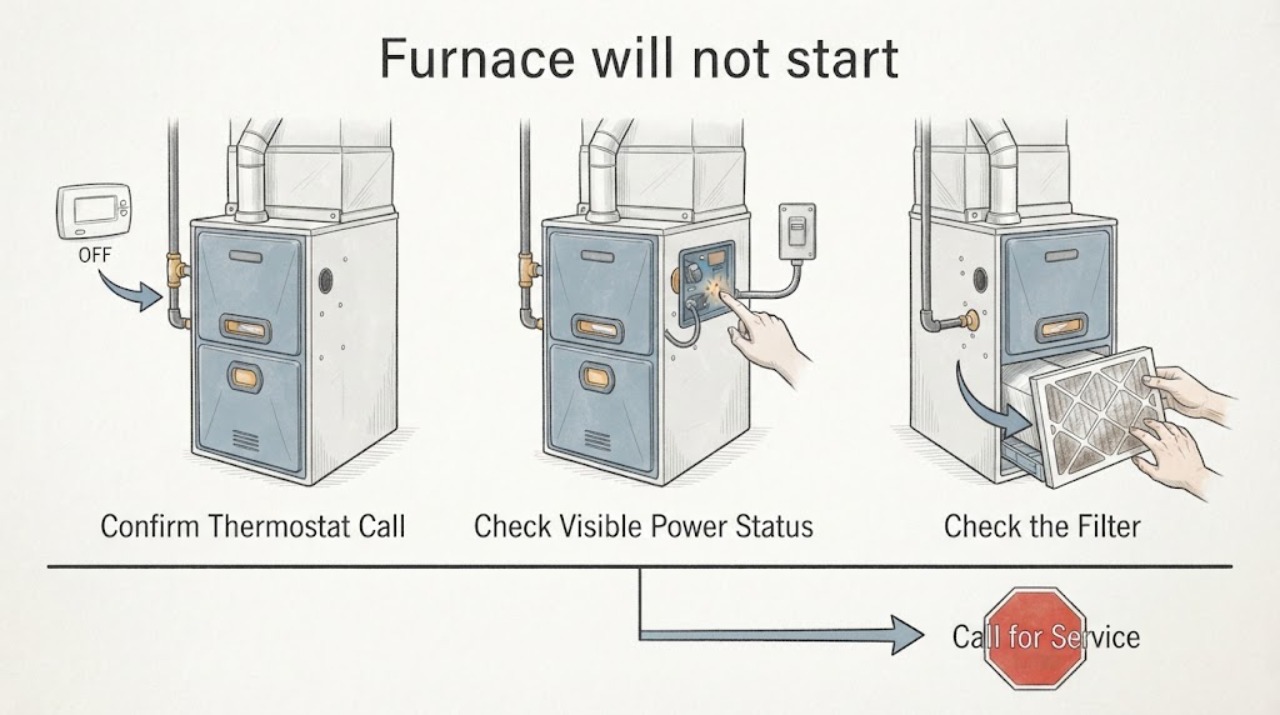
Work through in order
Diagnostic checks
Use only checks that match the exact appliance or system and its official guide.
-
Check 1
Use only the thermostat's normal controls to confirm Heat is selected, the setpoint is above the room reading, the display is stable, and no schedule, hold, fan, or remote setting is ending the call. Do not remove the thermostat or change installer wiring.
Expected result: Record a stable heat call, a blank or rebooting display, a mode or schedule that is not calling for heat, or a heat call that disappears before the furnace responds.
Next step: Correct only an obvious normal user setting according to the thermostat instructions. If the call remains unstable or the furnace stays unresponsive, arrange qualified HVAC service; do not jumper terminals.
Stop if: Stop for damaged, wet, scorched, or exposed thermostat wiring or any step requiring cover removal or terminal access.
Why this matters
Why: A missing or unstable call keeps the thermostat, low-voltage supply, or control path in consideration. A stable call that remains active shifts attention to furnace power, safety sequence, ignition, airflow, or venting.
-
Check 2
Without opening the furnace, check whether the clearly labeled service switch and HVAC breaker appear in their normal positions and whether any external display or status light is present. If a breaker is visibly tripped, use the exact owner manual's guidance only once and only when there is no odor, smoke, moisture, or damage; do not repeatedly reset it.
Expected result: Record normal power indications, a tripped breaker or off switch, a breaker that trips again, a blank display, or a visible lockout or alarm.
Next step: Leave a repeatedly tripping breaker or damaged switch off and call qualified HVAC or electrical service. If power looks normal but the furnace will not start, photograph the status indication and continue only with external checks.
Stop if: Stop for burning odor, smoke, arcing, water near electrical equipment, a hot panel, a damaged switch, or a breaker that will not remain on.
Why this matters
Why: No visible power can prevent the entire startup sequence. A repeated trip, dead display, or lockout suggests an electrical or control fault rather than proof that a switch or breaker should be reset again.
-
Check 3
Inspect only the user-accessible air filter, return opening, and visible supply registers. Confirm the filter is not heavily loaded and that registers are open and not blocked by furniture or coverings; do not remove the furnace blower or burner door.
Expected result: Record a clean filter and open registers, a loaded filter, several blocked registers, weak airflow, or an inaccessible filter.
Next step: Replace only a user-accessible filter with the exact type and size specified by the Amana or system manual. If airflow remains weak, the filter is inaccessible, or the furnace still will not start, stop and arrange service.
Stop if: Stop for soot, scorching, a missing filter, an abnormally hot supply, a damaged cabinet, or any need to enter the blower or burner compartment.
Why this matters
Why: Restricted airflow can reduce heat transfer and contribute to a limit opening or poor heat delivery. A clear filter and open registers do not rule out a blower, duct, heat-exchanger, or control issue.
-
Check 4
If this is a gas Amana furnace, inspect the visible exterior vent termination and combustion-air area from a safe position for leaves, nests, ice, water, or other obvious blockage. Do not climb, remove vent pieces, reach near exhaust, or probe a pressure-switch tube.
Expected result: Record a clear termination, a restricted-looking termination, abnormal exhaust, soot, water or ice, or no safe view of the vent path.
Next step: Stop using the furnace and arrange qualified HVAC service for any suspected blockage, abnormal exhaust, soot, water, or inaccessible vent. Do not restart repeatedly to see whether the furnace clears the condition.
Stop if: Stop for gas odor, exhaust entering the home, soot, flame or heat outside the termination, ice requiring a ladder, or any need to disassemble venting.
Why this matters
Why: A restricted flue or combustion-air path can keep pressure proving from completing and can create an unsafe combustion condition. An external observation does not identify a pressure switch, inducer, or heat exchanger as the failed part.
-
Check 5
With the cabinet closed, request heat once and observe only the external result: no sound, a draft or inducer sound, ignition attempt without a lasting flame, a brief flame followed by shutdown, or blower operation without warm air. Do not look into the burner compartment or try to relight or clean a component.
Expected result: Record the last stage that occurs, whether the thermostat call remains active, whether the blower continues, and whether the control shows a lockout or fault.
Next step: Stop repeated attempts and provide the exact sequence and model to a qualified technician. Do not bypass a pressure or limit switch, test gas pressure, or replace a component based only on the sound or timing.
Stop if: Stop for delayed or rough ignition, flame rollout, flame outside the burner area, unusual combustion noise, soot, gas odor, smoke, or carbon-monoxide alarm.
Why this matters
Why: No sound keeps thermostat, power, and control paths in consideration. Inducer without ignition keeps pressure, vent, ignitor, gas, and control paths open. Brief flame followed by shutdown keeps flame proving, limit, combustion, and control paths open.
-
Check 6
Read the status light or display only through the normal viewing window or exterior panel and record the exact code, blink count, color, timing, and sequence stage. Photograph the model and serial label if safely visible; do not remove a panel, press an unlabeled reset, or erase fault history.
Expected result: Record no light, a steady indication, a repeatable fault, a code associated with ignition or pressure, a limit or rollout indication, or a pattern that changes between attempts.
Next step: Use Amana's model-specific manual or support path and give the technician the code, model, last startup stage, filter and vent observations, and thermostat behavior. Leave internal diagnosis and repairs to qualified service.
Stop if: Stop if reading the code requires opening a panel, touching wiring, repeated resets, or approaching a hot, smoking, wet, or combustion-unsafe cabinet.
Why this matters
Why: The indication may direct a technician toward power, low voltage, pressure, airflow, limit, ignition, flame sense, or control diagnosis. Codes are model-specific, so a generic list cannot prove the failed part or authorize a reset.
Use your observations
Decision map
Find the observation that best matches what you see, then follow the next safe action.
-
PATH 01Next step
What you see
The thermostat call is absent or unstable, the display is blank, the service switch or breaker is off, or the furnace has no response with abnormal power indications.
Do this next
Use normal user controls and the exact Amana model instructions only. A recurring trip, dead display, damaged wiring, or unresolved no-start condition needs qualified HVAC or electrical diagnosis; do not bridge terminals or test energized wiring.
Why this path and its safety boundary
Why it matters: Thermostat, low-voltage, line-power, wiring, or control conditions are more likely than a burner or flame sensor fault.
-
PATH 02Next step
What you see
The blower or inducer runs but there is no warm-air heating sequence, or the furnace reports a pressure or limit-related indication.
Do this next
Keep the cabinet closed, stop repeated attempts, and arrange qualified service. Provide the last stage, code, airflow observations, and visible vent condition; do not bypass a switch or change blower settings.
Why this path and its safety boundary
Why it matters: A limit circuit, filter or duct restriction, pressure switch, vent, inducer, control, or heat-exchanger condition may be preventing the sequence from continuing.
-
PATH 03Next step
What you see
The furnace attempts ignition but burners do not light or do not remain lit, or the code points to ignition or flame sensing.
Do this next
Stop repeated ignition attempts and request qualified gas-furnace service. Do not clean, bend, replace, or test an ignitor, flame sensor, gas valve, or safety circuit as a generic owner step.
Why this path and its safety boundary
Why it matters: Ignitor, gas, flame-sense, grounding, pressure, combustion, wiring, or control paths remain possible; the symptom does not identify one part.
-
PATH 04Next step
What you see
The filter is loaded, registers or return air are blocked, airflow is weak or unusually hot, or the visible gas-furnace vent appears restricted.
Do this next
Correct only an obvious user-accessible filter or register issue according to the model instructions. Have persistent weak airflow, a blocked vent, recurring shutdown, or abnormal exhaust professionally diagnosed.
Why this path and its safety boundary
Why it matters: Airflow or venting can cause overheating, pressure failure, or a safety shutdown, but a clear external filter or vent does not rule out a concealed restriction or internal fault.
-
PATH 05Next step
What you see
There is gas odor, a carbon-monoxide alarm, smoke, flame outside the burner area, scorching, arcing, severe combustion noise, or unsafe exhaust.
Do this next
Leave as appropriate and contact emergency services, the gas utility, or urgent qualified HVAC help from a safe location. Do not operate switches in a suspected gas leak, touch wet electrical equipment, restart the furnace, or inspect inside the cabinet.
Why this path and its safety boundary
Why it matters: This is an immediate gas, combustion, fire, or electrical safety event, not a normal no-start diagnostic.
Helpful context
Understand the symptom
The last stage you can observe is the useful clue
An Amana furnace may fail before any sound, after the thermostat call, during inducer or pressure proving, during ignition, or after a brief flame. A fan that runs without heat is a different path from a completely dead unit. Observe only from the normal exterior viewing position with the cabinet closed; a status code and the last sequence stage are more useful to a technician than a guessed part.
Amana model identity matters
Amana's owner resources use the model number to locate the correct manuals and troubleshooting documents, and the official manuals page directs HVAC owners to the Amana HVAC support site. Furnace families, controls, and diagnostic indications vary. Record the model and serial label only if it is safely visible, and do not apply a generic blink chart or procedure to an unknown furnace.
Airflow and venting are upstream checks
A dirty filter or blocked duct can reduce airflow over the heat exchanger and contribute to a limit response. On a gas furnace, a blocked flue or weak inducer can prevent the pressure circuit from completing. Goodman identifies these as diagnostic branches and says routine inspection of the blower, inducer, burners, filter, and flue belongs with a licensed professional. A homeowner's role is limited to safe, visible checks.
Combustion and electrical work require a professional
Ignitors, flame sensors, gas valves, pressure switches, rollout and limit controls, wiring, and control boards are not interchangeable or safely diagnosed by symptom alone. Do not remove internal covers, bridge a switch, test energized wiring, change gas settings, or reset a rollout device. If there is gas odor, carbon monoxide, smoke, or abnormal flame, leave the area as appropriate and get help from a safe location.
Safety boundary
Stop conditions
- Stop using the furnace for gas odor, carbon-monoxide alarm, smoke, flame outside the burner area, scorching, arcing, delayed or rough ignition, severe combustion noise, or unsafe exhaust; leave as appropriate and get emergency or gas-utility help from a safe location.
- Do not open internal furnace covers, test live voltage or gas pressure, jumper thermostat terminals, change blower or combustion settings, or alter wiring as a homeowner diagnostic.
- Never bypass, repeatedly reset, hold closed, or substitute a limit, rollout, pressure, door, or other safety control; a repeated lockout requires diagnosis.
- Do not repeatedly restart a furnace that fails to start, attempts ignition without a lasting flame, runs a blower without heat, or shows a pressure or limit indication.
- Owner checks are limited to normal thermostat controls, safe external power and status observation, user-accessible filter and register inspection, visible exterior vent observation, and documentation; combustion, electrical, cabinet, and safety-component work requires qualified service.
Only after diagnosis
Potential parts
- air filter
Consider this only if the user-accessible filter is visibly loaded and the exact Amana or system instructions identify the correct replacement; a dirty filter may contribute to airflow or limit symptoms but does not prove the no-start cause.
Confirm exact dimensions, type, airflow orientation, and system requirements before replacement; do not run the furnace without the required filter. - thermostat or low-voltage control
Consider this category only after qualified diagnosis confirms an absent or unstable heat call or failed control and rules out power, wiring, airflow, venting, and safety causes.
Verify exact Amana or Goodman system, thermostat compatibility, wiring, configuration, and installer requirements; do not change terminals or settings by symptom alone. - hot-surface ignitor
Consider this only when the startup stage and qualified testing confirm an ignition fault and the exact model ignitor is damaged or otherwise defective.
Confirm exact model, ignitor design, connector, mounting, and approved service procedure; do not touch or test the ignitor as a generic owner repair. - flame sensor
Consider this only when burners ignite but qualified diagnosis confirms flame proving fails because of the sensor or its circuit after grounding, combustion, and pressure checks.
Confirm exact model, sensor geometry, wiring, grounding, and service procedure; a brief flame or code does not prove replacement is needed. - pressure switch or inducer assembly
Consider this only after the vent and tubing path is assessed and a qualified technician confirms the pressure circuit or inducer is outside the exact model's required operation.
Verify exact model, switch setting, inducer configuration, vent design, and safety requirements; never bypass, adjust, or substitute a pressure switch. - limit, rollout, or integrated control
Consider this only after qualified diagnosis identifies a failed safety or control component and investigates airflow, venting, combustion, wiring, and heat-exchanger causes.
Confirm exact model, safety function, electrical and temperature ratings, approved replacement, and required testing; never reset, bypass, or substitute a safety control from a symptom or code alone.
When checks do not resolve it
Need a professional?
Call a qualified HVAC technician when an Amana furnace will not respond to a confirmed heat call, a breaker trips, the status display is abnormal, the inducer or blower runs without heat, ignition fails, the flame does not remain established, a limit or pressure indication appears, airflow is weak or unusually hot, or the symptom persists after safe external checks. Seek urgent or emergency help for gas odor, carbon-monoxide alarm, smoke, flame rollout, scorching, severe combustion noise, arcing, or unsafe exhaust.
Safety scope: Owner checks are limited to normal thermostat controls, safe external power and status observation, accessible filter and register checks, visible exterior vent observation, model identification, and documentation. A qualified professional must handle cabinet access, live electrical or gas measurements, combustion and vent tests, ignition, flame sensing, pressure and limit circuits, wiring, and part replacement.
Common questions
FAQ
Why will my Amana furnace not start?
A missing thermostat call, power or low-voltage issue, pressure or vent problem, airflow or limit response, ignition or flame-proving failure, gas interruption, or control fault can all prevent startup. Confirm only normal user settings and visible conditions, then provide the last sequence stage and model to a qualified technician.
What should I check first on an Amana furnace?
Confirm the thermostat is calling for Heat, check visible power and status indications without opening the cabinet, inspect the accessible filter and registers, and observe the exterior vent only when safe. Do not bridge terminals, test live wiring, or remove panels.
What if my Amana furnace is completely quiet?
A stable thermostat call with no sound keeps power, low voltage, wiring, the control, and a lockout in consideration. Check only normal thermostat, switch, breaker, and visible status conditions; a recurring trip or dead display requires qualified HVAC or electrical diagnosis.
Why does the Amana inducer run but the furnace does not light?
Pressure proving, vent or tubing, inducer performance, ignition, gas, or control problems can stop the sequence after the inducer starts. Keep the cabinet closed, stop repeated attempts, record the code and external vent condition, and call a qualified technician.
Why does my Amana furnace light briefly and then shut off?
Flame proving is one possibility, but limit, pressure, airflow, grounding, combustion, gas, or control conditions can look similar. Do not clean, bend, or replace a flame sensor or reset a safety control by symptom alone; request qualified diagnosis.
Can a dirty filter stop an Amana furnace from starting?
A loaded filter can reduce airflow and contribute to overheating or a limit response. Replace only a user-accessible filter of the exact specified type, and arrange service if the furnace still will not start, airflow is weak, or a shutdown recurs.
What does an Amana furnace blinking light mean?
The meaning depends on the exact furnace family and control. Record the exact pattern, model, sequence stage, and timing, then use the model-specific Amana or Goodman documentation. A generic code list does not prove a failed component or authorize a reset.
Should I reset the rollout switch on an Amana furnace?
Do not reset, bypass, or hold closed a rollout or other safety control as a homeowner test. An open safety device can signal a serious combustion, vent, airflow, or heat-exchanger condition; stop use and obtain qualified service.
Can I open the Amana furnace panel to see what is wrong?
No. Internal compartments contain electrical, combustion, moving, and hot components, and the door may be part of the safety interlock. Limit checks to the exterior viewing position and user-accessible maintenance identified by the model manual.
When is an Amana furnace no-start an emergency?
Treat gas odor, a carbon-monoxide alarm, smoke, fire, flame outside the burner area, scorching, arcing, severe combustion noise, water near electrical equipment, or unsafe exhaust as urgent. Leave as appropriate and contact emergency services, the gas utility, or qualified help from a safe location.
Read the exact guide
Official sources
- Manuals and Guides | AmanaAmana · Amana manuals page used for the model-number and documentation boundary; it states that Amana HVAC systems are manufactured under license by Goodman Global and routes HVAC owners to Amana HVAC support.
- HVAC Learning CenterGoodman Manufacturing · Goodman official maintenance guidance used for general furnace component and safety context under the Amana-Goodman licensing relationship; it is not an owner repair procedure.
- Home - Product Help | AmanaAmana · Amana product-help portal used to support model-number lookup and escalation; it does not provide a universal furnace repair procedure.
- Customer Support, Warranty Info & Service Plans | AmanaAmana · Amana HVAC support page used to establish the brand's support boundary and professional-service path; model-specific manuals govern diagnosis.
- Service and TroubleshootingGoodman Manufacturing · Goodman official service manual used because Amana's official manuals page states its HVAC systems are manufactured under license by Goodman Global; exact Amana model documentation and qualified service take precedence.
Community feedback
Share a repair observation
Share a plain-text repair observation. Accepted observations are published automatically; this page may take a moment to update.