
On this page
Start here
Quick answer
A dirty, blocked, incorrectly installed, or overly restrictive air filter can reduce airflow and make an Amana furnace run poorly, but a clean filter does not prove the furnace's heat-producing components are working. Check the filter at the accessible return grille or filter cabinet, confirm its size and airflow orientation from the exact Amana instructions, and replace or clean it only as the manufacturer permits. Then check whether supply airflow and room temperature improve without opening the furnace cabinet. If the filter is clean or a correct replacement does not restore heat, the furnace cycles off, airflow remains weak, the filter slot leaks or will not fit, you smell gas, a carbon-monoxide alarm sounds, or diagnosis would require gas, flame, electrical, or internal-panel work, stop and use a licensed HVAC professional or emergency response as appropriate.
Before you begin
Safety first
- This article supports ordinary-access filter and visible-airflow observation only. A licensed HVAC professional must handle gas, flame, ignition, electrical, blower, heat-exchanger, venting, controls, internal panels, and combustion diagnosis.
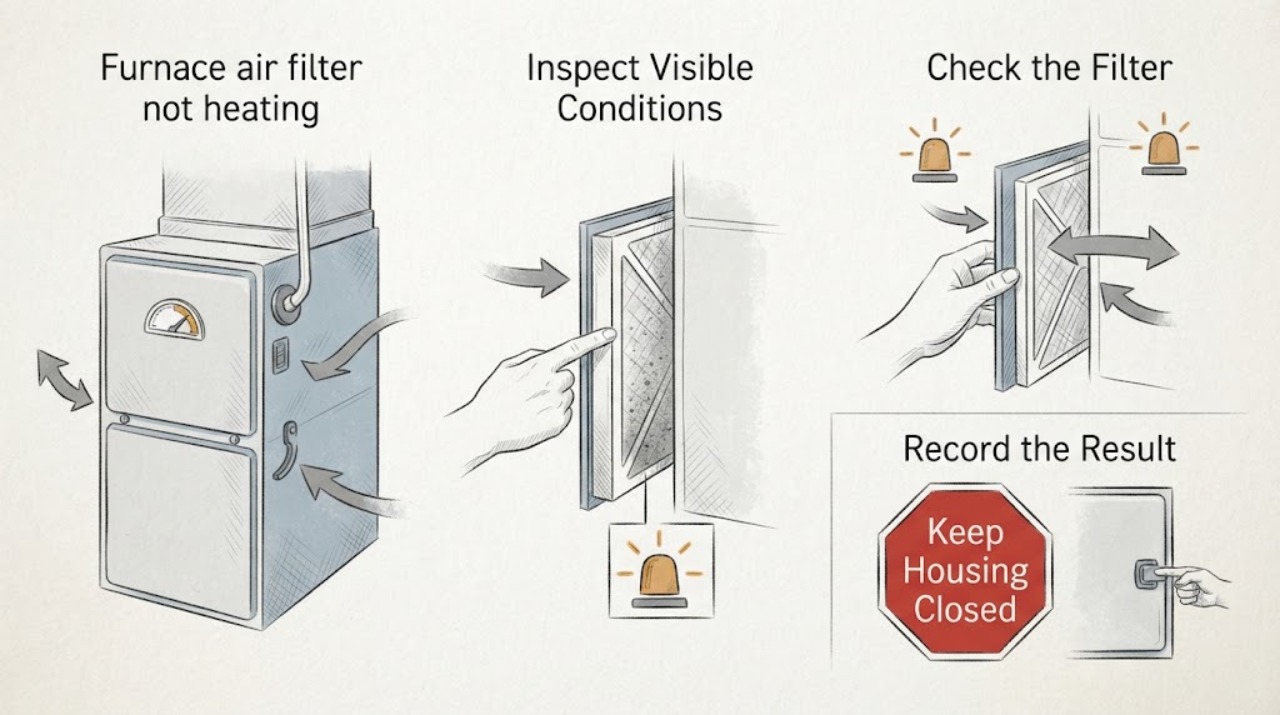
Work through in order
Diagnostic checks
Use only checks that match the exact appliance or system and its official guide.
-
Check 1
Set the thermostat to a normal heat call only if the home is otherwise safe, and from outside the furnace cabinet note whether the system is silent, the blower runs without warm air, the furnace starts and stops, or some registers have weak airflow. Locate the filter only at an accessible return grille or filter cabinet.
Expected result: Record the thermostat mode, whether any air moves, whether supply air is cool or warm, whether the symptom affects every room or only some registers, and whether the filter access is safely reachable without opening a furnace panel.
Next step: Inspect the accessible filter and supply/return grilles without dismantling the equipment. If the furnace is in an unsafe or inaccessible location, stop and arrange service rather than climbing or opening panels.
Stop if: Do not open the furnace cabinet, touch wiring, inspect burners, bypass a safety switch, adjust a gas valve, or continue testing if there is a gas odor, smoke, a carbon-monoxide alarm, or a damaged vent.
Why this matters
Why: Weak airflow across the home makes a return filter, blower, duct, or register restriction plausible. A normal blower with cool air, a completely silent system, or a short start-and-stop pattern is not established as a filter-only fault and may require professional diagnosis.
-
Check 2
With the system in the condition specified by the exact Amana instructions, remove the filter only from its ordinary accessible slot and inspect both faces, the frame, the seal around the slot, and the airflow-direction marking if one is present.
Expected result: Classify the filter as visibly loaded with dust or pet hair, damp, collapsed, torn, missing, clean but wrong-sized, installed backward, blocked by a dirty grille, or clean and correctly seated.
Next step: Compare the filter dimensions and type with the exact Amana manual or label. If the slot, frame, or filter is damaged or the filter cannot be identified, photograph the information and request qualified HVAC guidance.
Stop if: Do not reach into the blower area, remove a cabinet access panel, wash a disposable filter, operate without a required filter, or force a filter past a tight frame.
Why this matters
Why: A visibly clogged, collapsed, damp, or backward filter can restrict return airflow and plausibly explain weak heat delivery. A clean, dry, correctly sized, correctly oriented filter makes the filter a less likely explanation, so do not keep replacing filters while ignoring a no-heat or cycling symptom.
-
Check 3
If the filter is dirty or damaged and its required specification is known, install a clean replacement or clean a washable filter exactly as the Amana equipment instructions permit. Match the marked dimensions and airflow direction, seat the frame without gaps, and restore the access cover without forcing it.
Expected result: After the system resumes a normal heat call, observe whether airflow at several registers becomes stronger, the supply air becomes warm, the furnace runs through a normal cycle, or the original symptom remains.
Next step: Keep the replacement information and before-and-after observation. If heat is still absent, use the branches below and arrange professional diagnosis instead of changing to a more restrictive filter or touching furnace internals.
Stop if: Do not run the furnace with a missing or loose filter, force the cover closed, substitute an unverified filter type, or continue operation if there is overheating, smoke, gas odor, or a carbon-monoxide alarm.
Why this matters
Why: Improved airflow and restored heat after a correct filter change support restricted return airflow as a contributor. No improvement means the filter was not the whole problem; a filter that repeatedly loads quickly, will not seat, or makes airflow worse suggests a sizing, installation, or wider airflow issue.
-
Check 4
With the correct filter installed, check only visible return grilles, supply registers, and the area around the accessible air handler for blockage by furniture, dust, or stored items; do not enter the cabinet or alter ductwork.
Expected result: Note whether returns or supplies are blocked, whether airflow is weak everywhere or only at selected rooms, whether the filter slot leaks around its frame, and whether the blower sound changes unusually during a heat call.
Next step: Clear only ordinary-access obstructions and retest once. If airflow remains weak, the filter seals poorly, or duct or blower inspection is needed, document the pattern for a licensed HVAC technician.
Stop if: Do not seal, cut, or rebuild ductwork; remove blower panels; lubricate parts; or test electrical components as a homeowner filter check.
Why this matters
Why: Blocked grilles or a filter-slot leak can undermine airflow even with a new filter. Weak airflow in selected rooms suggests duct or register issues; weak airflow everywhere, unusual blower behavior, or a furnace that stops after starting needs HVAC diagnosis rather than another filter swap.
-
Check 5
After one correct filter change and a brief normal heat call, observe the furnace from outside the cabinet for a complete warm-air cycle; do not watch or adjust the burner, igniter, flame sensor, gas valve, limit switch, or wiring.
Expected result: Record whether the furnace produces warm air continuously, the blower runs with cool air, the burner starts then shuts off, the unit repeatedly short-cycles, or no heat call response occurs despite a clean correctly seated filter.
Next step: Stop at observation and provide the exact Amana model, filter specification, airflow pattern, cycle behavior, and any displayed code to a licensed HVAC technician. Do not reset or bypass a safety control to make the furnace run.
Stop if: Do not inspect flame or combustion parts, adjust gas, replace ignition or flame components, jumper controls, or continue operating when there is abnormal noise, smoke, soot, gas odor, vent damage, or a CO alarm.
Why this matters
Why: A stable warm-air cycle after filter replacement supports an airflow restriction as part of the original symptom. Cool air, repeated shutdown, short cycling, or no response leaves controls, blower, ignition, flame proving, gas supply, heat exchanger, thermostat, or other system causes open; those are not safe filter-level repairs.
-
Check 6
Before any further troubleshooting, check for an active carbon-monoxide alarm, gas odor, smoke or soot, water near electrical equipment, a damaged or blocked vent, or a home temperature that is becoming unsafe; record the symptom without searching inside the furnace.
Expected result: Classify the condition as no safety warning, suspected fuel or combustion hazard, an active CO alarm or related symptoms, electrical/water damage, or a furnace that cannot provide heat in cold conditions.
Next step: For a sounding CO alarm or suspected CO exposure, leave immediately for fresh air and contact emergency services; do not reenter or operate the furnace until authorities and trained personnel allow it. For other unsafe conditions, shut down only as directed by the equipment manual or emergency responder and arrange qualified service.
Stop if: Never search for a CO source, service a fuel-burning furnace without proper knowledge and tools, bypass safety devices, or use the furnace as a substitute heat source while a hazard is unresolved.
Why this matters
Why: No warning allows only the ordinary-access filter and airflow observations above. A fuel, combustion, electrical, venting, or CO warning supersedes filter diagnosis and can require immediate evacuation or emergency service; a licensed professional must assess the furnace before reuse.
Use your observations
Decision map
Find the observation that best matches what you see, then follow the next safe action.
-
PATH 01Safety boundary
What you see
The filter was visibly loaded or collapsed, the replacement matched the required size and type, and airflow and warm supply air returned without abnormal cycling.
Do this next
Record the filter type and replacement date, keep returns and supplies clear, and recheck sooner if airflow drops or the furnace begins cycling.
Why this path and its safety boundary
Why it matters: Restricted return airflow was a plausible contributor to the no-heat symptom, but the filter should still be maintained at the manufacturer's interval and monitored for rapid reloading.
Safety stop: If the filter loads unusually fast, airflow falls again, or heat becomes unreliable, arrange a professional airflow and furnace inspection rather than choosing a tighter filter by guesswork.
-
PATH 02Safety boundary
What you see
The filter is clean, dry, correctly sized, correctly oriented, and seated, but the furnace still supplies cool air, does not start, or does not complete a heating cycle.
Do this next
Stop filter substitutions and arrange licensed HVAC diagnosis; provide the exact Amana model, filter details, airflow observation, and cycle behavior.
Why this path and its safety boundary
Why it matters: The air filter is not established as the cause. Controls, thermostat, blower, ignition, flame proving, fuel supply, heat exchanger, or another system fault remains possible depending on the equipment.
Safety stop: Do not open the furnace, adjust gas, bypass a safety control, or replace an igniter or flame sensor based only on the symptom.
-
PATH 03Safety boundary
What you see
The replacement does not fit the slot, has an unknown specification, is installed backward, leaves a visible bypass gap, or makes airflow weaker.
Do this next
Turn the system off as the exact instructions direct, restore the known compatible filter specification, and ask a technician or Amana documentation source to confirm the model-specific filter.
Why this path and its safety boundary
Why it matters: A filter-selection or installation problem can itself restrict or bypass return air. Amana cautions that filter choice should match blower capacity, so a more restrictive rating is not an automatic upgrade.
Safety stop: Do not trim the frame, crush the filter, run without it, tape over the slot, or use a higher-resistance filter to compensate for a fit problem.
-
PATH 04Safety boundary
What you see
A correct clean filter is installed, but airflow remains weak at most registers, the filter slot leaks, the blower sounds abnormal, or the furnace stops after starting.
Do this next
Leave the cabinet closed and arrange professional airflow and furnace inspection; share whether the weakness is whole-home or room-specific and whether the furnace short-cycles.
Why this path and its safety boundary
Why it matters: The remaining restriction or shutdown may involve the blower, ductwork, controls, coils, or a safety response rather than the filter media alone.
Safety stop: Do not remove blower panels, clean internal coils, lubricate motors, jumper controls, or continue operation when there is overheating, smoke, soot, gas odor, or vent damage.
-
PATH 05Safety boundary
What you see
The filter is not clearly the cause and the furnace has a gas odor, soot, abnormal ignition, flame-related shutdown, damaged vent, or a carbon-monoxide alarm or suspected exposure.
Do this next
For a CO alarm or suspected exposure, leave for fresh air and contact emergency services; do not reenter or operate the furnace until trained personnel clear it. For gas odor or visible combustion/vent damage without an alarm, leave the area as appropriate and contact emergency or qualified HVAC/gas service.
Why this path and its safety boundary
Why it matters: This is a fuel-burning or combustion safety situation, not a filter-maintenance branch. A filter change cannot establish safe operation.
Safety stop: Do not look for the leak, test the flame, adjust a gas valve, bypass a switch, or restart the appliance to see whether the filter helped.
-
PATH 06Safety boundary
What you see
A new compatible filter briefly improves heat, but it becomes heavily loaded again unusually quickly or the same airflow/no-heat symptom returns.
Do this next
Record operating conditions, filter type, installation date, visible dust, and room/return pattern, then ask a qualified HVAC professional to inspect the return path and equipment.
Why this path and its safety boundary
Why it matters: The filter may be collecting an upstream dust load, or another airflow, duct, blower, installation, or indoor-air issue may be present. Replacing filters repeatedly does not identify the cause.
Safety stop: Do not install a tighter filter than the equipment supports, block returns, or open the air handler to clean internal components as a homeowner task.
Helpful context
Understand the symptom
Treat the filter as an airflow check, not a complete furnace diagnosis
The filter sits in the return-air path before air reaches the furnace or air handler. Dust loading can reduce airflow and increase the work the system must do, so a filter that is visibly packed with dust is a plausible contributor to weak or cool supply air. It is not proof that the igniter, flame, heat exchanger, blower, thermostat, or controls are sound. Check the filter from an ordinary accessible location and keep the furnace cabinet closed.
Use the exact filter specification and preserve airflow
Amana says filter choice should match the blower's capacity, and its maintenance guidance says replacement timing depends on the filter type and manufacturer recommendation. Do not choose a tighter filter simply because its rating sounds better, and do not install a filter that is bent, too small, too large, or facing the wrong way according to the equipment instructions. If the correct filter cannot be identified from the label or manual, pause and ask a qualified HVAC technician.
Know when the symptom has moved beyond the filter
If a correct filter change does not restore warm air, the fault may be elsewhere in the heating system or in airflow through the blower, ducts, or registers. Amana lists controls, blower components, burners, gas connections, valves, and the heat exchanger among professional inspection areas. A fuel-burning furnace also creates a carbon-monoxide safety boundary: an alarm or possible combustion problem is not a filter-maintenance task.
Safety boundary
Stop conditions
- Keep the furnace cabinet closed; do not touch wiring, burners, igniters, flame sensors, gas valves, heat exchangers, limit switches, or safety controls during a filter check.
- Do not bypass a safety switch, adjust gas, test combustion, or replace a flame or ignition component based only on a no-heat symptom.
- Do not run the furnace without a required filter, force a filter or access cover, trim a filter, or choose a more restrictive filter without exact equipment guidance.
- If a carbon-monoxide alarm sounds or CO exposure is suspected, leave immediately for fresh air, call emergency services, and do not reenter or operate the furnace until trained personnel clear it.
- Stop for gas odor, smoke, soot, a damaged or blocked vent, water near electrical equipment, abnormal overheating, or any repair requiring internal-panel access.
- If a correct filter replacement does not restore warm air or airflow, stop swapping filters and arrange licensed HVAC diagnosis.
Only after diagnosis
Potential parts
- furnace air filter
Consider this category only when the accessible filter is visibly dirty, damaged, missing, or the exact Amana documentation confirms that a compatible replacement is required.
Confirm the exact furnace or air-handler model, dimensions, filter type, airflow direction, and blower-compatible specification before ordering; do not infer fit from appearance alone. - furnace igniter
Consider this category only after a licensed technician confirms an ignition fault remains after the filter and airflow checks; a no-heat symptom alone does not identify the igniter.
Confirm the exact Amana model and technician-diagnosed ignition design before ordering or installing; this is an internal fuel-burning component, not a homeowner filter repair. - furnace flame sensor
Consider this category only after a licensed technician confirms a flame-proving fault and rules out airflow, control, fuel, venting, and other causes; do not infer it from a dirty filter.
Confirm the exact Amana model and technician's fitment information before ordering or installing; flame and combustion work require qualified service.
When checks do not resolve it
Need a professional?
Arrange licensed HVAC service when the filter is clean or correctly replaced but the Amana furnace still does not heat, airflow remains weak, the furnace short-cycles or stops after starting, the filter will not fit or reloads unusually quickly, the filter slot or ductwork leaks, or any diagnosis would require opening the cabinet or touching gas, flame, electrical, blower, vent, or heat-exchanger components. Treat a carbon-monoxide alarm, suspected CO exposure, gas odor, smoke, soot, or damaged vent as an immediate safety escalation rather than a filter repair.
Safety scope: This article supports ordinary-access filter and visible-airflow observation only. A licensed HVAC professional must handle gas, flame, ignition, electrical, blower, heat-exchanger, venting, controls, internal panels, and combustion diagnosis.
Common questions
FAQ
Can a dirty Amana furnace filter cause no heat?
A clogged filter can restrict airflow and make a furnace work harder, so it can contribute to weak or inadequate heat delivery. It does not prove that the furnace's ignition, controls, blower, gas, or heat-exchanger components are working; replace or clean the filter only to the exact Amana specification and escalate if heat remains absent.
How do I know whether my Amana furnace filter is blocked?
From the ordinary accessible filter location, inspect both faces and the frame for heavy dust, pet hair, dampness, collapse, or a backward or poor fit. A clean, dry, correctly sized and seated filter makes the filter a less likely cause of no heat, so do not keep swapping filters while the furnace remains cold or cycles off.
What filter should I use in an Amana furnace?
Use the size, type, airflow direction, and blower-compatible specification stated by the exact Amana furnace or air-handler instructions. Amana warns that a tightly woven filter can make a furnace work harder and says the filter should match blower capacity; do not choose a more restrictive filter by rating alone.
Can I run an Amana furnace without its filter to see if it heats?
Do not operate the system without a required filter. A filter protects the equipment from debris, and removing it can create an airflow and equipment-protection problem without diagnosing the no-heat cause. Use a known compatible replacement or arrange qualified service.
Why is my Amana furnace still blowing cold air after I changed the filter?
If the replacement is the correct size and type and is seated correctly, the filter is less likely to be the complete cause. Cool air, no response, or a furnace that starts and stops can involve controls, thermostat, blower, ignition, flame proving, fuel, venting, or another fault; leave the cabinet closed and call a licensed HVAC technician.
What if the new Amana furnace filter makes airflow worse?
Turn the system off as the exact equipment instructions direct and check that the dimensions, airflow direction, fit, and filter type are correct. Amana notes that filter choice must match blower capacity. Do not crush, trim, tape, or replace it with an even more restrictive filter; ask a qualified technician to confirm the specification.
When is an Amana furnace no-heat problem an emergency?
Treat a sounding carbon-monoxide alarm or suspected exposure, gas odor, smoke, soot, damaged vent, or water near electrical equipment as a safety escalation, not a filter check. Leave for fresh air and contact emergency services for a CO alarm or suspected exposure; do not reenter or operate the furnace until trained personnel clear it.
Read the exact guide
Official sources
- Preventive MaintenanceAmana · Amana Heating and Air Conditioning preventive-maintenance guidance; filter timing and system checks vary by exact equipment, filter type, installation, and local requirements.
- HVAC Operation | Impacts on heating and cooling | Amana® brandAmana · Amana HVAC learning-center information for forced-air heating and cooling systems; exact filter and airflow requirements depend on the installed equipment.
- HVAC Proper Installation of FiltersU.S. Department of Energy · U.S. Department of Energy Building Science Education guidance for ducted HVAC systems; the installed manufacturer's instructions control a specific Amana furnace.
- Carbon Monoxide Fact SheetUnited States Consumer Product Safety Commission · CPSC consumer-safety guidance for fuel-burning appliances including furnaces; emergency response and local instructions control an active alarm or suspected exposure.
- What type of filter should I use?Amana · Amana Heating and Air Conditioning FAQ guidance; the exact Amana furnace or air-handler documentation controls the filter specification for a particular installation.
- HVAC MaintenanceAmana · Amana HVAC learning-center maintenance guidance; gas and flame work is for licensed professional service and exact equipment procedures.
Community feedback
Share a repair observation
Share a plain-text repair observation. Accepted observations are published automatically; this page may take a moment to update.