
On this page
Start here
Quick answer
A Carrier furnace that is not heating may have no thermostat call, lost power, a blocked filter or vent, an ignition or flame-safety shutdown, or a fuel and combustion problem. First check the thermostat mode, set point, batteries if applicable, and fan setting, then inspect the filter and open supply and return grilles. From outside the cabinet, note whether the furnace is completely silent, the blower runs with cool air, ignition starts and stops, or a status code repeats. Do not open the furnace, adjust a gas valve, relight a pilot without the exact model instructions, test live voltage, or bypass a safety control. If you smell gas, hear a delayed bang, see soot or yellow flame, a carbon-monoxide alarm sounds, or you notice smoke, burning odor, exposed wiring, or repeated ignition failure, leave the area or shut the system down from a safe location as appropriate and arrange emergency or qualified HVAC help.
Before you begin
Safety first
- This article supports thermostat and filter checks, ordinary accessible vent observation, one safe external power check, code recording, and observation through an approved viewing window only. A qualified HVAC professional must handle gas or oil components, combustion, venting, heat-exchanger, ignition, flame-sensor, high-voltage, control-panel, and safety-device work.
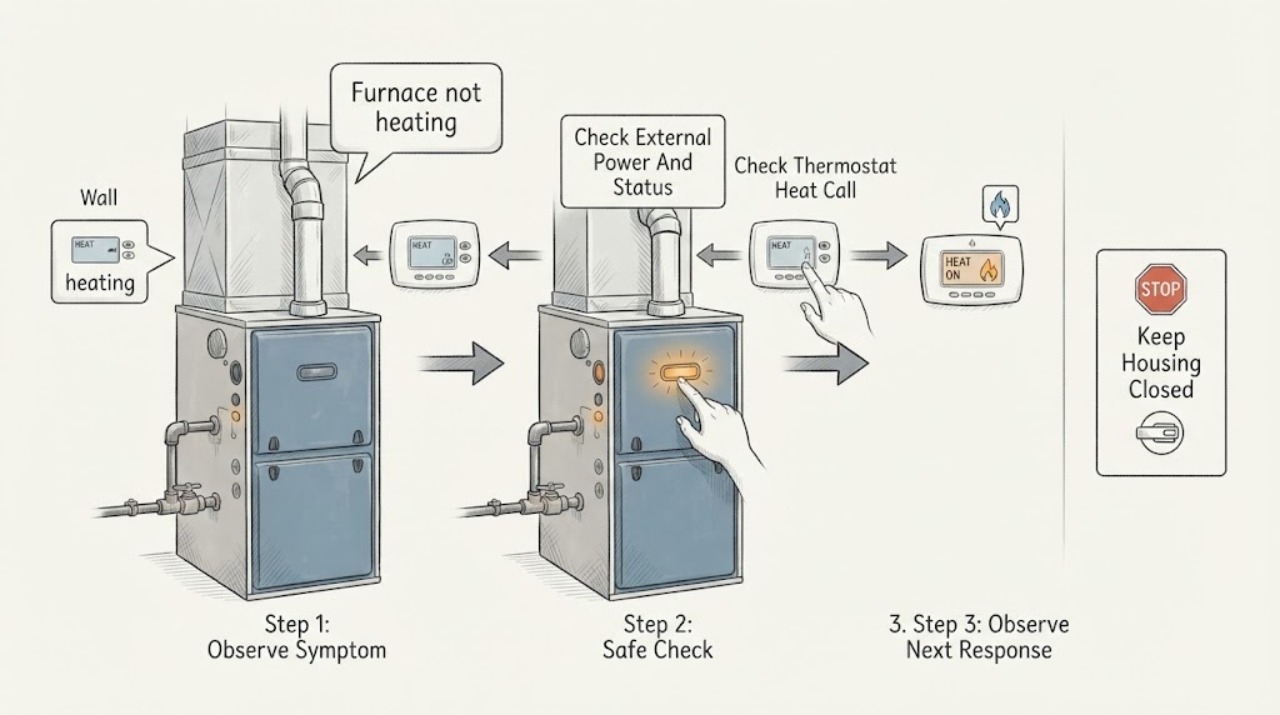
Work through in order
Diagnostic checks
Use only checks that match the exact appliance or system and its official guide.
-
Check 1
Move people and pets away from the furnace area, do not place anything over vents, and note the Carrier model, fuel type if known, thermostat display, room temperature, and the exact start sequence. Do not remove panels or reach into the unit.
Expected result: There is a gas or fuel odor, carbon-monoxide alarm, headache or dizziness, smoke, soot, yellow flame visible through an approved window, burning smell, sparking, exposed wiring, water around electrical equipment, or a loud delayed ignition; otherwise record whether the furnace is silent, clicks, starts a blower, lights briefly, or runs with cool air.
Next step: For gas odor or a CO alarm or symptoms, leave immediately, avoid switches and flames, and call emergency or gas authorities from outside. For other hazards, keep the furnace off and arrange qualified HVAC service. Continue only when no hazard is present and all observations are from ordinary external access.
Stop if: Stop immediately for gas or fuel odor, CO alarm or symptoms, smoke, fire, soot, yellow flame, sparking, burning odor, exposed wiring, water near electrical equipment, or a delayed bang at ignition.
Why this matters
Why: Gas or fuel odor, CO warning or symptoms, smoke, soot, abnormal flame, burning, sparking, or delayed ignition is a safety event, not a routine no-heat check. The remaining sound and sequence separates thermostat or power failure from airflow, ignition, or flame-proving behavior.
-
Check 2
At the thermostat, confirm the mode is Heat, set the temperature above the room reading, set the fan to Auto for a normal heat call, and replace batteries only if that thermostat uses them and the battery compartment is ordinary user access. Observe the heat-call indicator or message without changing wiring or removing the wall plate.
Expected result: The display is blank or unresponsive, the mode is Off or Cool, the set point is not above room temperature, the thermostat shows a heat call but the furnace does not respond, or the display and heat call are normal.
Next step: Correct only the user settings or batteries that clearly apply, then allow the thermostat's normal delay to expire. If the heat call is normal but the furnace remains unresponsive, continue to the external power and status check; do not jumper terminals or replace thermostat wiring.
Stop if: Do not remove thermostat wiring, bridge terminals, open the furnace, or continue if the wall unit has exposed or frayed wiring or a burning smell.
Why this matters
Why: Carrier links no heat to incorrect mode or set point, dead thermostat batteries, a power interruption, thermostat communication, or equipment controls. A normal heat call with no furnace response shifts attention to furnace power, status code, or a safety lockout rather than another thermostat setting.
-
Check 3
From a safe, dry position, check whether the Carrier furnace's accessible service switch appears on and whether the labeled HVAC breaker or fuse is tripped. Observe the furnace sight window or external status indicator for a repeating flash pattern and record it; do not remove the access door or probe electrical parts.
Expected result: The switch is off, the breaker is tripped, the furnace has no display or status light, a code repeats, the switch and breaker appear on with a normal status light, or the breaker trips again after a single reset.
Next step: If the labeled breaker is safely accessible, reset it once only; restore the furnace switch only when it is clearly the furnace switch and no hazard is present. If power does not return, the code persists, or the breaker trips again, leave the system off and arrange qualified service.
Stop if: Do not reset a breaker repeatedly, open the cabinet, remove a door interlock, touch terminals, or work around wet equipment or damaged wiring.
Why this matters
Why: A switched-off unit or one power interruption can explain a silent furnace. A repeating code is a diagnostic clue that must be matched to the exact Carrier model. A breaker that trips again or a status fault that persists indicates an electrical or safety problem, not a reason to keep resetting it.
-
Check 4
With the system off and from normal user access, inspect the return-air filter and accessible supply and return grilles. Replace a visibly dirty filter with the size and type specified by the equipment or filter instructions, and make sure vents are not blocked by furniture or coverings; do not remove the blower door.
Expected result: The filter is gray, visibly loaded, damaged, or missing; airflow is weak or uneven; several registers are blocked; or the filter and accessible grilles are clean and open but the furnace still does not heat.
Next step: Install only the model-specified filter, open unobstructed supply and return grilles, and observe one normal heat call. If airflow remains weak, the furnace short-cycles, or heat does not return, stop troubleshooting and arrange HVAC service.
Stop if: Do not run the furnace without its required filter, use a collapsed or wrong-size filter, remove the blower door, bypass a door switch, or continue after a burning smell or repeated safety shutdown.
Why this matters
Why: Carrier identifies a clogged filter and restricted vents as causes of low airflow, overheating, short cycling, and safety shutdown. A clean filter with weak airflow points to duct, blower, limit, or another system issue that cannot be assigned from the filter alone.
-
Check 5
If there is no gas or CO hazard and the Carrier furnace has an approved external viewing window, observe one normal startup from outside the cabinet only. Record whether the inducer or blower starts, ignition clicks or glows, burners light, the flame remains, and warm air follows; do not open the burner compartment, relight a pilot, clean a sensor, or adjust the gas supply.
Expected result: The furnace never attempts ignition, clicks or glows without a sustained flame, lights and shuts off quickly, has a yellow or unstable flame, runs the blower with no heat, or completes ignition but delivers no warm air.
Next step: Record the sequence and any code, then leave the furnace off and arrange qualified HVAC service for any failed ignition, abnormal flame, pilot that will not stay lit, repeated lockout, or blower-without-heat condition. Follow a pilot procedure only when the exact owner manual explicitly permits it and no safety warning is present; do not improvise.
Stop if: Do not open the burner compartment, touch ignition parts, relight repeatedly, adjust gas pressure or valves, clean a flame sensor, or continue for yellow flame, delayed ignition, gas odor, soot, smoke, or a CO alarm.
Why this matters
Why: Carrier associates no heat with ignition failure, pilot or flame-sensor problems, limit protection, gas supply issues, and airflow restriction. A brief flame followed by shutdown is a flame-proving or safety branch; a yellow or abnormal flame, delayed ignition, or gas concern requires professional combustion assessment.
-
Check 6
Assemble the observations for a qualified HVAC technician: model and fuel type, thermostat call, switch and breaker status, filter condition, airflow, status-code flash pattern, ignition sequence, flame behavior seen only through an approved window, and the time the no-heat symptom began.
Expected result: The basic settings, one safe breaker check, filter, and accessible vents do not restore heat; the same fault returns after a reset; the furnace locks out, short-cycles, or needs gas, combustion, electrical, limit, heat-exchanger, or internal control access.
Next step: Leave the furnace in the safe state indicated by the hazard and arrange qualified service. If cold weather creates a freeze risk, protect occupants and plumbing with safe temporary measures without operating a furnace that has an unresolved combustion, electrical, or safety fault.
Stop if: Do not remove panels, test energized circuits, alter gas or oil components, bypass safety switches, open a heat exchanger or vent, or keep resetting a lockout.
Why this matters
Why: The remaining causes involve equipment-specific diagnosis and may include igniter, flame sensor, limit control, blower, control board, gas valve, venting, heat exchanger, condensate, or fuel systems. The symptom alone cannot select a safe part or repair.
Use your observations
Decision map
Find the observation that best matches what you see, then follow the next safe action.
-
PATH 01Next step
What you see
The thermostat is blank, in Off or Cool, below the room temperature set point, has dead batteries, or does not show a heat call when Heat is requested.
Do this next
Correct only the clearly applicable user setting or battery, allow the thermostat's normal delay, and reassess. If the display remains blank or a correct heat call still does not reach the furnace, arrange thermostat or HVAC service without touching wiring.
-
PATH 02Next step
What you see
The thermostat shows a heat call but the Carrier furnace is silent, its service switch or breaker is off, no status light appears, or a code repeats; a breaker trips again after one reset.
Do this next
Leave power and cabinet hardware to a qualified technician after one safe external check. A repeated trip, missing status light, or lockout can indicate an electrical or safety fault and is not resolved by repeated resets.
-
PATH 03Next step
What you see
The blower runs with cool or weak air, the filter is visibly loaded, vents are blocked, airflow is uneven, or the furnace starts and stops after a short run.
Do this next
Replace the model-specified dirty filter and clear accessible grilles. If airflow or short cycling persists, stop using the furnace and arrange service for duct, blower, limit, or other system diagnosis.
-
PATH 04Next step
What you see
The furnace attempts ignition but does not light, lights and shuts off quickly, repeatedly locks out, or has a pilot or flame that will not remain; no user setting or filter correction changes the sequence.
Do this next
Keep the furnace off and have qualified HVAC service diagnose ignition, flame sensing, control, venting, and fuel conditions. Do not clean, adjust, relight repeatedly, or bypass the safety sequence.
-
PATH 05Next step
What you see
There is gas or fuel odor, a CO alarm or symptoms, soot, yellow or unstable flame, smoke, a delayed bang, burning odor, or visible damage.
Do this next
Leave the area for gas odor, CO alarm, smoke, or fire risk and call the appropriate emergency, gas, or HVAC authority from a safe location. Do not operate switches or restart the furnace until cleared by qualified responders.
-
PATH 06Next step
What you see
The thermostat calls for Heat, power and filter checks are normal, the furnace appears to complete a start sequence, but registers remain cool or the blower runs without sustained heat.
Do this next
Arrange qualified HVAC service. The pattern can involve flame sensing, limit control, blower, heat exchanger, fuel, venting, or another internal fault that cannot be identified safely from outside.
Helpful context
Understand the symptom
Start by separating no call, no power, no airflow, and no flame
The same cold room can result from different stages of a heating cycle. A blank thermostat or an incorrect mode means the furnace may never receive a heat request. A silent furnace with a failed switch or breaker has a different path from a blower that runs but delivers cool air. A furnace that attempts ignition and then stops has a combustion or flame-safety branch. Record the sequence and any Carrier code before resetting anything; the model's manual controls the meaning of a particular code.
Airflow checks matter even when the burners light
Carrier says a dirty filter restricts airflow and can cause a furnace to overheat and shut its burners down through a safety limit. Weak airflow, a gray or visibly loaded filter, and short cycles therefore deserve an airflow check before a component diagnosis. Inspect the filter and accessible registers only; do not remove a blower door or continue operating when the furnace has a burning smell, repeated limit trips, or damaged wiring.
Fuel combustion and carbon monoxide are not DIY diagnosis
Gas- and oil-burning furnaces can produce carbon monoxide, which CDC describes as invisible and odorless. Gas odor, a sounding CO alarm, soot, yellow flame, smoke, or a delayed ignition sound changes the response from troubleshooting to immediate safety and professional assessment. Do not test gas pressure, adjust a gas valve, clean an ignition or flame-sensor assembly, inspect a heat exchanger internally, or repeatedly reset a failed furnace.
Safety boundary
Stop conditions
- Leave immediately for gas or fuel odor, a carbon-monoxide alarm or symptoms, smoke, fire, or an abnormal flame; avoid switches and flames and call from a safe location.
- Stop for soot, yellow flame, delayed ignition bang, burning odor, sparking, exposed or frayed wiring, water near electrical parts, or a damaged furnace cabinet or vent.
- Do not open furnace panels, bypass a door or safety switch, test live voltage, adjust gas or oil pressure, work on a heat exchanger or vent, or alter ignition and flame-sensing components.
- Do not repeatedly reset a breaker or lockout, relight a pilot repeatedly, or keep operating a furnace that starts and stops abnormally or blows cool air after a safety shutdown.
- Do not select an igniter, flame sensor, limit switch, blower, control board, gas valve, or heat-exchanger part from the symptom alone; use the exact model and qualified diagnosis.
Only after diagnosis
Potential parts
- furnace air filter
Consider only the model-specified filter when the installed filter is visibly dirty, damaged, missing, or due for replacement; a clean filter does not justify replacing another component.
Confirm the exact Carrier filter size, type, airflow requirements, and owner's manual before replacement; do not operate without the required filter. - ignition component
Consider only after qualified diagnosis finds an ignition attempt with no sustained flame or an igniter fault; a silent furnace or thermostat problem does not identify an igniter.
Verify the complete Carrier model and confirmed ignition system before ordering; installation and testing are professional work. - flame-sensing or limit-control component
Consider only when service confirms rapid flame dropout, repeated safety shutdown, or a failed limit or flame-sensing component after airflow and thermostat causes are excluded.
Do not infer fit or failure from a short cycle alone; confirm exact Carrier model, control sequence, and technician diagnosis. - blower or furnace control component
Consider only if qualified diagnosis finds a blower, control, or communication fault after thermostat, power, filter, and ignition observations are documented.
Internal electrical parts vary by model and require qualified installation; do not test live circuits or select a part by appearance. - heat-exchanger or combustion-system component
Consider only after professional inspection identifies a heat-exchanger, burner, gas valve, fuel, or venting defect; no-heat symptoms cannot safely establish one of these failures.
Combustion and heat-exchanger work requires qualified HVAC service and exact model documentation; do not operate a furnace with CO or combustion warning signs.
When checks do not resolve it
Need a professional?
Arrange qualified HVAC service when correct thermostat settings, one safe external power check, a model-specified clean filter, and open accessible vents do not restore heat; when a status code repeats, the furnace short-cycles or locks out, ignition fails, a flame will not remain, the blower runs without heat, or diagnosis requires gas, combustion, high-voltage, venting, heat-exchanger, limit-control, or internal-panel access. Treat gas odor, CO alarm or symptoms, smoke, soot, yellow flame, burning odor, sparking, or delayed ignition as an immediate safety escalation.
Safety scope: This article supports thermostat and filter checks, ordinary accessible vent observation, one safe external power check, code recording, and observation through an approved viewing window only. A qualified HVAC professional must handle gas or oil components, combustion, venting, heat-exchanger, ignition, flame-sensor, high-voltage, control-panel, and safety-device work.
Common questions
FAQ
Why is my Carrier furnace not heating but the thermostat looks normal?
Check the filter, accessible vents, furnace service switch, breaker, and any external status code once. If the thermostat calls for heat but the furnace is silent, locks out, attempts ignition and stops, or blows cool air, arrange qualified HVAC service rather than opening the cabinet.
Can a dirty filter make a Carrier furnace stop heating?
Yes. Carrier says a clogged filter restricts airflow and can cause overheating and a safety shutdown. Replace only the model-specified filter and clear accessible grilles; persistent weak airflow or short cycling needs service.
What should I do if my Carrier furnace clicks but does not light?
Record the startup sequence and any status code, then stop repeated ignition attempts. Clicking without sustained flame can involve the ignition, flame-sensing, control, fuel, or venting system and needs qualified diagnosis.
Is it safe to relight a Carrier furnace pilot?
Only follow the exact model owner's manual if it explicitly provides a pilot procedure and no gas odor, soot, abnormal flame, or other warning is present. If the pilot will not stay lit, do not keep trying; arrange qualified service.
What if the furnace blower runs but the air is cold?
Confirm Heat mode, fan Auto, filter condition, and open vents. A blower with no sustained heat can follow an ignition or flame-safety shutdown, airflow limit trip, or another internal fault, so persistent cool air needs HVAC service.
Can a Carrier furnace produce carbon monoxide when it is not heating?
Gas- and oil-burning furnaces can produce carbon monoxide during combustion, and CDC describes CO as invisible and odorless. If a CO alarm sounds or anyone has symptoms, leave immediately and call emergency services from outside; do not troubleshoot the furnace indoors.
Read the exact guide
Official sources
- Common Thermostat Issues and How to TroubleshootCarrier · Carrier thermostat troubleshooting overview; thermostat features and HVAC wiring differ by model and installation.
- Furnace Troubleshooting Guide | Fix a Furnace Not WorkingCarrier · Carrier residential furnace troubleshooting overview; exact equipment type, fuel, controls, and owner-manual instructions govern a particular installation.
- Furnace Safety Fact SheetCenters for Disease Control and Prevention · CDC public-health furnace safety guidance for gas- and oil-burning furnaces; it does not diagnose a specific Carrier model.
- Furnace Repair Service | Signs, Costs & TroubleshootingCarrier · Carrier residential furnace repair guidance; service and component behavior depend on the exact furnace model and fuel system.
Community feedback
Share a repair observation
Share a plain-text repair observation. Accepted observations are published automatically; this page may take a moment to update.