
On this page
Start here
Quick answer
A furnace filter does not create heat; a dirty, wrong-size, backward, or poorly seated filter can reduce airflow and make the system run poorly or shut down, while no heat can also come from thermostat, power, ignition, flame-sensing, fuel, or limit faults. With the furnace off and cool, check the filter's condition, airflow arrow, fit, and accessible return path, then verify the thermostat and one normal power reset if the manual allows it. Do not bypass a safety switch, adjust a gas valve, open the burner compartment, or repeatedly reset a lockout. Stop for gas odor, smoke, a carbon-monoxide alarm, flame abnormality, or repeated breaker trips and call qualified HVAC service.
Before you begin
Safety first
- Do not bypass safety switches, adjust a gas valve, open burner or ignition compartments, clean or replace flame components, repeatedly reset lockout or breakers, or operate a furnace with combustion or CO warning signs.
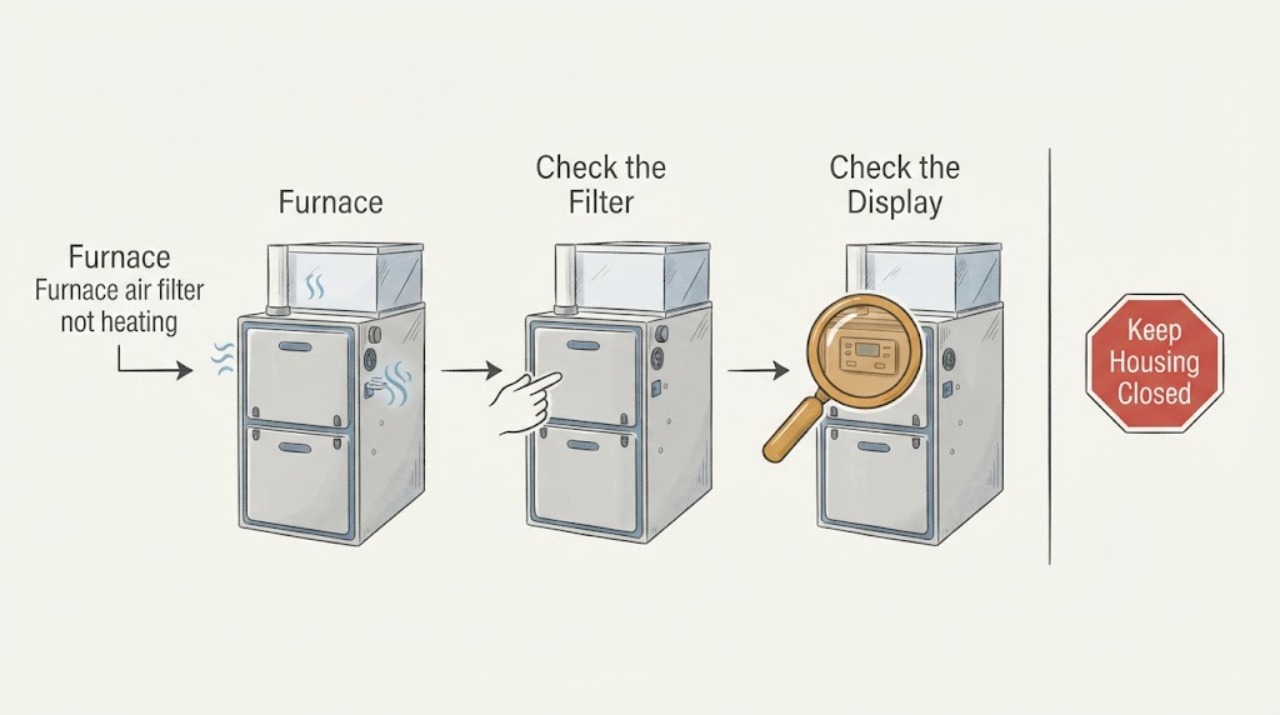
Work through in order
Diagnostic checks
Use only checks that match the exact appliance or system and its official guide.
-
Check 1
Turn the thermostat to off, let the system cool, and inspect only the accessible filter slot or return grille.
Expected result: Record whether the filter is visibly loaded with dust, wet, damaged, collapsed, missing, the wrong size, or seated with its airflow arrow pointing toward the air handler; also note if the return grille is blocked.
Next step: Use the exact filter size and orientation specified by the equipment or filter instructions, restore the access cover, and continue with external thermostat and power checks.
Stop if: Stop if the filter is burned or wet, access requires removing a burner panel, or the cabinet is hot, smoky, or damaged.
Why this matters
Why: A loaded or incorrectly seated filter can restrict airflow, while a normal, correctly installed filter means the no-heat cause is likely elsewhere and cannot be diagnosed by filter replacement alone.
-
Check 2
Check the thermostat from its normal user controls and confirm the mode, heat setpoint, and call-for-heat indication without opening the thermostat or furnace.
Expected result: Answer yes if the thermostat shows heat mode and a demand for heat while the room is below the setpoint; answer no if it is off, in another mode, blank, or not calling.
Next step: For no, correct only the documented user setting or battery step; for yes, observe the furnace externally for a response and record any status light or code.
Stop if: Stop if the thermostat or furnace wiring would need to be exposed, or if the system starts and stops unpredictably.
Why this matters
Why: A no directs attention to thermostat settings, batteries, or thermostat/power service; a yes means the furnace should be evaluated through its normal startup behavior, not by bypassing controls.
-
Check 3
With panels closed, observe one normal startup attempt from a safe distance; do not look into burners or touch vents, wiring, or switches.
Expected result: Record no response, blower-only air, a brief warm cycle followed by shutdown, a visible status code, unusual noise, or normal warm airflow that does not reach the rooms.
Next step: Write down the sequence and code for an HVAC technician; leave the equipment off if combustion behavior is abnormal or heat does not return reliably.
Stop if: Stop immediately for gas odor, soot, flame outside the burner area, smoke, loud combustion noise, or any CO alarm.
Why this matters
Why: The pattern distinguishes a possible power/thermostat issue, airflow or limit response, ignition/flame-sensing path, or duct-distribution problem, but it does not identify a component for DIY replacement.
-
Check 4
Check the furnace's dedicated breaker or service switch only from the normal user-accessible position, and perform one power reset only if the owner's manual permits it.
Expected result: Answer yes if the breaker or switch is off; answer no if it is on. After one permitted reset, note whether it runs normally or the protection opens again.
Next step: For an off switch, restore it only if there is no odor, smoke, water, or visible damage; for a repeat trip or no recovery, leave it off and call qualified HVAC/electrical service.
Stop if: Stop and leave power off for repeated trips, burning smell, water near electrical parts, arcing, or a damaged switch/cable.
Why this matters
Why: An off switch may explain a dead furnace, but a breaker that trips again signals an electrical fault; resetting does not prove the furnace is safe or repaired.
-
Check 5
Prepare a technician handoff without opening the furnace: record model/serial information, filter size and age, maintenance or filter changes, thermostat result, startup sequence, status code, and any recent outage or construction dust.
Expected result: Note whether airflow is weak at several registers, whether only one zone is affected, whether the filter becomes dirty unusually fast, and whether any CO alarm or combustion symptom occurred.
Next step: Schedule HVAC service and provide the complete timeline, photos of the filter label and status display, and the exact actions already taken.
Stop if: Stop all DIY work if diagnosis would involve bypassing a safety switch, adjusting gas, cleaning a flame sensor, or accessing ignition/burner components.
Why this matters
Why: These observations help separate restricted return/supply airflow from ignition, flame-sensing, control, fuel, or duct problems; they do not authorize access to gas or flame components.
Use your observations
Decision map
Find the observation that best matches what you see, then follow the next safe action.
-
PATH 01Next step
What you see
The filter is dirty, correctly replaced, the thermostat calls for heat, and the furnace runs normally.
Do this next
Monitor heat and airflow, follow the equipment's filter interval, and arrange service if the filter loads unusually quickly or the symptom returns.
-
PATH 02Next step
What you see
The filter is wet, burned, collapsed, wrong-sized, missing, or cannot be seated correctly.
Do this next
Leave the furnace off and call HVAC service to investigate moisture, overheating, fit, and airflow; do not improvise a filter or run without one.
-
PATH 03Next step
What you see
The thermostat is not calling, blank, or not set to heat.
Do this next
Use only the documented user setting or battery step. If the display remains blank or wiring would be exposed, call service.
-
PATH 04Next step
What you see
The furnace starts but produces blower-only air, short cycles, a fault code, or no sustained heat after the filter check.
Do this next
Stop repeated restarts and schedule HVAC diagnosis of airflow, limit operation, ignition, flame sensing, controls, fuel, and duct distribution.
-
PATH 05Next step
What you see
There is gas odor, soot, smoke, abnormal flame, a CO alarm, or possible CO symptoms.
Do this next
Leave immediately for fresh air when applicable, call emergency services or the gas utility from a safe location, and do not operate or re-enter until qualified personnel clear the equipment.
-
PATH 06Next step
What you see
A breaker trips again, the service switch or cabinet is hot/damaged, or water is near furnace electrical parts.
Do this next
Leave power off and contact qualified HVAC or electrical service. Do not open panels, bypass safeties, or keep resetting protection.
Helpful context
Understand the symptom
Separate filter symptoms from a no-heat fault
A clogged filter can dramatically reduce airflow, increase furnace run time, and increase motor wear. It cannot by itself prove that the igniter, flame sensor, control board, blower, fuel supply, or limit control has failed. Start with the accessible filter and return grille, then treat any persistent no-heat symptom as an HVAC diagnosis rather than a reason to install random parts.
Safe filter check
Set the thermostat to off and wait for the furnace and filter area to cool. Use only the filter access designed for the homeowner; do not remove a burner door or reach into the furnace. Note the size and airflow arrow printed on the filter, and replace or clean it only as the equipment and filter instructions allow. Filters should remain accessible; do not force a filter into a slot or run the unit with a missing filter.
Stop and call now
Leave the furnace off and get professional help for a gas smell, soot, flame rollout, smoke, unusual combustion noise, a carbon-monoxide alarm, severe headache/dizziness/nausea, a repeatedly tripping breaker, or a filter that is wet, burned, collapsed, or impossible to remove safely. If a CO alarm sounds or CO exposure is suspected, leave for fresh air and contact emergency services; do not re-enter or operate the furnace until responders and trained personnel clear it.
Only after diagnosis
Potential parts
- furnace air filter
A replacement filter is relevant only when the existing filter is dirty or damaged and the exact size and equipment guidance are known; a filter will not repair ignition or control faults.
Match the printed dimensions, airflow orientation, filter type, and equipment guidance; do not assume a higher rating is suitable for every system. - furnace igniter
An igniter is a professional-diagnosis part for a furnace that fails in its ignition sequence; no-heat symptoms alone do not identify it.
Match complete model, fuel type, electrical specification, mounting, and manufacturer procedure; installation involves combustion and electrical hazards. - furnace flame sensor
A flame sensor should be considered only after a qualified technician identifies flame-proving behavior; replacing it based on a dirty filter or symptom alone is unsafe.
Verify model, sensor shape, connector, and service instructions; do not bypass the sensor or access the burner compartment yourself.
When checks do not resolve it
Need a professional?
Call HVAC service for no heat that remains after the safe filter, thermostat, and one permitted power check; call urgently for gas odor, combustion abnormalities, a CO alarm or possible symptoms, repeated lockout, or repeated breaker trips.
Safety scope: Do not bypass safety switches, adjust a gas valve, open burner or ignition compartments, clean or replace flame components, repeatedly reset lockout or breakers, or operate a furnace with combustion or CO warning signs.
Have this ready
- Provide the furnace model and fuel type, filter dimensions/type/condition/orientation, thermostat display and demand, startup sequence, status code, airflow observations, recent filter or construction dust, and any odor, smoke, sound, water, or CO alarm event.
Common questions
FAQ
Can a furnace filter cause no heat?
A dirty or badly seated filter can restrict airflow and contribute to poor operation or shutdown, but it does not prove the heat-producing components are faulty. If the furnace still does not heat after the safe filter check, call HVAC service.
Which way should the filter arrow point?
Follow the arrow printed on the filter and the furnace or filter-slot instructions; it generally indicates airflow toward the air handler. If the slot or direction is unclear, do not guess or force the filter.
Can I replace the igniter or flame sensor myself?
No. These are combustion and safety-related components. The symptom does not identify the failed part, and bypassing a safety or opening the burner compartment can create fire, gas, electrical, or CO hazards.
Why does the blower run but the air is cold?
Possible paths include a filter or airflow restriction, an ignition or flame-proving fault, a limit response, a control issue, or duct/distribution problem. Record the startup sequence and status code and have an HVAC technician diagnose it.
What if my carbon-monoxide alarm sounds while the furnace is not heating?
Leave immediately for fresh air, call emergency services from a safe location, and do not re-enter or operate the furnace until responders and trained personnel clear it. Never try to find the CO source yourself.
Read the exact guide
Official sources
- Carbon Monoxide Fact SheetU.S. Consumer Product Safety Commission · General U.S. consumer safety guidance; follow local emergency and gas-utility procedures.
- HVAC Proper Installation of FiltersU.S. Department of Energy Building Science Education · General ducted HVAC guidance; the furnace and filter manual controls exact size and service intervals.
- Home Heating EquipmentU.S. Consumer Product Safety Commission · General consumer safety guidance for fuel-burning heating equipment.
Community feedback
Share a repair observation
Share a plain-text repair observation. Accepted observations are published automatically; this page may take a moment to update.