
On this page
Start here
Quick answer
First separate a blower-only problem from a furnace-that-is-not-producing-heat problem. If the blower runs but the air is cold, the thermostat may be set to Fan On, the burner or igniter may not be operating, a dirty filter may have triggered a safety limit, or a fuel, condensate, control, or flame-sensing fault may have stopped heat production. If the blower is silent, check the thermostat call, furnace switch, accessible breaker status, filter, and whether the blower door is fully closed; do not open the cabinet. Set the thermostat to Heat with the fan on Auto, replace a visibly dirty filter with the exact type specified by the manual, and keep returns and supply vents clear. If the blower remains silent, runs with weak or abnormal airflow, the furnace short cycles, or a burner repeatedly fails, turn the system off and arrange qualified HVAC service. If you smell gas, see soot or smoke, hear a bang at ignition, notice a burning smell, or a carbon-monoxide alarm sounds, leave the area and follow emergency safety guidance instead of testing the furnace.
Before you begin
Safety first
- This article supports observing the blower and heat sequence from a safe position, checking thermostat settings, replacing an accessible filter with the manual-specified type, clearing obvious vent obstructions, and checking an accessible external switch or single tripped breaker when safe. It does not authorize cabinet access, live electrical or capacitor testing, burner or flame-sensor work, fuel adjustment, vent access, or safety-control bypass.
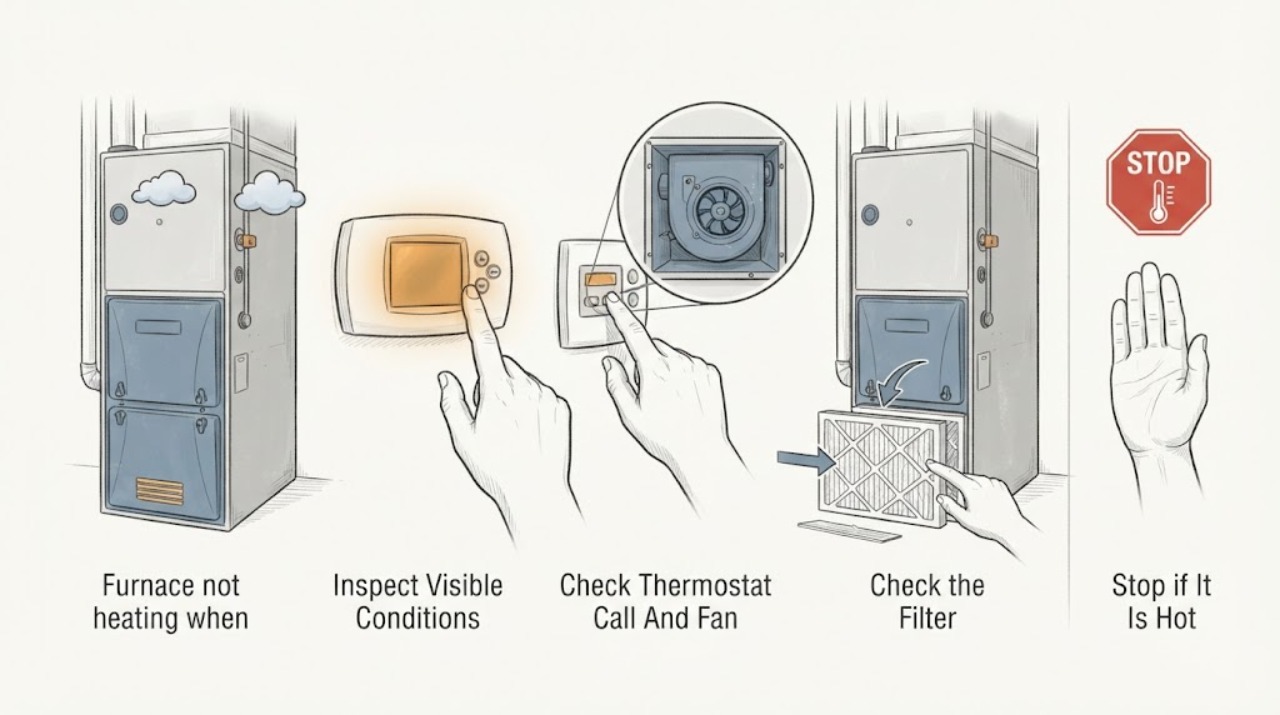
Work through in order
Diagnostic checks
Use only checks that match the exact appliance or system and its official guide.
-
Check 1
From a safe position at a register and away from the furnace access opening, make one normal call for heat and listen and feel for the sequence. Note whether the blower starts, whether air is warm or cold, whether the burner or igniter can be observed only through a manufacturer-provided viewing window, and whether the system stops, retries, or shows a fault indicator.
Expected result: Record the pattern as blower running with cold air, blower silent with no airflow, blower starting and stopping repeatedly, weak airflow, or a normal short startup delay followed by warm air. Note lockout, blinking-code, unusual noise, soot, smoke, odor, or flame outside the intended area.
Next step: Use the blower-running or blower-silent branch, then perform only the accessible thermostat, filter, vent, and power checks. Do not repeatedly restart a furnace that fails ignition or locks out.
Stop if: Do not stand near an open access panel, reach into the furnace, bypass a door switch, or continue if there is gas odor, soot, smoke, a bang at ignition, flame rollout, or a carbon-monoxide alarm.
Why this matters
Why: Blower with cold air means the blower may be healthy while heat production is interrupted by settings, ignition, flame sensing, airflow protection, fuel, condensate, or control faults. A silent blower makes power, thermostat, door-switch, motor, capacitor, control, or lockout issues more likely. Abnormal combustion signs are safety stops.
-
Check 2
At the thermostat, confirm the mode is Heat, the setpoint is above the room temperature, and the fan is Auto unless the exact manual specifies another normal setting. Check only the visible battery or power indication and any displayed furnace fault message.
Expected result: Note whether the thermostat is calling for heat, whether the fan was set to On, whether the blower responds when the call is present, and whether changing an obvious Fan On setting to Auto changes the cold-air symptom.
Next step: Correct only an obvious mode, setpoint, or fan-setting error and observe one cycle. If the blower remains silent or the burner does not stay on, stop changing thermostat settings and arrange HVAC diagnosis.
Stop if: Do not raise the setpoint repeatedly to force cycles, defeat a lockout, change thermostat wiring, or assume that a fan response proves the furnace is heating.
Why this matters
Why: Fan On can run the blower when no heat is being produced and make registers feel cold. A confirmed heat call with a silent blower or a running blower and repeated burner failure points to the furnace power, airflow, ignition, flame-sensing, limit, or control path instead of a simple fan-setting issue.
-
Check 3
With the furnace off and only the routine filter access available, inspect the air filter and visible return and supply paths. Replace a visibly dirty filter only with the size and type specified by the furnace manual, and move furniture or open room supply vents that are plainly blocking airflow.
Expected result: Record whether the filter is loaded, the return grille is blocked, supply airflow is weak, vents are closed, or the blower and heat sequence changes after the correct filter and clear airflow are restored.
Next step: Observe one controlled cycle after the filter and airflow correction. Arrange service if the blower is still silent, airflow remains weak, the furnace short cycles, or cold air continues.
Stop if: Do not run the furnace without a filter, install an unapproved restrictive filter, remove the blower door, clean the blower wheel, or adjust a limit switch.
Why this matters
Why: Restricted airflow can overheat the heat exchanger, trip a limit safety, stop the burner, or strain the blower. If a clean correct filter and clear vents do not restore heat or airflow, the fault may involve the blower motor, capacitor, limit, burner, flame sensor, ignition, condensate, or control.
-
Check 4
Without opening the furnace cabinet, check that the external furnace power switch is on, the accessible furnace breaker is not tripped, and any plainly visible blower-door panel is fully seated as designed. If a breaker trips again or a fuse fails, leave it off and do not reset it repeatedly.
Expected result: Record whether the thermostat and furnace have power, whether a breaker or fuse had changed state, whether the external switch was off, whether the blower responds after a single safe correction, and whether a breaker trips again.
Next step: Restore only an obviously switched-off control or single tripped breaker when there is no odor, smoke, water, or visible damage. If the blower remains silent or the breaker trips again, turn the system off and arrange service.
Stop if: Do not remove panels, replace a fuse with a larger size, bypass the blower-door switch, probe wiring, or work inside a wet or damaged furnace.
Why this matters
Why: No power or an unseated blower door can keep the blower and furnace from operating. A repeated trip or fuse failure points to an electrical or motor fault that requires professional diagnosis, not a larger fuse or repeated reset.
-
Check 5
Turn the furnace off and arrange qualified HVAC service when the blower remains silent, runs with weak or abnormal airflow, the blower runs while heat is absent after the accessible checks, the burner repeatedly fails, the system locks out, or any internal component needs access.
Expected result: Provide the technician the model, fuel type, thermostat call, blower pattern, air temperature, filter and vent condition, power observations, fault code or light pattern, sounds, odors, and any safe viewing-window flame observation.
Next step: Do not return the furnace to normal heating until the technician confirms correct blower operation, stable heat production, safe combustion or electrical operation, and proper limit and safety controls.
Stop if: Do not test live wiring, open the burner or blower compartment, clean internal components, adjust fuel pressure, bypass safety controls, or repeatedly reset a lockout.
Why this matters
Why: A technician can distinguish thermostat or power, blower motor or capacitor, control, filter and airflow, limit, ignition, flame sensing, burner, gas or oil, condensate, venting, or heat-exchanger faults. The symptom does not identify a replaceable part by itself.
Use your observations
Decision map
Find the observation that best matches what you see, then follow the next safe action.
-
PATH 01Safety boundary
What you see
The blower runs during a heat call, but the registers stay cold or only briefly warm, and the thermostat and filter or airflow checks do not resolve it.
Do this next
Turn the furnace off after documenting the sequence and arrange qualified HVAC service for the heating and safety controls.
Why this path and its safety boundary
Why it matters: The blower may be circulating air while the burner is not igniting or staying on, or a limit, flame-sensing, fuel, condensate, venting, or control condition is interrupting heat production.
Safety stop: Do not open the burner compartment, clean a flame sensor, relight repeatedly, adjust gas or oil components, or bypass a limit or flame-proving control.
-
PATH 02Safety boundary
What you see
The thermostat calls for Heat, the blower is silent, and a single check finds no obvious thermostat-setting error, switched-off furnace control, tripped breaker, dirty filter, or unseated routine-access door.
Do this next
Leave the furnace off and arrange HVAC service, especially if the breaker trips again or the furnace has an error indicator.
Why this path and its safety boundary
Why it matters: A blower motor, capacitor, control, fuse, door switch, thermostat circuit, power, or lockout problem is more likely; internal electrical diagnosis is required.
Safety stop: Do not open the blower compartment, test a capacitor or wiring, bypass the door switch, or install a larger fuse or breaker.
-
PATH 03Safety boundary
What you see
The filter is heavily loaded, returns or vents are blocked, airflow is weak, and the furnace short cycles or the blower continues after heat stops; the symptom improves little or only briefly after airflow is corrected.
Do this next
Use the manual-specified filter and clear obvious airflow obstructions, observe one cycle, and arrange service if the furnace still fails to heat or cycles abnormally.
Why this path and its safety boundary
Why it matters: Restricted airflow and a limit-protection shutdown are more likely, but a persistent fault may have overheated or damaged the blower, limit, heat exchanger, or another component.
Safety stop: Do not run without a filter, use an excessively restrictive filter, block returns, or bypass the high-limit safety.
-
PATH 04Safety boundary
What you see
There is gas odor, soot, smoke, a burning or combustion odor, a bang or delayed ignition, flame outside the intended area, a carbon-monoxide alarm, water near electrical components, or repeated lockout.
Do this next
Turn the system off if it is safe to do so, leave the area for gas or carbon-monoxide danger, follow emergency or gas-provider guidance, and arrange qualified service before operation.
Why this path and its safety boundary
Why it matters: A potentially unsafe fuel-burning, venting, electrical, or heat-exchanger condition is present; this is not a filter or thermostat repair.
Safety stop: Do not operate switches when gas odor is present, relight a pilot, reset the furnace, open panels, or investigate combustion components while the hazard exists.
Helpful context
Understand the symptom
The blower symptom narrows the diagnosis
A blower that runs does not prove that the furnace is heating: it may be circulating room-temperature air because the fan is set to On, because the burner never ignited, or because a safety control stopped heating. A silent blower can mean no heat call, no power, a door-switch condition, a lockout, or a blower motor or control fault. Observe the sequence without removing panels or repeatedly forcing ignition.
Start with settings, airflow, and accessible power checks
The low-risk checks are the thermostat mode and fan setting, an accessible filter, clear return and supply vents, the furnace's external switch, and an accessible breaker that is not tripped. A dirty filter or blocked return can overheat the furnace and trigger a limit shutdown; a fan set to On can make a normal no-heat interval feel like a failure. If these checks do not restore normal operation, the remaining work is professional.
Do not turn a comfort problem into a combustion or electrical hazard
Do not open the blower or burner compartment, test capacitors or wiring, clean burners or flame sensors, adjust gas pressure, or bypass a safety switch. Gas, ignition, limit, condensate, and blower components interact, and the same cold-air symptom can come from different causes. Gas odor, soot, smoke, unusual ignition, or a carbon-monoxide alarm requires an immediate stop.
Safety boundary
Stop conditions
- Do not repeatedly cycle or reset a furnace whose blower is silent, whose burner fails, whose system locks out, or whose registers stay cold after the accessible checks.
- Do not open blower or burner compartments, test capacitors or energized wiring, clean burners or flame sensors, adjust gas or oil pressure, or bypass a door, limit, rollout, or flame-proving safety control.
- Do not run without the correct filter, use a larger fuse or breaker, block return or supply airflow, or continue when water is near electrical components.
- If you smell gas, do not operate switches or create ignition sources; leave the area and follow gas-provider or emergency guidance. If a carbon-monoxide alarm sounds, leave and seek emergency assistance.
- Arrange qualified HVAC service when the blower stays silent, airflow is weak or abnormal, the furnace short cycles, cold air continues, the burner fails, a breaker trips again, or any combustion or electrical safety sign appears.
Only after diagnosis
Potential parts
- furnace blower motor or capacitor
Consider this category only when qualified testing confirms that the blower is silent, weak, noisy, or repeatedly tripping protection because of its motor, capacitor, or related assembly.
Confirm the complete furnace model, motor type, capacitor rating, wiring, and service instructions; electrical testing and replacement require qualified HVAC service. - furnace air filter
Consider this only when the routine filter is visibly dirty or due for replacement and the furnace manual specifies the correct size and type.
Match the manual-specified dimensions and approved airflow characteristics; a filter does not replace diagnosis of a persistent no-heat or blower fault. - furnace ignition, flame-sensing, limit, or control component
Consider this category only after qualified diagnosis identifies an ignition, flame-proving, limit, control, or related safety fault rather than a thermostat, filter, or airflow issue.
Fuel-burning and safety components are model-specific and must be selected, installed, and tested by qualified service using the manufacturer's documentation.
When checks do not resolve it
Need a professional?
Arrange qualified HVAC service when the blower remains silent during a confirmed heat call, runs with weak or abnormal airflow, or runs while the furnace produces no heat after checking the thermostat, accessible power, filter, and vents. Call promptly for repeated burner failure, short cycling, lockout, breaker trips, unusual ignition, soot, smoke, water near electrical components, or a carbon-monoxide alarm. If gas is smelled, leave the area and follow emergency or gas-provider guidance rather than testing the furnace.
Safety scope: This article supports observing the blower and heat sequence from a safe position, checking thermostat settings, replacing an accessible filter with the manual-specified type, clearing obvious vent obstructions, and checking an accessible external switch or single tripped breaker when safe. It does not authorize cabinet access, live electrical or capacitor testing, burner or flame-sensor work, fuel adjustment, vent access, or safety-control bypass.
Common questions
FAQ
Why is my furnace not heating when the blower runs?
The blower can circulate room-temperature air while the burner never ignites, a flame sensor stops fuel, a dirty filter triggers a limit shutdown, or the thermostat fan is set to On. Fuel, condensate, venting, and control faults are also possible. Check the accessible settings and filter once, then arrange service if heat does not return.
What should I check if the furnace blower is silent?
Confirm Heat mode and a call for heat, check the fan setting, inspect the accessible filter, make sure the external furnace switch is on, and check for a single tripped breaker only when there is no odor, smoke, water, or visible damage. If the blower remains silent, the problem may involve power, the door switch, motor, capacitor, control, or lockout and needs professional service.
Can a dirty filter cause both a silent blower and no heat?
A dirty filter can restrict airflow, overheat the furnace, and trigger safety shutdown, but it does not prove that the blower motor is healthy or failed. Replace it only with the manual-specified type, keep returns clear, and call for service if the blower stays silent, airflow is weak, or the furnace still does not heat.
Why does the blower keep running after the furnace stops heating?
A blower may continue briefly after a heating cycle to distribute residual heat, or it may run because the thermostat fan is set to On. If it runs continuously with the thermostat off, the filter is restricted, or the furnace short cycles and delivers cold air, a limit, thermostat, blower, control, or heat-production problem needs diagnosis.
When is a silent furnace blower an emergency?
A silent blower alone is usually a service problem, but gas odor, smoke, soot, burning or combustion odor, unusual ignition, water near electrical parts, or a carbon-monoxide alarm changes the response. Turn the system off if safe, leave for gas or carbon-monoxide danger, follow emergency guidance, and do not reset or open the furnace.
Read the exact guide
Official sources
- Furnace Blower Motor Repair & Replacement GuideCarrier · Carrier residential furnace blower guidance; motor, capacitor, wiring, and access vary by model.
- Furnace Not Blowing Hot Air? Get Help NowTrane · Trane residential furnace guidance for gas and related systems; exact fuel and model procedures vary.
- Furnace Troubleshooting Guide | Fix a Furnace Not WorkingCarrier · Carrier residential furnace guidance; fuel systems, controls, and internal service procedures are model-specific.
- Furnace Blower Not Working: Causes and SolutionsTrane · Trane residential gas-furnace guidance; exact blower, controls, ignition, and access procedures vary by model.
Community feedback
Share a repair observation
Share a plain-text repair observation. Accepted observations are published automatically; this page may take a moment to update.