
On this page
Start here
Quick answer
If a furnace igniter is not heating, do not remove the access panel or test the igniter with a meter. First confirm that the thermostat is calling for heat, the furnace has normal power, the filter and registers are not obviously blocked, and any diagnostic light or sight window can be read without opening the cabinet. A hot-surface igniter should glow during the ignition sequence, while other furnaces use a spark or pilot system; no glow, repeated clicking, a burner that never lights, or a flame that drops out can have different causes. Leave a tripped breaker alone, never bypass a safety control, and call a qualified HVAC technician for ignition, gas, electrical, venting, or flame-sensing diagnosis.
Before you begin
Safety first
- Limit self-checks to thermostat settings, external indicators or sight windows, normally accessible filters and registers, and a safe ground-level view of vent terminations. Do not open the furnace, touch the igniter, measure live voltage, adjust gas controls, bypass safety switches, or relight an unfamiliar system.
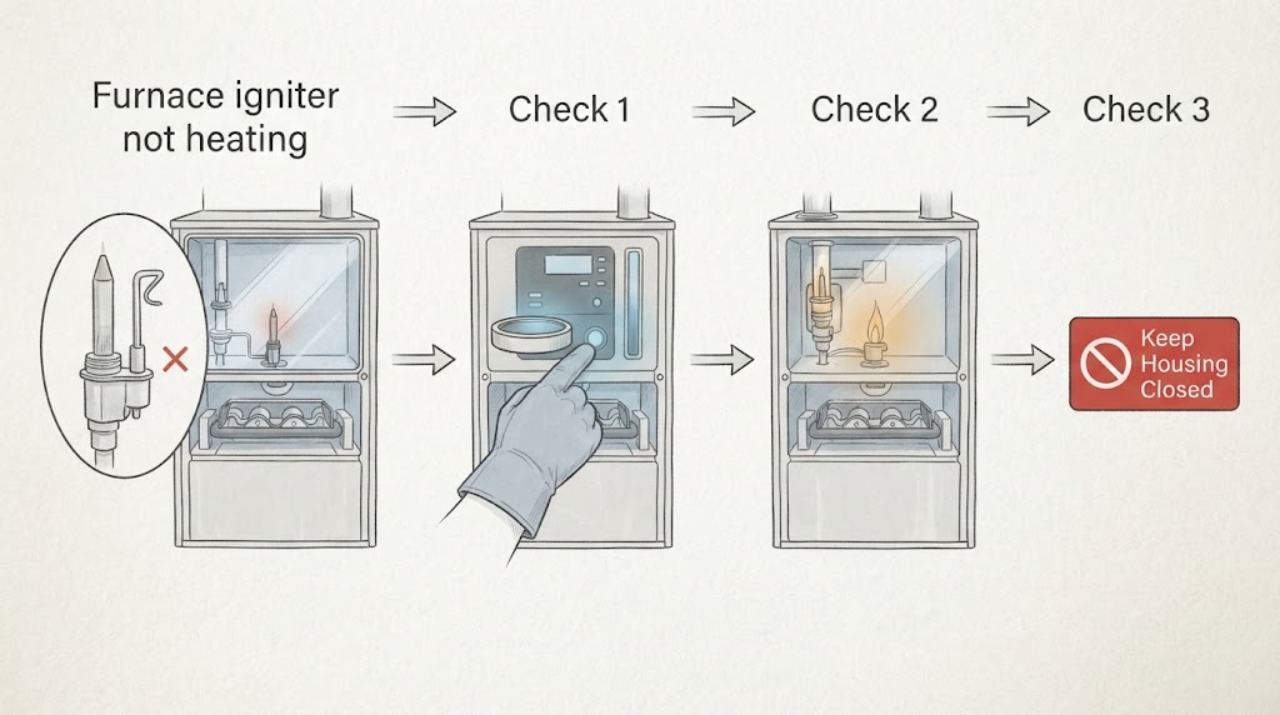
Work through in order
Diagnostic checks
Use only checks that match the exact appliance or system and its official guide.
-
Check 1
Set the thermostat to its normal heat mode and raise the set temperature only enough to create an ordinary call for heat. From a safe position, note whether the furnace responds, whether the blower runs, and whether the thermostat or furnace display shows a warning.
Expected result: The furnace may remain silent, run the blower without heat, start a sequence and stop, or show a manufacturer-specific status light or message.
Next step: Record the exact response and compare it with the owner's manual. If the thermostat is calling for heat but the sequence repeatedly stops, continue only with the safe observations below and arrange HVAC service.
Stop if: Do not remove the furnace panel, hold a door switch closed, or use a jumper to force a heat call.
Why this matters
Why: A missing heat call, control setting, or system power issue can prevent the igniter stage from being reached. A blower-only response does not prove the igniter is defective.
-
Check 2
Look at the furnace's accessible power indication and the nearby service switch or breaker without touching wet equipment or opening the cabinet. If the breaker is tripped, leave it off and arrange service; do not reset it repeatedly to make the igniter heat.
Expected result: The furnace may have no display or response, the service switch may be off, the breaker may be tripped, or the controls may appear powered while ignition still does not start.
Next step: Photograph or record the indicator state and tell the technician whether the breaker or switch changed. Do not work inside the electrical panel or furnace cabinet.
Stop if: Stop for a burning odor, smoke, sparks, damaged wiring, wet equipment, heat at the switch, or a breaker that trips again.
Why this matters
Why: The igniter and control board need electrical power, but loss of power does not identify whether the cause is the switch, breaker, wiring, control, or another fault. A tripped breaker is a reason to investigate, not an invitation to keep resetting it.
-
Check 3
Inspect only the normally accessible furnace filter, return opening, and supply registers. If the filter is visibly loaded and the owner's manual identifies a customer-replaceable filter, replace it with the specified type without opening the burner compartment; otherwise leave it in place and record its condition.
Expected result: The filter may be clean, heavily loaded, missing, incorrectly seated, or impossible to identify safely. Registers may be open, blocked by objects, or unaffected.
Next step: After one clearly authorized filter change, make one normal heat call and observe whether the startup pattern changes. If the igniter still does not heat or the furnace locks out, stop testing and call an HVAC technician.
Stop if: Do not remove the blower or burner panel, clean internal burners, or substitute a filter based only on size or appearance.
Why this matters
Why: Restricted airflow can contribute to furnace shutdown or poor heating, but a clean filter does not clear the igniter, flame sensor, gas, control, or venting system.
-
Check 4
During one ordinary heat call, observe the startup sequence only through a manufacturer-provided sight window or external indicator. Do not remove a cover or reach into the furnace. Record whether a hot-surface element glows, a spark is heard or seen through the intended window, a pilot appears when the manual says one should, and whether the main burner lights.
Expected result: The sequence may stop before ignition, show no glow, click without a flame, light briefly and go out, or complete ignition and still deliver cool air.
Next step: Stop after one observed sequence and provide the exact pattern to the technician. Do not repeat cycles to force ignition or attempt to clean or reposition the igniter or flame sensor.
Stop if: Stop immediately for gas odor, delayed ignition, a bang, flame outside the burner area, smoke, unusual flame color, or any warning that requires opening the cabinet.
Why this matters
Why: No glow or spark can fit an igniter, power, control, or safety-chain issue; glow or spark without burner ignition can involve gas delivery or burner conditions; a brief flame can involve flame sensing or another safety response. The observation narrows the diagnosis but does not identify a replaceable part.
-
Check 5
From outside and ground level, look for an obvious obstruction at the furnace intake or exhaust termination, such as snow, leaves, or debris, only if the manufacturer's installation guidance identifies those terminations and the area is safe to approach. Record any blockage without reaching into the pipe or changing the venting.
Expected result: The termination may be clear, visibly obstructed, damaged, disconnected, or inaccessible from a safe position.
Next step: Keep the furnace off and call an HVAC professional for any blockage, damage, or uncertainty. Do not disassemble the vent, bypass a pressure switch, or use the furnace until a qualified person confirms safe operation.
Stop if: Leave immediately for a carbon-monoxide alarm, gas odor, headache, dizziness, nausea, unusual combustion noise, or a vent that is disconnected or damaged.
Why this matters
Why: Blocked or damaged venting can stop a furnace through a safety control and can create a combustion or carbon-monoxide concern. A clear termination does not rule out an internal vent, pressure, heat-exchanger, or control problem.
Use your observations
Decision map
Find the observation that best matches what you see, then follow the next safe action.
-
PATH 01Safety boundary
What you see
The thermostat is not calling for heat, the furnace is completely unresponsive, or the service switch or breaker is off or tripped while the igniter never enters the sequence.
Do this next
Confirm only the ordinary thermostat setting and record the power state. Leave a tripped breaker off and call an HVAC technician if the furnace remains unresponsive or the breaker trips again.
Why this path and its safety boundary
Why it matters: The failure may be upstream of the igniter: thermostat demand, power, switch, control, or a protective trip. The igniter itself has not yet been isolated as the cause.
Safety stop: Do not reset repeatedly, open the electrical panel, force a door switch, or jumper controls.
-
PATH 02Safety boundary
What you see
The thermostat calls for heat and the furnace begins its sequence, but a hot-surface igniter shows no glow or a spark system produces no intended ignition while the burner remains off.
Do this next
Leave the furnace in its safe state and request professional ignition diagnosis. Provide the model, indicator pattern, startup timing, and whether the blower or inducer ran.
Why this path and its safety boundary
Why it matters: An igniter, ignition power, control signal, wiring, or safety-chain problem is possible. A no-glow observation is not permission to touch or meter the igniter.
Safety stop: Stop immediately for gas odor, smoke, sparking, delayed ignition, or a lockout that recurs after one normal call.
-
PATH 03Safety boundary
What you see
The igniter visibly glows or the intended spark occurs, but the burner does not light, clicks repeatedly, or the system stops after the ignition attempt.
Do this next
Stop cycling the furnace and call a qualified HVAC professional to check combustion, gas, ignition, and safety systems. Do not adjust the gas valve or open the burner compartment.
Why this path and its safety boundary
Why it matters: Gas delivery, burner condition, ignition position, control timing, or a safety response may be involved. The igniter is producing an ignition signal, so replacing it without diagnosis may not solve the no-heat condition.
Safety stop: Leave the home for gas odor, a bang, flame outside the burner area, or a carbon-monoxide alarm.
-
PATH 04Safety boundary
What you see
The burner lights briefly and goes out, the furnace repeatedly locks out, or the igniter appears normal but the blower delivers cool air after the attempt.
Do this next
Keep the furnace out of service and give the technician the exact sequence, filter state, status light, and number of attempts observed. Do not clean the flame sensor or bypass a safety device.
Why this path and its safety boundary
Why it matters: Flame sensing, airflow, limit or pressure safety, gas supply, control, or another system condition may be shutting combustion down. A normal-looking igniter does not clear the rest of the ignition chain.
Safety stop: Stop for repeated ignition attempts, unusual combustion noise, smoke, gas odor, or a carbon-monoxide alarm.
-
PATH 05Safety boundary
What you see
A vent termination is blocked or damaged, combustion looks abnormal, a carbon-monoxide alarm sounds, or anyone has headache, dizziness, nausea, confusion, or unusual fatigue while the furnace operates.
Do this next
Leave the building for fresh air, call emergency services from outside, and do not re-enter or operate the furnace until responders and qualified HVAC personnel say it is safe.
Why this path and its safety boundary
Why it matters: The situation may involve combustion or venting hazards rather than a routine igniter replacement. Carbon monoxide cannot be safely diagnosed by smell or by repeated furnace cycles.
Safety stop: Do not search for the source, relight the furnace, silence the alarm, or use other fuel-burning appliances inside.
Helpful context
Understand the symptom
A furnace may use a hot-surface igniter that glows, a spark igniter, or an intermittent pilot system. That means “not heating” does not always mean a glowing element should be visible. Use only the furnace's normal thermostat controls and any manufacturer-provided sight window or indicator that can be read without removing a panel. The goal is to identify where the startup sequence stops, not to repair the ignition assembly from the front of the cabinet.
Gas combustion and line-voltage controls make this a professional-service boundary. Do not open the burner compartment, touch the igniter, clean the flame sensor, measure live voltage, adjust the gas valve, bypass a door or pressure safety switch, or repeatedly reset a lockout. If you smell gas or a carbon-monoxide alarm sounds, leave the building and call emergency services from outside.
Only after diagnosis
Potential parts
- furnace igniter
Consider this part only after a qualified technician confirms that the ignition element or spark component has failed and the exact furnace design requires replacement.
Confirm the exact furnace model, ignition type, mounting, electrical characteristics, and manufacturer fit information before ordering. - furnace flame sensor
Consider this part only when professional diagnosis shows that the flame-sensing circuit is causing a brief flame or shutdown; a no-glow igniter symptom does not establish this part as the cause.
Confirm the exact furnace model, sensor shape, mounting, control compatibility, and manufacturer instructions before selection. - furnace air filter
Consider this only when the owner manual identifies a customer-replaceable filter and the installed filter is loaded or damaged; a filter change does not repair an ignition fault.
Confirm the filter dimensions, type, airflow rating, and furnace instructions before selecting a replacement.
When checks do not resolve it
Need a professional?
Call a qualified HVAC technician when the igniter does not glow or spark, the burner fails to light, the flame goes out, the furnace locks out, the breaker trips, or diagnosis requires opening the cabinet, testing live circuits, handling gas, cleaning burners or sensors, or inspecting venting.
Safety scope: Limit self-checks to thermostat settings, external indicators or sight windows, normally accessible filters and registers, and a safe ground-level view of vent terminations. Do not open the furnace, touch the igniter, measure live voltage, adjust gas controls, bypass safety switches, or relight an unfamiliar system.
Have this ready
- Provide the furnace brand and model if visible without opening the cabinet, thermostat setting, startup sequence, glow or spark observation, status-light pattern, filter condition, breaker behavior, vent-termination condition, and any odor or alarm.
Common questions
FAQ
How can I tell whether my furnace uses a glowing igniter?
Some furnaces use a hot-surface igniter that glows, while others use a spark or intermittent pilot system. Check the owner's manual or an existing sight window without removing a panel; do not assume that no visible glow means every furnace has a failed igniter.
Can I test the furnace igniter with a multimeter?
Do not test it yourself unless you are qualified for the furnace's gas and electrical systems. Igniter diagnosis can involve live voltage, fragile high-temperature parts, and combustion safety; have an HVAC technician perform the inspection and test.
What does it mean if the igniter glows but the furnace does not heat?
Glow shows that one ignition step occurred, not that gas delivery, burners, flame sensing, controls, airflow, or venting are safe and correct. If the burner does not light or the flame goes out, stop cycling the furnace and request professional diagnosis.
Should I reset the furnace breaker when the igniter is not heating?
No, not repeatedly. A tripped breaker can indicate a furnace or electrical problem. Leave it off and call an HVAC professional, especially if it trips again or there is a burning odor, smoke, or damaged wiring.
What should I do if I smell gas or the carbon-monoxide alarm sounds?
Leave the building immediately, get to fresh air, and call emergency services from outside. Do not operate the furnace, relight it, search for the source, or re-enter until emergency responders and qualified professionals say it is safe.
Read the exact guide
Official sources
- Carbon Monoxide Fact SheetU.S. Consumer Product Safety Commission · General U.S. consumer safety guidance for fuel-burning appliances; local emergency and building requirements also apply.
- Furnace Ignitor: Understanding its Function and ImportanceCarrier · General Carrier educational guidance; exact furnace design and the manufacturer's manual control the actual diagnosis.
- Furnace Not Igniting? Find Out Why and What to DoTrane · Trane troubleshooting guidance used for general sequence interpretation; exact model instructions and local requirements control.
Community feedback
Share a repair observation
Share a plain-text repair observation. Accepted observations are published automatically; this page may take a moment to update.