
On this page
Start here
Quick answer
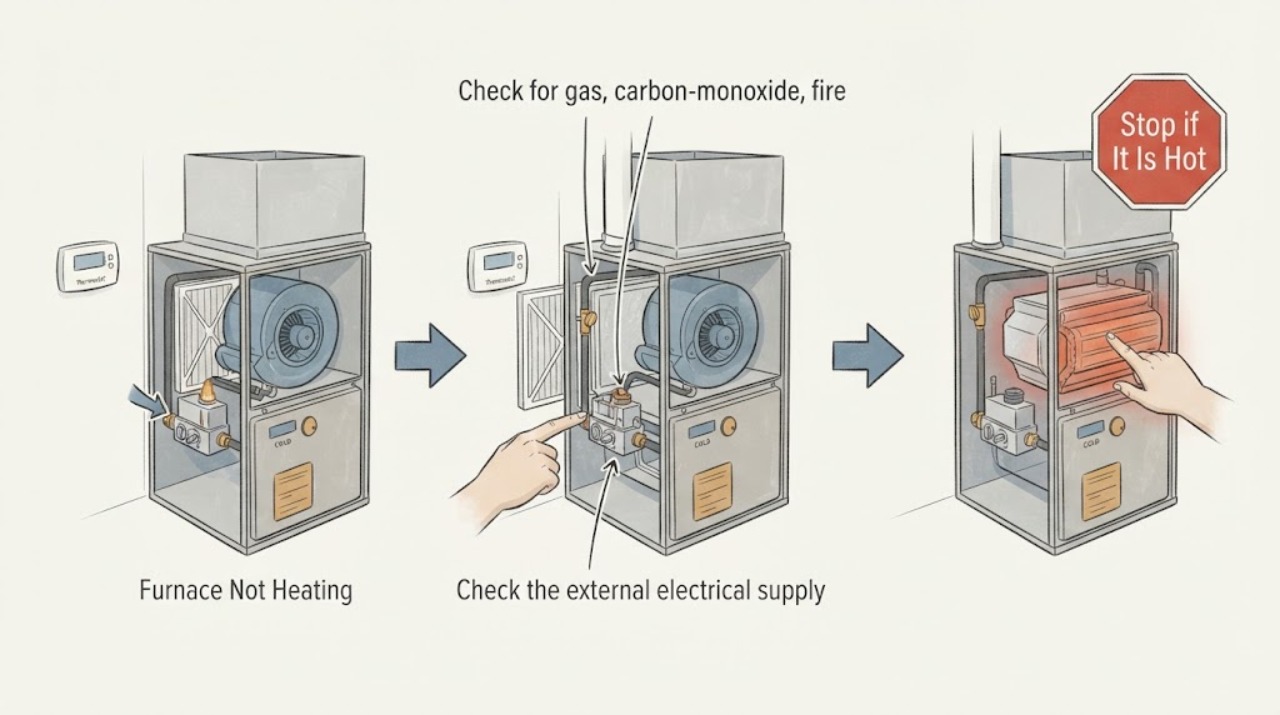
An Amana furnace that is not heating can have a thermostat setting or battery issue, lost electrical power, a restricted filter or airflow path, a blocked outdoor vent, a lockout, or a fuel, ignition, flame-sensing, blower, or control fault. Start with safe observations: set the thermostat to HEAT and a temperature above the room temperature, note whether it calls for heat, check the accessible electrical panel for a tripped breaker, inspect the filter and visible supply and return grilles, and record any status light or message. Do not open the furnace cabinet, test high-voltage or gas circuits, adjust gas pressure, or try to light a burner by hand. Standing-pilot and electronic-ignition Amana models are different; observe a pilot or ignition sequence only through the exact model instructions and any provided sight window. Stop for gas odor, a carbon-monoxide alarm, smoke, abnormal flame, a hot connection, repeated lockout, or a blocked flue and arrange qualified HVAC service or emergency help.
Before you begin
Safety first
- Keep the furnace off for gas odor, a CO alarm or symptoms, smoke, soot, abnormal flame, damaged or blocked flue, arcing, hot connections, water near electrics, repeated breaker trips, or repeated lockout. Do not re-enter after a CO alarm until emergency responders permit it and do not reuse the furnace until trained personnel service it.
Work through in order
Diagnostic checks
Use only checks that match the exact appliance or system and its official guide.
-
Check for gas, carbon-monoxide, fire, and electrical danger first
From a safe position, look and listen for a gas odor, a carbon-monoxide alarm, smoke, soot, flame outside the burner area, a hot plug or connection, arcing, water near electrical equipment, or a furnace that repeatedly attempts ignition. If a CO alarm sounds, occupants have headache, dizziness, nausea, confusion, or breathing trouble, or gas odor is present, leave without searching for the source and call emergency services or the gas emergency line from outside.
Expected result: Gas odor, a sounding CO alarm, possible CO symptoms, smoke, abnormal flame, arcing, or a hot electrical connection is present.
Next step: Keep everyone outside, do not operate switches or the furnace, and call emergency services or the gas utility from a safe location. Do not re-enter or reuse the furnace until trained personnel say it is safe.
Stop if: Do not try to locate a CO source, relight a burner, reset the furnace repeatedly, or ventilate by operating electrical switches in a gas-smelling area.
Why this matters
Why: This is an immediate gas, carbon-monoxide, fire, or shock hazard and is not a thermostat or filter troubleshooting case.
-
Confirm that the thermostat is actually calling for heat
At the thermostat, select HEAT rather than COOL or OFF, set the target temperature above the room temperature, and set the fan to AUTO unless the exact thermostat instructions say otherwise. Note whether the display is powered, whether it reports a call for heat or a schedule hold, and whether the display is blank or shows a low-battery message. Do not remove the thermostat from its wall plate or change wiring.
Expected result: The thermostat is off, set to another mode, below the room temperature, blank, unable to hold settings, or clearly calling for heat while the furnace remains idle.
Next step: Correct only the mode, setpoint, schedule, fan setting, or user-replaceable battery identified by the thermostat instructions. If a valid call for heat produces no furnace response, continue with external furnace checks and prepare for service.
Stop if: Do not jumper thermostat terminals, change low-voltage wiring, or use a heat call to force a furnace with a safety symptom to run.
Why this matters
Why: A missing thermostat demand or thermostat power problem can prevent the furnace from starting; a valid heat call with no response shifts attention to furnace power, a safety interlock, or the control sequence.
-
Check the external electrical supply safely
If the thermostat calls for heat but the furnace is silent, look at the home's accessible electrical panel for a tripped furnace breaker or failed fuse. Check the furnace service switch only from a dry, unobstructed position and only if its purpose is clear. Do not open furnace compartments. Never measure energized voltage as a homeowner; an unfamiliar, hot, damaged, or repeatedly tripping device requires an electrician or HVAC technician.
Expected result: The breaker is tripped, a fuse is failed, the furnace switch is off, the supply appears normal, or power trips again when a call for heat is made.
Next step: If the panel and equipment are dry and there is no hazard, restore a tripped breaker or switch once according to the home's instructions. If it trips again, leave it off and arrange qualified electrical or HVAC service.
Stop if: Do not repeatedly reset a breaker, remove a fuse-panel cover, touch terminals, or run a furnace with damaged wiring or a hot connection.
Why this matters
Why: A lost supply can make the furnace appear dead, while a repeat trip indicates a fault rather than a simple setting. Normal external power with no response points toward a control, safety, motor, or ignition problem.
-
Inspect the filter and visible airflow path
Turn the furnace off and disconnect electrical power before removing an accessible return-air filter, following its installation instructions. Check whether the filter is loaded with dust, installed backward, collapsed, wet, or the wrong size. Also look from the room side for blocked return grilles or supply registers. Replace a disposable filter only with the same size and appropriate type specified for the installation; do not run the furnace without a filter.
Expected result: The filter is dirty, wet, damaged, backward, or missing; return or supply grilles are blocked; or the filter and visible grilles are clear.
Next step: Correct a visible filter or grille issue only after power is safely off, then allow one normal heat call to observe. If heat remains absent, the filter becomes dirty quickly, or the furnace overheats or cycles off, arrange service.
Stop if: Do not operate without a filter, use a guessed higher-restriction filter, remove a cabinet panel, or bypass a limit or safety switch.
Why this matters
Why: Restricted airflow can reduce heat delivery and can trigger a furnace limit or blower protection response. Clear airflow does not rule out ignition, gas, control, or heat-exchanger faults.
-
Check only the exterior air intake and flue termination
For a high-efficiency Amana furnace, inspect the visible outdoor intake and exhaust terminations from ground level or another safe position for snow, leaves, nests, ice, or other obstruction. Do not climb, remove vent fittings, enter the combustion compartment, or probe a flue. If the termination is blocked, keep the furnace off and have the obstruction and venting assessed by a qualified technician.
Expected result: An intake or exhaust termination is obstructed, damaged, disconnected, corroded, or not safely accessible; or the visible terminations appear clear.
Next step: Do not operate with a blocked, damaged, or disconnected termination. Arrange qualified HVAC service for venting inspection; if clear, continue with thermostat, sequence, and code observations rather than opening the furnace.
Stop if: Do not climb to a roof or ladder position, remove vent piping, seal a vent, or operate the furnace when combustion gases may not exhaust safely.
Why this matters
Why: Combustion-air or flue restrictions can stop ignition or create a carbon-monoxide hazard. A clear exterior termination does not prove the internal vent, pressure switch, or heat exchanger is safe.
-
Observe the start sequence without removing panels
With the thermostat calling for heat and the furnace otherwise safe, listen from outside the cabinet for the sequence your model documents: a call for heat, an induced-draft or vent motor, an ignition attempt, burner operation, and then the indoor blower. Observe supply air temperature at a register and any status light through a provided sight glass only. Do not defeat the door switch or watch exposed flames.
Expected result: There is no response, the inducer runs but ignition never occurs, ignition occurs but flame drops out, the blower runs without heat, warm air starts and stops, or the status light flashes a repeatable pattern.
Next step: Record the order, timing, sounds, air temperature, and exact light pattern, then use the model manual's user-level interpretation. If ignition fails, flame drops out, or a code returns, leave internal diagnosis to a qualified technician.
Stop if: Do not open the burner compartment, bypass a door or pressure switch, touch a flame sensor, or test gas or high-voltage ignition circuits.
Why this matters
Why: Each pattern narrows the issue differently: thermostat or power, vent or pressure, ignition or flame sensing, airflow or limit, or a code-defined lockout. It does not identify a replaceable part without model-specific diagnosis.
-
Treat pilot and electronic ignition as different systems
Use the exact Amana model information to determine whether the furnace has a standing pilot or an automatic ignition device. If a standing pilot is visible through the model-provided viewing arrangement, record whether it is present without reaching in. For automatic ignition, listen for the documented sequence and note whether a burner lights; never attempt to light it by hand or adjust the gas valve.
Expected result: The model has no standing pilot, the pilot is out, the igniter clicks or glows but no burner lights, the burner lights and immediately goes out, or the ignition type cannot be identified.
Next step: Follow only the exact owner instructions if they provide a safe user step; otherwise leave the furnace off and arrange qualified HVAC service for fuel, ignition, flame-sensing, pressure, or control diagnosis.
Stop if: Do not light a burner by hand, cycle the gas valve, adjust gas pressure, remove burner panels, or repeat ignition attempts when gas odor or abnormal flame is present.
Why this matters
Why: A pilot observation, an automatic-ignition failure, and a flame-sensing dropout require different model-specific service procedures. An absent or unidentified pilot is not permission to improvise a lighting method.
-
Record status lights, lockout, and thermostat messages
Read the furnace sight-glass LED or thermostat message from the outside without removing a compartment cover. Count a repeating flash sequence, photograph the display, and record whether the blower runs continuously or the thermostat says call for service. Match the result only to the exact Amana model or the manual supplied with the installed furnace.
Expected result: A repeating code or service message appears, the furnace is in lockout, the blower runs continuously, or there is no code and the furnace still does not heat.
Next step: Follow the manual's user-level reset or observation guidance once only if it is explicitly allowed and no hazard exists. If the code returns or the furnace remains cold, give the technician the exact code and sequence.
Stop if: Do not enter service diagnostics, alter control-board settings, bypass safeties, or erase a code before recording it.
Why this matters
Why: A code or lockout indicates that the control detected an abnormal condition; no code does not rule out a thermostat, airflow, ignition, or fuel issue. Daikin and Amana control sequences vary by furnace family.
-
Use one documented reset only after safe checks
Only when there is no gas odor, CO alarm, smoke, abnormal flame, water near electrics, or repeated breaker trip, follow the exact model's owner-level reset instruction once. A reset may involve a thermostat cycle or an external power interruption specified by the manual; do not remove covers or interrupt power while servicing. Observe one complete heat call afterward.
Expected result: The furnace completes ignition and delivers warm air, returns to lockout, repeats the same code, or remains silent after the permitted reset.
Next step: If the symptom returns, leave the furnace off and arrange qualified service with the model, code, sequence, filter, thermostat, and power observations. Do not keep resetting to obtain heat.
Stop if: Do not reset a furnace with a combustion or electrical hazard, bypass a lockout, or continue operation after a repeated failure.
Why this matters
Why: A successful single cycle can indicate a temporary control state, but a returning lockout or code means the initiating fault remains. A silent furnace after reset needs electrical, thermostat, or control diagnosis.
Use your observations
Decision map
Find the observation that best matches what you see, then follow the next safe action.
-
PATH 01Next step
What you see
The thermostat was not in HEAT, the setpoint was not above room temperature, its display was blank, or a user-level battery or setting correction restores a heat call and normal heating.
Do this next
Monitor one normal cycle. If the thermostat loses power again or a valid heat call is ignored, arrange HVAC or thermostat service without changing wiring.
Why this path and its safety boundary
Why it matters: The thermostat demand or setting was more likely than a furnace control failure.
-
PATH 02Next step
What you see
The thermostat calls for heat, the furnace has no response, and a safe external breaker or service-switch correction restores operation without another trip.
Do this next
Monitor for recurrence. Leave power off and call a qualified electrician or HVAC technician for another trip, damaged wiring, heat, or a silent furnace.
Why this path and its safety boundary
Why it matters: A lost external supply was plausible, but a repeat trip would indicate an electrical or equipment fault.
-
PATH 03Next step
What you see
The furnace runs but airflow is weak, the filter is loaded or backward, grilles are blocked, or the furnace overheats and shuts down, then airflow improves after a safe filter or grille correction.
Do this next
Use the specified filter and keep grilles open. Arrange service if the filter dirties rapidly, heat still fails, or limit cycling returns.
Why this path and its safety boundary
Why it matters: A restricted return or supply path is more likely than an immediate ignition-board failure.
-
PATH 04Next step
What you see
The inducer runs but there is no ignition, the ignition attempt is heard but no burner lights, or the exterior intake or exhaust is blocked.
Do this next
Keep the furnace off, do not light or adjust anything, and arrange qualified HVAC service to inspect the venting, pressure, ignition, and fuel path.
Why this path and its safety boundary
Why it matters: Combustion-air, vent, pressure, ignition, or gas-control trouble is more likely and is not a safe homeowner repair.
-
PATH 05Next step
What you see
A burner lights but drops out, the blower runs without warm air, a code returns, or a lockout repeats after the permitted user checks.
Do this next
Record the exact sequence and code and leave the furnace off for qualified diagnosis. Do not bypass a safety or repeat resets.
Why this path and its safety boundary
Why it matters: Flame sensing, airflow limit, gas control, control board, safety circuit, or another internal fault is possible.
-
PATH 06Next step
What you see
The furnace is heating but the home remains cold, the filter and registers are clear, and the unit runs continuously or cycles unusually.
Do this next
Arrange an HVAC assessment of airflow, ductwork, thermostat placement, furnace capacity, and combustion performance rather than increasing gas settings.
Why this path and its safety boundary
Why it matters: Duct distribution, sizing, airflow, thermostat sensing, heat loss, or a performance fault may be involved; Amana notes that equipment sizing and thermostat behavior affect comfort.
-
PATH 07Next step
What you see
Gas odor, a CO alarm, headache or dizziness, smoke, soot, flame outside the burner area, arcing, a hot connection, or a blocked or damaged flue is present.
Do this next
Leave the building, call emergency services or the gas utility from outside, and do not re-enter or operate the furnace until qualified personnel clear it.
Why this path and its safety boundary
Why it matters: This is an immediate life-safety or fire hazard, and ordinary no-heat troubleshooting must stop.
Helpful context
Understand the symptom
First classify what “not heating” means
A furnace may not be heating because it never receives a call from the thermostat, because the blower runs but the burners do not light, because the burners light and shut down, or because warm air is produced but cannot reach the rooms. Those patterns lead to different checks. Amana explains that the thermostat controls the heating call, while a gas furnace's burner, heat exchanger, blower, and flue must all operate together.
Filters are a user check; combustion and electrical compartments are not
Amana identifies a dirty filter as a common cause of poor heating performance and recommends regular filter care. The filter location and replacement procedure vary by installation. Furnace manuals reserve burner, gas valve, ignition, wiring, heat exchanger, flue, and electrical-compartment work for qualified technicians. A clean filter does not make it safe to remove a panel or test a live furnace.
Pilot and ignition advice depends on the exact furnace
Some older equipment may have a standing pilot; many Amana gas furnaces use an automatic ignition device. Do not assume a pilot exists, do not light a burner by hand, and do not repeat ignition attempts when gas odor or an abnormal flame is present. Use the model and serial label to locate the correct owner information, then limit your observation to the documented external sequence.
Safety boundary
Stop conditions
- Stop immediately for gas odor, a sounding carbon-monoxide alarm, possible carbon-monoxide symptoms, smoke, soot, flame outside the burner area, a blocked or damaged flue, arcing, a hot connection, water near electrics, or repeated breaker trips. Leave or keep clear and call emergency, gas, electrical, or HVAC help from a safe location.
- Do not remove internal furnace covers, touch burner or ignition wiring, test high voltage, adjust gas pressure, change gas-valve settings, bypass a door, limit, rollout, or pressure switch, or light a burner by hand.
- Do not keep resetting a lockout, repeating ignition attempts, operating without a filter, or running the furnace when the blower, flame, vent, or safety sequence is abnormal.
- Use the exact Amana model information for pilot versus automatic ignition, status-code meanings, filter location, thermostat compatibility, reset steps, and venting. A generic furnace sequence cannot confirm a failed control board, igniter, gas valve, or heat exchanger.
Only after diagnosis
Potential parts
- thermostat or thermostat control
Consider this only when the thermostat has no valid heat call or fails to communicate correctly and qualified diagnosis separates it from furnace power, wiring, and control faults.
Thermostat compatibility depends on the Amana system type, stages, wiring, and communicating features. Confirm the exact equipment and installation requirements before replacement. - air filter
Consider this only when the installed filter is dirty, damaged, missing, or the wrong size and the replacement follows the installation's specified size and type.
Filter dimensions and approved type are installation-specific. Do not use a guessed restrictive filter or operate the furnace without filtration. - ignition or flame-sensing component
Consider this only when qualified diagnosis confirms an ignition or flame-sensing fault after thermostat, power, airflow, venting, and safety observations.
Igniters and flame sensors vary by Amana furnace family and fuel system. They are internal combustion components and require exact model confirmation and qualified installation. - furnace control board or integrated control module
Consider this only when qualified service confirms an internal control or communication fault rather than a thermostat, supply, safety, airflow, ignition, or gas problem.
Control modules are model- and revision-specific and may require configuration or safety checks. Do not order one from a status light or symptom alone.
When checks do not resolve it
Need a professional?
Request qualified HVAC service for no heat after the thermostat, external power, filter, airflow, and visible termination checks; failed or unstable ignition; pilot or flame-sensing symptoms; repeated lockout or status code; abnormal blower or limit behavior; blocked or damaged venting; or any suspected gas, control, heat-exchanger, or electrical fault.
Safety scope: Keep the furnace off for gas odor, a CO alarm or symptoms, smoke, soot, abnormal flame, damaged or blocked flue, arcing, hot connections, water near electrics, repeated breaker trips, or repeated lockout. Do not re-enter after a CO alarm until emergency responders permit it and do not reuse the furnace until trained personnel service it.
Common questions
FAQ
What should I check first when my Amana furnace is not heating?
Confirm the thermostat is calling for HEAT, check the accessible electrical panel for a tripped breaker, inspect the filter and visible airflow, and record any status light or message. Stop for gas odor, a carbon-monoxide alarm, smoke, an abnormal flame, or a repeated electrical trip.
Can a dirty filter make an Amana furnace stop heating?
A restricted filter can reduce airflow and heat delivery and may contribute to a protective limit response. Replace or clean it only according to the installation instructions and with power safely off. If the filter is clear but heat is still absent or the furnace overheats, call for service.
Should I relight the pilot on an Amana furnace that is not heating?
Do not assume the furnace has a standing pilot. Many models use automatic ignition, and the exact owner instructions control. Never light a burner by hand, adjust a gas valve, or repeat ignition attempts when gas odor or an abnormal flame is present; use qualified HVAC service.
What does an Amana furnace status light or lockout mean?
It means the model's control detected an operating condition, but the exact flash pattern and meaning vary by furnace family. Record the complete pattern and match it to the exact manual. A returning lockout requires qualified diagnosis; do not bypass a safety or keep resetting it.
What should I do if a carbon-monoxide alarm sounds while the furnace is running?
Leave immediately for fresh air, call emergency services or the fire department from outside, and do not re-enter until responders permit it. Do not operate the furnace again until trained personnel inspect and service the appliance.
Read the exact guide
Official sources
- Preventive MaintenanceAmana · Amana heating and cooling systems, including gas furnaces; service details depend on exact installation
- How Central Heating Works| Gas Furnace | Amana® brandAmana · Amana central gas furnaces; individual ignition, staging, and controls vary by model
- Thermostat Categories | Heating and Cooling | Amana brandAmana · Amana HVAC thermostat concepts; exact furnace and thermostat wiring remain model-specific
- HID-2004 HI-124B 5.9.13.pmdDaikin Comfort · The specific Daikin furnace manual family; use as manufacturer safety and sequence guidance, not as universal Amana model instructions
- Carbon Monoxide Fact SheetU.S. Consumer Product Safety Commission · U.S. consumer safety guidance for homes using fuel-burning furnaces and other appliances
Community feedback
Share a repair observation
Share a plain-text repair observation. Accepted observations are published automatically; this page may take a moment to update.