
On this page
Start here
Quick answer
A dirty, incorrectly installed or overly restrictive air filter can reduce the airflow an Amana furnace needs, but a filter is not the only reason a furnace may start and stop too soon. Turn the thermostat to a normal heat demand and observe the pattern without opening the furnace: whether the burner starts, the blower runs, warm air reaches the rooms, and a fault indication appears. Then inspect the accessible filter for heavy loading, collapse, moisture, damage and the correct airflow direction, and replace it only with the type and size specified for the exact system. Do not run a gas furnace without its required filter, stack filters, choose a higher-efficiency filter by guesswork, bypass a limit or safety control, or test gas, combustion or live electrical parts. If short cycling continues with a clean, correctly fitted filter, a restricted return or supply, dirty coil or blower, thermostat or control issue, furnace sizing problem, or a safety-limit condition needs qualified diagnosis. Stop for gas odor, smoke, soot, abnormal flame, carbon-monoxide alarm, burning smell, sparks, or a furnace cabinet that is overheating, and arrange licensed Amana HVAC service.
Before you begin
Safety first
- This article supports only normal thermostat observation, accessible filter inspection or model-approved replacement, room-side airflow checks and symptom recording. Gas, combustion, heat-exchanger, limit-control, live electrical, blower, coil, duct-static-pressure and internal furnace work require a licensed HVAC professional.
Work through in order
Diagnostic checks
Use only checks that match the exact appliance or system and its official guide.
-
Check 1
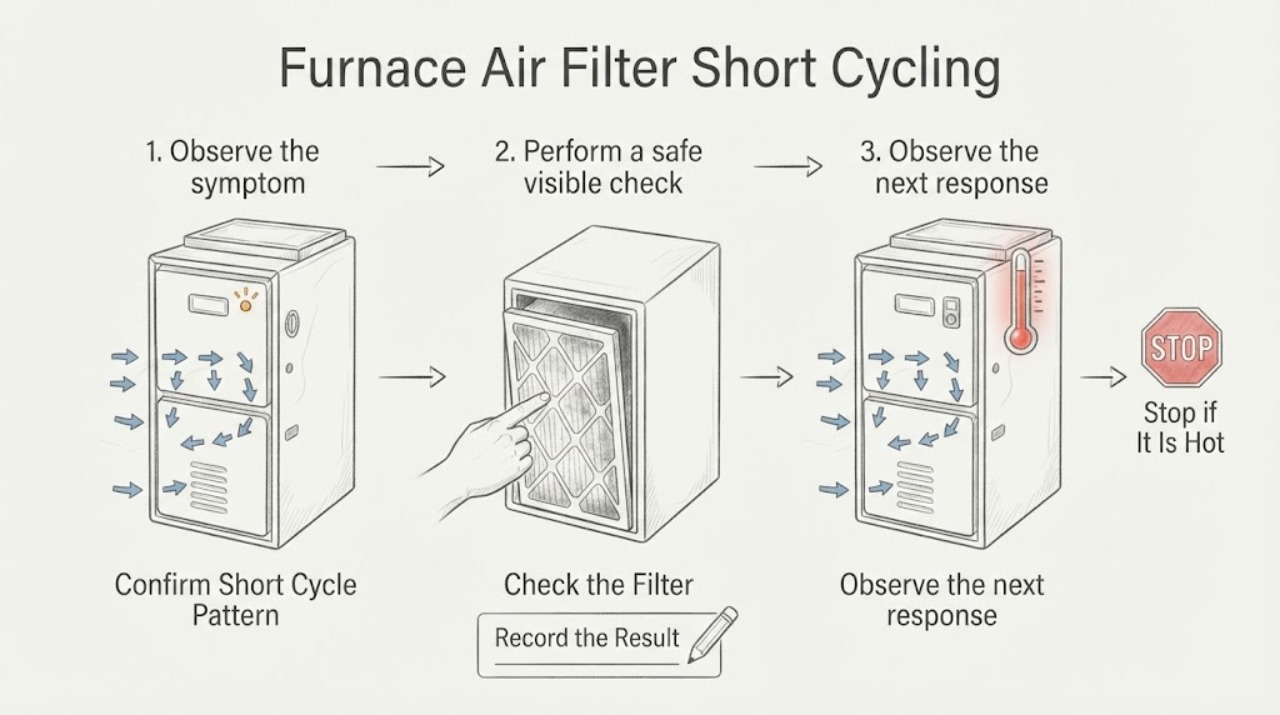
Set the thermostat to a normal heat demand and observe one cycle from the room, without opening the furnace. Note whether the thermostat still calls for heat when the furnace stops, whether the burner starts, whether the blower delivers warm air, whether the blower continues after the burner stops, and whether a display or indicator shows a fault.
Expected result: The thermostat reaches its setting quickly, the burner stops while the call remains, the blower is absent or stops early, the furnace locks out, or the cycle appears normal but frequent.
Next step: Record the sequence, thermostat state, room temperature trend and any fault indication. Do not repeatedly restart or reset the furnace; arrange qualified service if the call remains while heat stops or a fault returns.
Stop if: Stop immediately for gas odor, smoke, soot, abnormal flame, carbon-monoxide alarm, burning smell, sparks, or an unusually hot cabinet or supply register.
Why this matters
Why: A thermostat satisfied quickly can fit equipment sizing or thermostat placement; a burner stopping while the call remains can fit airflow or safety-limit behavior; no blower response can fit a blower or control issue. A normal-looking cycle that repeats frequently needs timing and room-temperature context rather than a filter conclusion alone.
-
Check 2
Turn the thermostat off and inspect only the accessible return-air filter location. Note whether the filter is visibly loaded with dust, wet, collapsed, damaged, installed backward, the wrong thickness, or missing; follow the arrow on the replacement filter and the exact Amana system instructions when fitting a new one.
Expected result: The filter is heavily loaded, wet or collapsed, installed backward or incorrectly, missing, or clean and correctly seated.
Next step: Replace a damaged or loaded filter with the exact model-approved size and type, then restore the thermostat and observe only one normal cycle. If short cycling remains, stop treating the filter as the diagnosis and arrange qualified HVAC service.
Stop if: Do not run the furnace without its required filter, stack filters, force a filter into a rack, touch wiring, or reach into the blower cabinet.
Why this matters
Why: A loaded or incorrectly fitted filter can restrict airflow or allow bypass and is a plausible contributor to short cycling. A clean, correctly seated filter makes a return restriction, supply restriction, blower, coil, thermostat, sizing or safety-control issue more important to investigate.
-
Check 3
Compare the filter's printed size, type and airflow arrow with the exact Amana model information and the filter instructions, using only an ordinary-access label or paperwork. Do not upgrade to a tighter filtration rating or add a second filter to solve dust concerns without professional confirmation of blower capacity.
Expected result: The filter matches the model guidance, the dimensions or type are uncertain, the filter is unusually restrictive, or the system has a media cabinet or multiple return locations.
Next step: Use the model documentation or ask a licensed HVAC professional to confirm filter compatibility and airflow. Do not use a thinner, thicker, higher-rated or improvised filter as a test.
Stop if: Stop if accessing the filter requires removing a furnace panel, the filter rack is damaged, or the filter is wet near electrical components.
Why this matters
Why: A matching filter makes a filter-selection error less likely. An uncertain or restrictive filter can reduce airflow even when it is new; a media cabinet or multiple return path means the visible filter may not be the only airflow element.
-
Check 4
With the furnace off, inspect only the visible return grille, supply registers and accessible duct openings for blocked furniture, closed registers, collapsed flexible duct or obvious debris. Restore ordinary room-side airflow paths without opening ductwork, blower compartments or coil cabinets.
Expected result: The return is blocked, several supply registers are closed, a visible duct is crushed or disconnected, airflow is weak at many rooms, or the room-side path appears clear.
Next step: Clear only ordinary room-side obstructions and observe whether airflow and cycling improve over one normal call. If the pattern remains, arrange qualified service for airflow and duct evaluation rather than closing more registers or opening the furnace.
Stop if: Do not remove supply grilles, cut ducts, open the blower or coil cabinet, or run the furnace with a blocked return or obvious damaged duct.
Why this matters
Why: A blocked return or restricted supply path can compound filter resistance and reduce delivered airflow. Weak airflow at many rooms after a good filter makes blower, coil, duct, static-pressure or system-design issues more likely; a clear visible path does not rule out hidden restrictions.
-
Check 5
Observe whether the thermostat is in direct sunlight, a draft, a supply-air stream or another unusually warm location, and compare its reading with the general room comfort without moving or opening it. Note whether the furnace shuts off at the thermostat setting or while rooms remain cold.
Expected result: The thermostat is exposed to a local draft or heat source, reaches its setting while rooms remain cold, or stays below its setting when the furnace stops.
Next step: Record the thermostat location and cycle sequence. Do not relocate or rewire the thermostat as a trial; arrange qualified HVAC service if the call ends unexpectedly or the home does not heat evenly.
Stop if: Do not remove the thermostat cover, alter low-voltage wiring, bypass a control or keep cycling the furnace when rooms remain cold.
Why this matters
Why: A thermostat location or sensing issue can end a heat call early; a furnace that stops below the setting points away from a simple satisfied thermostat and toward a safety, control, airflow or equipment problem. Room-to-room differences can also reflect duct balance or sizing.
-
Check 6
Record the Amana model and serial information from ordinary-access paperwork or labeling, the filter condition and fit, cycle sequence, thermostat call, airflow symptoms, register and return observations, fault indicator and any unusual odor or noise. Do not open the furnace to read a hidden control-board code.
Expected result: Short cycling persists after a correctly fitted filter and clear room-side airflow, the furnace repeatedly displays a fault, warm air is weak, or a safety symptom appears.
Next step: Leave the furnace off if a safety symptom or repeated fault is present and arrange licensed Amana HVAC service. Provide the model, records and exact sequence; do not bypass a safety or continue resetting it.
Stop if: Stop for gas odor, carbon-monoxide alarm, smoke, soot, abnormal flame, burning smell, sparks, water near wiring or a cabinet that is overheating.
Why this matters
Why: Persistent cycling needs model-specific diagnosis of blower operation, heat exchanger and burner condition, airflow and static pressure, thermostat and controls, safety-limit response, duct design, equipment sizing and other possible faults. The filter may be a contributor without being the failed part.
Use your observations
Decision map
Find the observation that best matches what you see, then follow the next safe action.
-
PATH 01Safety boundary
What you see
Do this next
Fit the model-approved filter correctly, then observe one normal call. If the furnace still cycles early, arrange qualified service for airflow and safety diagnosis.
Why this path and its safety boundary
Why it matters: Filter resistance or bypass is a plausible contributor to the short cycling, but the filter result does not prove that the furnace safety response is healthy.
Safety stop: Do not operate without the required filter, stack filters, use an improvised filter or bypass a limit control.
-
PATH 02Safety boundary
What you see
Do this next
Keep the furnace from repeated cycling and arrange licensed HVAC service for airflow, controls and safety checks. Do not install a more restrictive filter to compensate.
Why this path and its safety boundary
Why it matters: A hidden airflow restriction, blower or coil issue, thermostat or control fault, safety-limit response, sizing or duct condition is more likely than the filter alone.
Safety stop: Stop for gas odor, smoke, soot, abnormal flame, carbon-monoxide alarm, burning smell, sparks or an overheating cabinet.
-
PATH 03Safety boundary
What you see
Do this next
Restore clear room-side paths only and arrange a qualified airflow and duct inspection if cycling continues. Do not close more registers or alter ductwork as a test.
Why this path and its safety boundary
Why it matters: A system airflow or duct restriction can compound filter resistance and leave the furnace unable to deliver heat normally; the restriction may be hidden from room-side view.
Safety stop: Do not operate with a blocked return, damaged duct or overheating symptom.
-
PATH 04Safety boundary
What you see
Do this next
Record the thermostat location and room pattern and arrange qualified HVAC evaluation. Do not relocate or rewire the thermostat without model and system guidance.
Why this path and its safety boundary
Why it matters: Thermostat location, sensing, duct balance, equipment sizing or installation may be ending the call before the home is comfortable; the filter may not be the primary cause.
Safety stop: Do not bypass the thermostat or leave the furnace cycling if a safety fault, gas odor or combustion symptom is present.
-
PATH 05Safety boundary
What you see
Do this next
Turn the furnace off and arrange licensed Amana HVAC service. For gas odor or a carbon-monoxide alarm, leave the area and follow local emergency guidance.
Why this path and its safety boundary
Why it matters: A safety, control, combustion, blower, heat-exchanger or airflow fault needs professional diagnosis; continued resets can hide a dangerous condition.
Safety stop: Do not open the furnace, test live electrical parts, adjust gas controls, inspect a burner manually, bypass a safety or restart repeatedly.
Helpful context
Understand the symptom
Short cycling is a pattern, not a filter diagnosis
A furnace that starts and stops before the home reaches the thermostat setting may be reacting to restricted airflow, a control or thermostat signal, a safety condition, duct or blower trouble, or equipment sizing. A dirty filter can be a useful first check because it is accessible, but replacing it does not prove that the original filter caused the cycling or that the furnace is safe to keep running.
Use the filter as an airflow clue
Look for a loaded filter, an arrow facing the wrong way, a filter that is bowed or wet, or a filter rack that does not close. A filter that looks clean can still be the wrong thickness or too restrictive for the blower. Amana advises choosing a filter that matches the blower's capacity and consulting a professional before changing filtration type.
Keep the gas furnace safety boundary firm
Do not remove the furnace cabinet, bypass a limit, inspect a burner flame up close, measure live voltage, alter gas controls, or keep resetting a fault. If a filter change does not resolve the pattern, a qualified technician needs to inspect airflow, blower operation, controls, heat exchanger, burner and safety response using model-specific procedures.
Safety boundary
Stop conditions
- Stop the furnace and leave the area for gas odor, carbon-monoxide alarm, smoke, soot, abnormal flame, burning smell, sparks, water near wiring or an overheating cabinet; seek appropriate emergency, gas or HVAC help.
- Do not bypass a limit or safety control, test live voltage, adjust gas controls, inspect or clean burners, open the furnace cabinet or work on the heat exchanger and flue as a user check.
- Do not run the furnace without its required filter, stack filters, use a filter of uncertain size or restriction, or keep changing filter ratings to mask persistent short cycling.
- Do not close additional supply registers, block a return, cut or alter ductwork, relocate or rewire the thermostat, or keep resetting a fault that returns.
- Arrange licensed Amana HVAC service when short cycling continues with a clean, correctly fitted filter, when airflow remains weak, or when the furnace stops before a valid heat call is satisfied.
Only after diagnosis
Potential parts
- Amana furnace air filter
Consider this consumable only when the installed filter is loaded, damaged, wet, missing or not the model-approved size and type.
Filter dimensions, depth, airflow direction and allowable restriction depend on the exact Amana furnace and filter cabinet; confirm the model guidance before ordering. - furnace blower motor or wheel
Consider this category only after qualified testing confirms inadequate blower operation or airflow with the filter and room-side paths correct.
Motor, wheel, speed control, mounting and wiring vary by exact Amana model; internal diagnosis and replacement require a licensed technician. - furnace limit or temperature-sensing control
Consider this category only when qualified diagnosis confirms a safety or temperature-control fault after airflow and filter conditions are evaluated.
Safety-control type, rating and mounting are model-specific; never bypass or substitute this component by appearance. - furnace thermostat or control board
Consider this category only when qualified diagnosis shows that a valid heat call is ending early or the furnace control is cycling abnormally with airflow confirmed.
Thermostat compatibility, wiring and control-board revision depend on the complete system; confirm the exact model and configuration before replacement.
When checks do not resolve it
Need a professional?
Arrange licensed Amana HVAC service when short cycling continues after replacing a loaded or incorrectly fitted filter with the exact model-approved type, when airflow remains weak, when a return or duct restriction is suspected, when the thermostat is satisfied early, or when a fault recurs. Provide the model and serial information if safely accessible, filter condition and fit, cycle sequence, thermostat call, airflow observations, register and return status, and any fault indicator. Stop and seek urgent gas, carbon-monoxide, electrical or HVAC help for gas odor, carbon-monoxide alarm, smoke, soot, abnormal flame, burning smell, sparks, wet wiring or an overheating cabinet.
Safety scope: This article supports only normal thermostat observation, accessible filter inspection or model-approved replacement, room-side airflow checks and symptom recording. Gas, combustion, heat-exchanger, limit-control, live electrical, blower, coil, duct-static-pressure and internal furnace work require a licensed HVAC professional.
Common questions
FAQ
Can a dirty air filter make an Amana furnace short cycle?
It can contribute by restricting airflow, but it is not proof that the filter is the only cause. Inspect the accessible filter, fit the exact model-approved replacement and observe one normal heat call. If the furnace still stops while the thermostat calls, a technician needs to check airflow, blower, controls and safety response.
What air filter should I use in an Amana furnace?
Use the size, type and airflow direction specified for the exact Amana system. Amana warns that a tight filter can make a furnace work harder to move air and says the filter should match blower capacity. Do not choose a higher-efficiency filter as a short-cycling test without professional confirmation.
How can I tell if the filter is causing the short cycling?
A loaded, wet, collapsed, backward or incorrectly sized filter plus weak airflow makes filter restriction plausible. Replace it with the exact approved filter and observe only a normal cycle. If the call still ends early, the filter may not be the cause and repeated resets or filter changes will not diagnose the furnace.
What else causes an Amana furnace to short cycle after a filter change?
Possible contributors include a blocked return or supply, duct restriction, dirty blower or coil, thermostat sensing or control trouble, equipment sizing, or a safety-limit response. Amana's maintenance guidance assigns airflow, blower, controls, gas, burner and heat-exchanger checks to qualified service.
When is Amana furnace short cycling an urgent problem?
Stop the furnace and seek urgent help for gas odor, a carbon-monoxide alarm, smoke, soot, abnormal flame, burning smell, sparks, wet wiring or an overheating cabinet. For repeated cycling without those hazards, arrange licensed HVAC service rather than bypassing a safety or repeatedly resetting the furnace.
Read the exact guide
Official sources
- What type of filter should I use?Amana · Official Amana HVAC FAQ used for the filter-choice boundary: a tight media filter can make a furnace work harder to move air, so the filter must match blower capacity.
- HVAC Operation | Impacts on heating and cooling | Amana brandAmana · Official Amana HVAC learning resource used for dirty-filter airflow restriction, blower and duct airflow context, thermostat effects and the caution against selecting filtration beyond system capacity.
- HVAC MaintenanceAmana · Official Amana HVAC maintenance resource used for gas-furnace hazard awareness, airflow and equipment complexity, professional inspection and service escalation.
- Preventive MaintenanceAmana · Official Amana preventive-maintenance guidance used to separate routine filter care from qualified checks of controls, blower, burner, heat exchanger, gas connections and electrical components.
Community feedback
Share a repair observation
Share a plain-text repair observation. Accepted observations are published automatically; this page may take a moment to update.