
On this page
Start here
Quick answer
A Carrier furnace is short cycling when it starts and stops repeatedly before the home reaches the thermostat setting. First note whether the burners stop after only a few seconds, after the furnace has heated up, or because the thermostat display stops calling for heat. With the furnace off and cool, replace a visibly dirty or damaged filter with the exact size and airflow direction, open blocked supply and return grilles, and check the thermostat mode, batteries if used, and location near a heat source. Do not open the burner or blower compartment, bypass a limit or flame-sensing safety, adjust gas pressure, or repeatedly reset a fault. If the furnace still cycles, airflow is weak, a safety or fault indicator returns, the blower continues unexpectedly, or there is a gas odor, smoke, exhaust concern, or carbon-monoxide alarm, keep it off and use a qualified Carrier HVAC professional or the gas utility for the urgent hazards.
Before you begin
Safety first
- This article supports observing sequence timing from outside the cabinet, checking thermostat settings and accessible batteries, replacing the exact user-accessible filter, opening unobstructed grilles, and noting visible external vent conditions. A qualified technician must handle burner and blower access, flame sensing, ignition, gas, pressure, venting, electrical controls, limit testing, airflow measurements, and final combustion and carbon-monoxide safety checks.
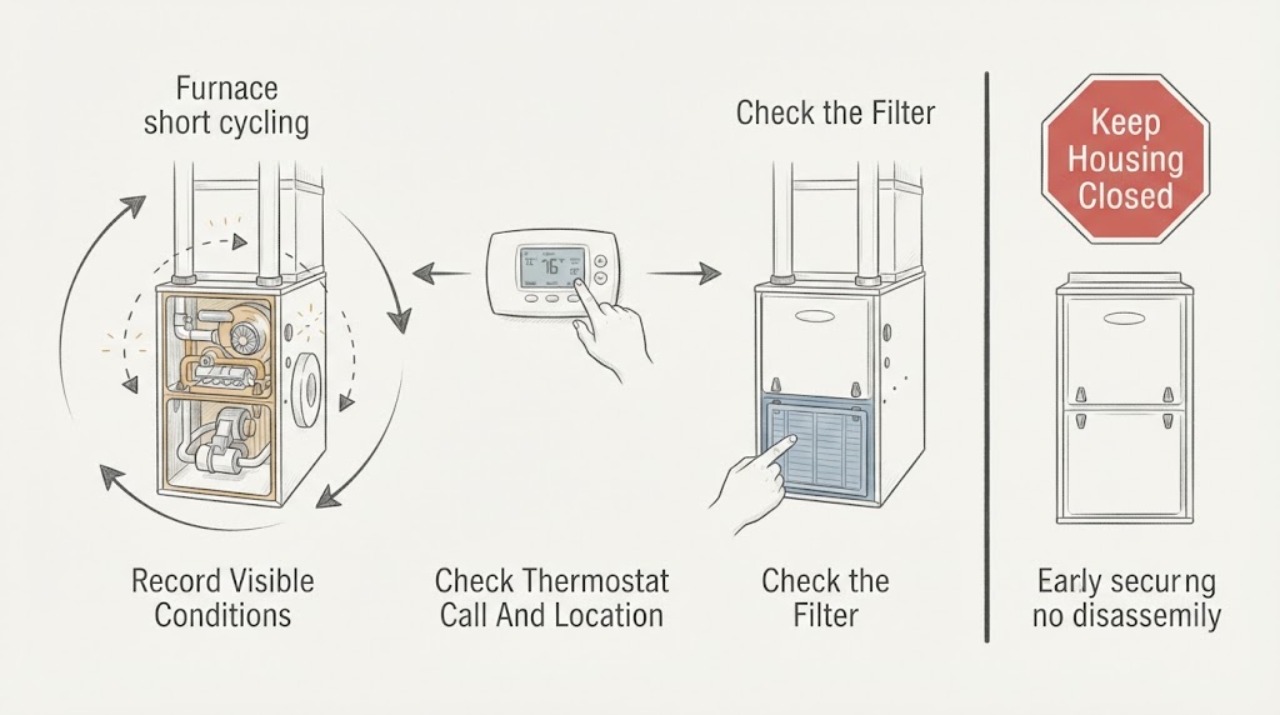
Work through in order
Diagnostic checks
Use only checks that match the exact appliance or system and its official guide.
-
Check 1
If the furnace is operating and there is no danger sign, stop the thermostat heat call and observe from outside the cabinet. On the next ordinary call only if safe, record when the inducer or burner starts, when warm air begins, when the burners stop, whether the blower continues, and how soon another call begins.
Expected result: Classify the pattern as flame or heat ending within seconds, burners ending after the cabinet has warmed, the thermostat reaching its setting, a blower-only run, repeated retries or lockout, or a cycle that occurs while the thermostat still calls for heat.
Next step: Use the matching branch below and stop repeated test cycles. Persistent cycling, any retry or lockout pattern, or a cycle with weak heat requires qualified HVAC diagnosis rather than a guessed component.
Stop if: Stop immediately for gas odor, smoke, burning odor, a carbon-monoxide alarm, loud ignition, exposed wiring, or a vent concern; leave the area as needed and obtain emergency or utility help from a safe location.
Why this matters
Why: A seconds-after-ignition dropout makes flame-sensing or ignition control more likely; a warm-up shutdown with weak airflow makes airflow restriction or a limit-safety response more likely; a call that ends at the set point makes thermostat reading, sizing, or normal satisfaction more likely.
-
Check 2
At the wall thermostat, confirm Heat mode, a set point above the room reading, and fan setting appropriate for the system. Replace batteries only if the thermostat uses them and the holder is accessible. From the outside, note whether the thermostat is in direct sun, beside a cooking or heating source, near a draft, or showing a blank screen or recurring alert; do not pull wiring or remove the furnace control panel.
Expected result: Record a heat call that disappears before the room is warm, a set point that is reached quickly, a blank or rebooting display, a thermostat near a heat source or draft, or a steady heat call while the furnace itself stops.
Next step: Correct only a clear mode, battery, or nearby-obstruction issue that the thermostat instructions permit, then observe without forcing repeated cycles. If the call remains active while the furnace stops, continue to the filter and airflow checks and arrange service if the pattern persists.
Stop if: Do not move thermostat wires, bridge terminals, change installer settings, open the furnace controls, or continue after exposed or frayed wiring, a returning error, or a burning smell.
Why this matters
Why: A disappearing call or misleading thermostat location can end a cycle without a furnace safety trip. A steady call while the furnace stops points more toward airflow, flame sensing, limit protection, ignition, venting, or another furnace-side fault.
-
Check 3
With the furnace off and cool, inspect the user-accessible return filter and the room supply and return grilles. Replace a visibly dirty, collapsed, or damaged filter only with the exact size, type, and airflow direction specified for the installed Carrier system, and remove furniture or coverings from grilles without closing registers to balance rooms.
Expected result: Record a clean filter with open grilles, a packed or backward filter, a filter that does not fit its rack, blocked return air, many closed supplies, weak airflow, or a filter location that is internal or unsafe to reach.
Next step: Correct a simple filter or grille restriction as the owner instructions allow, then watch one normal call only if no red flag is present. If short cycling continues, keep the furnace off and request HVAC service; do not compensate by removing the filter or opening internal panels.
Stop if: Do not run the furnace without its required filter, force an oversized or collapsed filter into place, reach into the blower compartment, or treat a persistent limit-type cycle as a filter problem after the airflow correction.
Why this matters
Why: Restricted return or supply airflow can overheat the heat exchanger and invoke a limit shutdown. A filter that is clean and correctly installed, or a filter change that does not improve the cycle, makes a blower, coil, duct, limit, sizing, or control issue more likely rather than clearing the furnace.
-
Check 4
From outside the furnace cabinet, inspect the immediate return and supply transition and, where present, the visible outdoor intake and exhaust termination. Look for furniture or stored items restricting the unit, snow, leaves, nests, a disconnected-looking pipe, or an object covering an opening; do not remove a furnace panel, disassemble venting, or reach into an opening.
Expected result: Record no external obstruction, a blocked return or grille, a questionable intake or exhaust termination, a loose or damaged vent, water or debris near a termination, or a furnace that short cycles with all visible airflow paths clear.
Next step: Clear only loose material that can be removed without tools and without approaching the furnace flame or vent opening. For a damaged or questionable vent or for continued cycling after an external check, leave the furnace off and arrange qualified service.
Stop if: Do not tape, shorten, reroute, cap, drill, or detach vent or intake piping, and do not restart the furnace after a carbon-monoxide alarm, exhaust concern, or visible vent separation until it has been professionally cleared.
Why this matters
Why: An obvious external airflow restriction can contribute to overheating. A blocked, disconnected, or damaged fuel-furnace vent changes the risk to combustion and carbon monoxide; an unobstructed exterior does not rule out an internal vent, pressure, heat-exchanger, or control fault.
-
Check 5
If the Carrier furnace has a user-visible status light or thermostat alert, record the exact code or blink pattern and the point in the cycle when it appears. Read the installed model's owner information without removing a panel; do not reset repeatedly just to clear a code or attempt to watch the burner directly.
Expected result: Record no alert, a flame-proving or ignition-related alert, a limit or airflow-related alert, a pressure or vent-related alert, repeated retries, or a code that returns after one normal reset permitted by the owner instructions.
Next step: Give the exact model, code, blink count, timing, filter result, airflow result, and thermostat behavior to a qualified Carrier technician. Keep the furnace off for a recurring alert or any cycle involving gas, ignition, venting, or safety controls.
Stop if: Do not bypass a flame sensor, limit switch, pressure switch, door interlock, or control; do not jumper thermostat terminals or enter service mode without qualified training.
Why this matters
Why: A code or repeated retry narrows the technician's inspection toward flame sensing, ignition, limit, pressure, vent, or control logic, but the code alone does not identify a safe replacement part. A returning alert is evidence to stop testing, not a reason to bypass the safety.
-
Check 6
Record the Carrier model and serial information if safely visible, fuel type, approximate cycle timing, thermostat call behavior, filter size and condition, grille and vent observations, status code, and any recent maintenance, installation, or power event. Keep the system off when the cause is not resolved by a simple external check.
Expected result: Provide whether the burners stop before the thermostat is satisfied, whether the blower continues, whether airflow is weak, whether the cycle changes after a filter correction, and whether a hazard signal or recurring code appeared.
Next step: Arrange a qualified Carrier HVAC inspection for persistent short cycling, repeated retries, weak airflow, abnormal blower operation, recurring alerts, or a furnace that does not reach the set point. Ask the technician to diagnose the complete sequence instead of replacing a part from the symptom alone.
Stop if: Do not keep cycling the furnace for a recording, remove the blower or burner door, test live wiring, adjust gas pressure, alter venting, or order a flame sensor, limit switch, motor, or control before diagnosis.
Why this matters
Why: This separates a thermostat-ending call from an airflow or limit shutdown and from a seconds-after-ignition flame-proving issue. If these observations do not identify a simple external restriction, internal safety, combustion, electrical, blower, duct, coil, sizing, and control paths remain possible.
Use your observations
Decision map
Find the observation that best matches what you see, then follow the next safe action.
-
PATH 01Safety boundary
What you see
The thermostat stops calling before the home is actually comfortable, its reading is affected by sun, a nearby heat source, or a draft, or the furnace reaches the set point unusually quickly while airflow and heat appear normal.
Do this next
Correct only an accessible battery, mode, or obvious nearby obstruction allowed by the thermostat instructions. If the call behavior remains abnormal, have a qualified technician verify thermostat calibration, wiring, staging, duct distribution, and furnace sizing.
Why this path and its safety boundary
Why it matters: A thermostat sensing or configuration issue, normal satisfaction, or an oversized or poorly distributed system is more likely than a limit trip. A thermostat display that continues to call while the furnace stops points back to the furnace side.
Safety stop: Do not move wiring, change installer parameters, or keep testing if the display is damaged, wiring is exposed, or a burning odor is present.
-
PATH 02Safety boundary
What you see
The thermostat continues to call, the furnace heats for a while, airflow is weak or uneven, the filter is dirty or backward, grilles are blocked, or the blower continues after the burners stop.
Do this next
Install the exact approved filter and open accessible grilles. If airflow or cycling does not return to normal on one safe observation, keep the furnace off and arrange service for airflow measurement, blower operation, heat exchanger temperature, limit behavior, and duct or coil condition.
Why this path and its safety boundary
Why it matters: Restricted return or supply airflow, a dirty coil, blower or motor problem, duct restriction, or a limit-safety response is more likely. A filter correction can remove one cause but cannot prove that the limit switch or blower is sound.
Safety stop: Do not remove the filter, open the blower compartment, force a safety switch, or repeatedly restart after a limit-type shutdown.
-
PATH 03Safety boundary
What you see
The burners light and stop within seconds, the furnace retries or locks out, the thermostat still calls for heat, or a flame-sensing or ignition alert appears.
Do this next
Keep the burner compartment closed, record the sequence and alert, and arrange qualified Carrier service. The technician must verify ignition and flame proving with the model-specific procedure before deciding whether cleaning, adjustment, or a replacement is appropriate.
Why this path and its safety boundary
Why it matters: Flame sensing, ignition sequence, gas supply, burner condition, or control logic is more likely than a room-air filter alone. The control may be closing the gas valve because flame was not safely confirmed.
Safety stop: Do not clean or remove the flame sensor, relight or adjust burners, alter gas pressure, bypass the flame-sensing circuit, or run the furnace with a door removed.
-
PATH 04Safety boundary
What you see
There is a carbon-monoxide alarm, gas odor, smoke, exhaust-like odor, a loud ignition event, visible vent separation or blockage, or anyone develops symptoms while the fuel-burning furnace operates.
Do this next
Leave the area and contact emergency services or the gas utility from a safe location as appropriate. Do not operate switches, use a flame, restart the furnace, or re-enter until the hazard has been addressed and the appliance is professionally cleared.
Why this path and its safety boundary
Why it matters: A gas leak, combustion, vent, heat-exchanger, or other life-safety problem is possible. A working safety shutdown does not make it safe to keep restarting the furnace, and absence of an odor does not rule out carbon monoxide.
Safety stop: This is an urgent stop boundary; do not troubleshoot inside the cabinet or attempt a vent, gas, burner, or combustion repair.
-
PATH 05Safety boundary
What you see
The thermostat remains in a heat call, the filter and accessible grilles are correct, no external obstruction is found, but the Carrier furnace still starts and stops or a safety alert returns.
Do this next
Keep the furnace off and arrange a qualified Carrier HVAC inspection. Supply the model, fuel type, sequence timing, thermostat call status, filter and airflow observations, code or blink pattern, and any recent work so the technician can test the whole heating sequence.
Why this path and its safety boundary
Why it matters: An internal blower, limit, flame-sensing, ignition, pressure, vent, control, duct, coil, or sizing fault remains possible. The absence of a visible cause is not evidence that continued operation is safe.
Safety stop: Do not choose a replacement component from the symptom, repeatedly reset a lockout, open the cabinet, jumper controls, or run the unit with an unsecured access door.
Helpful context
Understand the symptom
The point in the heat sequence narrows the cause
Short cycling is not one single failure. A Carrier furnace that lights and stops within seconds has a different pattern from one that heats for a while, stops with the blower running, and then tries again. A cycle that ends when the thermostat reaches the set point may be normal satisfaction or an oversize or control issue. Record the sequence from a safe position before changing anything; the timing is more useful than guessing a replacement part.
Airflow can trigger a protective shutdown
Carrier explains that a dirty filter, closed supply registers, or blocked return air can reduce the air moving across the heat exchanger. Internal temperature can then rise enough for a limit safety to stop the burners. A filter or grille correction is a reasonable homeowner check, but it does not prove that a limit switch, blower, evaporator coil, duct system, or furnace sizing is healthy.
Very short burner runs need a different boundary
Carrier describes the flame sensor as a safety device that confirms a burner flame after the gas valve opens; if the control does not receive confirmation, it closes the gas valve. A furnace that lights and drops out almost immediately, retries, locks out, or displays a fault should not be treated as a filter-only problem. Keep the burner compartment closed and give the technician the exact sequence and any displayed code.
Venting and carbon monoxide are not DIY branches
For a fuel-burning furnace, a blocked, disconnected, or damaged vent or heat exchanger can contribute to carbon-monoxide exposure. A carbon-monoxide alarm, exhaust-like odor, smoke, or suspected gas leak changes the task from troubleshooting to emergency safety. Leave the area as appropriate and contact emergency services or the gas utility from a safe location; do not operate switches or restart the furnace to test it.
Safety boundary
Stop conditions
- Turn the furnace off and seek urgent utility or emergency help for a carbon-monoxide alarm, gas odor, smoke, exhaust concern, visible vent separation, or a loud or abnormal ignition event.
- Keep the system off for repeated flame retries or lockout, a returning safety alert, weak airflow after a correct filter, a blower that behaves abnormally, exposed wiring, a burning odor, or cycling that continues while the thermostat still calls for heat.
- Do not open burner or blower compartments, bypass a flame sensor, limit switch, pressure switch, or door interlock, test live wiring, adjust gas pressure, alter venting, or operate with an unsecured access door.
- Do not keep restarting the Carrier furnace to reproduce short cycling. A temporarily normal cycle after a reset or filter change does not clear an unresolved airflow, safety, ignition, combustion, or control fault.
Only after diagnosis
Potential parts
- Carrier-compatible furnace air filter
Consider a filter only when the installed filter is visibly dirty, collapsed, damaged, or the wrong size or direction and the installed system instructions identify its replacement.
Confirm the exact Carrier model, filter dimensions, approved filtration type, airflow arrow, and any media-cabinet requirements; do not infer fit from short cycling alone. - Carrier furnace flame sensor
Consider this category only after qualified diagnosis confirms a flame-proving fault that matches a burner dropout within seconds or a related alert.
Confirm the exact furnace model, sensor geometry, mounting, and approved service procedure; do not bypass, clean, or replace a flame-sensing safety based only on timing. - Carrier furnace limit switch
Consider this category only after airflow has been evaluated and qualified testing confirms a failed or incorrectly operating limit device.
Confirm the exact model, temperature rating, probe or mounting details, and manufacturer-approved part; never substitute a switch or defeat it to stop cycling. - Carrier furnace thermostat or control component
Consider this category only when the thermostat ends a call incorrectly, a control diagnosis confirms a communication or relay fault, or the existing control is incompatible with the installed furnace configuration.
Verify the exact Carrier furnace, thermostat family, wiring, staging, and control requirements with the installation documentation or technician; do not select a control from the symptom alone.
When checks do not resolve it
Need a professional?
Arrange qualified Carrier HVAC service when short cycling persists after the correct filter, open grilles, and basic thermostat checks; when the thermostat calls but the furnace stops; when the burners drop out within seconds; when airflow is weak; when a safety or status alert returns; or when the unit may be oversized or incorrectly distributed. Treat gas odor, carbon-monoxide alarm, smoke, exhaust concern, visible vent damage, or abnormal ignition as an urgent safety boundary and contact the gas utility or emergency service from a safe location.
Safety scope: This article supports observing sequence timing from outside the cabinet, checking thermostat settings and accessible batteries, replacing the exact user-accessible filter, opening unobstructed grilles, and noting visible external vent conditions. A qualified technician must handle burner and blower access, flame sensing, ignition, gas, pressure, venting, electrical controls, limit testing, airflow measurements, and final combustion and carbon-monoxide safety checks.
Common questions
FAQ
What does short cycling mean on a Carrier furnace?
It means the furnace starts and stops repeatedly before the thermostat's requested temperature is reached. Note whether the burners stop within seconds, after the furnace warms, or when the thermostat ends the call; those patterns lead to different checks.
Can a dirty filter make a Carrier furnace short cycle?
Yes. Carrier explains that a dirty filter or blocked vents can restrict airflow, allow heat to build up, and trigger a protective limit shutdown. Replace a visibly dirty filter only with the exact approved size and airflow direction; continued cycling still needs service.
Why does my Carrier furnace start and stop after a few seconds?
A seconds-after-ignition dropout can indicate that the flame-sensing control did not confirm combustion, although ignition, gas, or control faults can look similar. Do not open the burner compartment or bypass the sensor; record the sequence and arrange qualified service.
Could the thermostat be causing Carrier furnace short cycling?
It can, especially if the call ends early, the thermostat is affected by a nearby heat source or draft, batteries are weak, or the display is unstable. If the thermostat continues to call while the furnace stops, the fault is more likely on the furnace, airflow, safety, or control side.
When is Carrier furnace short cycling an emergency?
Treat gas odor, a carbon-monoxide alarm, smoke, exhaust concern, visible vent separation or blockage, loud abnormal ignition, or symptoms while the fuel-burning furnace operates as an urgent safety boundary. Leave the area as appropriate and contact emergency services or the gas utility from a safe location; do not restart the furnace.
Read the exact guide
Official sources
- Furnace Troubleshooting Guide | Fix a Furnace Not WorkingCarrier · Official Carrier furnace troubleshooting guidance; checks and fuel-system details vary by installed model.
- What Is Furnace Short Cycling? Causes and SolutionsCarrier · Official Carrier consumer guidance for residential furnace short cycling; exact behavior varies by model and installation.
- Furnace Flame Sensor: What It Is, Why It Fails, and How to Fix ItCarrier · Official Carrier educational guidance for furnace flame sensing; exact sensor access and procedures vary by model.
- What is a Furnace Limit Switch? | Ultimate Guide & TroubleshootingCarrier · Official Carrier educational guidance for gas furnace limit switches; exact switch design and access vary by model.
- Common Thermostat Issues and How to TroubleshootCarrier · Official Carrier thermostat guidance; controls and settings vary by thermostat and HVAC system.
- Gas Appliances (CO Sensors)U.S. Consumer Product Safety Commission · Official CPSC safety information about vented gas heating appliances, including furnaces; it does not replace the installed furnace manual or emergency guidance.
Community feedback
Share a repair observation
Share a plain-text repair observation. Accepted observations are published automatically; this page may take a moment to update.