
On this page
Start here
Quick answer
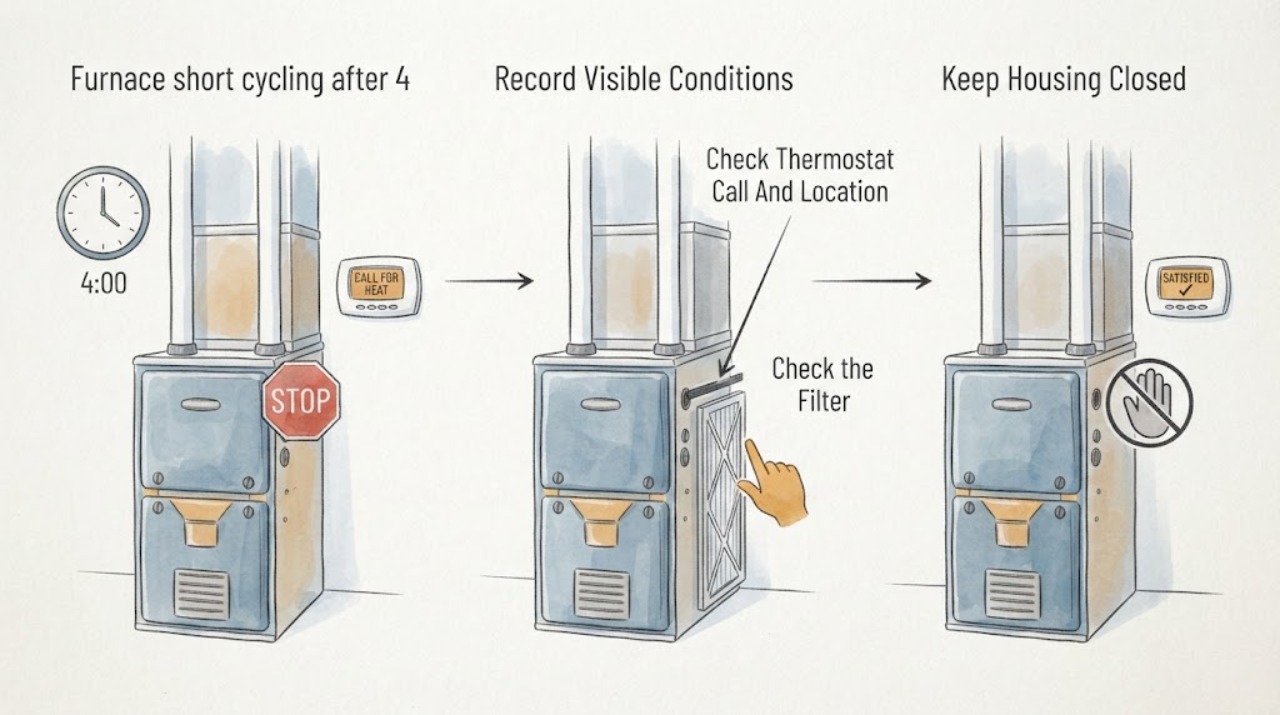
If a Carrier furnace starts and stops after about 4 to 6 minutes, treat that timing as an observation rather than a diagnosis. First confirm the thermostat is calling for Heat, the set point is above room temperature, the fan is on Auto, and the thermostat is not in a draft, sunlit spot, or near a heat source. Then, with the system off, inspect the model-specified filter and accessible supply and return grilles. A cycle that ends while the blower continues, has weak airflow, or repeats after a short heat run can indicate an airflow restriction or limit-protection response; a thermostat display that changes, loses the heat call, or reads a warmed location points toward thermostat sensing or configuration. If ignition drops out, a status code repeats, the breaker trips, airflow stays weak, or any gas odor, carbon-monoxide alarm, smoke, soot, abnormal flame, burning odor, sparking, or exposed wiring appears, stop and arrange qualified HVAC service or emergency help as appropriate. Do not open the furnace, jumper thermostat terminals, bypass a safety control, test live circuits, or adjust gas equipment.
Before you begin
Safety first
- This article supports thermostat settings and visible location checks, a model-specified filter replacement, accessible grille observation, cycle timing, code recording, and observation through an approved window only. A qualified HVAC professional must handle thermostat wiring, high-voltage parts, blower and capacitor work, limit and ignition controls, gas or oil components, venting, combustion, heat-exchanger inspection, sizing, and internal-panel diagnosis.
Work through in order
Diagnostic checks
Use only checks that match the exact appliance or system and its official guide.
-
Check 1
From a safe position, time several heating cycles from the start of heat to shutdown and record whether the thermostat still shows a heat call, whether the blower continues, whether warm air was delivered, and whether the pattern is consistently about 4 to 6 minutes. Do not remove furnace panels.
Expected result: There is gas or fuel odor, a CO alarm or symptoms, smoke, soot, abnormal flame, burning odor, sparking, exposed wiring, water near electrical equipment, or a delayed bang; otherwise the furnace stops after the observed interval with the thermostat still calling, the call disappears, the blower continues, or the whole system goes quiet.
Next step: For gas odor, a CO alarm or symptoms, smoke, or fire risk, leave and call from a safe location. For other hazards, keep the furnace off and arrange qualified service. If no hazard is present, continue with external thermostat and airflow observations only.
Stop if: Stop immediately for gas or fuel odor, CO alarm or symptoms, smoke, fire, soot, abnormal flame, delayed ignition, burning odor, sparking, exposed wiring, or water near electrical equipment.
Why this matters
Why: The 4-to-6-minute interval is useful timing evidence but does not identify a cause. A heat call that remains active while the burners stop makes airflow or limit protection, ignition, or an internal control more plausible; a heat call that disappears makes thermostat sensing, set-point, or control behavior more plausible. A hazard is not a diagnostic branch.
-
Check 2
At the thermostat, confirm Heat mode, set the temperature above the current room reading, leave the fan on Auto for a normal heat call, and replace batteries only when the model uses an ordinary accessible battery compartment. Inspect the surrounding location without removing the wall plate.
Expected result: The display is blank or erratic, the heat-call indicator disappears before the room reaches set point, the set point is not above room temperature, the thermostat is in direct sun or a draft or near a door, window, oven, register, or other heat source, or the display and heat call remain stable.
Next step: Correct only a clearly wrong setting or applicable battery and remove obvious obstructions from around the thermostat without relocating or rewiring it. Observe one or two normal cycles. If the call still drops early, the display is unreliable, or service requires wiring access, arrange thermostat/HVAC diagnosis.
Stop if: Do not remove the thermostat wall plate, bridge terminals, change wiring, or continue if wiring is exposed, hot, damaged, or smells burned.
Why this matters
Why: An incorrect setting, weak battery, or warmed or drafty location can make the thermostat satisfy or interrupt the call prematurely. A stable heat call during a 4-to-6-minute shutdown shifts attention away from the thermostat signal and toward airflow, limit, ignition, or furnace control behavior; it does not prove the thermostat is good.
-
Check 3
Turn the system off and inspect the return-air filter through its normal user access. Check that accessible supply registers and return grilles are open and not covered by furniture, rugs, or other obstructions. Replace a visibly dirty or damaged filter only with the size and type specified for the equipment.
Expected result: The filter is gray, loaded, damaged, missing, or wrong-sized; several grilles are blocked; airflow is weak or uneven; or the filter and accessible grilles are clean and open while the furnace still ends the heat run after 4 to 6 minutes.
Next step: Install the model-specified filter, open unobstructed registers and returns, and observe one normal call. If the furnace still stops early, airflow remains weak, or the blower behavior is abnormal, turn it off and arrange qualified HVAC service.
Stop if: Do not operate without the required filter, use a collapsed or improvised filter, remove the blower door, bypass a door switch, or continue after a burning smell or repeated safety shutdown.
Why this matters
Why: Carrier links restricted airflow to heat-exchanger overheating and a safety limit shutdown. A loaded filter or blocked grille is a plausible contributor to a short run, but correcting it does not prove that the limit switch, blower, duct system, or thermostat caused the fault. Clean accessible airflow with persistent short cycling moves the issue to service diagnosis.
-
Check 4
Only when no safety warning is present, observe one startup from outside the cabinet or through an approved viewing window. Record whether the inducer or blower starts, ignition occurs, flame remains, the blower continues after burner shutdown, and whether a visible Carrier status code repeats; do not open the burner compartment or touch controls.
Expected result: The furnace never starts, ignition clicks or glows without sustained flame, flame lights and drops out, the blower runs with cool air, the blower runs after a short burner run, a code repeats, or the furnace completes a stable sequence but the thermostat call ends early.
Next step: Write down the exact sequence, interval, and code and arrange qualified HVAC service for any failed ignition, flame dropout, repeated lockout, abnormal flame, persistent blower-without-heat, or repeated limit-like shutdown. Do not repeatedly reset or relight the furnace.
Stop if: Do not open panels, relight repeatedly, clean an igniter or flame sensor, adjust gas pressure or valves, bypass a limit, or continue for abnormal flame, delayed ignition, gas odor, soot, smoke, or a CO warning.
Why this matters
Why: No ignition or a brief flame points toward ignition, flame-proving, fuel, venting, or control diagnosis. A burner stop followed by blower operation is consistent with a temperature-safety response but can have other causes. A stable sequence with the thermostat ending the call makes thermostat sensing, configuration, or system sizing more plausible; timing alone cannot select a part.
-
Check 5
Prepare a service note with the exact Carrier model, fuel type if known, the 4-to-6-minute timing, thermostat display and location, filter and airflow observations, blower behavior, startup sequence, and any status-code flashes. Keep the furnace in the safe state indicated by the observations.
Expected result: Settings, a model-specified filter, unobstructed accessible grilles, and ordinary external observations do not stop the short cycling; the symptom returns, a code or lockout repeats, a breaker trips, or diagnosis would require wiring, limit, blower, ignition, vent, gas, heat-exchanger, or cabinet access.
Next step: Leave the furnace off when a safety or repeated shutdown is present and arrange qualified HVAC service. Give the technician the recorded pattern and do not order a component until the exact model and diagnosis establish compatibility.
Stop if: Do not remove panels, test energized circuits, alter gas or oil components, bypass safety switches, access the heat exchanger or vent, or keep resetting a lockout.
Why this matters
Why: The remaining possibilities include thermostat calibration or wiring, airflow or duct restrictions, limit protection, blower or control faults, ignition or flame proving, venting, fuel, incorrect sizing, or another model-specific condition. The interval and symptom pattern narrow the handoff but do not authorize a part replacement.
Use your observations
Decision map
Find the observation that best matches what you see, then follow the next safe action.
-
PATH 01Next step
What you see
The thermostat display is unstable, loses its heat-call indicator, or satisfies while the room is still below the set point, especially when the wall unit is sunlit, drafty, or near another heat source.
Do this next
Correct only the applicable setting or battery and remove obvious local obstructions. If the call still drops after 4 to 6 minutes, have the thermostat, configuration, and wiring diagnosed without opening the wall unit.
-
PATH 02Next step
What you see
The thermostat continues to call for Heat, the furnace ends the burner run after 4 to 6 minutes, the blower continues or warm airflow is weak, and the filter or grilles show restriction.
Do this next
Replace the correct visibly loaded filter and clear accessible grilles once. Persistent weak airflow or recurrence points to blower, duct, coil, limit, or system-setup service; do not bypass a safety control.
-
PATH 03Next step
What you see
The furnace attempts ignition but never establishes flame, lights briefly and drops out, locks out, or displays a repeating fault independent of the thermostat's stable call.
Do this next
Keep the furnace off and provide the exact sequence and code to a qualified HVAC technician. Ignition, flame proving, venting, fuel, and control work is not a thermostat adjustment.
-
PATH 04Next step
What you see
The thermostat call remains stable, the filter and accessible grilles are clean and open, the furnace starts normally, and the room remains below set point even though the heat ends after the observed 4-to-6-minute interval.
Do this next
Arrange service to evaluate limit behavior, blower performance, duct or coil restriction, control timing, furnace sizing, and model-specific operation. Do not infer that the thermostat or limit switch alone has failed.
-
PATH 05Next step
What you see
Gas or fuel odor, a CO alarm or symptoms, smoke, soot, yellow or unstable flame, delayed ignition, burning odor, sparking, or damaged wiring is present.
Do this next
Leave for gas odor, CO warning or symptoms, smoke, or fire risk and call emergency, gas, or qualified HVAC help from a safe location. Do not operate switches or restart the furnace until cleared.
Helpful context
Understand the symptom
Use the 4-to-6-minute timing to describe the pattern, not to name the failed part
A furnace that ends a heating run after roughly 4 to 6 minutes may be satisfying the thermostat, protecting itself from overheating, losing ignition, or responding to another control condition. Count several cycles from burner or heat start to shutdown and note whether the blower continues, the thermostat still shows a heat call, and whether the home reaches the set point. Carrier defines short cycling as repeated operation before the desired temperature is reached, but the interval alone does not distinguish thermostat, airflow, limit, ignition, sizing, or control causes.
The thermostat is the first component-specific check
Carrier notes that a faulty thermostat, low batteries, faulty wiring, or placement near a heat source can send an incorrect signal. Check only ordinary user settings and the visible location: Heat mode, set point above room temperature, fan Auto, stable display, and a wall location away from direct sun, drafts, doors, windows, and nearby heat. Do not remove the wall plate or change terminals; the exact Carrier control and furnace wiring determine compatibility.
Airflow and limit protection can end a normal-looking heat call
Carrier says a dirty filter or blocked vents can restrict airflow, raise heat-exchanger temperature, and trigger a safety shutdown. A short run followed by continued blower operation, weak supply airflow, or a heavily loaded filter makes that pattern more likely. Inspect only the filter and accessible grilles with the system off. Repeated limit trips, a clean filter with weak airflow, or any need to access the blower, limit switch, ductwork, or heat exchanger requires service.
Combustion and high-voltage diagnosis stay on the service side
If the furnace attempts ignition and the flame disappears, locks out, shows a repeating code, or produces a delayed ignition sound, do not keep resetting it. Carrier identifies ignition, flame-sensing, gas, venting, and safety-control faults as reasons for professional assessment. Gas- and oil-burning furnaces can produce carbon monoxide; a CO alarm or symptoms, gas odor, smoke, soot, yellow or unstable flame, burning odor, sparking, or exposed wiring changes this from routine troubleshooting to an immediate safety response.
Safety boundary
Stop conditions
- Leave immediately for gas or fuel odor, a carbon-monoxide alarm or symptoms, smoke, or fire; avoid flames and switches and call from a safe location.
- Stop for soot, yellow or unstable flame, delayed ignition, burning odor, sparking, exposed or frayed wiring, water near electrical equipment, or a damaged cabinet or vent.
- Do not open furnace panels, remove a door interlock, jumper thermostat terminals, test live voltage, adjust gas or oil pressure, access the heat exchanger or vent, or bypass a limit or other safety control.
- Do not repeatedly reset a breaker or lockout, relight a pilot repeatedly, or keep operating a furnace that stops after a short run with weak airflow or a safety code.
- Do not choose a thermostat, limit switch, blower, igniter, flame sensor, control board, gas valve, duct, or heat-exchanger part from the 4-to-6-minute symptom alone; exact model diagnosis is required.
Only after diagnosis
Potential parts
- furnace air filter
Consider only when the installed filter is visibly dirty, damaged, missing, or due for replacement and the equipment documentation identifies that filter size and type.
Confirm the exact Carrier model, filter dimensions, type, and airflow requirements before replacement; do not operate without the required filter. - thermostat
Consider only after diagnosis finds inaccurate sensing, a persistent early loss of the heat call, failed controls, or incompatibility after airflow and furnace operation are checked; a 4-to-6-minute cycle alone does not prove thermostat failure.
Confirm the complete Carrier system, stages, wiring, power requirements, and exact model fit before ordering; installation and wiring changes require qualified service. - limit or flame-safety control
Consider only when qualified testing identifies a failed or repeatedly tripping limit or flame-safety device after airflow and thermostat causes are addressed.
Temperature ratings, probe geometry, control sequence, and model fit must be verified by a qualified technician; never bypass this safety device. - blower or furnace control component
Consider only when service confirms inadequate blower operation, control timing, or a related internal fault after the filter, grilles, thermostat call, and ignition observations are documented.
Internal electrical parts vary by Carrier model and require qualified installation; do not select by appearance or test energized circuits. - ignition or flame-sensing component
Consider only when a qualified diagnosis confirms no ignition or rapid flame dropout with a stable thermostat call and adequate airflow.
Verify the exact Carrier model and ignition system before ordering; combustion and flame-sensing service is professional work.
When checks do not resolve it
Need a professional?
Arrange qualified HVAC service when the thermostat call, model-specified filter, accessible grilles, and ordinary external observations do not resolve the repeated 4-to-6-minute shutdown; when the heat call remains active but the burner stops, airflow is weak, a status code or lockout repeats, ignition fails, a breaker trips, or diagnosis requires wiring, blower, limit, venting, combustion, fuel, high-voltage, heat-exchanger, or internal cabinet access. Treat gas odor, a CO alarm or symptoms, smoke, soot, abnormal flame, burning odor, sparking, or delayed ignition as an immediate safety escalation.
Safety scope: This article supports thermostat settings and visible location checks, a model-specified filter replacement, accessible grille observation, cycle timing, code recording, and observation through an approved window only. A qualified HVAC professional must handle thermostat wiring, high-voltage parts, blower and capacitor work, limit and ignition controls, gas or oil components, venting, combustion, heat-exchanger inspection, sizing, and internal-panel diagnosis.
Common questions
FAQ
Does a Carrier furnace stopping after 4 to 6 minutes prove the thermostat is bad?
No. Four to six minutes is a timing observation, not a diagnosis. A thermostat that loses its heat call or senses a warmed or drafty location is one branch; a stable call with burner shutdown, weak airflow, or continued blower operation can indicate airflow, limit, ignition, or another furnace condition.
What should I check first on a Carrier furnace that short-cycles?
Confirm Heat mode, a set point above room temperature, fan Auto, a stable display, and a normal thermostat location. With the system off, inspect the model-specified filter and accessible supply and return grilles. Do not open the furnace or touch thermostat wiring.
Can a dirty filter cause a Carrier furnace to stop after a few minutes?
Yes. Carrier says restricted airflow can overheat the heat exchanger and trigger a safety limit shutdown. Replace a visibly dirty filter with the specified type and size and clear accessible grilles once; persistent short cycling or weak airflow needs qualified service.
What if the thermostat still calls for heat when the Carrier furnace stops?
That pattern makes thermostat satisfaction less likely and raises airflow, limit-protection, ignition, blower, or control questions. Record whether the blower continues and any external code, then arrange service if the pattern repeats rather than bypassing a safety control.
Should I replace the Carrier thermostat because of short cycling?
Only after diagnosis finds inaccurate sensing, a persistent premature loss of the heat call, failed controls, or incompatibility. Short cycling can also result from airflow restriction, limit protection, ignition, sizing, or other furnace faults, so confirm the exact system and diagnosis before ordering a thermostat.
When is Carrier furnace short cycling an emergency?
Leave for gas or fuel odor, a carbon-monoxide alarm or symptoms, smoke, or fire risk and call from a safe location. Stop for soot, abnormal flame, delayed ignition, burning odor, sparking, exposed wiring, or water near electrical equipment; do not restart until qualified responders clear the condition.
Read the exact guide
Official sources
- Furnace Safety Fact SheetCenters for Disease Control and Prevention · CDC public-health safety guidance for fuel-burning furnaces; it does not diagnose a Carrier furnace or thermostat.
- What is a Furnace Limit Switch? | Ultimate Guide & TroubleshootingCarrier · Carrier residential furnace limit-switch overview; exact limit ratings, controls, and service procedures vary by model.
- What Is Furnace Short Cycling? Causes and SolutionsCarrier · Carrier residential furnace troubleshooting overview; the 4-to-6-minute observation does not identify a particular cause or model behavior.
- Furnace Thermostats: Types, Compatibility, & Installation GuideCarrier · Carrier thermostat guidance; features, stages, wiring, power, and compatibility vary by thermostat and furnace model.
- Furnace Troubleshooting Guide | Fix a Furnace Not WorkingCarrier · Carrier residential furnace troubleshooting overview; exact model, fuel, control sequence, and owner manual govern a particular installation.
Community feedback
Share a repair observation
Share a plain-text repair observation. Accepted observations are published automatically; this page may take a moment to update.