
On this page
Start here
Quick answer
A Maytag furnace is short cycling when it starts and stops repeatedly before the home reaches the thermostat setting. The thermostat is a useful first branch, but it is not automatically the failed part. Record whether the thermostat display stops calling for heat when the furnace stops, whether the thermostat is near a draft, heat source, doorway, or direct sun, and whether a schedule, setpoint, battery, or recent thermostat change coincides with the symptom. Then check the filter and visible supply and return grilles. If the thermostat continues to call while the furnace shuts down, suspect airflow, limit, ignition, flame-sensing, vent, or another furnace safety condition; do not open the cabinet or test wiring. A short cycle after a new thermostat can also reflect equipment compatibility or configuration. Stop for gas odor, a carbon-monoxide alarm, smoke, abnormal flame, repeated lockout, a hot connection, or a rapidly worsening cycle and arrange qualified HVAC service.
Before you begin
Safety first
- Keep the furnace off for gas odor, a CO alarm or symptoms, smoke, soot, abnormal flame, damaged venting, arcing, hot electrical connections, repeated lockout, or repeated breaker trips. Do not open the furnace, rewire the thermostat, or bypass any safety.
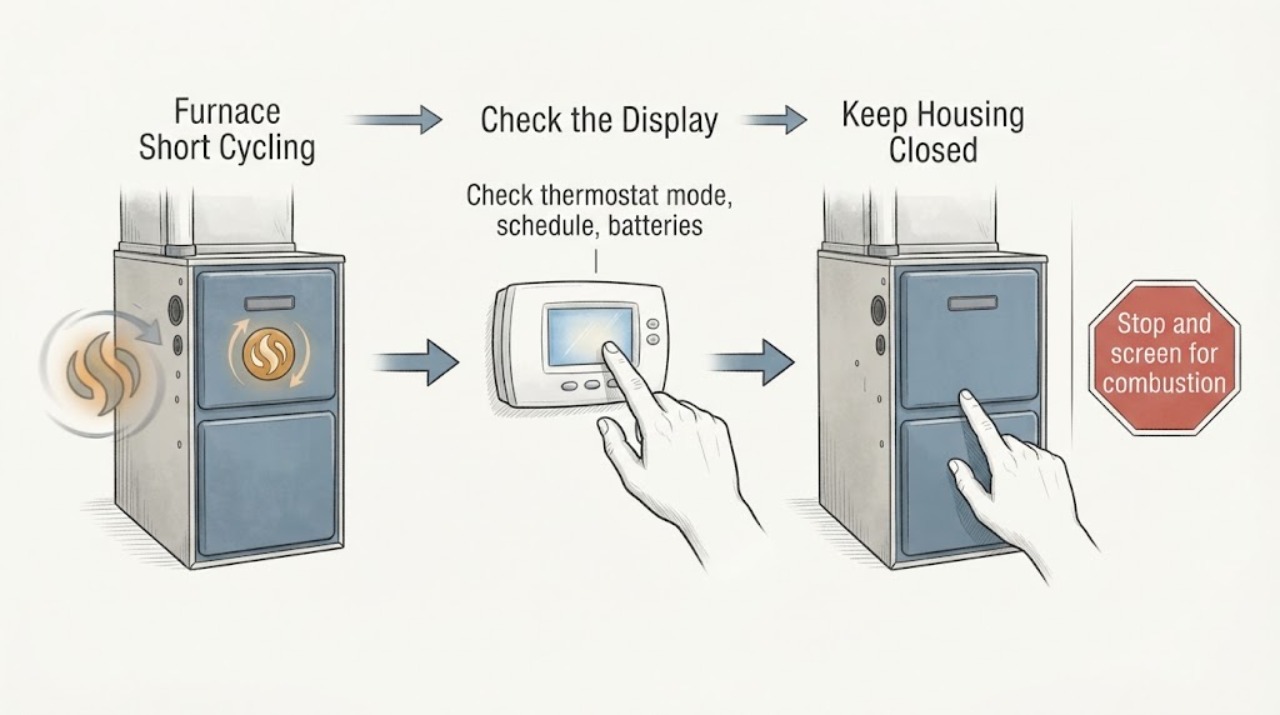
Work through in order
Diagnostic checks
Use only checks that match the exact appliance or system and its official guide.
-
Stop and screen for combustion or electrical danger
From a safe position, note gas odor, a carbon-monoxide alarm or possible symptoms, smoke, soot, abnormal flame, arcing, a hot plug or connection, water near electrical equipment, or a furnace that repeatedly locks out. If a CO alarm sounds or anyone has headache, dizziness, nausea, confusion, or breathing trouble, leave for fresh air and call emergency services from outside.
Expected result: Gas odor, a sounding CO alarm, possible CO symptoms, smoke, an abnormal flame, arcing, a hot connection, or repeated electrical trips is present.
Next step: Keep everyone clear, do not operate the furnace or nearby switches in a gas-smelling area, and call emergency services, the gas utility, or qualified service from a safe location. Do not reuse the furnace until trained personnel clear it.
Stop if: Do not search for the CO source, relight a burner, open the furnace, or keep resetting a lockout after a hazardous symptom.
Why this matters
Why: This is a gas, carbon-monoxide, fire, or shock hazard, not a thermostat-tuning problem.
-
Define the short-cycle pattern against the thermostat display
For one supervised, otherwise safe heat call, record the starting room temperature, thermostat setpoint, whether the thermostat says heat is active, the approximate run time, the off time, the supply-air feel, and the number of starts. Note whether the thermostat call disappears at each stop or remains active while the furnace stops.
Expected result: The thermostat stops calling before the furnace stops, the thermostat keeps calling while the furnace stops, the display resets or goes blank, or the cycle is caused by a schedule or setpoint change.
Next step: Use the matching branch below. Do not change several thermostat settings at once, because that erases the evidence needed to separate a thermostat demand issue from a furnace safety shutdown.
Stop if: Stop the observation for gas odor, abnormal flame, smoke, a hot connection, severe noise, repeated lockout, or a cycle that worsens rapidly.
Why this matters
Why: A demand that ends with the furnace suggests sensing, schedule, setting, or normal target behavior; a continuing demand with furnace shutdown points toward airflow, limit, ignition, vent, control, or another furnace condition.
-
Check thermostat mode, schedule, batteries, and setpoint
Verify that the thermostat is in HEAT, the fan is in the intended AUTO or model-documented mode, the schedule is not changing the target, and the displayed room temperature is plausible. If the model uses user-replaceable batteries, follow its instructions and record whether the display loses power or resets. Do not remove the wall plate or alter terminals.
Expected result: The mode is wrong, a schedule or hold changes the target, the display is blank or resetting, batteries are low, or the thermostat remains stable and calls for heat consistently.
Next step: Correct only the documented user setting or battery issue and observe one normal cycle. If the display remains unstable or the furnace still cycles with a stable call, arrange thermostat or HVAC service.
Stop if: Do not jumper, rewire, or reprogram advanced staging or cycle settings without the exact thermostat and furnace documentation.
Why this matters
Why: A mode, schedule, power, or setpoint problem can create apparent cycling. A stable display and persistent call make the furnace response the more important branch.
-
Inspect thermostat location and recent control changes
From the room side, look for the thermostat on an interior wall exposed to a supply register, return draft, doorway, window, direct sun, cooking heat, fireplace heat, or an uninsulated wall. Record whether the short cycling began after installing, moving, updating, or changing the thermostat and whether the Maytag system is single-stage, two-stage, variable-speed, or dual-fuel if known.
Expected result: The thermostat is in a draft or heat pocket, the location changed, a new thermostat was installed, staging or dual-fuel equipment is present, or the location and controls are unchanged.
Next step: Do not relocate or rewire the thermostat as an experiment. Ask a qualified HVAC technician to evaluate placement, compatibility, staging, and sensor accuracy; use the recorded timing to support the diagnosis.
Stop if: Do not open the thermostat, splice wires, or substitute a generic thermostat for a communicating or multi-stage system.
Why this matters
Why: A location bias can make the thermostat reach its target before the rest of the home. A recent replacement or mismatched staging setup can cause incorrect demand behavior; unchanged placement makes a furnace or airflow branch more likely.
-
Check the filter and visible airflow without bypassing safety controls
Turn the furnace off and disconnect power before inspecting an accessible filter. Record whether it is loaded with dust, wet, collapsed, backward, missing, or the wrong size. Look from the room side for blocked return grilles or supply registers. Replace a disposable filter only with the installation's specified size and type, and do not operate without a filter.
Expected result: The filter is dirty or restrictive, the grilles are blocked, the blower airflow is weak, or the filter and visible airflow path are clear.
Next step: Correct only a visible filter or grille issue with power safely off, then observe one normal cycle. If the furnace still stops while the thermostat calls, or the filter loads unusually fast, arrange service.
Stop if: Do not run without a filter, close registers to change cycling, remove cabinet panels, or bypass a limit switch.
Why this matters
Why: Restricted airflow can overheat the heat exchanger and cause a protective shutdown that looks like short cycling. Clear airflow makes thermostat demand, sizing, ignition, venting, and other furnace causes relatively more likely.
-
Observe the furnace response from outside the cabinet
During one safe heat call, listen from outside the furnace for the thermostat demand, inducer start, ignition attempt, burner operation, blower start, warm air, and shutdown order. Read a status light or message only through a provided sight glass or external display. Do not remove the door, defeat a door switch, or watch exposed combustion components.
Expected result: The thermostat call ends normally, the furnace stops before ignition, burners light then shut off, the blower continues after flame stops, the furnace flashes a code, or the blower and burners stop together.
Next step: Record the exact order and code and match it to the Maytag or equipment manual. If the furnace stops with a continuing call, a flame drops out, or a code returns, leave internal diagnosis to qualified service.
Stop if: Do not touch burners, ignition parts, flame sensors, gas valves, wiring, or high-voltage components.
Why this matters
Why: The sequence distinguishes a demand ending from an airflow, ignition, flame-sensing, vent, limit, control, or normal post-purge condition. The sound pattern cannot identify a failed part by itself.
-
Separate thermostat control from equipment sizing and duct distribution
Compare the thermostat location and call state with room temperatures and airflow at several accessible registers. Note whether the thermostat room reaches the target quickly while distant rooms remain cold, whether the furnace runs for very short periods in mild weather, or whether it stops with weak airflow or a continuing call. Do not close vents or change gas settings to extend a cycle.
Expected result: The thermostat room reaches target quickly while other rooms lag, all rooms experience repeated short calls, or the furnace stops with a continuing call and weak airflow.
Next step: Arrange a qualified HVAC assessment of thermostat placement, load calculation, ductwork, airflow, staging, and furnace operation. Keep registers in their intended configuration while collecting evidence.
Stop if: Do not close registers, block returns, increase the setpoint repeatedly, or alter burner or blower settings to mask short cycling.
Why this matters
Why: The first pattern makes thermostat placement, oversizing, duct balance, or load distribution more likely; the last pattern makes airflow or a furnace safety condition more likely. A thermostat replacement is not a remedy for a sizing problem.
-
Record codes and use only one documented reset if permitted
Photograph any thermostat message, furnace LED flash pattern, or lockout indicator before changing anything. If the exact Maytag or furnace manual permits a homeowner-level thermostat cycle or external power reset and no safety symptom exists, perform it once and observe one complete call. Do not open the cabinet or reset a furnace that has a combustion, electrical, or repeated lockout symptom.
Expected result: The furnace runs normally once and stays stable, the same short cycle returns, a code or lockout returns, or the thermostat message persists.
Next step: Leave the furnace off and arrange qualified service with the exact timing, thermostat call state, code, filter result, and reset result. Do not keep resetting to obtain heat.
Stop if: Do not bypass a lockout, repeatedly cycle power, erase a code before recording it, or continue operation after an abnormal flame or safety symptom.
Why this matters
Why: A one-time recovery may indicate a temporary control state, but recurrence means the initiating condition remains. A returning code requires model-specific diagnosis rather than more resets.
Use your observations
Decision map
Find the observation that best matches what you see, then follow the next safe action.
-
PATH 01Next step
What you see
The thermostat display changes mode, schedule, setpoint, or power state at the same time the furnace stops, and one documented user correction restores a stable call.
Do this next
Monitor one normal cycle. If the display resets again or cycling returns with a stable call, arrange thermostat and HVAC service without changing wiring.
Why this path and its safety boundary
Why it matters: A thermostat demand or setting issue is more likely than a furnace safety shutdown.
-
PATH 02Next step
What you see
The thermostat room reaches its target quickly, distant rooms remain cold, and the furnace stops because the thermostat no longer calls.
Do this next
Request a qualified load, duct, placement, and staging assessment. Do not close registers or repeatedly raise the setpoint to mask the comfort imbalance.
Why this path and its safety boundary
Why it matters: Thermostat placement, oversizing, duct distribution, or house load is more likely than a defective thermostat relay alone.
-
PATH 03Next step
What you see
Short cycling began after a thermostat replacement or update, especially on a two-stage, variable-speed, communicating, or dual-fuel Maytag system.
Do this next
Keep the system in its documented safe mode and have a qualified HVAC technician verify thermostat compatibility, staging, and wiring. Do not rewire the wall control.
Why this path and its safety boundary
Why it matters: Compatibility, staging, configuration, sensor, or wiring differences are plausible and cannot be confirmed from the display alone.
-
PATH 04Next step
What you see
The thermostat continues to call for heat while the furnace stops, the filter or grilles are restricted, and airflow is weak or the supply air becomes unusually hot.
Do this next
Correct only the visible filter or grille issue with power safely off and observe once. If the continuing-call shutdown returns, leave the furnace off and arrange service.
Why this path and its safety boundary
Why it matters: Airflow restriction or a protective furnace limit response is more likely than the thermostat ending the cycle.
-
PATH 05Next step
What you see
The thermostat continues to call, airflow is normal, but the inducer, ignition, burner, or flame-sensing sequence stops early or a status code repeats.
Do this next
Record the sequence and exact code and obtain qualified HVAC service. Do not open the cabinet or bypass a safety.
Why this path and its safety boundary
Why it matters: Ignition, flame sensing, venting, gas control, safety, or furnace control trouble is possible; the thermostat is not proven to be the cause.
-
PATH 06Next step
What you see
All rooms experience repeated short calls even with a stable thermostat display and clear airflow, particularly soon after installation or in mild weather.
Do this next
Ask a licensed HVAC professional to evaluate sizing, ductwork, thermostat placement, staging, and furnace operation. Do not alter burner settings.
Why this path and its safety boundary
Why it matters: Equipment sizing, staging, load calculation, duct balance, or installation may be involved rather than a simple thermostat setting.
-
PATH 07Next step
What you see
Gas odor, a CO alarm or symptoms, smoke, soot, abnormal flame, arcing, a hot connection, repeated lockout, or a rapidly worsening cycle occurs.
Do this next
Leave or keep clear, call emergency services or the gas utility from a safe location, and do not operate the furnace until trained personnel inspect it.
Why this path and its safety boundary
Why it matters: The immediate risk is gas, carbon monoxide, fire, shock, or equipment damage and ordinary short-cycle troubleshooting must stop.
Helpful context
Understand the symptom
The thermostat branch is about demand, not just the setpoint
When the thermostat reaches its sensed target, it should end a normal heat call. A thermostat that loses or creates a call unexpectedly, is affected by a draft or nearby heat source, has a schedule or battery problem, or is incompatible with staged or communicating equipment can make the furnace appear to short cycle. Compare the thermostat's call state with the furnace's actual start and stop rather than changing the temperature repeatedly.
A furnace can stop while the thermostat still calls
If the thermostat continues to request heat while burners or the blower stop, the thermostat is less likely to be the sole cause. Restricted airflow, a dirty filter, an open limit, ignition or flame-sensing trouble, venting, gas supply, or a control fault may be involved. These are internal or combustion-system diagnoses; a homeowner's checks should remain external and model-specific.
Short cycling can also be a sizing or distribution problem
An oversized system can reach the thermostat quickly and shut down before remote rooms are comfortable. Maytag and Department of Energy guidance connect short cycling with incorrect sizing, comfort loss, and equipment wear. Correcting that condition requires a qualified load, duct, and control assessment; raising the setpoint or closing registers is not a repair.
Safety boundary
Stop conditions
- Stop immediately for gas odor, a sounding carbon-monoxide alarm or possible symptoms, smoke, soot, abnormal flame, a blocked or damaged flue, arcing, a hot connection, water near electrical equipment, repeated breaker trips, or repeated furnace lockout. Keep clear and call emergency, gas, electrical, or HVAC help from a safe location.
- Do not remove furnace or thermostat covers, change wiring, test energized circuits, adjust gas pressure, touch ignition or flame-sensing parts, bypass a limit or safety switch, or alter burner or blower settings.
- Do not keep resetting the furnace, raising the thermostat repeatedly, closing registers, blocking returns, or operating without a filter to mask a short cycle.
- Use the exact Maytag equipment and thermostat instructions for staging, compatibility, cycle settings, status codes, and reset behavior. A thermostat that stops calling and a furnace that stops while still called are different diagnostic branches.
Only after diagnosis
Potential parts
- thermostat or room sensor
Consider this only when qualified diagnosis confirms inaccurate sensing, an unstable thermostat demand, or an incompatible control after placement, settings, and system wiring are checked.
Maytag thermostat compatibility depends on furnace stages, communicating features, heat-pump or dual-fuel configuration, wiring, and system generation. Confirm the exact equipment and installation requirements first. - furnace air filter
Consider this only when the installed filter is dirty, damaged, missing, or the wrong size and the replacement follows the specified installation size and type.
Filter location, dimensions, and approved restriction vary by installation. Do not use an unapproved restrictive filter or operate without one. - furnace control board or limit control
Consider this only when qualified service confirms a control or limit fault after thermostat demand, airflow, ignition, venting, and safety causes are evaluated.
Control and limit components are model- and revision-specific and require internal access and safety verification. Do not order from a short-cycle symptom or code alone.
When checks do not resolve it
Need a professional?
Request service for recurring short cycles, a thermostat that loses or creates a heat call unexpectedly, cycling after thermostat replacement, a furnace that stops while the thermostat still calls, weak airflow, repeated lockout or status code, suspected oversizing or duct imbalance, or any combustion or electrical symptom.
Safety scope: Keep the furnace off for gas odor, a CO alarm or symptoms, smoke, soot, abnormal flame, damaged venting, arcing, hot electrical connections, repeated lockout, or repeated breaker trips. Do not open the furnace, rewire the thermostat, or bypass any safety.
Common questions
FAQ
Can a Maytag thermostat cause a furnace to short cycle?
It can contribute when its demand changes unexpectedly, its sensor is affected by location, its schedule or power resets, or it is incompatible with the furnace's stages or communicating controls. Compare the thermostat call state with the furnace stop before blaming the thermostat.
What if the thermostat keeps calling for heat while the Maytag furnace stops?
That pattern makes the thermostat ending the cycle less likely. Check the filter and visible airflow safely, record the furnace sequence and status light, and arrange service for airflow, limit, ignition, flame-sensing, vent, gas, or control diagnosis if it repeats.
Can thermostat location make a furnace appear to short cycle?
Yes. A thermostat near drafts, direct sun, a doorway, a supply register, or another heat source can sense a local condition that does not represent the rest of the home. Do not relocate or rewire it as a guess; have a qualified technician assess placement and system balance.
Can a dirty filter cause Maytag furnace short cycling?
A restricted filter can reduce airflow and contribute to a protective shutdown. Inspect or replace it only with power safely off and the specified size and type. If the thermostat still calls and the furnace keeps stopping, arrange service rather than bypassing a limit or running without a filter.
When is short cycling an emergency?
Stop for gas odor, a carbon-monoxide alarm or symptoms, smoke, soot, abnormal flame, arcing, hot electrical connections, repeated lockout, or a blocked or damaged flue. Leave or keep clear and call emergency, gas, electrical, or HVAC help from a safe location.
Read the exact guide
Official sources
- How a Central Gas Furnace Work | AmanaAmana · Amana central gas furnaces; individual Maytag furnace sequences and safety codes vary by model
- What Is a Manual J Load Calculation?Maytag HVAC · Maytag HVAC system sizing and short-cycle explanation; the page uses air-conditioning examples, so furnace diagnosis remains model-specific
- Carbon Monoxide Fact SheetU.S. Consumer Product Safety Commission · U.S. homes using fuel-burning furnaces and other appliances
- Thermostat Compatibility | Heating and Cooling | Amana® brandAmana · Amana heating and cooling systems; relevant thermostat compatibility principles apply only when the installed Maytag system has comparable control architecture
- HVAC Operation | Impacts on heating and cooling | Amana® brandAmana · Amana HVAC operation; use for general control and sizing concepts, not a substitute for the exact Maytag manual
Community feedback
Share a repair observation
Share a plain-text repair observation. Accepted observations are published automatically; this page may take a moment to update.