
On this page
Start here
Quick answer
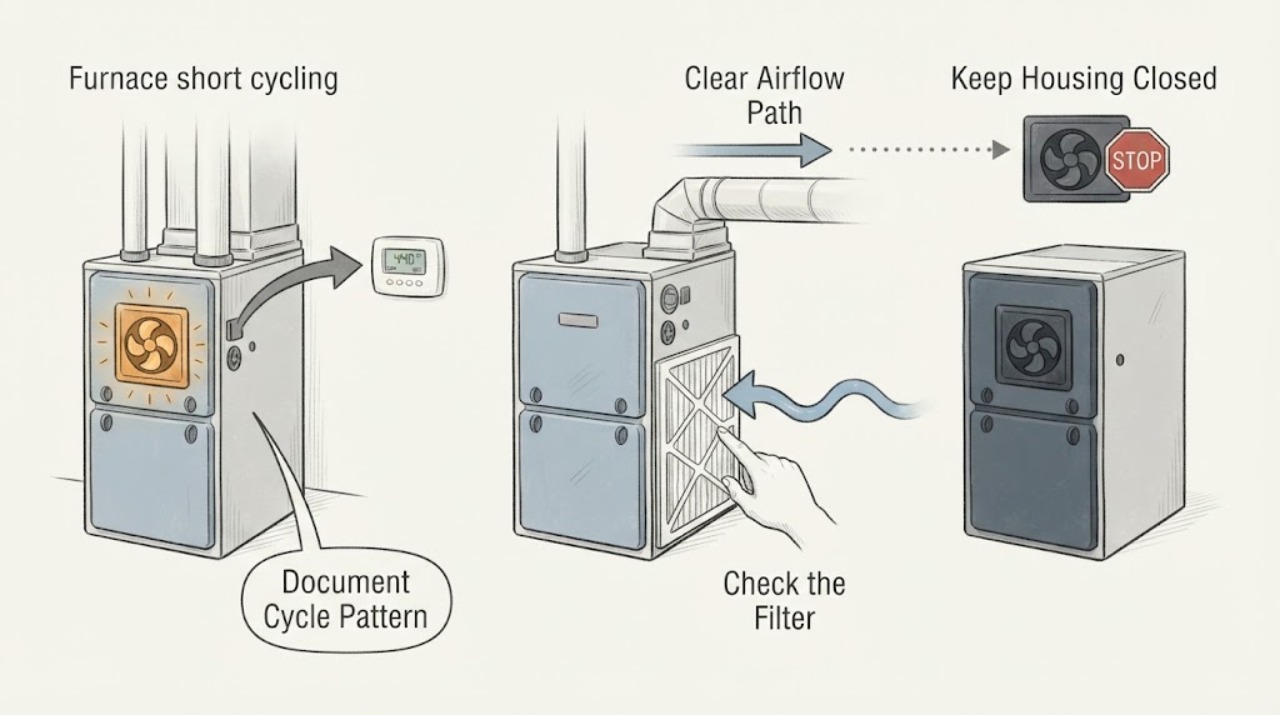
An Amana furnace is short cycling when it starts and stops repeatedly before the thermostat's heat demand is satisfied. Begin with the homeowner-safe causes: verify the thermostat is actually calling for heat, inspect the accessible air filter, make sure supply and return grilles are open and unobstructed, and look for an external vent or intake blockage without climbing or dismantling anything. A dirty filter or restricted airflow can make the furnace shut down on a safety limit, but the same symptom can also come from thermostat/control problems, ignition or flame proving, venting, blower performance, or equipment sizing. If the furnace stops before the room reaches the set temperature, locks out, repeatedly restarts, produces a gas or burning odor, triggers a carbon-monoxide alarm, or short cycling continues after the accessible checks, stop repeated operation and arrange qualified HVAC service.
Before you begin
Safety first
- Do not open the furnace cabinet, test energized wiring, bypass controls, adjust gas pressure, clean combustion components, or dismantle venting.
Work through in order
Diagnostic checks
Use only checks that match the exact appliance or system and its official guide.
-
Check 1
Observe one heating call from a safe position without removing a furnace panel. Record whether the burners ignite, whether warm air reaches the rooms, when the heat stops relative to the thermostat setpoint, whether the blower continues, and whether the thermostat display stays on.
Expected result: The thermostat reaches its setpoint before shutdown, the furnace stops while the room is still below the setpoint, the display resets, the blower continues, or the furnace shows a fault or lockout.
Next step: Write down the sequence and use it to choose a branch. Stop repeated heating calls for any lockout, abnormal flame, gas odor, smoke, carbon-monoxide alarm, or burning electrical smell.
Stop if: Do not open the furnace cabinet, watch exposed burners, reset a lockout repeatedly, or continue operation to collect more cycles when a hazard is present.
Why this matters
Why: A satisfied thermostat is different from a furnace safety or control shutdown. Stopping before setpoint, losing the display, or showing a fault makes repeated cycling an equipment or control issue rather than a normal cycle.
-
Check 2
With the furnace off, inspect the accessible filter location and compare the filter with the exact Amana installation or owner's instructions. Replace or clean it only when it is the correct serviceable type and can be handled without opening the furnace or disturbing wiring.
Expected result: The filter is visibly loaded with dust, installed in the wrong direction or position, damaged, missing, or clean and correctly installed.
Next step: Correct only an obvious filter issue using the model instructions, then allow one normal heat call to see whether cycling changes. If the filter is clean or cycling persists, continue to airflow and service checks rather than fitting a higher-resistance filter by guesswork.
Stop if: Do not run the furnace without the required filter, force a filter into place, remove an access panel, or change filter type or size without confirming model requirements.
Why this matters
Why: A dirty, blocked, missing, or misinstalled filter can restrict airflow and make the heating system work harder. A clean filter does not rule out blocked ducts, blower issues, limit operation, or another internal fault.
-
Check 3
From inside the home, confirm that supply registers and return grilles are open, visible, and not covered by furniture, rugs, curtains, or stored items; note whether airflow is weak, unusually hot, uneven, or normal without removing duct covers.
Expected result: Several returns or supplies are blocked, airflow is weak in many rooms, one room is affected, air is normal, or the furnace shuts down before the thermostat is satisfied despite clear grilles.
Next step: Move only ordinary loose obstructions away from grilles and make one normal heat call. Do not close other registers to compensate; request HVAC service if airflow remains weak or the furnace still short cycles.
Stop if: Do not enter inaccessible spaces, cut into ducts, remove plenums, change blower settings, or run the furnace with a panel removed.
Why this matters
Why: Restricted return or supply airflow can make the furnace operate outside its intended balance. A problem in one room may be a local duct or register issue; weak airflow throughout the home or persistent cycling after clearing visible obstructions needs professional airflow and safety evaluation.
-
Check 4
Check the thermostat's mode, heat setting, fan setting, display, schedule, and accessible battery compartment according to the thermostat instructions. From the room, note drafts, sunlight, lamps, supply-air discharge, or other heat sources near the thermostat.
Expected result: The thermostat is not calling for heat, reaches the setpoint unusually quickly, loses its display, is exposed to a draft or heat source, or continues calling while the furnace stops early.
Next step: Correct only the documented mode, schedule, battery, or obvious room obstruction; do not move or rewire the thermostat as a test. If it continues calling while the furnace stops, record the display and arrange qualified service.
Stop if: Do not remove the thermostat from its base, jumper terminals, alter wiring, or defeat a temperature or safety control.
Why this matters
Why: A control that is satisfied, resetting, or being influenced by its location can create apparent short cycling. A continuing heat call with early furnace shutdown points back toward airflow, limit, ignition, venting, blower, or control diagnosis.
-
Check 5
From ground level or another already safe location, look at the furnace's exterior intake and exhaust termination, if present, for visible leaves, snow, nests, damage, or an obstruction; do not climb, remove a vent, or reach into it.
Expected result: The termination is visibly blocked or damaged, the furnace has an unusual exhaust pattern, or the accessible exterior path appears clear.
Next step: If an obstruction can be removed from the ground without tools or contact with the equipment, follow the exact Amana instructions; otherwise turn the furnace off and request qualified HVAC service for any blockage, damage, or unusual exhaust.
Stop if: Do not climb, dismantle venting, inspect combustion chambers, adjust gas controls, or restart after a suspected flue or combustion fault without professional assessment.
Why this matters
Why: Combustion-air or flue restrictions can affect furnace operation and safety, but a visual check cannot prove draft, pressure-switch, combustion, or heat-exchanger condition. A clear termination does not rule out an internal or concealed restriction.
-
Check 6
Combine the cycle timing, thermostat call, filter and airflow findings, exterior termination observation, fault display, and safety symptoms to decide whether the furnace should remain off for HVAC service.
Expected result: Cycling stops after a documented filter or room-airflow correction; or the furnace still stops before setpoint, locks out, has weak airflow, shows a fault, has a blocked or damaged termination, or produces an odor or alarm.
Next step: Leave the furnace off and arrange qualified HVAC service for persistent short cycling or any fault or safety symptom. Provide the written sequence, thermostat behavior, filter details, airflow pattern, model information, and recent maintenance history.
Stop if: Do not bypass safeties, adjust gas pressure, test live electrical parts, clean internal burners or sensors, alter venting, or repeatedly reset the furnace.
Why this matters
Why: A resolved accessible restriction supports monitoring during a normal call. Persistent cycling or any combustion, safety, control, or internal airflow symptom needs professional diagnosis; the correct part cannot be selected from short cycling alone.
Use your observations
Decision map
Find the observation that best matches what you see, then follow the next safe action.
-
PATH 01Safety boundary
What you see
The thermostat reaches its setpoint or stops calling for heat before the home is comfortable, or its display resets or reacts to a draft, sunlight, supply register, or nearby heat source.
Do this next
Correct only a documented setting, battery, or obvious environmental interference. If the thermostat still ends calls early or resets, arrange HVAC service for control and thermostat evaluation.
Why this path and its safety boundary
Why it matters: The apparent short cycling may be in the thermostat signal, schedule, location, or sensing rather than a furnace safety shutdown.
Safety stop: Do not move, rewire, jumper, or bypass the thermostat as a troubleshooting experiment.
-
PATH 02Safety boundary
What you see
The thermostat continues calling, the filter is dirty or restricted, several registers or returns are blocked, or airflow is weak throughout the home and the furnace stops before setpoint.
Do this next
Correct only the accessible filter or room obstruction using the model instructions and make one normal call. If cycling persists or airflow remains weak, leave the furnace off and request qualified service.
Why this path and its safety boundary
Why it matters: Restricted airflow is more likely to be contributing, but an internal blower, limit, duct, or installation issue can produce the same pattern after the filter and visible obstructions are corrected.
Safety stop: Do not close other vents, run without the filter, change blower settings, or open the furnace to inspect a limit or blower.
-
PATH 03Safety boundary
What you see
The furnace starts a heat call but shuts down before setpoint, repeatedly locks out, shows a fault, has abnormal ignition or flame behavior, or has a blocked or damaged intake or flue termination.
Do this next
Turn the furnace off and arrange qualified HVAC service. Report the fault display and exact sequence, and do not reset it repeatedly to restore heat.
Why this path and its safety boundary
Why it matters: Ignition, flame proving, pressure, venting, gas, limit, control, or other safety conditions become more likely than a simple thermostat setting; these require trained diagnosis.
Safety stop: Do not adjust gas controls, inspect the burner or heat exchanger, bypass a pressure or limit switch, or dismantle venting.
-
PATH 04Safety boundary
What you see
The filter and visible airflow paths are clear, the thermostat keeps calling, no fault is displayed, and short cycling has existed since installation or occurs despite normal airflow.
Do this next
Ask a licensed HVAC professional to review the installation, heat-load sizing, duct airflow, thermostat configuration, and furnace operation together.
Why this path and its safety boundary
Why it matters: Equipment sizing, duct balance, thermostat setup, staging, or component matching needs professional evaluation; changing the thermostat setpoint is not a sizing correction.
Safety stop: Do not alter gas input, blower speed, staging jumpers, or ductwork to make the cycle longer.
-
PATH 05Safety boundary
What you see
There is gas odor, smoke, a carbon-monoxide alarm, flame outside the normal burner area, a damaged flue, burning electrical odor, or an active electrical hazard.
Do this next
Leave the area for gas or carbon-monoxide concerns and seek appropriate emergency guidance from a safe location. Otherwise keep the furnace off and arrange qualified HVAC or electrical service.
Why this path and its safety boundary
Why it matters: This is a safety emergency or stop-use condition, not a routine short-cycle diagnosis.
Safety stop: Do not operate switches near a gas odor, relight equipment, enter the cabinet, or attempt to identify the combustion fault yourself.
Helpful context
Understand the symptom
Confirm what is actually cycling
A normal furnace call ends when the thermostat is satisfied, so count a short-cycle complaint only when the burners or heating call stop while the room still needs heat and then restart soon afterward. Note whether the supply air is warm, whether the blower continues after the heat stops, and whether the thermostat display resets or shows a fault. Those observations separate a satisfied thermostat from a furnace safety shutdown without opening the cabinet.
Check airflow before assuming a failed furnace part
A filter that is dirty or installed incorrectly can restrict return airflow and make the furnace work harder. Check only the filter location and visible grilles described by the exact Amana documentation, and replace or clean the filter only if it is the correct type and accessible without opening the furnace. Keep supply and return paths clear; do not close many registers to force heat elsewhere, and do not remove a blower panel to inspect the fan.
Thermostat, sizing, and duct design need different answers
If the thermostat reaches its setpoint quickly, is mounted near a draft, supply register, heat source, or direct sun, or loses its display, the control signal may need attention. If the thermostat never reaches the setpoint while airflow is normal, the system may have a duct, capacity, installation, or combustion problem. Equipment that is too large or improperly matched can also cycle frequently; only a qualified HVAC professional can evaluate sizing and system performance rather than changing the setpoint as a cure.
Leave combustion and safety controls to a professional
A furnace may shut down because a limit, flame-proving, pressure, venting, blower, gas, or control condition is detected. These are not ordinary homeowner adjustments. Do not bypass a limit switch, adjust gas pressure, clean a burner or flame sensor inside the cabinet, test live voltage, or repeatedly reset a lockout. Give the technician the timing, thermostat behavior, filter condition, airflow observations, fault display, and any recent service or installation history.
Safety comes before another heating cycle
Stop using the furnace for a gas odor, smoke, flames outside the normal burner area, a carbon-monoxide alarm, a damaged flue, a strong burning smell, or an electrical smell. Leave the area for a gas or carbon-monoxide concern and seek appropriate emergency guidance from a safe location. If there is no immediate hazard but the furnace keeps short cycling, turn it off and arrange qualified HVAC service; repeated starts can add wear without solving the cause.
Safety boundary
Stop conditions
- Turn the furnace off for gas odor, smoke, flame outside the normal burner area, a carbon-monoxide alarm, a damaged flue, burning electrical odor, or an active electrical hazard.
- Stop repeated resets or heating calls when the furnace locks out, stops before the thermostat is satisfied, or displays a fault.
- Do not open the cabinet, test live voltage, bypass a limit or pressure switch, adjust gas controls, clean internal burners or flame sensors, or change blower settings.
- Do not climb to clear a vent, dismantle venting, or alter ductwork while investigating short cycling.
Only after diagnosis
Potential parts
- furnace air filter
Consider only if the exact Amana instructions identify a replaceable filter that is dirty, damaged, missing, or the wrong size; a filter is not a substitute for diagnosing persistent short cycling.
Confirm the exact model, filter dimensions, airflow direction, and manufacturer requirements before ordering. - thermostat or thermostat sensor
Consider only when service confirms a thermostat, sensor, schedule, or control-signal fault after checking settings and environmental placement.
Confirm system stages, fuel type, wiring, and exact furnace and thermostat compatibility; do not infer fit from brand alone. - blower motor or airflow component
Consider only if a qualified technician confirms inadequate blower performance or a failed airflow component after the filter and accessible grilles are clear.
Motor characteristics, controls, wheel, and mounting vary by model; verify exact model fitment and electrical requirements through service. - limit, ignition, or flame-sensing control
Consider only after a technician identifies the specific safety or ignition control responsible for the premature shutdown or lockout.
Do not select a safety control from a symptom or bypass it; confirm the exact part and approved replacement procedure for the furnace model.
When checks do not resolve it
Need a professional?
Arrange qualified HVAC service when the Amana furnace continues to short cycle after the accessible filter, grille, and thermostat checks, stops before the thermostat is satisfied, locks out, shows a fault, has weak airflow despite clear visible paths, or has a blocked or damaged intake or flue. Leave the area and seek appropriate emergency guidance for gas odor or a carbon-monoxide alarm; keep the furnace off for smoke, flame outside the normal burner area, burning electrical odor, or a damaged flue.
Safety scope: Do not open the furnace cabinet, test energized wiring, bypass controls, adjust gas pressure, clean combustion components, or dismantle venting.
Common questions
FAQ
What does short cycling mean on an Amana furnace?
It means the furnace starts and stops repeatedly before the thermostat's heat demand is satisfied. Confirm that the thermostat is still calling when the furnace stops, then check only the accessible filter, grilles, thermostat context, and exterior termination. Persistent early shutdown needs qualified HVAC diagnosis.
Can a dirty furnace filter cause short cycling?
A dirty or blocked filter can restrict airflow and make the furnace work harder, so it is a useful first check. Replace or clean it only as the exact Amana instructions allow. If the filter is clean or the furnace still cycles early, the cause may be duct, blower, limit, ignition, control, venting, or sizing related.
Should I close vents to stop an Amana furnace from short cycling?
No. Closing registers can upset the designed airflow balance and does not repair a furnace fault. Keep supply and return paths visible and unobstructed, and have a professional evaluate weak airflow or persistent cycling.
Is short cycling caused by the thermostat?
Sometimes the thermostat can end a heat call early because of its settings, location, battery, display, or control signal. If it continues calling while the furnace stops, the issue is more likely in airflow, safety controls, ignition, venting, blower operation, or system sizing and needs service.
When should I turn an Amana furnace off immediately?
Turn it off for gas odor, smoke, a carbon-monoxide alarm, flame outside the normal burner area, a damaged flue, burning electrical odor, repeated lockout, or a fault that appears during every call. Leave the area for a gas or carbon-monoxide concern and seek appropriate emergency guidance from a safe location.
Read the exact guide
Official sources
- Maintenance ChecklistENERGY STAR · ENERGY STAR residential furnace and HVAC maintenance and safe service boundaries
- Preventive MaintenanceAmana · Amana brand furnace maintenance, airflow, controls, and professional safety inspection guidance
- HVAC Proper Installation of FiltersU.S. Department of Energy Building Science Education · U.S. Department of Energy HVAC filter placement and airflow guidance
- HVAC OperationAmana · Amana HVAC operation, airflow balance, thermostat, system sizing, and cycling context
- Clean Heating and CoolingENERGY STAR · ENERGY STAR heating and cooling efficiency, airflow, sizing, and short-cycle context
- Service and TroubleshootingGoodman Manufacturing · Manufacturer service-manual fault patterns applicable to similar gas-furnace safety and airflow diagnosis
Community feedback
Share a repair observation
Share a plain-text repair observation. Accepted observations are published automatically; this page may take a moment to update.