
On this page
Start here
Quick answer
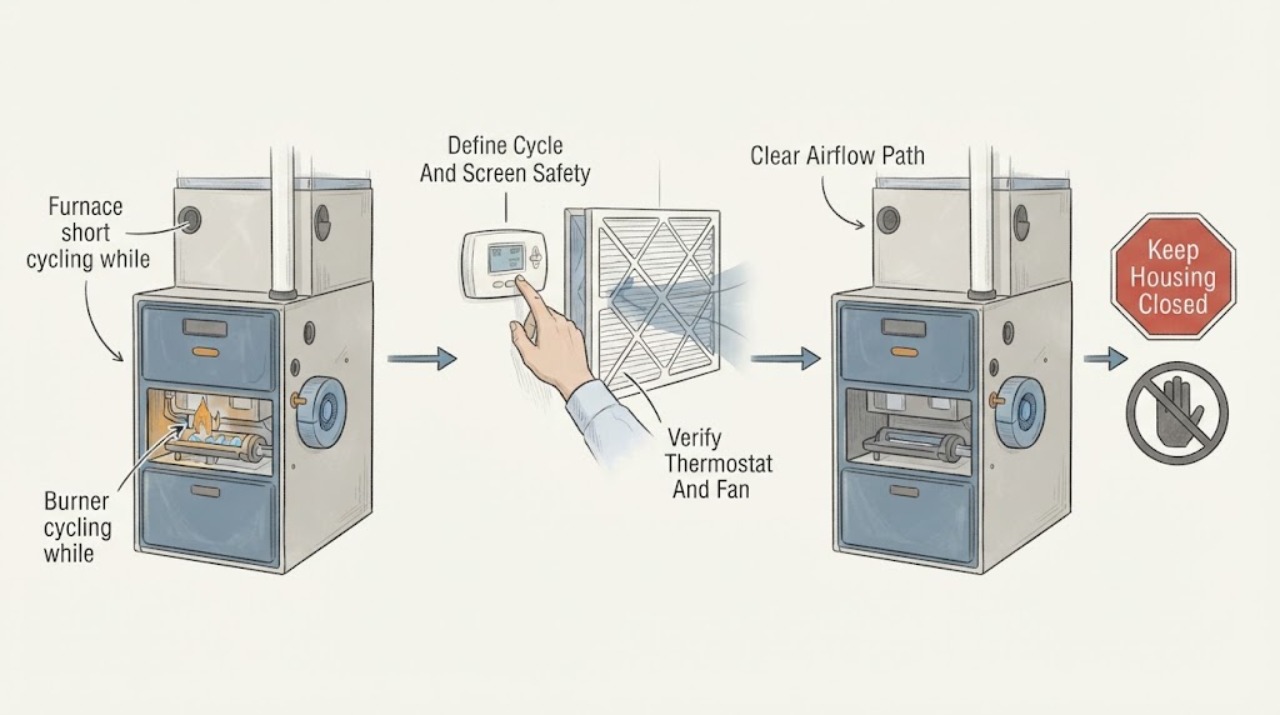
Short cycling means the furnace starts a heat cycle but stops and restarts before the home reaches the thermostat setting. The blower may continue briefly after the burners stop as the system cools or distributes remaining heat; a fan set to On can also circulate air when no heat is being produced. First verify Heat mode, a set temperature above the room temperature, and fan Auto. Then inspect an accessible filter and make sure return grilles and supply registers are not blocked. Restricted airflow can overheat a furnace and trip a limit safety, leaving the blower running while heat is off. If short cycling continues with a clean filter and open airflow, ignition, flame sensing, a limit control, condensate safety, blower, thermostat, ductwork, or incorrect equipment sizing may be involved. Keep the furnace off and arrange qualified HVAC service for repeated cycling, gas odor, soot, unusual combustion noise, water at the furnace, a carbon-monoxide alarm, or any repair requiring cabinet, gas, electrical, vent, or safety-control access.
Before you begin
Safety first
- This article covers safe observation of thermostat settings, cycle behavior, an accessible filter and visible airflow check, and external condensate or alert recording. It does not authorize combustion inspection, manual ignition, gas or electrical measurement, panel removal, safety bypass, or concealed drain, vent, duct, or heat-exchanger work.
Work through in order
Diagnostic checks
Use only checks that match the exact appliance or system and its official guide.
-
Check 1
From a safe position, observe whether the furnace starts and stops repeatedly before the thermostat is satisfied, and screen for gas odor, soot, smoke, unusual combustion noise, a carbon-monoxide alarm, or illness; do not open the furnace cabinet.
Expected result: Record whether the blower alone continues, whether warm air ever arrives, whether cycles repeat, and whether any gas, combustion, alarm, or symptom warning is present. Do not remain near the equipment to gather more evidence if a warning exists.
Next step: For a warning, leave the area and contact emergency, fuel-supplier, or qualified HVAC help from a safe location. Without a warning, continue with thermostat and airflow observations without forcing another cycle.
Stop if: Do not restart, manually ignite, bypass a safety, touch gas fittings, or use tools near the furnace when a warning or odor is present.
Why this matters
Why: A brief blower run after a completed cycle can be normal, while repeated early burner shutdown is short cycling. Any gas, combustion, carbon-monoxide, or illness warning takes priority over airflow troubleshooting and may indicate a dangerous condition.
-
Check 2
Without removing the thermostat cover, verify that the mode is Heat, the set temperature is above the room temperature, and the fan is Auto rather than On; note battery or alert messages and whether the thermostat is near a vent, heat source, sunlight, or a recently changed wiring installation.
Expected result: Record the mode, fan setting, set point, room reading, battery state, alert, and whether the blower runs continuously when there is no heat call or stops when the thermostat is satisfied.
Next step: Set Heat and Auto correctly if needed and observe the existing behavior once. If the thermostat is blank, recently rewired, unstable, or still causes early cycling, leave the furnace alone and arrange HVAC service.
Stop if: Do not remove wiring, jump terminals, move the thermostat, enter service settings, or open the furnace control compartment.
Why this matters
Why: Fan On can make the blower run with unheated air, while an incorrect mode, set point, battery, location, wiring, or calibration can create false or premature heat calls. A correct setup with repeated short cycles makes airflow, safety, ignition, or equipment causes more likely.
-
Check 3
Turn the thermostat off and inspect only an easily accessible filter and visible return grilles and supply registers; replace a loaded or damaged filter with the exact type and orientation specified by the furnace instructions, and reopen any visibly closed supply registers.
Expected result: Classify the filter as clean, dust-loaded, wet, damaged, missing, wrong-sized, or inaccessible; note blocked returns, closed registers, unusual duct noise, or weak airflow from multiple rooms.
Next step: Restore a confirmed compatible filter and unobstructed visible airflow, then allow one normal call to show whether cycling changes. If it still cycles, keep the furnace off and arrange HVAC diagnosis rather than trying a higher-restriction filter or bypassing a switch.
Stop if: Do not operate without the required filter, force a filter, remove a blower door, clean internal burners or coils, or repeatedly reset a limit or lockout.
Why this matters
Why: Restricted return or supply airflow can overheat the heat exchanger, trip a limit safety, and leave the blower running after the burners stop. A clean filter and open visible airflow shift suspicion to blower performance, the limit control, duct restrictions, ignition, flame sensing, or equipment sizing.
-
Check 4
After the thermostat and visible airflow checks, observe one normal heat call from the registers and thermostat display without opening the furnace, watching a burner, or touching venting, gas, or electrical components.
Expected result: Record whether warm air begins before the cycle stops, the blower starts or continues while air turns cool, the thermostat call remains active, the unit makes repeated ignition attempts, or an external status indicator or thermostat alert appears.
Next step: Stop repeated calls and give the timing, air temperature change, blower behavior, and any visible alert to a qualified HVAC professional; do not create another failure event to watch the burner.
Stop if: Stop for gas odor, soot, smoke, unusual noise, a carbon-monoxide alarm, water near the equipment, or any request to remove a cabinet panel.
Why this matters
Why: Warm air followed by blower cooldown can be a normal completed sequence. Cold air after early burner shutdown, repeated ignition attempts, a persistent heat call, or a fault indicator suggests limit, airflow, ignition, flame-sensing, condensate, control, or fuel problems that cannot be identified safely from the register.
-
Check 5
Without removing panels or touching combustion, gas, electrical, refrigerant, or vent components, inspect the accessible floor around a high-efficiency furnace for condensate water, overflow, or a pump alert, and note whether the short cycling began after a remodel, insulation change, duct change, or furnace replacement.
Expected result: Record a dry area, standing water, an overflowing pan, a condensate alarm, a blocked-looking external outlet, recent building changes, or short cycling that has existed since installation; do not probe or clear an internal drain.
Next step: Keep the furnace off for water, an alarm, persistent cycling, or an inaccessible drain and arrange HVAC service. Provide the installation history and photos of visible water or alerts without disturbing the equipment.
Stop if: Do not pour chemicals into a condensate line, bypass a float or limit, clear an internal flue or drain, or adjust gas or electrical controls.
Why this matters
Why: Condensate safety can prevent burners from operating while the blower continues. Cycling present since installation or after major load or duct changes can also indicate sizing, duct design, or installation concerns. These patterns need professional assessment rather than a guessed switch or control replacement.
Use your observations
Decision map
Find the observation that best matches what you see, then follow the next safe action.
-
PATH 01Safety boundary
What you see
The furnace completes a heat cycle, warm air is delivered, and the blower runs briefly afterward before stopping; the thermostat is satisfied and no warning exists.
Do this next
Confirm the expected sequence in the exact furnace manual and monitor. Arrange service if the blower never stops, air becomes cold during an active heat call, or the unit starts and stops before reaching the set point.
Why this path and its safety boundary
Why it matters: The blower behavior is consistent with a normal cooldown or heat-distribution period rather than proof of short cycling.
Safety stop: Do not bypass a fan or limit control to shorten the blower run.
-
PATH 02Safety boundary
What you see
The blower runs between calls or while the thermostat is satisfied, and the thermostat fan is set to On with no combustion or safety warning.
Do this next
Set the fan to Auto and observe whether the blower follows heating calls. If it still runs continuously or the thermostat setup is unstable, arrange service for thermostat, fan-limit, blower, or control evaluation.
Why this path and its safety boundary
Why it matters: The fan command can be circulating room-temperature air without a furnace heat cycle; this does not establish a burner or igniter fault.
Safety stop: Stop for gas odor, soot, unusual combustion noise, or any electrical issue; do not remove the thermostat cover or furnace panel.
-
PATH 03Safety boundary
What you see
The filter is loaded or returns or registers are blocked, the furnace heats briefly, then the burners stop while the blower continues or the system restarts repeatedly.
Do this next
Replace the filter with the exact permitted type and restore visible airflow, then observe one normal call. If cycling remains, keep the furnace off and have a technician check airflow, blower operation, limit controls, and heat-exchanger condition.
Why this path and its safety boundary
Why it matters: Restricted airflow can overheat the heat exchanger and trigger a limit safety shutdown, producing the continuing-blower symptom.
Safety stop: Do not bypass a limit, operate without a filter, close more vents to balance rooms, or reset a recurring shutdown.
-
PATH 04Safety boundary
What you see
The filter and visible airflow are acceptable, but the furnace repeatedly starts and stops, fails to produce sustained heat, shows an alert, or has condensate water or a pump indication.
Do this next
Leave the furnace off and arrange qualified HVAC diagnosis of the complete sequence, including combustion and safety controls. Give the technician the cycle timing, blower behavior, status indication, fuel type, and condensate observations.
Why this path and its safety boundary
Why it matters: Ignition, flame sensing, burner, gas or oil supply, limit control, condensate safety, blower, or control faults are more likely than a simple thermostat setting.
Safety stop: Do not manually light, clean a burner or flame sensor, replace an igniter, bypass a safety, or clear an internal condensate or vent path.
-
PATH 05Safety boundary
What you see
Short cycling has existed since installation or began after duct, insulation, thermostat, or major building changes, while basic filter and visible airflow checks are normal.
Do this next
Arrange professional load, duct, thermostat, and installation review; do not compensate by closing registers, changing cycle settings, or replacing a safety component.
Why this path and its safety boundary
Why it matters: Equipment sizing, duct design, thermostat location or compatibility, installation configuration, or changed heat load may be causing the thermostat to satisfy too quickly or the furnace to operate outside its intended airflow.
Safety stop: Stop for overheating, unusual noise, gas or soot warning, water damage, or any request to alter wiring or gas controls.
-
PATH 06Safety boundary
What you see
Gas odor, soot, smoke, a carbon-monoxide alarm, headache or dizziness, a boom or forceful ignition sound, or a suspected venting problem accompanies the cycling.
Do this next
Leave the area, avoid flames, switches, and electrical equipment, and contact emergency or fuel-service help from a safe location. Do not return or restart until qualified responders clear the system.
Why this path and its safety boundary
Why it matters: This is a combustion or indoor-air safety emergency, not a short-cycle maintenance branch.
Safety stop: Do not stay to read codes, inspect the burner, move the furnace, or reset the equipment.
Helpful context
Understand the symptom
Do not confuse a blower delay with short cycling
The blower and burners do not always stop together. A normal control sequence can keep the blower running briefly after a heat call, while Fan On can run it between calls. Short cycling is the repeated start-and-stop of the heating cycle before the thermostat is satisfied. Track whether the air ever becomes warm and whether the burners or heat-producing stage stop early; the blower continuing alone does not identify the cause.
Airflow is the first homeowner-accessible branch
A loaded filter, blocked return, closed supply register, dirty blower path, or duct restriction can reduce the air moving across the heat exchanger. The furnace may then overheat and stop the burners while the blower continues. A filter and visible vent check is reasonable when the parts are safely accessible; limit-switch testing, burner cleaning, and duct repair belong to a qualified technician.
Persistent cycling needs the entire heating sequence checked
If airflow is acceptable but the furnace still starts and stops, the cause may be a thermostat reading or wiring issue, ignition or flame-proving failure, a limit or rollout response, condensate safety, venting, blower performance, or equipment sizing. Do not bypass a safety control or keep resetting a lockout. Record the sequence and arrange service before component replacement is chosen.
Safety boundary
Stop conditions
- Leave the area and seek emergency or fuel-service help from a safe location for gas odor, soot, smoke, a carbon-monoxide alarm, illness, hissing, or a boom or forceful combustion noise.
- Do not bypass a limit, rollout, door, flame-sensing, condensate, or other furnace safety control, and do not keep resetting a recurring lockout.
- Do not manually ignite the burner, adjust gas or oil pressure, remove furnace panels, clean internal burners, inspect a heat exchanger, or open venting or electrical compartments.
- Keep the furnace off for repeated short cycles after a clean-filter check, water at a condensate pan, persistent blower operation with the thermostat off, or a status alert that returns.
- Use only the exact filter and accessible maintenance procedure specified for the furnace; do not close registers or change thermostat cycle settings to hide a persistent fault.
Only after diagnosis
Potential parts
- furnace air filter
Consider this only when the accessible filter is loaded, wet, damaged, missing, or incorrect and the furnace instructions confirm its replacement specification.
Confirm exact dimensions, airflow direction, and permitted restriction for the furnace; do not use a higher-restriction filter to address a short-cycle symptom without guidance. - furnace thermostat
Consider this only after qualified diagnosis confirms a thermostat, wiring, location, or compatibility fault causing premature or repeated heat calls.
Confirm the furnace stages, fuel and control wiring, voltage, and exact thermostat compatibility; do not change terminals or cycle settings as a test. - furnace limit or flame-sensing component
Consider this category only after qualified testing identifies a limit or flame-proving fault and airflow, heat-exchanger, ignition, and safety causes are evaluated.
Match the exact furnace model, temperature or sensing characteristics, mounting, and service procedure; never bypass the safety component. - furnace ignition or condensate component
Consider this category only when qualified diagnosis confirms an ignition component or condensate safety component as the cause of the short-cycle sequence.
Confirm the furnace model, fuel type, ignition or drain arrangement, wiring, and manufacturer service information before any professional replacement.
When checks do not resolve it
Need a professional?
Use immediate emergency or fuel-service help for gas odor, soot, smoke, a carbon-monoxide alarm, illness, hissing, or abnormal combustion noise. Arrange qualified HVAC service for repeated short cycling, a blower that continues unexpectedly, persistent cold air, a clean filter with open airflow but no sustained heat, condensate water or alerts, a recently changed thermostat or duct system, cycling since installation, or any work involving ignition, flame sensing, limit controls, gas, electrical, venting, or concealed components.
Safety scope: This article covers safe observation of thermostat settings, cycle behavior, an accessible filter and visible airflow check, and external condensate or alert recording. It does not authorize combustion inspection, manual ignition, gas or electrical measurement, panel removal, safety bypass, or concealed drain, vent, duct, or heat-exchanger work.
Common questions
FAQ
Is it normal for the furnace blower to keep running after the heat turns off?
A brief blower run can be normal while remaining heat is distributed or the equipment cools. It is different from the furnace repeatedly stopping before the thermostat is satisfied or the blower continuing indefinitely with no heat; those patterns need further diagnosis.
Can Fan On make a furnace seem to be short cycling?
Fan On can circulate room-temperature air between heat cycles, which can feel like cold air even when the furnace is not calling. Set the fan to Auto and observe the heating cycle; repeated early burner shutdown is a separate fault path.
Can a dirty filter cause furnace short cycling?
Yes. A loaded filter restricts airflow, which can overheat the furnace and trigger a limit safety that stops the burners while the blower continues. Replace it only with the exact permitted filter; persistent cycling needs HVAC service.
Why does my furnace turn off before the house reaches the thermostat setting?
Restricted airflow, a limit or flame-sensing response, ignition or fuel trouble, thermostat error, condensate safety, duct conditions, or equipment sizing can all stop a cycle early. A filter and visible vent check is reasonable; internal safety and combustion diagnosis belongs to a technician.
Should I reset the furnace when it short cycles?
Do not repeatedly reset it to hide the symptom. Check only the thermostat settings, accessible filter, and visible airflow; if cycling returns, keep the furnace off and arrange professional diagnosis of airflow, limits, ignition, flame sensing, condensate, and controls.
When is furnace short cycling an emergency?
Leave the area and seek emergency or fuel-service help for gas odor, soot, smoke, a carbon-monoxide alarm, illness, hissing, or a boom or forceful combustion noise. Keep the furnace off for water near equipment or repeated cycling that does not resolve with safe filter and airflow checks.
Read the exact guide
Official sources
- Furnace Short Cycling: What It Is and How to Stop ItTrane · Trane residential gas-furnace troubleshooting guidance; exact sequence and service requirements vary by model and fuel.
- HVAC Proper Installation of FiltersU.S. Department of Energy, Building Science Education · U.S. Department of Energy educational material for ducted HVAC systems; the furnace manufacturer's filter specification controls a particular installation.
- What is a Furnace Limit Switch? Ultimate Guide & TroubleshootingCarrier · Carrier furnace limit-switch guidance; the component and sequence are model-specific and require qualified service.
- Furnace Blower Not Working: Causes and SolutionsTrane · Trane residential furnace blower guidance; operating delays and controls vary by model.
- What Is Furnace Short Cycling? Causes and SolutionsCarrier · Carrier residential furnace guidance; specific thresholds, controls, and repair procedures vary by equipment.
Community feedback
Share a repair observation
Share a plain-text repair observation. Accepted observations are published automatically; this page may take a moment to update.