
On this page
Start here
Quick answer
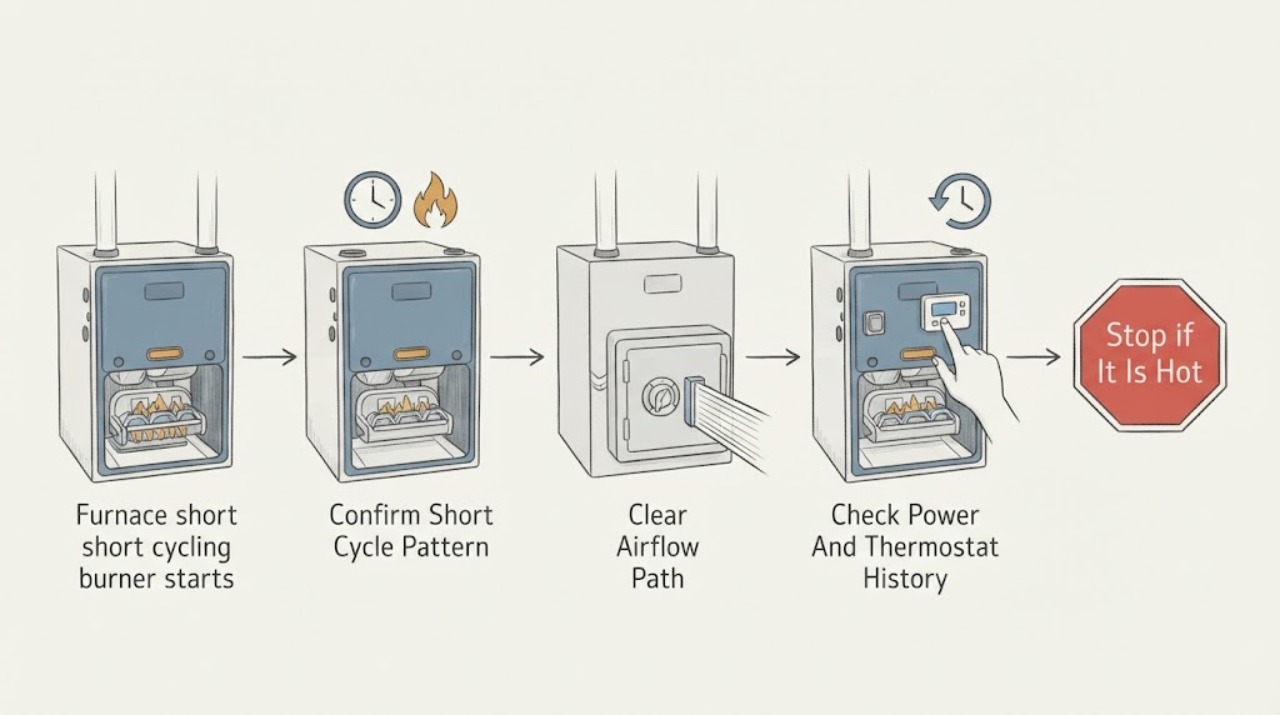
If the furnace burner starts and then stops before the home is warm, first confirm that the thermostat is still calling for heat and record whether the blower continues. A dirty filter, blocked return or supply, or another airflow restriction can make the furnace overheat and shut the burners off through a safety control. Other possibilities include a thermostat or sizing issue, a condensate safety condition on a condensing furnace, ignition or flame-sensing failure, fuel interruption, or a control fault. Check only the thermostat, accessible filter, open vents, external switch or breaker, and any status code or sight-window observation that the owner manual identifies. Do not bypass a limit or rollout switch, adjust gas, clean burners or a flame sensor, open the burner compartment, or repeatedly reset the furnace. Stop using it and arrange qualified HVAC service for repeated short cycles, abnormal flame, gas odor, smoke, burning odor, or any electrical warning.
Work through in order
Diagnostic checks
Use only checks that match the exact appliance or system and its official guide.
-
Check 1
Read the thermostat and observe one ordinary heating call from a safe position. Confirm Heat mode and a setpoint above room temperature, then note when the burner starts and stops and whether the blower continues afterward.
Expected result: Record a stable heat call with burner-off/blower-on, a call that ends normally at the setpoint, repeated burner starts while the call remains active, a normal post-cycle fan delay, or a call that disappears unexpectedly.
Next step: Record the cycle timing and continue only with the external filter, vent, and power checks. If the burner repeatedly stops before the call is satisfied, leave the furnace off and arrange HVAC diagnosis.
Stop if: Stop immediately for gas odor, smoke, burning odor, loud ignition, visible abnormal flame, severe vibration, or an electrical enclosure that is hot, buzzing, wet, or damaged.
Why this matters
Why: A call that ends at the setpoint is not the same as short cycling. Repeated burner dropouts while the call remains active make airflow restriction, overheating protection, ignition, flame sensing, fuel, condensate, or control causes relevant. A blower that continues after burner shutdown may be a normal delay or a response to a safety event.
-
Check 2
Turn the furnace off and inspect the filter through its normal user access. Check that all accessible supply registers and return grilles are open and not covered by furniture, rugs, or drapes; do not remove the blower door or reach into the return.
Expected result: Record a clean, correctly seated filter and clear grilles; a visibly loaded or damaged filter; a missing or backwards filter; blocked return or supply airflow; or an access point that requires tools or cabinet removal.
Next step: If the filter is clearly due and replacement is an ordinary user-access task, install the manufacturer-specified filter in the marked airflow direction, restore the cover, and observe one cycle. If short cycling continues, stop and call an HVAC technician.
Stop if: Never run the furnace without its specified filter. Do not force a panel, substitute an unknown filter type, bypass a safety, or clean internal furnace parts.
Why this matters
Why: A loaded filter or blocked airflow can reduce heat transfer, strain the blower, and contribute to overheating and a limit shutdown. A clear filter and vents do not rule out a dirty internal blower, coil, duct problem, safety control, or ignition fault.
-
Check 3
From a dry, safe position, note whether the furnace service switch and labeled breaker are on and whether the short cycling began after a thermostat replacement, schedule change, power event, or maintenance visit. Do not open an electrical panel or touch thermostat wiring.
Expected result: Record normal power and no recent change; a switch that was turned off; a single clearly tripped breaker; a repeat trip; a recent thermostat installation or wiring change; or a thermostat display or schedule that is unstable.
Next step: Correct only an obvious user setting or switched-off control. A clearly tripped breaker may be reset once if there is no hazard; leave it off for another trip or any heat, odor, buzzing, or damage and arrange HVAC or electrical service.
Stop if: Do not open the panel, alter wiring, bypass a fuse or breaker, or repeatedly reset a protective device.
Why this matters
Why: A power interruption or thermostat configuration can create an irregular call, but a repeat breaker trip points to an electrical or equipment fault. A recent installation or wiring change can affect staging, compatibility, or call termination and needs model-specific verification.
-
Check 4
With furnace panels closed, observe one cycle from a safe position and read only an external status light or code or a flame through a manufacturer-provided viewing window, if present. Do not open a burner compartment or reach toward the flame, igniter, vent, or blower.
Expected result: Record that the inducer or blower runs but the burner never lights; the burner lights then stops; a code or lockout appears; an approved viewing window shows a steady normal flame; or the flame is yellow, lifting, unstable, or accompanied by soot or unusual odor.
Next step: Stop the furnace and request qualified HVAC diagnosis for any repeated dropout, code, lockout, no-light sequence, or abnormal flame. If gas odor is present, leave without operating switches and contact the gas utility or emergency services from a safe location.
Stop if: Do not relight a pilot, clean a flame sensor or burner, adjust gas, bypass a limit or rollout switch, or repeat ignition attempts to reproduce the symptom.
Why this matters
Why: A no-light sequence makes ignition, fuel, pressure, or control causes relevant. A brief flame followed by dropout makes flame sensing, fuel, condensate, limit, or control causes relevant. A code or abnormal flame narrows the service handoff but cannot identify a part or authorize a reset or adjustment.
-
Check 5
If the furnace is a high-efficiency condensing model and its drain or pan is visible without opening equipment, look for standing water, overflow, or a blocked-looking external discharge. Do not open the drain system, pour chemicals, or remove a safety switch.
Expected result: Record no visible water; water in or around the pan; an external drain that is visibly overflowing; or a location that cannot be inspected safely.
Next step: Leave the furnace off and request HVAC service for water, overflow, recurring lockout, or uncertain drainage. Keep people away from wet electrical equipment and do not bypass the condensate safety.
Stop if: Stop for active overflow, water near wiring or controls, structural water damage, or any need to remove a panel or manipulate a condensate safety device.
Why this matters
Why: A blocked condensate path can trigger a safety measure that prevents burners from igniting or keeps the system from completing a cycle on some condensing furnaces. Water can also be unrelated or near electrical components, so the observation does not establish the cause.
-
Check 6
Prepare the service request with the furnace model if safely visible, fuel type, thermostat state, cycle timing, blower response, filter and vent condition, switch and breaker history, external code, flame-window observation if any, condensate or water notes, and any odor or sound.
Expected result: Confirm that the record contains external observations only and that no gas valve, burner, igniter, flame sensor, limit switch, control board, capacitor, blower, wiring, or condensate safety was touched.
Next step: Request qualified HVAC diagnosis when the burner continues to start and stop, especially when the filter and vents are clear or any code, water, odor, abnormal flame, or repeat shutdown is present.
Stop if: Stop all homeowner troubleshooting when the next step requires cabinet access, electrical measurement, gas or combustion work, flame-sensor or igniter handling, or internal component removal.
Why this matters
Why: A detailed sequence lets the technician separate airflow and overheating from thermostat, power, ignition, flame-sensing, fuel, condensate, limit, blower, or control faults without asking the homeowner to make a hazardous diagnosis.
Use your observations
Decision map
Find the observation that best matches what you see, then follow the next safe action.
-
PATH 01Next step
What you see
The burner starts, the blower runs, airflow is weak or returns are blocked, and the burner stops before the thermostat is satisfied; the filter is visibly loaded or the vents are obstructed.
Do this next
Correct only an obvious filter or grille issue with the furnace off, then observe one cycle. If the burner still drops out, leave the furnace off and arrange HVAC diagnosis; never bypass the limit or rollout protection.
Why this path and its safety boundary
Why it matters: Restricted airflow and an overheating limit response are more likely than a thermostat-only issue, although a blower, coil, duct, or safety fault can produce the same pattern.
-
PATH 02Next step
What you see
The filter and grilles are clear, airflow is steady, but the burner repeatedly lights and drops out while the heat call remains active.
Do this next
Stop the furnace and call a qualified HVAC technician. Do not clean or replace the flame sensor or igniter, adjust gas, or reset a safety device without professional diagnosis.
Why this path and its safety boundary
Why it matters: Ignition, flame sensing, fuel, condensate, limit, or control causes become more likely than a simple airflow restriction.
-
PATH 03Next step
What you see
The burner stops when the thermostat call ends or the room reaches the setpoint, but the home remains uncomfortable or the thermostat call is irregular after a setting or installation change.
Do this next
Verify only the thermostat mode, setpoint, fan setting, schedule, and visible battery status. Arrange HVAC service for persistent comfort problems or a recent installation/wiring change rather than forcing longer cycles.
Why this path and its safety boundary
Why it matters: The observed stop may be normal cycle completion, while thermostat placement, schedule, staging, sizing, or an unstable call may explain comfort complaints; this is different from a burner dropping out during an active call.
-
PATH 04Next step
What you see
The burner stops and the blower continues with weak or cool airflow, or a high-efficiency furnace shows external condensate water, overflow, or a recurring lockout.
Do this next
Leave the furnace off and request HVAC diagnosis. Do not open the blower or drain compartments, bypass a condensate safety, or keep resetting the system.
Why this path and its safety boundary
Why it matters: A blower or airflow fault, condensate safety action, limit response, ignition issue, or control problem is more likely; continued fan operation does not prove that heating is complete.
-
PATH 05Next step
What you see
The short cycle includes gas odor, smoke, burning odor, yellow or unstable flame, loud ignition, a hot or buzzing enclosure, severe vibration, or a repeated breaker trip.
Do this next
Stop using the furnace. For gas odor, leave without operating switches and contact the gas utility or emergency services from a safe location; use qualified HVAC or electrical service for other warnings.
Why this path and its safety boundary
Why it matters: A combustion, electrical, overheating, or mechanical safety fault may be present and cannot be made safe by a homeowner reset or part swap.
Helpful context
Understand the symptom
Short cycling means the burner is stopping before the heat call is satisfied
A normal furnace may keep its blower running briefly after the burner stops, so listen for the burner start and the blower separately. Short cycling is a repeated pattern in which the burner starts, stops, and starts again while the home still needs heat. If the thermostat ends the call normally, that is different from a burner that drops out while the call remains active. Record the timing and the fan response rather than repeatedly restarting the furnace.
Airflow restriction is the safest first distinction
A loaded filter or blocked return or supply can reduce airflow, make the heat exchanger run hotter, and trigger a protective shutdown. Check only the filter through its normal access and keep registers and returns clear. If the filter and vents are clear but the burner still drops out, do not assume the limit switch is bad; the blower, coil, ductwork, condensate safety, controls, ignition, flame sensing, or fuel path may need testing.
Ignition and safety components stay on the professional side
A burner that lights briefly and then stops can reflect failure to prove or maintain a flame, an ignition or fuel problem, a condensate safety action, or another control sequence. A limit or rollout device is a safety component, not a reset target. Gas, combustion, electrical, and internal blower work is model-specific and hazardous; the useful homeowner evidence is the sequence, external code, filter and airflow state, and whether any warning is present.
Safety boundary
Stop conditions
- Gas, flame, burner, igniter, flame sensor, gas valve, limit, rollout, and combustion work is professional-only; never bypass safety devices or adjust fuel delivery.
- Do not open the furnace cabinet, touch wiring or a capacitor, reach into the blower, remove a burner panel, clear an internal condensate path, or repeatedly reset a lockout or breaker.
- Stop immediately for gas odor, smoke, burning odor, yellow or unstable flame, loud ignition, severe vibration, water near electrical equipment, or a hot, buzzing, or damaged enclosure.
Only after diagnosis
Potential parts
- furnace air filter
Consider this only when the installed filter is visibly loaded or damaged and the exact size and type are confirmed; a filter cannot fix ignition, flame-sensing, limit, or control faults.
Match the exact size, airflow direction, and manufacturer requirements, and never operate the furnace without its specified filter. - furnace limit switch
Consider this only after a qualified technician confirms a failed limit switch and determines why the furnace overheated or the switch opened; repeated cycling is not proof that the switch itself is defective.
Confirm the exact furnace model, switch rating, mounting, and manufacturer-approved specification with the technician; never bypass the switch. - furnace thermostat
Consider this only if testing confirms the thermostat or its configuration is ending or corrupting the heat call; burner dropout can also originate in airflow, ignition, fuel, limit, or control systems.
Confirm furnace type, staging, wiring, power requirements, and exact compatibility before selecting or installing a thermostat.
When checks do not resolve it
Need a professional?
Call a qualified HVAC technician when the burner starts and stops before the thermostat is satisfied, especially after the filter and vent checks are clear, or when the furnace has weak airflow, blower-only cool air, condensate water, a code, a lockout, or repeated cycling. Escalate immediately for gas odor, smoke, burning odor, abnormal flame, loud ignition, severe vibration, a hot or buzzing enclosure, or repeated breaker trips.
Have this ready
- Provide the furnace model if safely visible, fuel type, thermostat state, cycle timing, blower response, filter and vent condition, switch and breaker history, status code, flame-window observation if any, condensate or water notes, sound, and odor. State that no internal, gas, electrical, or safety component was disturbed.
Common questions
FAQ
Why does my furnace burner start and then stop?
Restricted airflow, overheating protection, ignition or flame-sensing failure, fuel or condensate problems, a thermostat or control issue, or another safety response may be involved. Check only the thermostat, accessible filter, clear vents, external power, and status information; repeated burner dropouts need HVAC diagnosis.
Is it normal for the furnace blower to keep running after the burner stops?
A short blower delay can be normal, but a blower that continues while the burner repeatedly drops out before the heat call is satisfied can also accompany a safety or ignition problem. Record the sequence and stop the furnace if short cycling repeats or any warning appears.
Can a dirty filter cause furnace short cycling?
Yes. A loaded filter can restrict airflow, increase heat buildup, and contribute to a limit or safety shutdown. Replace it only through ordinary access with the specified type and direction; if the burner still starts and stops, call a technician.
Should I reset the limit switch when the burner keeps stopping?
No. A limit or rollout switch is a safety device, and resetting or bypassing it can conceal overheating or a combustion fault. Leave internal safety components alone and have a qualified HVAC technician diagnose why the furnace is cycling.
Can I clean the flame sensor or replace the igniter myself?
Do not treat those as general homeowner steps. The ignition and flame-sensing sequence involves gas, combustion, electrical, and safety controls; a qualified technician should confirm the failure and exact model-specific replacement without bypassing protection.
Read the exact guide
Official sources
- Furnace Troubleshooting: Gas Furnace SolutionsTrane · Trane gas-furnace guidance used for external checks and combustion escalation; no gas or flame procedure is generalized to an unbranded furnace.
- Thermostat Says Heat On but Furnace Not RunningTrane · Trane thermostat guidance used for control-versus-furnace distinctions; exact thermostat and furnace wiring remain model-specific.
- Heater Not Working? Try Our Furnace Troubleshooting GuideCarrier · Carrier residential furnace troubleshooting used for general filter, airflow, short-cycle, and ignition symptom interpretation; exact model instructions govern.
- Furnace Not Blowing Hot AirTrane · Trane gas-furnace troubleshooting used for general no-heat and safety-sequence interpretation; gas and internal component work is not generalized to homeowners.
- Furnace Blower Not Working: Causes and SolutionsTrane · Trane gas-furnace blower guidance used for sequence interpretation and professional boundaries; exact equipment design controls.
- Furnace Not Turning On? Troubleshooting & Repair GuideCarrier · Carrier residential furnace guidance used for distinguishing a thermostat call from furnace response and for service escalation, not model-specific repair.
Community feedback
Share a repair observation
Share a plain-text repair observation. Accepted observations are published automatically; this page may take a moment to update.