
On this page
Start here
Quick answer
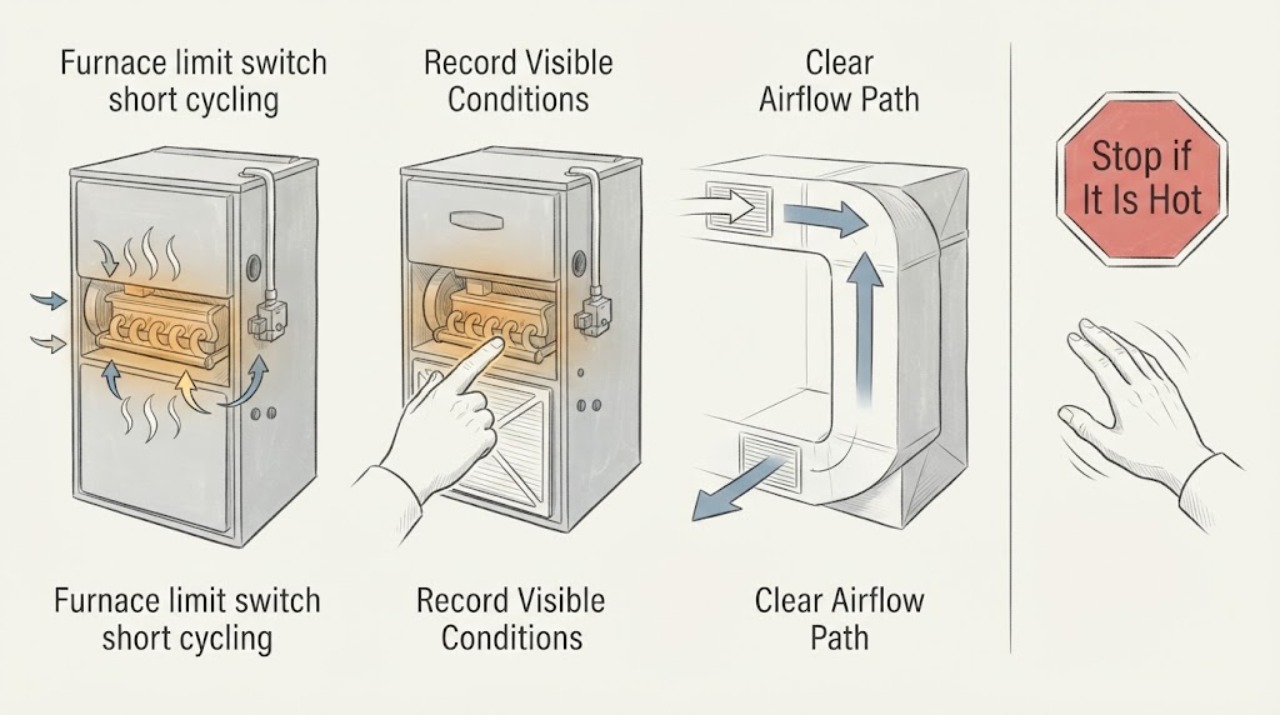
A furnace limit switch is a safety control that can shut off the burners when the furnace overheats, so short cycling does not prove the switch itself has failed. First record when the burners stop and whether the blower continues, then check only the thermostat setting, accessible filter, open return and supply vents, and any normal status code visible without opening the cabinet. Restricted airflow can make the furnace overheat and open the limit circuit; a faulty switch, blower, heat exchanger, sizing, ignition, or control problem can look similar. Never bypass or manually reset a safety switch. If rapid cycling continues after the accessible airflow checks, the furnace shuts down before heating, a breaker trips, or you smell gas or combustion products, stop the furnace and call a qualified HVAC professional.
Work through in order
Diagnostic checks
Use only checks that match the exact appliance or system and its official guide.
-
Check 1
From outside the furnace cabinet, call for heat once and record the sequence: whether the furnace starts, when the burners light, when they stop, whether the blower keeps running, and whether warm air reaches the rooms. Note whether the pattern is new, repeated, or present since installation.
Expected result: The burners stop after a short run while the blower continues, the thermostat cancels the call, ignition never completes, or the furnace restarts after a cooling pause; record any visible normal status code.
Next step: Save the timing and status indication for the technician. Do not repeat the call to force a code or reproduce overheating.
Stop if: Stop for smoke, flames, gas or flue odor, loud ignition, burning smell, arcing, or a carbon-monoxide alarm.
Why this matters
Why: Burner shutdown with continued blower operation is consistent with a protective high-limit response but does not prove the switch is bad. A cancelled thermostat call points toward control or sizing behavior, while failed ignition or a repeated fault broadens the path to ignition, venting, control, or gas-service diagnosis.
-
Check 2
Inspect the air filter only at its normal user-accessible location and replace it if it is visibly loaded and the owner's manual permits replacement. Confirm return grilles and supply registers are open and not blocked by furniture, curtains, or stored items; do not remove a furnace or coil panel.
Expected result: The filter is gray or loaded, a return or supply path is blocked, airflow is weak, or these accessible conditions look normal while short cycling continues.
Next step: Correct only the accessible filter or vent condition allowed by the manual, then allow one controlled heating call. If the symptom remains, shut the furnace off and arrange service.
Stop if: Stop for soot, melted material, unusual heat, wet equipment, a blocked return that requires moving heavy objects, or any need to open the cabinet.
Why this matters
Why: Restricted airflow can make the heat exchanger area overheat and open the limit circuit. Normal filter and vent conditions make blower, coil, duct, sizing, limit-switch, or another internal issue more likely.
-
Check 3
Check the thermostat mode, temperature setting, schedule or hold, fan setting, and visible power or battery state. Look at its location for direct sunlight, a supply register, a draft, or a nearby heat source, but do not remove the thermostat or touch its wiring.
Expected result: The thermostat is in an unexpected mode or schedule, its display is blank or rebooting, it is locally heated or cooled, or settings and location are stable while the furnace still short cycles.
Next step: Correct only an obvious setting or battery issue described by the thermostat manual, then observe once. Leave calibration, relocation, wiring, and replacement to a qualified technician.
Stop if: Stop if the thermostat is hot, wet, damaged, has exposed wiring, or requires removing its base.
Why this matters
Why: A thermostat can satisfy the call too early or send an incorrect signal when its settings, power, calibration, or location are wrong. Stable thermostat evidence keeps the limit response and furnace airflow or equipment causes in focus.
-
Check 4
With all furnace access panels closed, read any status light or display through its normal viewing window and compare it with the exact owner manual. Record a limit, rollout, airflow, ignition, or lockout indication without pressing a manual-reset button, bridging terminals, or cycling the power repeatedly.
Expected result: A repeated limit or safety indication appears, the status is normal but short cycling persists, no code is available, or a manual-reset control appears to have tripped.
Next step: Photograph the indicator and call a qualified HVAC technician with the exact code and sequence. Keep the furnace off when the safety indication repeats.
Stop if: Stop for a rollout or overheating indication, soot, combustion odor, smoke, flames, or any need to remove a panel.
Why this matters
Why: A safety indication supports a furnace-protection or overheating path but does not identify whether airflow, the switch, heat exchanger, blower, or controls caused it. A manual-reset event is evidence for professional inspection, not permission to reset and continue operating.
-
Check 5
After one permitted filter, vent, or thermostat correction and only when no hazard is present, observe one heating call from a clear position. Stop the call at the thermostat if rapid cycling returns, the furnace does not heat, or a new physical symptom appears; do not keep operating it to see whether the switch resets.
Expected result: The furnace completes a stable heating cycle, the burners stop early again while the blower continues, the furnace fails to ignite, or the system develops noise, odor, heat, soot, or a warning.
Next step: Provide the technician with cycle timing, thermostat state, filter and vent results, status codes, and whether the blower continued after burner shutdown.
Stop if: Stop all testing for gas or flue odor, smoke, flames, loud ignition, burning smell, arcing, soot, or a carbon-monoxide alarm.
Why this matters
Why: A single stable cycle supports monitoring but does not prove the limit circuit or underlying cause is fixed. A repeated early shutdown or any combustion or safety symptom requires professional testing before further operation.
Use your observations
Decision map
Find the observation that best matches what you see, then follow the next safe action.
-
PATH 01Safety boundary
What you see
The burners stop early, the blower continues, and a loaded filter or blocked return/supply path is found without any gas, smoke, water, or electrical hazard.
Do this next
Correct only the accessible filter or vent condition allowed by the manual, observe one cycle, and arrange service if rapid cycling returns.
Why this path and its safety boundary
Why it matters: Restricted airflow is a plausible reason the furnace overheats and opens the limit circuit, but the switch and heat exchanger still should not be assumed healthy.
Safety stop: Do not reset or bypass the limit switch and do not open the furnace cabinet.
-
PATH 02Safety boundary
What you see
The burners stop early with the blower continuing, but the accessible filter, returns, supplies, thermostat settings, and location appear normal.
Do this next
Keep the furnace off and request qualified diagnosis of airflow, temperature rise, the limit circuit, heat exchanger, blower, and system sizing.
Why this path and its safety boundary
Why it matters: A blower, coil, duct, limit-switch, heat-exchanger, control, sizing, or other internal condition remains possible. A replacement switch alone could leave the overheating cause in place.
Safety stop: Do not hold the switch closed, change its rating, jumper the circuit, or continue running the furnace for comparison.
-
PATH 03Safety boundary
What you see
The thermostat cancels the heating call as the furnace stops, especially when its schedule, location, or displayed temperature changes unexpectedly.
Do this next
Correct only a documented thermostat setting or battery issue, then obtain professional calibration, compatibility, or sizing assessment if the pattern returns.
Why this path and its safety boundary
Why it matters: Thermostat sensing, schedule, power, or an oversized system is more likely than a limit switch opening, though the furnace still needs service if cycling remains abnormal.
Safety stop: Do not relocate the thermostat or change its wiring without model-specific professional guidance.
-
PATH 04Safety boundary
What you see
A rollout or overheating indication, soot, gas or flue odor, smoke, flames, loud ignition, arcing, or a carbon-monoxide alarm accompanies the short cycling.
Do this next
Leave the area for gas or carbon-monoxide danger, keep people clear, and contact the gas utility or emergency responders as appropriate; otherwise keep the furnace off and call qualified service.
Why this path and its safety boundary
Why it matters: The furnace may have a combustion, heat-exchanger, gas, venting, or electrical safety problem that exceeds homeowner observation.
Safety stop: Stop all interaction with the furnace and do not reset a safety control.
Helpful context
Understand the symptom
What the limit switch is doing
The limit switch monitors furnace temperature and can stop the burners when the heat exchanger area becomes too hot. That is a protective response, not a normal repair target. A dirty filter, blocked return or supply path, blower problem, dirty coil, oversized furnace, thermostat issue, ignition fault, or a defective limit switch can all produce a furnace that starts and stops before the room reaches the setpoint.
Use the sequence to narrow the cause
Note what happens after a call for heat: whether the inducer and burners start, whether warm air reaches the rooms, when the burners stop, and whether the blower continues. A burner that stops while the blower continues can fit a high-limit response, but the observation does not distinguish airflow restriction from a switch or internal fault. A furnace that has short-cycled since installation raises a sizing or installation question, while a new change raises maintenance or equipment diagnosis.
Why bypassing is unsafe
The limit circuit exists to protect the heat exchanger and home from unsafe overheating. Bridging terminals, holding a switch closed, pressing an unexplained reset, or running the furnace with a removed panel defeats that protection and can hide the reason the furnace is getting too hot. A technician must test the switch and the cause together before replacing anything.
Safety boundary
Stop conditions
- Stop for gas or flue odor, a carbon-monoxide alarm, smoke, flames, loud ignition, burning smell, arcing, soot, water near electrical equipment, or a rollout/overheating warning.
- Do not bypass, jumper, hold closed, or manually reset a limit or rollout switch; do not open panels, handle gas, test live circuits, or alter control wiring.
- After one permitted filter, vent, or thermostat correction and one controlled call, stop operation if rapid cycling returns or the furnace fails to heat normally.
Only after diagnosis
Potential parts
- furnace high-limit switch
Consider this only after a qualified technician confirms the switch fails testing or repeatedly opens after airflow and overheating causes have been addressed.
Match the exact furnace model, switch type, temperature rating, probe length, mounting, wiring, and manufacturer service instructions; never substitute a higher-rated or generic switch. - furnace air filter
Consider this only when the normal user-accessible filter is visibly loaded and the owner's manual permits replacement; it cannot correct a failed limit switch, blower, coil, sizing, or combustion problem.
Confirm dimensions, filter type, airflow direction, and equipment requirements before selecting one. - furnace blower motor
Consider this only after professional airflow and electrical testing identifies a blower motor problem contributing to overheating or limit trips.
Confirm motor type, voltage, horsepower, speed controls, mounting, and furnace compatibility; installation is technician work.
When checks do not resolve it
Need a professional?
Call a qualified HVAC technician when short cycling repeats after an accessible filter, vent, and thermostat check, when a safety indication appears, when the blower continues after early burner shutdown, or when ignition, airflow, gas, venting, electrical, or heat-exchanger concerns are present.
Have this ready
- Burner start and stop timing and whether the blower continued
- Thermostat mode, setpoint, schedule, displayed temperature, and location
- Filter and return/supply vent condition
- Any status code, rollout or limit indication, noise, odor, soot, smoke, or water
- Furnace model, fuel type, age, recent installation or service, and any prior switch replacement
Common questions
FAQ
Does a short-cycling furnace always have a bad limit switch?
No. The limit switch may be responding correctly to overheating caused by restricted airflow, a blower or coil problem, or another furnace fault. Thermostat behavior, sizing, ignition, heat exchanger, controls, and the switch itself can produce similar timing.
Can a dirty filter make the limit switch open?
Yes. A loaded filter or blocked airflow can reduce air movement across the heat exchanger and cause the furnace to overheat, which may open the limit circuit. Replace an accessible filter only as the manual permits, then escalate if cycling continues.
Should I reset or bypass the furnace limit switch?
No. The limit circuit is a safety control. Bypassing or repeatedly resetting it can allow unsafe overheating and hide the underlying cause. Have a qualified HVAC technician test the switch and the furnace conditions together.
What does it mean if the blower keeps running after the burners stop?
It can fit a normal cool-down response or a high-limit shutdown, depending on the model and timing. If the burners stop early and the pattern repeats, the furnace needs professional diagnosis of airflow, the limit circuit, and the underlying heat condition.
When is furnace short cycling an emergency?
Treat gas or flue odor, a carbon-monoxide alarm, smoke, flames, loud ignition, burning smell, arcing, soot, or a rollout or overheating warning as an immediate safety issue. Leave the area when necessary and contact emergency or gas-utility support from a safe location.
Read the exact guide
Official sources
- What is a Furnace Limit Switch? | Ultimate Guide & TroubleshootingCarrier · Manufacturer guidance used to explain the limit circuit and safe boundaries; exact switch design and service procedure vary by furnace model.
- Furnace Troubleshooting Guide | Fix a Furnace Not WorkingCarrier · Manufacturer homeowner troubleshooting guidance used for accessible settings, filter, vents, and gas-safety boundaries; exact owner-manual instructions control.
- Furnace Short Cycling: Causes and SolutionsTrane · Manufacturer guidance used to distinguish limit-switch response from broader furnace causes; exact equipment behavior varies by model.
- What Is Furnace Short Cycling? Causes and SolutionsCarrier · Manufacturer homeowner guidance for short cycling; it does not replace model-specific instructions or professional diagnosis.
Community feedback
Share a repair observation
Share a plain-text repair observation. Accepted observations are published automatically; this page may take a moment to update.