
On this page
Start here
Quick answer
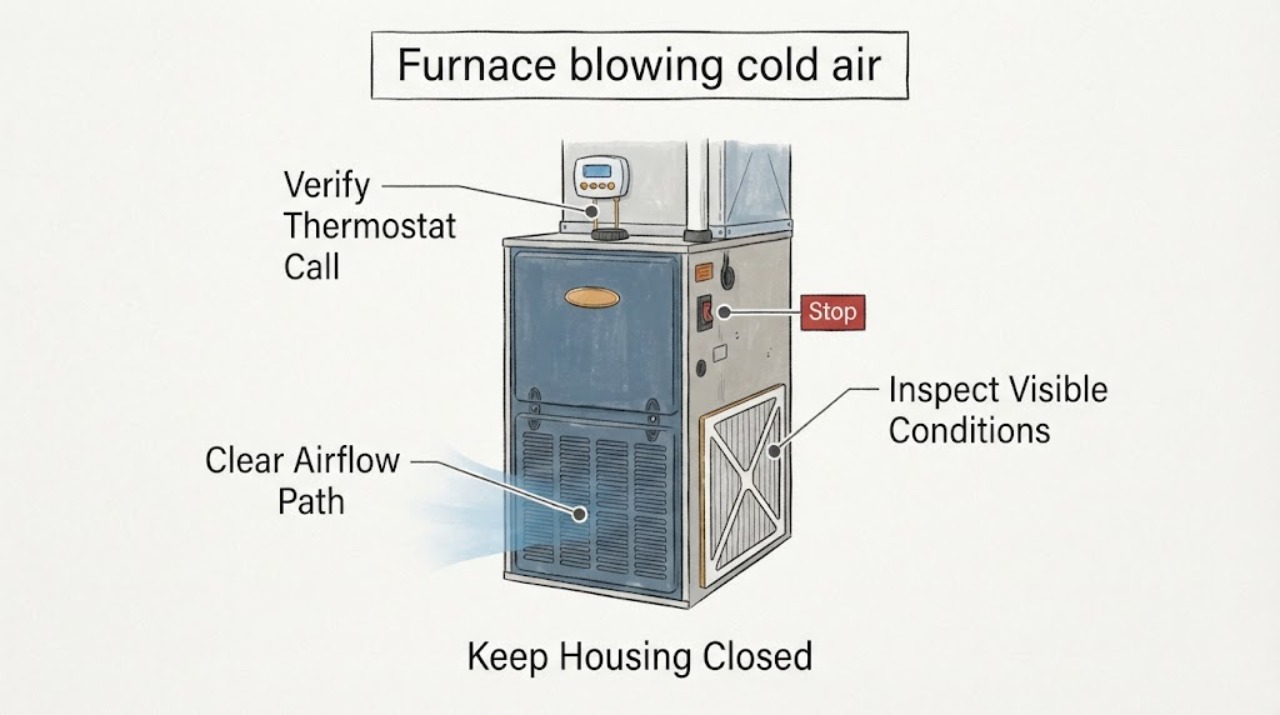
An Amana furnace can blow cool air briefly at the start of a cycle or while the blower is circulating air, but air that stays cold while the thermostat calls for heat means the heating sequence is not completing. First verify that the thermostat is calling for heat and the fan is set to Auto, then check the user-accessible filter and supply-air pattern without opening the furnace. Record whether the blower runs before any heat, whether warm air appears and then stops, and whether a visible status light or code is present. Do not inspect burners, ignition, gas valves, flue passages, live wiring, or the heat exchanger yourself. Stop and leave the home for a gas odor or carbon-monoxide alarm, and arrange qualified HVAC service for repeated cold air, a failed ignition sequence, a blocked vent, overheating shutdown, or any fuel-burning safety concern.
Before you begin
Safety first
- This article supports thermostat-setting confirmation, ordinary-access filter and grille inspection, system identification, and observation from outside the furnace cabinet. It does not authorize combustion, gas, vent, refrigerant, electrical, heat-exchanger, safety-control, or internal panel work.
Work through in order
Diagnostic checks
Use only checks that match the exact appliance or system and its official guide.
-
Check 1
At the thermostat, select Heat, set the fan to Auto, and set the target above the current room temperature; do not remove the thermostat or change wiring.
Expected result: The thermostat shows an active heat call and the blower starts, the fan runs with no heat call, or the display is blank or reports a fault.
Next step: Keep the setting documented and observe one cycle. Arrange HVAC service if a valid heat call produces no warm air, the fan will not stop, or the thermostat cannot maintain a heat request.
Stop if: Do not jumper terminals, bypass thermostat controls, or continue testing if the thermostat wiring is exposed or damaged.
Why this matters
Why: A fan-only setting or absent heat call can explain cool air without a furnace heating failure. A valid heat call with cool air moves the check to the furnace sequence; a blank or faulting thermostat needs controls assessment.
-
Check 2
With the furnace operating normally and no safety warning present, inspect the user-accessible air filter and the return and supply grilles without opening the furnace cabinet.
Expected result: The filter is visibly loaded, installed in the correct direction and reasonably clear, or the return or supply path is blocked by furniture, dust, or stored items.
Next step: If the filter is due for service, replace or clean it only as the filter and Amana instructions specify, restore airflow, and observe one cycle. If cold air persists or the filter loads unusually quickly, request HVAC diagnosis.
Stop if: Do not remove furnace panels, reach toward burners or wiring, use the furnace with a missing filter, or alter the filter size or rating by guesswork.
Why this matters
Why: A loaded filter or blocked airflow path can restrict circulation and contribute to poor heating performance or protective shutdown. A clear filter does not prove that the burners, fan, limit control, or heat exchanger are healthy.
-
Check 3
From outside the cabinet and without looking through an unsafe opening, observe the sequence after a heat call: inducer or ignition sound if audible, warm-air arrival, blower operation, and whether the furnace stops or retries.
Expected result: The blower runs before any warm air, warm air arrives and then turns cold, the system retries repeatedly, or no heating response is heard while the blower runs.
Next step: Record the timing and leave the furnace controls and panels untouched. Arrange service for repeated retries, a failed sequence, or a cycle that never produces sustained warm air.
Stop if: Do not watch or adjust a burner flame, ignition component, gas valve, pressure switch, limit control, or electrical part.
Why this matters
Why: Blower-first cool air can be a normal startup delay or a failed ignition/heating sequence. Warm air that turns cold or repeated retries can indicate a protective shutdown or heat-production fault; no heat response with blower operation needs qualified diagnosis.
-
Check 4
If the Amana furnace has a status window or indicator visible without removing a panel, record its normal or fault pattern and any thermostat message; do not defeat a door switch or open the cabinet.
Expected result: The indicator is normal, shows a repeated fault pattern, is not visible, or the furnace has no readable code.
Next step: Photograph or write down the pattern, model, and cycle behavior and provide them to the HVAC technician. Use the service path when a fault returns or the indicator is unavailable.
Stop if: Do not bypass an interlock, reset repeatedly, remove access doors, or test live electrical or combustion components.
Why this matters
Why: A repeated indicator pattern can help a technician identify the failed part of the heating sequence, but a homeowner should not translate an unknown pattern into a gas, ignition, or electrical repair.
-
Check 5
Identify whether the Amana equipment is a gas furnace, electric heat system, heat pump, or dual-fuel setup from its label and thermostat, without changing operating mode repeatedly.
Expected result: The label identifies a gas furnace, the system is a heat pump or dual-fuel system, the thermostat is in emergency or auxiliary heat, or the equipment type is unclear.
Next step: Give the exact system type and model to the technician and follow the model manual for mode behavior. Do not test an unfamiliar heating source by opening equipment or changing refrigerant or gas controls.
Stop if: Stop for smoke, fuel odor, a carbon-monoxide alarm, exposed wiring, ice or water damage, or a system that changes mode unexpectedly.
Why this matters
Why: Gas furnaces require combustion and heat-exchanger checks, while a heat pump or dual-fuel system can blow cool air during a mode change or use a different heating source. The same cold-air symptom does not prove the same failed component.
-
Check 6
Before any further run time, check from a safe location for fuel odor, smoke, unusual combustion noise, a carbon-monoxide alarm, or symptoms among occupants; do not search for a vent or gas leak source.
Expected result: No safety warning is present and the furnace merely blows cold air, or there is a fuel odor, smoke, alarm, illness symptom, damaged vent, or visible water or fire damage.
Next step: For a safety warning, leave the building for fresh air, call emergency services or the gas utility from outside as appropriate, and do not reuse the furnace until qualified personnel clear it. Otherwise arrange HVAC service for persistent cold air.
Stop if: Never remain inside to locate carbon monoxide, relight a burner, repair a gas connection, inspect a flue, or restart a furnace after an alarm.
Why this matters
Why: A symptom-only cold-air case can be documented for normal HVAC service. A fuel-burning or carbon-monoxide warning is an immediate life-safety event, not a furnace adjustment opportunity.
Use your observations
Decision map
Find the observation that best matches what you see, then follow the next safe action.
-
PATH 01Next step
What you see
The thermostat is not calling for heat or the fan is set to On, or cool air lasts only briefly before warm air arrives and the cycle completes.
Do this next
Leave the fan on Auto, verify the heat call, and observe a complete cycle without changing wiring or opening the furnace.
Why this path and its safety boundary
Why it matters: A control setting or normal blower startup behavior is more likely than a failed heat-producing component.
-
PATH 02Safety boundary
What you see
A user-accessible filter is loaded or the return or supply path is blocked, and the furnace has weak airflow or shuts down before warming the home.
Do this next
Restore the specified filter and clear only ordinary obstructions, then arrange service if cold air, repeated shutdown, or rapid filter loading continues.
Why this path and its safety boundary
Why it matters: Restricted airflow may be contributing, but it does not establish that the filter is the only cause or that internal safety controls are reset.
Safety stop: Do not operate without a filter or remove cabinet panels to investigate the limit control, blower, or heat exchanger.
-
PATH 03Next step
What you see
A valid heat call is present, the blower runs, but warm air never arrives, the air turns cold after a short warm period, or the furnace repeatedly retries.
Do this next
Leave the equipment untouched and arrange qualified HVAC diagnosis with the model, status pattern, filter condition, and cycle timing.
Why this path and its safety boundary
Why it matters: Ignition, fuel delivery, flame sensing, airflow protection, controls, or heat-exchanger-related service is possible; the symptom cannot identify a safe user-replaceable part.
-
PATH 04Next step
What you see
The label or thermostat identifies a heat pump or dual-fuel system, and the cold air occurs during a mode change, defrost, auxiliary-heat transition, or unclear operating mode.
Do this next
Record the system type and thermostat message and use the model-specific manual or qualified HVAC service; do not change refrigerant, gas, or electrical settings.
Why this path and its safety boundary
Why it matters: The equipment may be using a different heat source or transition sequence, so gas-furnace assumptions are not reliable.
-
PATH 05Safety boundary
What you see
A carbon-monoxide alarm sounds, fuel odor or smoke is present, occupants feel ill, or a vent or combustion area appears damaged.
Do this next
Leave immediately for fresh air, call emergency services or the gas utility from outside as appropriate, and keep the furnace off until trained personnel inspect it.
Why this path and its safety boundary
Why it matters: This is a life-safety and combustion-venting emergency, not a cold-air troubleshooting case.
Safety stop: Do not re-enter to find the source, silence the alarm, relight the furnace, or operate it before professional clearance.
Helpful context
Understand the symptom
Separate a normal blower delay from a failed heat cycle
The first question is whether the air is briefly cool or remains cool throughout a heat call. A blower can move room-temperature air before the furnace has produced heat, and a fan set to On or Circulate can run without a heating request. If warm air never arrives, appears only briefly, or the furnace shuts down and restarts, the heating sequence needs diagnosis rather than a longer thermostat setting.
The filter and airflow are useful homeowner checks, not a license to open the furnace
Amana identifies filter condition, blower operation, controls, gas connections, valves, burners, and the heat exchanger as separate maintenance concerns. A homeowner can check a readily accessible filter and clear return or supply obstructions without removing panels. Burner, ignition, flame, electrical, vent, and heat-exchanger work belongs to a qualified heating professional.
Treat fuel-burning safety signals as an immediate stop condition
Gas and oil furnaces can produce carbon monoxide when combustion or venting is unsafe. A carbon-monoxide alarm, combustion odor, smoke, headache, dizziness, nausea, or unusual confusion is not a troubleshooting branch. Leave the area for fresh air, contact emergency services as appropriate, and do not operate the furnace again until trained personnel have checked it.
Safety boundary
Stop conditions
- Do not open the furnace cabinet, defeat a door switch, inspect or adjust burners, relight a pilot, change a gas valve, or touch ignition or live electrical parts.
- Do not bypass a limit, pressure, flame, or other safety control, reset repeatedly, or alter venting, combustion air, refrigerant, or thermostat wiring.
- Leave immediately and call emergency services or the gas utility from outside for a carbon-monoxide alarm, fuel odor, smoke, severe illness symptoms, or fire risk.
- Keep the furnace out of service for visible vent or heat-exchanger damage, water intrusion, uncontrolled heating, repeated ignition retries, or cold air with a valid heat call that does not resolve after the filter check.
- Do not use a generic gas-furnace procedure for an Amana heat pump, dual-fuel system, or unknown model; identify the system and use model-specific qualified service.
Only after diagnosis
Potential parts
- Amana furnace air filter
Consider this category only if the installed model and filter specification confirm that the existing filter is loaded or damaged and routine replacement is due.
Confirm the exact equipment and filter specification from Amana documentation; do not guess a size, airflow rating, or installation direction. - Amana furnace ignition or flame-sensing component
Consider this category only after qualified diagnosis confirms that the heating sequence fails at ignition or flame proving and identifies the exact component.
Confirm model fit and the complete safety sequence with a qualified HVAC technician; do not remove or test combustion parts as a homeowner. - Amana furnace blower or limit-control component
Consider this category only when qualified measurements identify a blower, airflow-protection, or limit-control fault after the filter and grille checks are complete.
Confirm the exact model, control configuration, and cause of shutdown before ordering; a part swap cannot substitute for airflow and safety diagnosis.
When checks do not resolve it
Need a professional?
Arrange qualified HVAC service when the thermostat has a valid heat call but warm air never arrives, warm air turns cold, the furnace repeatedly retries or shuts down, a fault indicator returns, the filter is clear but airflow or heat remains abnormal, the system type or model is unclear, or any burner, vent, gas, electrical, heat-exchanger, or refrigerant check is required. Treat a carbon-monoxide alarm, fuel odor, smoke, or occupant illness as an immediate emergency and do not reuse the furnace until it is professionally cleared.
Safety scope: This article supports thermostat-setting confirmation, ordinary-access filter and grille inspection, system identification, and observation from outside the furnace cabinet. It does not authorize combustion, gas, vent, refrigerant, electrical, heat-exchanger, safety-control, or internal panel work.
Common questions
FAQ
Why is my Amana furnace blowing cold air at the start of a cycle?
A brief period of room-temperature air can occur while the blower starts and the heating sequence has not yet produced warm air. If warm air never arrives, appears only briefly, or the furnace retries, verify the thermostat and filter from safe access and arrange qualified HVAC diagnosis.
Can a dirty filter make an Amana furnace blow cold air?
A loaded filter can restrict airflow and contribute to poor heating performance or protective shutdown, but it does not prove that the filter is the only fault. Replace or clean it only as the exact Amana and filter instructions specify; persistent cold air needs service.
Should I look at the burner or relight my Amana furnace?
No. Do not open the cabinet, inspect or adjust burners, relight a pilot, bypass a safety control, or touch gas or ignition parts. Record the thermostat call, cycle behavior, and any visible status pattern for a qualified HVAC technician.
What should I do if my furnace blows cold air and the carbon-monoxide alarm sounds?
Leave immediately for fresh air and call emergency services or the gas utility from outside as appropriate. Do not stay inside to find the source or reuse the furnace until trained personnel inspect and clear the fuel-burning equipment.
Read the exact guide
Official sources
- Customer Support, Warranty Info & Service Plans | AmanaAmana brand · Use to route unknown model, fault, or documentation cases to Amana support or the installing dealer without exposing commercial destinations.
- Carbon Monoxide Fact SheetU.S. Consumer Product Safety Commission · Use for immediate action when a carbon-monoxide alarm or poisoning symptoms occur and for the prohibition on unskilled fuel-burning-appliance service.
- Heating and Cooling Basics | Learn about HVAC | Amana® brandAmana brand · Use to distinguish a heating sequence from blower-only air and to keep gas-furnace and heat-pump behavior separate; it is not a homeowner repair procedure.
- Find Out How Packaged Systems WorkAmana brand · Use only when the equipment may be packaged or dual-fuel; system-specific controls and service instructions remain authoritative.
- Preventive MaintenanceAmana brand · Use to define the ordinary-access filter boundary and the professional scope for furnace components; exact maintenance depends on the installed system.
- Gas Furnaces With Outstanding Performance From AmanaAmana brand · Use only for Amana gas-furnace identity and component context; it does not identify the assigned furnace model or authorize internal repair.
- Furnace Safety Fact SheetCenters for Disease Control and Prevention · Use for the emergency stop boundary around fuel-burning furnaces, carbon monoxide, and professional safety checks; it does not diagnose an Amana furnace fault.
Community feedback
Share a repair observation
Share a plain-text repair observation. Accepted observations are published automatically; this page may take a moment to update.