
On this page
Start here
Quick answer
If a fuel-burning furnace lights its burner and then shuts it off while the blower sends cold air, the shutdown may be a safety response rather than a simple thermostat problem. A dirty or restricted filter can cause overheating and a limit switch to stop the burner; a flame sensor or pilot-safety problem can shut off fuel when flame is not proven; and burners, ignition, gas supply, controls, or venting can also be involved. Observe the startup sequence from a safe position, confirm the thermostat is calling for heat with the fan on Auto, replace a visibly dirty filter with the exact type specified by the manual, and keep supply and return vents unobstructed. If the burner repeatedly goes out, the furnace locks out, the flame is abnormal, the unit is short cycling, or cold air continues after these checks, turn the system off and arrange qualified HVAC service. If you smell gas, see soot or flame outside the combustion area, hear a delayed ignition or bang, or a carbon-monoxide alarm sounds, leave the area and follow emergency gas and CO procedures instead of testing the furnace.
Before you begin
Safety first
- This article supports observing the startup sequence from a safe position, checking thermostat settings, replacing an accessible filter with the manual-specified type, and clearing obvious room-vent obstructions. It does not authorize burner or control access, flame-sensor or pilot work, live electrical testing, gas-valve or pressure adjustment, vent access, or safety-control bypass.
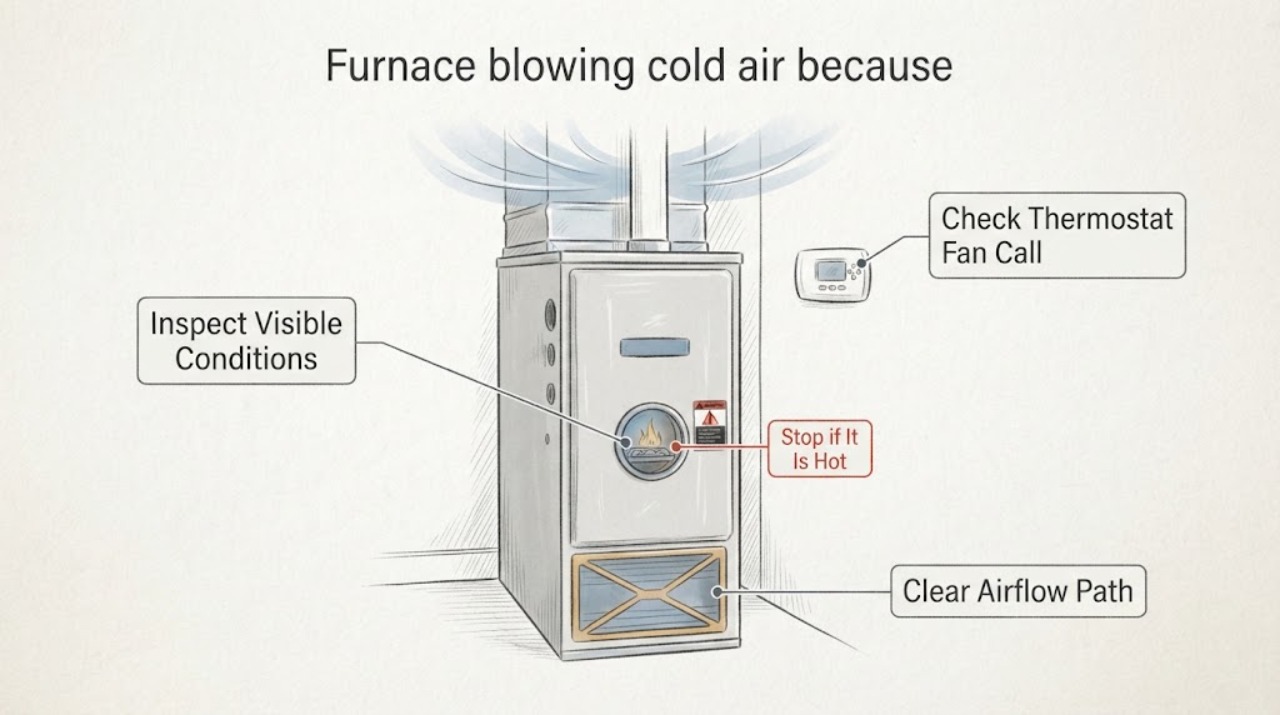
Work through in order
Diagnostic checks
Use only checks that match the exact appliance or system and its official guide.
-
Check 1
From a safe position away from the furnace access opening and supply registers, observe one normal call for heat without removing panels. Note whether the inducer or ignition starts, the burner lights, the burner goes out after a short interval, the blower starts afterward, and whether the thermostat or furnace shows a fault indicator.
Expected result: Record whether the burner never lights, lights and immediately drops out, runs briefly then drops out, or stays lit while the blower still sends cool air. Record any lockout, repeated ignition attempt, unusual sound, or visible flame outside the intended viewing area.
Next step: Use the sequence to choose the airflow, flame-loss, or immediate-safety branch. Do not keep restarting a furnace that repeatedly fails ignition or locks out.
Stop if: Do not open the combustion compartment, reach toward the burner, bypass a rollout or limit control, or continue if there is gas odor, soot, smoke, flame outside the chamber, or delayed ignition.
Why this matters
Why: A burner that lights and then shuts off points toward flame proving, airflow or limit protection, burner or gas delivery, venting, or control issues. A blower-only cold-air symptom can instead be fan settings or a normal startup delay. An abnormal sound or flame requires a stop rather than another cycle.
-
Check 2
At the thermostat, confirm the mode is Heat, the setpoint is above the room temperature, and the fan is set to Auto unless the manual specifies a different normal setting. Check only the thermostat's visible battery or power indication and any displayed furnace code.
Expected result: Note whether the thermostat is actually calling for heat, whether the fan is On rather than Auto, whether the room reaches the setpoint, and whether a code or lockout appears after the burner goes out.
Next step: Correct only an obvious thermostat mode or fan-setting error, then observe one cycle. If the burner still does not stay lit, stop changing thermostat settings and arrange HVAC diagnosis.
Stop if: Do not raise the setpoint repeatedly to force cycles, disable a lockout, or treat a recurring burner failure as a thermostat problem.
Why this matters
Why: A fan set to On can circulate room-temperature air between heat cycles, but it does not explain a burner that repeatedly lights and drops out. A confirmed heat call with burner loss points back to furnace ignition, flame proving, airflow protection, fuel, or controls.
-
Check 3
With the furnace off and the filter access intended for routine homeowner maintenance, inspect the air filter and visible return and supply paths. Replace a visibly loaded filter only with the size and type specified by the furnace manual, and open supply registers that were deliberately closed or blocked by furniture.
Expected result: Record whether the filter is heavily dirty, airflow at the registers is weak, the return is obstructed, several vents are closed, or the furnace runs longer after the filter and vents are corrected.
Next step: After one controlled observation, arrange service if the burner still drops out, airflow remains weak, the furnace short cycles, or the filter becomes dirty again unusually quickly.
Stop if: Do not run the furnace without its filter, use a filter that restricts airflow beyond the manual's specification, remove the blower door, or adjust a limit switch.
Why this matters
Why: Restricted airflow can overheat the heat exchanger and trip a limit switch, shutting off the burner while the blower continues and cold air is felt at the registers. If a clean, correct filter and open vents do not change the burner dropout, a flame-proving, burner, gas, vent, or control fault remains possible.
-
Check 4
If the furnace has a designed viewing window, look only through that window while the unit is operating normally; otherwise do not remove an access panel. From ground level outside, check only that an accessible intake or exhaust termination is not obviously blocked by snow, leaves, or debris. Do not climb, probe, or alter the vent.
Expected result: Note whether the flame stays established, repeatedly drops out, appears to roll out of the intended burner area, or is accompanied by soot, a bang, a strong exhaust smell indoors, or a vent blockage.
Next step: Turn the furnace off and arrange qualified HVAC service for repeated flame loss or any abnormal combustion sign. If gas odor or a carbon-monoxide alarm is present, leave the area and follow emergency procedures.
Stop if: Do not remove panels, clean or reposition a flame sensor, relight a pilot repeatedly, adjust the gas valve, clear a roof vent from a ladder, or continue operation with an abnormal flame or combustion odor.
Why this matters
Why: A flame that cannot stay established can involve the flame sensor, pilot or ignition assembly, burner, gas delivery, venting, or controls. Flame rollout, soot, delayed ignition, or indoor combustion odor is an unsafe combustion pattern, not a cleaning task.
-
Check 5
Turn the furnace off and arrange qualified HVAC service when the burner repeatedly fails to stay lit, the unit enters lockout, the cold-air symptom continues after the thermostat, filter, and vent checks, or any internal component needs access. Keep the service request focused on the observed ignition sequence rather than ordering a guessed sensor or gas part.
Expected result: Provide the technician with the model, fuel type, thermostat call, burner and blower sequence, filter condition, airflow observations, fault code or light pattern, visible flame behavior, recent maintenance, and any gas or combustion warning.
Next step: Do not return the furnace to normal heating until the technician confirms stable ignition, proper combustion and venting, safe limit operation, and warm-air delivery.
Stop if: Do not bypass safety controls, test live wiring, adjust gas pressure, open the combustion chamber, or repeatedly reset a furnace that loses flame.
Why this matters
Why: A technician can distinguish a dirty or failed flame sensor, pilot or igniter, burner restriction, limit switch, gas valve or supply, venting, control, or heat-exchanger problem. The same cold-air symptom can result from several different faults.
Use your observations
Decision map
Find the observation that best matches what you see, then follow the next safe action.
-
PATH 01Safety boundary
What you see
The burner lights during a heat call, then shuts off within the cycle while the blower continues to deliver cold or room-temperature air, especially after the filter and vents are confirmed clear.
Do this next
Turn the furnace off after documenting the sequence and arrange qualified HVAC service for the combustion and safety controls.
Why this path and its safety boundary
Why it matters: Flame proving, ignition or pilot assembly, burner, gas delivery, venting, limit protection, or controls may be stopping the burner; a flame-sensor problem is one possibility, not a confirmed diagnosis.
Safety stop: Do not clean or replace the flame sensor, adjust gas components, bypass a limit, or repeatedly reset the furnace.
-
PATH 02Safety boundary
What you see
The filter is heavily loaded, return or supply airflow is restricted, the furnace short cycles, and the burner stops while the blower continues; the problem changes little or improves after a correct filter and open vents.
Do this next
Use the exact filter specified by the manual, keep vents and returns clear, observe one cycle, and arrange service if the burner still drops out or the filter loads again quickly.
Why this path and its safety boundary
Why it matters: Restricted airflow and a limit-protection shutdown are more likely than a thermostat-only fault, but persistent dropout still needs professional diagnosis for airflow, limit, heat exchanger, and burner operation.
Safety stop: Do not run without a filter, install a restrictive unapproved filter, bypass a limit switch, or keep operating a furnace that overheats.
-
PATH 03Safety boundary
What you see
The thermostat fan is set to On or the blower delivers cool air only briefly at startup, while the burner sequence is normal and no repeated flame loss or fault appears.
Do this next
Set the fan to Auto if that is the normal manual setting and allow the model's startup delay; arrange service if cold air persists well beyond startup or the burner later drops out.
Why this path and its safety boundary
Why it matters: Fan circulation or a normal warm-up delay is more likely than a burner that cannot stay lit.
Safety stop: Do not alter furnace safety controls or assume a normal delay when there is a fault code, repeated ignition attempt, gas odor, or abnormal combustion sign.
-
PATH 04Safety boundary
What you see
There is gas odor, soot, flame outside the intended burner area, a delayed ignition bang, a strong combustion odor indoors, a carbon-monoxide alarm, or repeated lockout with abnormal flame behavior.
Do this next
Leave the area if gas or combustion danger is suspected, avoid switches and ignition sources as appropriate, follow local emergency and gas-provider guidance, and arrange qualified service before re-entry or operation.
Why this path and its safety boundary
Why it matters: A potentially unsafe fuel-burning or venting condition is present; this is not a homeowner sensor, filter, or thermostat repair.
Safety stop: Do not operate the furnace, relight a pilot, reset the unit, open panels, or investigate the vent while the hazard is present.
Helpful context
Understand the symptom
First confirm that the burner is the part dropping out
Cold air can be normal briefly while a furnace warms its heat exchanger, or it can happen when the blower is set to run continuously. The more specific failure is a burner that ignites and then goes out, after which the blower continues to move unheated air. Note the sequence without repeatedly forcing another ignition attempt.
Airflow is the safe homeowner check with the biggest diagnostic value
A visibly dirty filter, blocked return, or closed supply vents can restrict airflow, raise heat-exchanger temperature, and trigger a limit shutdown. Replace only the filter specified by the furnace manual and open only obvious room vents. Do not remove the blower or burner compartment, clean a flame sensor, adjust gas pressure, or bypass a limit switch.
Repeated flame loss belongs with a technician
A flame sensor, pilot assembly, ignition control, burner, gas valve, vent, or combustion problem cannot be safely diagnosed from the vent temperature alone. Furnace safety controls are intended to stop fuel when flame is not established. Gas odor, soot, abnormal flame, delayed ignition, or a carbon-monoxide alarm changes this from a comfort complaint to an immediate safety stop.
Safety boundary
Stop conditions
- Do not continue cycling or resetting a furnace whose burner repeatedly lights and goes out, enters lockout, or blows cold air after a failed ignition sequence.
- Do not open the burner or control compartment, clean or reposition a flame sensor, test live wiring, adjust gas pressure or valves, or bypass a limit, rollout, flame-proving, or other safety control.
- Do not operate the furnace with a missing or unapproved restrictive filter, blocked return, severely obstructed vent, abnormal flame, soot, or combustion odor.
- If you smell gas, do not operate switches or create ignition sources; leave the area and follow the gas provider or emergency guidance. If a carbon-monoxide alarm sounds, leave and seek emergency assistance.
- Arrange qualified HVAC service when the burner will not stay lit, airflow checks do not resolve the dropout, the furnace short cycles, the fault code returns, or any fuel or combustion safety sign appears.
Only after diagnosis
Potential parts
- furnace flame sensor or pilot-safety assembly
Consider this category only when a technician confirms that the furnace loses flame because its flame-proving or pilot-safety component is dirty, damaged, or out of specification.
Confirm the complete furnace model, ignition design, connector, mounting, and service instructions before sourcing a part; do not select one from the symptom or code alone. - furnace air filter
Consider this only when the existing filter is due for routine replacement and the furnace manual specifies the replacement size and filtration requirements.
Match the manual-specified dimensions and approved filter type; an overly restrictive filter can worsen airflow and does not substitute for diagnosis of a recurring burner dropout. - furnace ignition, limit, or control component
Consider this category only after qualified testing identifies an ignition, limit, rollout, gas-control, or control-board fault rather than a filter or thermostat setting.
Fuel-burning and safety components are model-specific and must be selected, installed, and tested by qualified service using the manufacturer documentation.
When checks do not resolve it
Need a professional?
Arrange qualified HVAC service when a furnace burner repeatedly lights and goes out, the unit locks out, cold air continues after confirming Heat mode, fan Auto, a correct clean filter, and open vents, or the flame and airflow behavior is abnormal. Treat gas odor, soot, flame rollout, delayed ignition, indoor combustion odor, or a carbon-monoxide alarm as an immediate safety stop: leave the area, follow emergency or gas-provider guidance, and do not restart the furnace until it is professionally checked.
Safety scope: This article supports observing the startup sequence from a safe position, checking thermostat settings, replacing an accessible filter with the manual-specified type, and clearing obvious room-vent obstructions. It does not authorize burner or control access, flame-sensor or pilot work, live electrical testing, gas-valve or pressure adjustment, vent access, or safety-control bypass.
Common questions
FAQ
Why does my furnace blow cold air when the burner will not stay lit?
When the burner goes out, the blower may continue running to move air or cool the furnace, so the registers feel cold. Restricted airflow can trip a limit switch, while a flame-sensor or pilot-safety problem can stop fuel when flame is not proven. Burners, gas delivery, venting, and controls can also be involved.
Can a dirty furnace filter make the burner shut off?
Yes. A loaded filter can restrict airflow, raise heat-exchanger temperature, and trigger limit protection that shuts off the burner while the blower continues. Replace the filter only with the type specified in the furnace manual, keep returns and vents clear, and arrange service if the burner still drops out.
Is a flame sensor the same as the furnace temperature limit?
No. A flame sensor verifies that a burner flame is present so fuel can be kept on; a limit control responds to furnace temperature and airflow conditions. Either safety response can leave the blower running with cold air, so the symptom does not identify which component failed.
Should I keep resetting a furnace that lights and then goes out?
No. Repeated burner dropout can indicate flame proving, airflow, gas, ignition, venting, or control trouble. Turn the furnace off and arrange qualified HVAC service, especially if it locks out, makes a bang, shows soot, or has an abnormal flame. Never reset through gas odor or a carbon-monoxide alarm.
Can I relight the pilot when the furnace blows cold air?
Only an older furnace with a standing pilot may have a relighting procedure, and the exact manual controls it. Never attempt it if gas is smelled, the flame is abnormal, or the pilot repeatedly goes out; leave the furnace off and contact a licensed HVAC technician. Modern furnaces commonly use electronic ignition instead.
Read the exact guide
Official sources
- Furnace Troubleshooting Guide | Fix a Furnace Not WorkingCarrier · Carrier residential gas and oil furnace guidance; fuel systems and controls remain model-specific and professional when internal.
- Furnace Pilot Light: How It Works, Common Problems & How to Fix ItCarrier · Carrier guidance for older standing-pilot gas furnaces; modern electronic-ignition furnaces require their exact manual and service procedures.
- Why Is My Furnace Blowing Cold Air? | 10 Common Causes & FixesCarrier · Carrier residential furnace guidance; exact ignition, filter, controls, and service procedures vary by furnace model and fuel type.
- Furnace Main Burner Shuts Off After Ignition: 4 Reasons WhyTrane · Trane gas-furnace troubleshooting guidance; exact components, access, and permitted checks vary by model.
- Understanding Furnace Flame Sensor BasicsLennox · Lennox consumer explanation of flame sensing; exact furnace designs, access, and service procedures vary by model.
Community feedback
Share a repair observation
Share a plain-text repair observation. Accepted observations are published automatically; this page may take a moment to update.