
On this page
Start here
Quick answer
A Carrier furnace can feel cold briefly while its heat exchanger warms, or it can circulate room-temperature air when the thermostat fan is set to On. If the air stays cold, becomes cold after the furnace starts, or arrives with weak airflow or repeated cycling, check the thermostat call, the user-accessible filter, registers, returns, and any reachable exterior intake or exhaust for blockage. Do not open the burner compartment or bypass a safety control. Persistent cold air needs qualified HVAC diagnosis; gas odor, soot, smoke, a carbon-monoxide alarm, sparking, or unusual combustion noise is an immediate stop condition.
Before you begin
Safety first
- This article supports thermostat observation, accessible filter and vent checks, and safe external intake or exhaust inspection only. Do not open furnace compartments, touch gas or electrical components, bypass safety controls, or perform ignition, flame-sensor, gas-valve, heat-exchanger, or live electrical work.
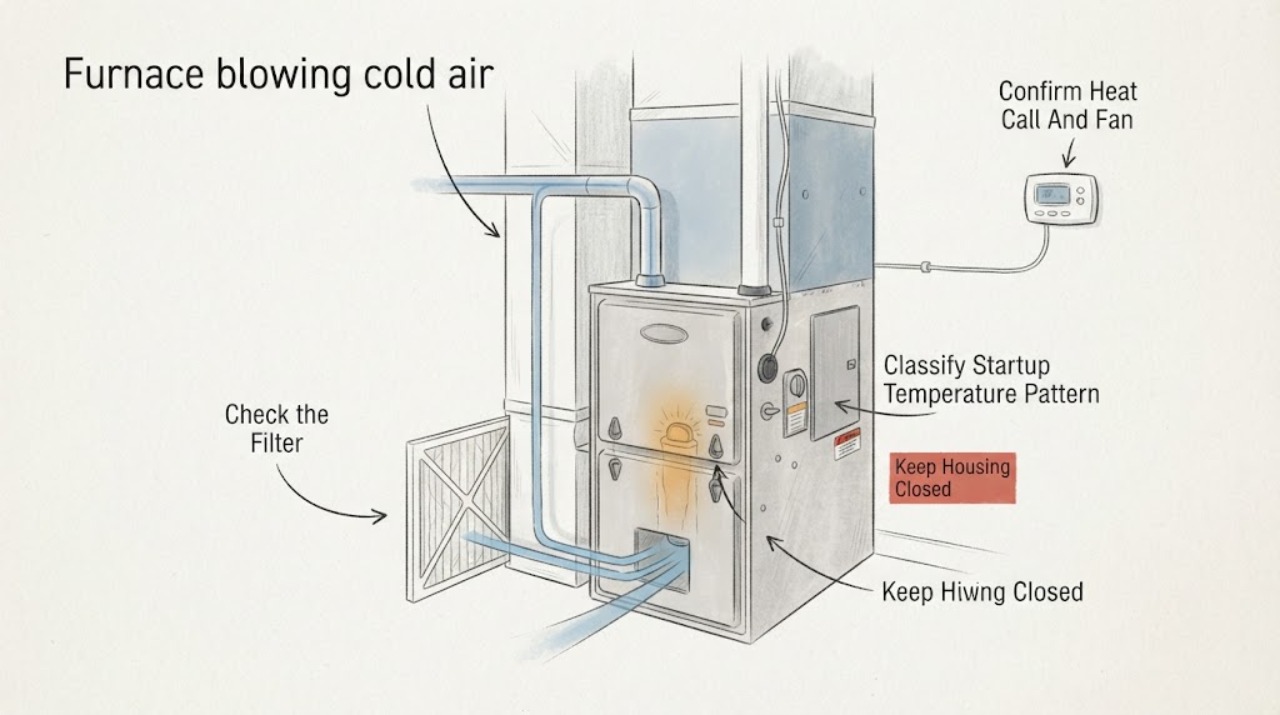
Work through in order
Diagnostic checks
Use only checks that match the exact appliance or system and its official guide.
-
Check 1
From the thermostat's normal interface, confirm that the mode is Heat, the target temperature is above the room temperature, and the fan is Auto unless the exact installation instructions say otherwise. Check for an unexpected schedule or remote setting without removing the thermostat cover.
Expected result: The mode is Cool or Off, the setpoint is not calling for heat, the fan is On, or the settings are already correct.
Next step: Correct only an obvious setting error and watch one normal heat call. If the fan is Auto and the air still stays cold, continue with the external checks and stop repeated testing if the sequence is abnormal.
Stop if: Do not open the thermostat, jumper terminals, alter wiring, or continue testing with gas odor, smoke, soot, a carbon-monoxide alarm, sparking, or unusual combustion noise.
Why this matters
Why: Cool or Off cannot request furnace heat, and Fan On can circulate room-temperature air between heating cycles. Correct settings that do not change the symptom make an airflow, limit, ignition, fuel, or control issue more likely.
-
Check 2
With no hazard present, observe one ordinary startup from the living area. Note whether the blower starts before warm air, warm air follows a brief delay, heat never appears, or warm air changes back to cold during the same call.
Expected result: Cool air is brief and then warms, the blower runs continuously without heat, burners appear to start and stop quickly, or the furnace repeatedly restarts.
Next step: Compare the sequence with the exact Carrier owner manual. If cold air persists beyond the documented startup behavior or the furnace cycles abnormally, turn the furnace off and arrange qualified service rather than repeatedly restarting it.
Stop if: Do not remove an access panel to watch flames, touch the ignition area, relight a pilot without exact model instructions, or keep cycling a furnace that bangs, smells of gas, produces soot, or shuts down repeatedly.
Why this matters
Why: Brief cool air can match the heat-exchanger warm-up behavior Carrier describes. Persistent cold air or a warm-then-cold pattern points toward a limit, ignition, flame-sensing, fuel, venting, or control sequence problem.
-
Check 3
Turn the furnace off at its normal thermostat control, then inspect the user-accessible air filter without opening the burner compartment. If it is visibly loaded or damaged, replace it only with the size and type specified for the installation.
Expected result: The filter is visibly loaded or damaged, or it is reasonably clean and correctly installed.
Next step: After a correct filter change, observe one normal call only if no warning sign exists. If cold air, weak airflow, or short cycling remains, keep the furnace off and arrange diagnosis; do not run it without the required filter.
Stop if: Do not force a filter into place, run without the required filter, remove the blower door, bypass a limit or rollout switch, or treat a repeated safety shutdown as fixed because the filter was changed.
Why this matters
Why: Carrier says restricted filter airflow can overheat the heat exchanger and trip a limit control, leaving the blower on while the burners are off. A clean filter makes a filter-only explanation less likely but does not clear the blower, duct, limit, ignition, or control system.
-
Check 4
With the furnace off, walk the heated rooms and check that supply registers are open and not covered, and that return grilles are not blocked by furniture or stored items. Do not remove ductwork or furnace panels.
Expected result: Several registers or a return are intentionally closed or obstructed, airflow is weak at multiple registers, or the air path is open and airflow is normal.
Next step: Open only registers that were intentionally closed and clear ordinary furniture or objects from returns, then watch one cycle if the furnace has no hazard signs. Persistent weak airflow or cold air requires service rather than duct or blower disassembly.
Stop if: Do not seal, cut, or dismantle ductwork as a furnace repair, block returns, or continue operation when airflow is very weak, the furnace short-cycles, or a safety warning appears.
Why this matters
Why: Carrier identifies blocked or closed vents and returns as airflow restrictions that can contribute to overheating, limit trips, uneven heat, and short cycling. Normal external airflow makes an internal blower, duct, limit, ignition, or control fault more likely.
-
Check 5
If the installation has reachable outdoor combustion-air or exhaust openings, inspect them from a safe standing position for snow, leaves, nests, or other obvious blockage. Also record any status light or message visible through the normal exterior display or viewing window; do not open a cabinet to reach it.
Expected result: An exterior opening is obstructed, the opening is clear but the furnace shows a recurring status indication, or no obstruction or user-visible indication is present.
Next step: Do not climb, insert tools, or disturb a vent you cannot safely reach. Report the obstruction or exact status pattern with the model information to a qualified HVAC technician; consult the model manual before interpreting a code.
Stop if: Do not enter a confined area, open the furnace cabinet, reset a rollout or other safety device, clear an internal vent, or operate the furnace when a vent is damaged, combustion odor is present, or carbon monoxide is suspected.
Why this matters
Why: Carrier warns that blocked intake or exhaust can interfere with furnace operation and can create a combustion concern. A recurring status indication is model-specific evidence for a service diagnosis, while clear openings and no visible indication shift attention to internal sequence, fuel, airflow, or controls.
Use your observations
Decision map
Find the observation that best matches what you see, then follow the next safe action.
-
PATH 01Next step
What you see
The thermostat was on Fan On or the furnace delivered cool air only at the beginning of the call, then produced warm air with normal airflow and no warning signs.
Do this next
Use Heat and Fan Auto when appropriate and confirm the model's normal sequence in its owner manual. Arrange service if the delay lengthens, the air never warms, or the pattern changes.
Why this path and its safety boundary
Why it matters: Fan circulation or a normal heat-exchanger warm-up is more likely than a failed heating component.
-
PATH 02Safety boundary
What you see
The filter is loaded or returns/registers are restricted, airflow is weak, and the blower continues after heat stops or the furnace cycles off quickly.
Do this next
Correct only the accessible filter or intentional vent obstruction. Keep the furnace off and arrange service if cold air, weak airflow, or short cycling remains.
Why this path and its safety boundary
Why it matters: Restricted airflow and a limit-control shutdown are more likely than a thermostat-only issue; the furnace may be protecting the heat exchanger.
Safety stop: Never bypass the limit control, run without the required filter, or keep operating through repeated safety shutdowns.
-
PATH 03Safety boundary
What you see
Airflow is reasonable, but heat never develops, the furnace starts and the burners do not sustain, or warm air changes back to cold while a heat call remains active.
Do this next
Record the safe-to-observe startup sequence and any visible status indication, then arrange qualified HVAC diagnosis. Do not infer a failed part from the symptom or order an internal component before model-specific testing.
Why this path and its safety boundary
Why it matters: Ignition, flame sensing, fuel supply, pressure or venting, gas valve, blower, limit, or control problems are more likely than a simple thermostat setting.
Safety stop: Do not open the burner compartment, clean or reposition a flame sensor, adjust gas controls, test live wiring, or defeat a safety switch.
-
PATH 04Safety boundary
What you see
Cold air occurs with gas odor, soot, smoke, a carbon-monoxide alarm, sparking, unusual banging or grinding, or a blocked or damaged combustion vent.
Do this next
Stop using the furnace and leave the area when appropriate. Avoid flames and electrical switching near a suspected gas leak, and contact emergency or utility help from a safe location. Arrange qualified inspection before use.
Why this path and its safety boundary
Why it matters: This is a combustion or equipment-safety situation, not a routine filter or thermostat adjustment.
Safety stop: Do not investigate inside, touch gas controls, attempt a reset, clear an internal vent, or restart the furnace while a combustion hazard is suspected.
-
PATH 05Next step
What you see
Thermostat settings, the specified filter, registers, returns, and reachable external vent openings are reasonable, but cold air persists or the furnace shows an abnormal sequence or recurring status indication.
Do this next
Keep the furnace off and arrange qualified Carrier or HVAC service. Give the technician the model information, timing of the cold air, airflow observations, startup sequence, and any visible status pattern.
Why this path and its safety boundary
Why it matters: An internal ignition, flame-sensing, limit, blower, fuel, venting, heat-exchanger, or control issue is more likely and cannot be identified safely from the living area.
Helpful context
Understand the symptom
Start by identifying when the air turns cold
The timing changes the diagnosis. Air that is cool only at the beginning of a heat call can be the blower waiting for the heat exchanger to warm. A fan set to On can also circulate room-temperature air between calls. Air that remains cold after the normal startup sequence, or turns cold after heat initially appears, is a fault pattern rather than a delay to ignore. Carrier's exact owner manual is the right reference for model-specific sequence behavior.
Airflow can trigger a furnace safety shutdown
A loaded filter, blocked return, or too many closed supply registers can reduce the air moving across the heat exchanger. Carrier explains that overheating can trip a limit control, stopping the burners while the blower continues. That combination often feels like cold air from the vents. An accessible filter and deliberately closed vents are reasonable checks; a limit control should never be bypassed.
A startup that never produces heat is not a filter-only problem
If the blower runs but heat never develops, or the burners light and drop out quickly, Carrier lists ignition, flame sensing, gas or oil supply, and computerized controls among possible causes. A homeowner can record the sequence or a status indication visible through the normal user interface, but should not open the burner area, adjust gas controls, or replace an internal safety component from the symptom alone.
Combustion warnings change the response
Gas odor, soot, smoke, a carbon-monoxide alarm, sparking, or unusual banging or grinding is not a routine cold-air complaint. Stop using the furnace, leave the area when appropriate, avoid flames and electrical switching near a suspected gas leak, and contact emergency or utility help from a safe location. Use the furnace again only after qualified assessment.
Only after diagnosis
Potential parts
- furnace air filter
Consider this category only when the accessible filter is visibly loaded or damaged and the installation specifies a replaceable filter of that size and type.
Confirm the dimensions, airflow rating, and installation requirements from the existing filter or Carrier documentation before ordering. - flame sensor or igniter
Consider this category only after a qualified technician confirms an ignition or flame-sensing fault from the observed startup sequence.
Confirm the exact Carrier model, ignition system, electrical characteristics, and manufacturer fit information; this is not a homeowner test or replacement recommendation. - limit switch or control board
Consider this category only when professional diagnosis confirms a limit-control or control-board fault after airflow, ignition, fuel, and heat-exchanger checks.
Confirm the exact model, staging, safety-control specification, wiring, and manufacturer fit information with the technician; never bypass a safety device. - blower motor or heat-exchanger assembly
Consider this category only after qualified inspection establishes a blower or heat-exchanger fault and identifies the correct assembly.
Confirm the furnace model, motor or heat-exchanger design, combustion configuration, and professional installation requirements before ordering.
When checks do not resolve it
Need a professional?
Arrange qualified HVAC service when a Carrier furnace continues blowing cold air after the thermostat, filter, register, return, and safe external vent checks; when the blower runs without heat; when burners do not sustain; when a limit or ignition indication returns; or when startup behavior is abnormal. Stop use immediately for gas odor, carbon-monoxide alarm, soot, smoke, sparking, unusual banging or grinding, repeated safety shutdowns, or a blocked or damaged combustion vent.
Safety scope: This article supports thermostat observation, accessible filter and vent checks, and safe external intake or exhaust inspection only. Do not open furnace compartments, touch gas or electrical components, bypass safety controls, or perform ignition, flame-sensor, gas-valve, heat-exchanger, or live electrical work.
Common questions
FAQ
Why does my Carrier furnace blow cold air when the heat is on?
The fan may be set to On, or the blower may be delivering cool air briefly while the heat exchanger warms. If air stays cold, turns cold after heat begins, or the furnace cycles quickly, restricted airflow, a limit shutdown, ignition or flame-sensing fault, fuel issue, venting problem, or control fault is more likely. Check only the accessible items and arrange service if the pattern persists.
Can a dirty filter make a Carrier furnace blow cold air?
Yes. Carrier says a severely restricted filter can reduce airflow, overheat the heat exchanger, and trip a limit control that stops the burners while the blower continues. Replace a visibly loaded accessible filter only with the specified type. If cold air or short cycling remains, keep the furnace off and arrange service.
What if my Carrier furnace starts and then blows cold air?
A burner that does not sustain can leave the blower moving cold air. Carrier lists ignition, flame sensing, fuel supply, limit, and control faults as possible causes. Record the safe-to-observe sequence and any user-visible status indication, but do not open the burner area, adjust gas controls, or bypass a safety device.
Is a Carrier furnace blowing cold air dangerous?
Cold air alone is usually a malfunction clue, but gas odor, soot, smoke, a carbon-monoxide alarm, sparking, unusual banging or grinding, or a blocked combustion vent changes the response. Stop using the furnace, leave the area when appropriate, and contact emergency or utility help from a safe location. Do not restart it before qualified assessment.
Read the exact guide
Official sources
- What is a Furnace Limit Switch? | Ultimate Guide & TroubleshootingCarrier · Carrier residential furnace limit switch and restricted airflow
- Gas Furnace Repair Services & Troubleshooting TipsCarrier · Carrier residential gas-furnace troubleshooting and safety
- What is a Furnace Ignitor? | Repair & Replacement GuideCarrier · Carrier residential furnace ignition sequence with cold-air or short-cycle symptoms
- Your Guide To A Furnace Not Turning OnCarrier · Carrier residential furnace that fails to start or sustain heat
- Heater Not Working? Try Our Furnace Troubleshooting GuideCarrier · Carrier residential furnace troubleshooting
- Why Is My Furnace Blowing Cold Air? | 10 Common Causes & FixesCarrier · Carrier residential furnace blowing cold air
Community feedback
Share a repair observation
Share a plain-text repair observation. Accepted observations are published automatically; this page may take a moment to update.