
On this page
Start here
Quick answer
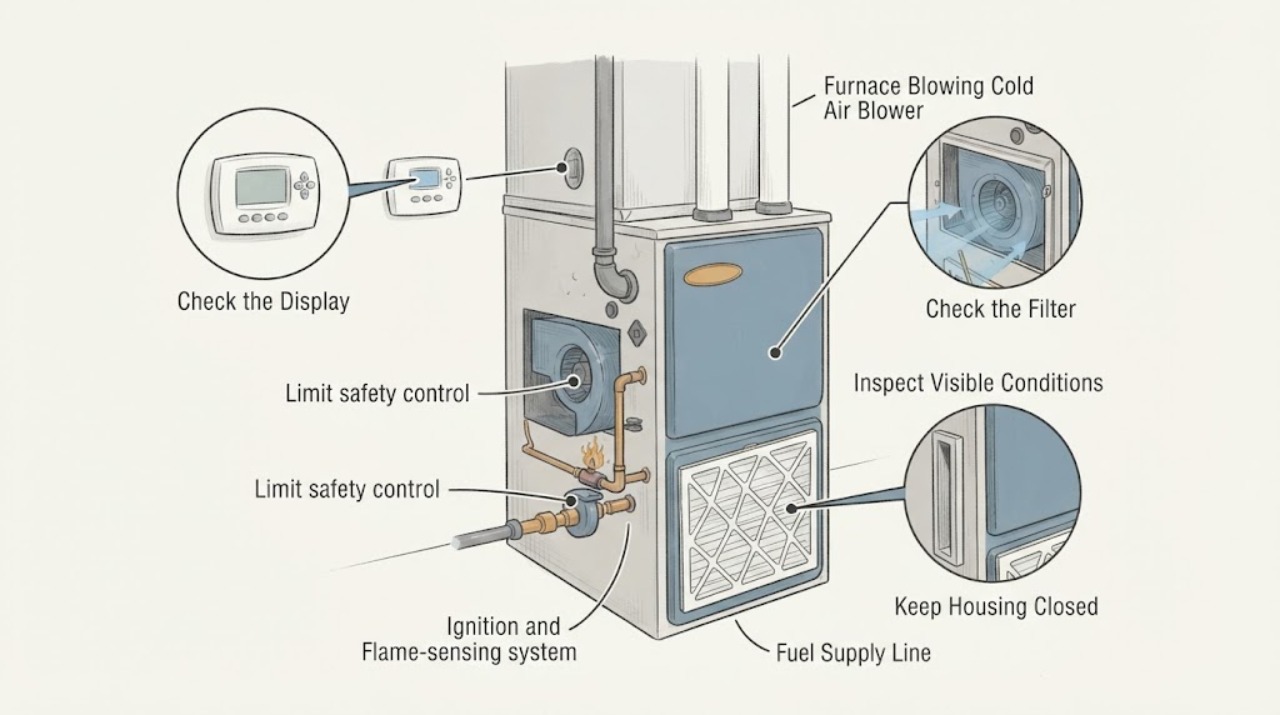
If the furnace blower runs but the registers feel cold, first check the thermostat mode and fan setting. Fan set to On can circulate room-temperature air when the burners are off, and a short blower run at startup or after shutdown can be normal while the heat exchanger warms or residual heat is distributed. If the thermostat calls for Heat with the fan on Auto, inspect the accessible filter and make sure return and supply grilles are not blocked. A clogged filter can restrict airflow, overheat the furnace, and cause a safety limit to shut the burners off while the blower continues. If the blower runs but the burners never establish heat, the ignition, flame sensor, fuel, limit, or control system may need professional diagnosis. Do not open the furnace cabinet, touch gas or ignition parts, bypass a safety control, or repeatedly reset power. For a strong gas smell, a carbon-monoxide alarm, smoke, soot, arcing, or repeated breaker trips, leave the area or home as appropriate, contact emergency or utility services from a safe location, and keep the furnace off until it is professionally cleared.
Before you begin
Safety first
- Do not open the furnace cabinet, touch burners, gas valves, igniters, flame sensors, limit switches, wiring, or control boards; do not bypass a safety control, relight or adjust gas components, test voltage, or repeatedly reset a breaker. For a strong gas smell, CO alarm, smoke, or combustion symptoms, leave the home or affected area and contact emergency or utility services from a safe location.
Work through in order
Diagnostic checks
Use only checks that match the exact appliance or system and its official guide.
-
Check 1
Use the thermostat's normal controls to confirm the mode is Heat, the set point is above the room temperature, and the fan is set to Auto rather than On. Note whether the blower stops when there is no heat call and whether the cold air occurs only at startup or after shutdown. Do not remove the thermostat cover or change wiring.
Expected result: The fan is set to On; the mode or schedule is not calling for heat; the blower runs briefly around a heat call; or the blower continues while Heat and Auto are correctly selected.
Next step: Correct only the normal mode, set point, schedule, or fan setting and observe one complete heat call. If the blower still runs with cold air during a correct call, continue with the filter and airflow checks; do not keep changing settings to force the furnace to run.
Why this matters
Why: Fan On can circulate room-temperature air without active heating, and a brief pre- or post-cycle blower period may be normal for the model. A correct Heat/Auto call with prolonged cold airflow makes an ignition, airflow, limit, fuel, or control issue more likely.
-
Check 2
Inspect the furnace filter through its ordinary user-accessible slot or rack with the furnace turned off at the thermostat. Note whether it is visibly clogged, collapsed, wet, damaged, or installed backward, and check that return grilles and supply registers are not covered by furniture or stored items. Do not operate the furnace without the required filter and do not open the blower or burner compartment.
Expected result: The filter is heavily loaded or damaged; return airflow is blocked; several supply registers have weak airflow; or the filter and airflow look normal.
Next step: If the filter is clearly due for replacement, use the exact size and type specified for the furnace and observe one normal call. If the filter is wet, airflow is weak across the home, cold air continues with a clean filter, or the furnace repeatedly shuts the burners off, arrange HVAC service rather than opening the cabinet.
Stop if: Stop for water near electrical equipment, smoke, soot, a burning or gas odor, or any need to remove a furnace door or access panel.
Why this matters
Why: A restricted filter or blocked return can reduce airflow and contribute to overheating, a limit safety shutdown, and a blower that continues with cold air. Normal airflow makes a filter-only explanation less likely and shifts attention toward heat generation, controls, or another professional fault.
-
Check 3
Observe one heat call from outside the cabinet. Listen for the normal sequence as described by the owner's manual, and note whether the blower starts before any warmth, whether warm air appears briefly and then turns cold, or whether the blower runs without any sign of heat. If the furnace has an existing manufacturer-provided sight glass, observe only through it; do not open a door or reach toward the flame.
Expected result: Warm air never appears; warm air appears briefly and then becomes cold; the blower starts after a delay and then delivers warmth; or the visible flame is absent, yellow, uneven, or unstable where a sight glass is provided.
Next step: Record the sequence and turn the furnace off for an absent or abnormal flame, repeated burner dropout, soot, unusual noise, or persistent cold air. Arrange qualified furnace service; do not relight, clean, bend, bypass, or adjust ignition, burner, flame-sensing, gas, or limit components.
Stop if: Stop immediately for a strong gas odor, soot, smoke, an abnormal flame, a bang on ignition, or any need to open the combustion compartment.
Why this matters
Why: No heat after a correct call makes ignition, flame sensing, fuel, limit, or control problems more likely. Heat that begins and then drops out can occur when a safety control interrupts combustion. A brief cold period before warm air or a short post-cycle blower period may be normal. An abnormal visible flame is a combustion-service issue, not a homeowner adjustment.
-
Check 4
Check only normal external power indications: note whether the furnace service switch appears on, whether the thermostat display is stable, and whether a breaker is already tripped. Do not test voltage, remove electrical covers, or repeatedly reset a breaker. If the furnace has a user-visible status light without opening the cabinet, record the pattern rather than treating it as a diagnosis.
Expected result: The thermostat is blank or intermittent; the service switch appears off; a breaker is tripped; the status indicator shows a fault pattern; or external power indications are normal but the blower still runs cold.
Next step: Restore only an accidentally switched-off normal service switch if it is clearly accessible and safe, and do not reset a breaker that trips again. For a recurring trip, blank thermostat, fault indicator, or continued cold air with normal power indications, leave the furnace off and arrange qualified service.
Stop if: Stop for a repeated trip, burning or electrical odor, smoke, arcing, hot wiring, or exposed conductors.
Why this matters
Why: Unstable control power, a tripped breaker, or a diagnostic indicator can accompany an electrical or control fault. A normal external view does not clear the ignition, flame, limit, blower, fuel, or heat exchanger path.
-
Check 5
Check the fuel and safety context without manipulating the furnace. Note whether other fuel appliances work normally only if you can do so without entering an unsafe area, and note any gas odor, soot, unusual exhaust, carbon-monoxide alarm, headache, dizziness, or confusion. Do not try to prove a leak, operate a gas valve, or continue a heat call when a warning sign is present.
Expected result: There is a strong or lingering gas smell, a carbon-monoxide alarm, soot or smoke, abnormal exhaust, physical symptoms, or no combustion warning but the blower still produces cold air.
Next step: For gas odor or a CO alarm, leave the home or affected area and contact emergency or utility services from a safe location; do not use switches or flames while leaving. For smoke, soot, abnormal exhaust, or continuing cold air without an emergency warning, turn the furnace off and arrange qualified HVAC service.
Stop if: Stop all inspection and leave for a strong gas smell, CO alarm, smoke, or symptoms that could be related to combustion exposure.
Why this matters
Why: Gas odor, a CO alarm, soot, smoke, or symptoms can indicate a combustion or venting hazard and outrank ordinary cold-air troubleshooting. Without those warnings, a fuel, ignition, limit, or control failure can still require a trained technician even when the blower operates.
-
Check 6
Prepare the service handoff from the observations already made: record the thermostat mode and fan setting, filter condition, airflow, the timing of blower and burner sounds, whether warmth ever appeared, any visible sight-glass observation, power events, and any odor or alarm. Photograph only the accessible filter, thermostat display, or exterior label; do not remove a panel to obtain a model or fault code.
Expected result: The symptom resolves after the correct thermostat or filter adjustment; the blower continues cold with normal settings and airflow; or a safety condition prevents further observation.
Next step: Give the technician the timeline and observations, keep the furnace off for warning signs, and do not attempt internal cleaning, gas work, ignition repair, or control replacement based only on the blower symptom.
Why this matters
Why: A response to Fan Auto or a correctly fitted filter supports a setting or airflow contributor. Persistent cold air with a correct call and clean airflow directs diagnosis to ignition, flame sensing, safety controls, fuel, blower control, or the heat exchanger. Safety symptoms require no further homeowner testing.
Use your observations
Decision map
Find the observation that best matches what you see, then follow the next safe action.
-
PATH 01Next step
What you see
The fan is set to On, or cold air appears only briefly before the furnace warms up or after the burners stop, and the furnace otherwise heats normally.
Do this next
Use Fan Auto when you want the blower to run only with a heat call, and compare the timing with the exact owner's manual. Arrange service if the delay becomes prolonged, the pattern changes, or the furnace does not produce sustained warmth.
Why this path and its safety boundary
Why it matters: The blower behavior is consistent with a thermostat fan setting or a model-specific startup or post-cycle delay rather than a failed heat source.
-
PATH 02Next step
What you see
The filter is clogged or wet, return or supply airflow is restricted, airflow is weak at several registers, and the burners appear to stop while the blower continues.
Do this next
Replace only an accessible filter with the exact specified type and size, then observe one call. If the filter is wet, airflow remains weak, burners drop out, or cold air returns, turn the furnace off and arrange professional service without opening the cabinet.
Why this path and its safety boundary
Why it matters: Restricted airflow and an overheating limit response are more likely. The blower may be running to cool the furnace after a safety control interrupts heat production; a dirty filter may not be the only issue if the pattern persists.
-
PATH 03Next step
What you see
The thermostat correctly calls for Heat with Fan Auto, airflow is reasonable, but no warmth appears or warmth disappears shortly after ignition; a fault indicator or repeated burner dropout may be present.
Do this next
Turn the furnace off and arrange qualified HVAC diagnosis. Do not relight a pilot without exact manufacturer direction, clean a flame sensor, test a gas valve, bypass a limit, or open the combustion or electrical compartment.
Why this path and its safety boundary
Why it matters: Ignition, flame sensing, fuel delivery, limit controls, or the furnace control board is more likely than a blower failure. The blower is doing its job of moving air, but the heat source is not staying enabled.
-
PATH 04Next step
What you see
A strong or lingering gas odor, CO alarm, soot, smoke, abnormal exhaust, physical symptoms, or an abnormal visible flame accompanies the cold-air complaint.
Do this next
Leave the home or affected area and contact emergency or utility services from a safe location for gas odor, CO alarm, smoke, or symptoms. Keep the furnace off and do not re-enter or resume operation until the appropriate professionals say it is safe.
Why this path and its safety boundary
Why it matters: A possible fuel, combustion, venting, or carbon-monoxide hazard takes priority over comfort troubleshooting. The home and occupants need a safe response, not repeated furnace starts.
-
PATH 05Next step
What you see
The thermostat or furnace power is intermittent, a breaker trips, the blower runs with Heat off, or the blower behavior remains abnormal after the mode, filter, and airflow checks.
Do this next
Do not keep resetting power or opening the furnace. Leave the system off for recurring trips, burning odor, exposed wiring, or smoke and arrange qualified HVAC service; provide the exact timing of the blower and power events.
Why this path and its safety boundary
Why it matters: An electrical, thermostat, blower motor, fan-limit, or control-board problem is more likely. External power checks cannot identify a safe internal repair.
Helpful context
Understand the symptom
Cold air does not always mean the blower has failed
The blower's job is to move air; it does not create heat. A furnace may run the blower briefly before warm air is ready or after the burners stop, and Fan On can make it run continuously between heat calls. The more concerning pattern is a correct Heat call with the blower continuing while the burners never establish or stay on, especially when airflow is weak, the house remains cold, or the furnace repeatedly starts and stops.
Use airflow clues to separate a filter issue from a heat-generation issue
A blocked filter or covered return can reduce airflow enough to overheat the heat exchanger and trip a limit safety control. The burners then stop while the blower runs to cool the furnace, which feels like cold air. If airflow is normal and the furnace never produces warmth, the ignition, flame sensor, fuel supply, safety controls, or control board become more plausible. A filter can be checked at its normal access point; the heat-producing section cannot be safely diagnosed by opening the cabinet.
Keep combustion and electrical work outside the homeowner check
The safe inspection boundary is the thermostat, accessible filter, unblocked registers and returns, a normal user-visible power indicator, and an existing sight glass if the exact furnace is designed with one. Do not remove doors, touch burners, gas valves, igniters, flame sensors, limit switches, wiring, or circuit components. Gas odor, a carbon-monoxide alarm, soot, smoke, or an abnormal flame changes this from a comfort complaint to a safety event.
Only after diagnosis
Potential parts
- replacement furnace air filter
Consider this category only when the accessible filter is visibly loaded, wet, damaged, or due for replacement and airflow or burner operation improves after the correct filter is installed.
Confirm the exact dimensions, filter type, airflow direction, and furnace guidance before ordering. Never operate the furnace without the required filter. - thermostat or fan-control component
Consider this category only after qualified testing links continuous blower operation or incorrect heat calls to the thermostat or fan control; cold air alone does not identify this part.
Confirm the furnace type, wiring, staging, control sequence, and manufacturer requirements before selecting a component. Do not open or rewire the thermostat as a user repair. - flame sensor or ignition component
Consider this category only when qualified diagnosis confirms that ignition or flame sensing fails after the blower starts or the burners drop out; a clean filter and cold air do not prove either part is faulty.
Match the furnace model, ignition design, mounting, electrical characteristics, and manufacturer service information. Combustion and ignition work requires qualified service. - limit switch or furnace control board
Consider this category only after a qualified technician confirms a limit-control or control-board fault causing the burners to stop while the blower continues.
Confirm the furnace model, safety ratings, wiring, control sequence, and manufacturer procedures. Do not bypass or replace a safety control based only on the symptom.
When checks do not resolve it
Need a professional?
Stop and arrange qualified HVAC service when the blower continues to deliver cold air with Heat and Auto correctly set, after a clean and correctly fitted filter, or when burners fail to light, drop out, the furnace shows a fault indicator, or airflow remains weak. Leave the home or affected area and contact emergency or utility services from a safe location for a strong gas smell, carbon-monoxide alarm, smoke, soot, abnormal exhaust, or combustion-related symptoms. Do not open the cabinet, handle gas or ignition parts, bypass safety controls, test electrical components, or repeatedly reset power.
Safety scope: Do not open the furnace cabinet, touch burners, gas valves, igniters, flame sensors, limit switches, wiring, or control boards; do not bypass a safety control, relight or adjust gas components, test voltage, or repeatedly reset a breaker. For a strong gas smell, CO alarm, smoke, or combustion symptoms, leave the home or affected area and contact emergency or utility services from a safe location.
Common questions
FAQ
Why is my furnace blower running but blowing cold air?
The fan may be set to On, the blower may be in a normal startup or post-cycle delay, or the furnace may have stopped producing heat because of restricted airflow, a limit safety response, ignition or flame-sensing trouble, fuel delivery, or a control fault. Check Heat and Auto, inspect the accessible filter, and note the sequence. Persistent cold air with correct settings needs qualified furnace diagnosis.
Should the furnace fan run after the heat shuts off?
A short blower run after a heating cycle can distribute remaining heat and may be normal for the model. If the blower runs continuously with the thermostat off, or cold air continues for an unusually long time, check that Fan is set to Auto. If it still runs abnormally, arrange service for the thermostat, fan-limit control, blower, or control board.
Can a dirty furnace filter make the furnace blow cold air?
Yes. A clogged filter restricts airflow, can overheat the heat exchanger, and may cause a safety limit to stop the burners while the blower continues. Inspect the filter through normal access and replace it with the exact specified type and size if it is due. If the filter is wet, airflow is weak, or cold air continues, turn the furnace off and call for service.
What if the furnace blower runs but the burners never light?
The ignition, flame-sensing, fuel, limit, or control system may be preventing heat production. You can record the timing and any user-visible status indication, but do not open the cabinet, relight or adjust gas components, clean the flame sensor, bypass a safety control, or test wiring. Turn the furnace off and arrange qualified HVAC service.
Is a furnace blowing cold air a carbon-monoxide emergency?
Cold air by itself does not prove a carbon-monoxide problem, but a CO alarm, strong or lingering gas odor, soot, smoke, abnormal exhaust, or combustion-related symptoms is an emergency boundary. Leave the home or affected area and contact emergency or utility services from a safe location. Do not operate the furnace again until the appropriate professionals say it is safe.
Read the exact guide
Official sources
- Furnace Troubleshooting Guide | Fix a Furnace Not WorkingCarrier · Manufacturer troubleshooting guidance for furnace heating failures and airflow-related safety shutdowns
- Furnace Troubleshooting: Gas Furnace SolutionsTrane · Manufacturer homeowner safety guidance for a gas furnace that fails to produce heat or may have a combustion or venting concern
- Furnace Blower Not Working: Causes and SolutionsTrane · Manufacturer troubleshooting guidance for a furnace blower that runs continuously or runs while the furnace produces no heat
- Why Is My Furnace Blowing Cold Air? | 10 Common Causes & FixesCarrier · Manufacturer homeowner guidance for a furnace whose blower runs while the delivered air is cool or cold
Community feedback
Share a repair observation
Share a plain-text repair observation. Accepted observations are published automatically; this page may take a moment to update.