
On this page
Start here
Quick answer
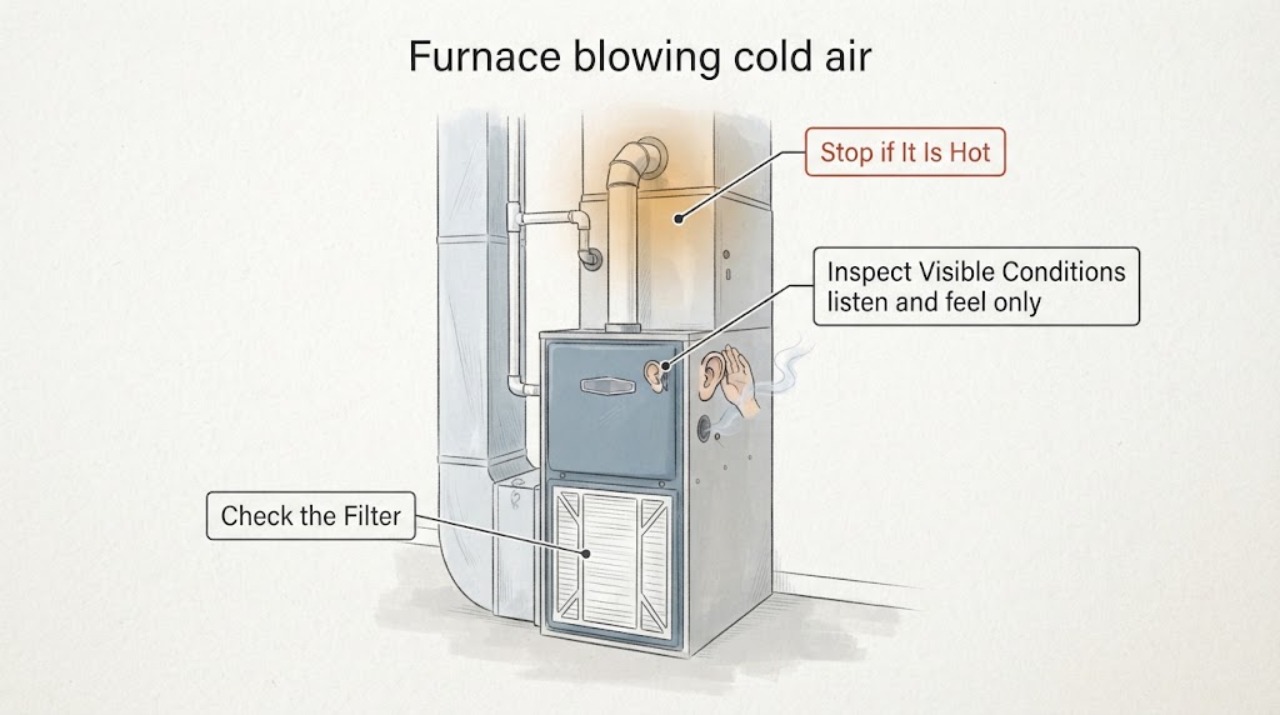
A furnace can blow cool air briefly while a heat cycle starts, or continuously when the thermostat is calling for heat but the burners are not heating. First check the thermostat mode, setpoint, and fan setting, then observe one normal cycle, the accessible filter, and the open supply and return vents. Record any visible status code. Do not open the furnace cabinet or work on gas, combustion, or electrical parts. Stop and leave the home for a gas odor, smoke, a carbon-monoxide alarm, or other emergency warning; call emergency services or the gas utility as appropriate. If the air stays cold, the unit short-cycles, or a code remains, arrange qualified HVAC service.
Work through in order
Diagnostic checks
Use only checks that match the exact appliance or system and its official guide.
-
Check 1
At the thermostat, observe the selected mode, the fan setting, the room temperature, the heat setpoint, and any heat-call indicator. If the controls are accessible, use the owner's normal controls to select Heat, set the target above the room reading, and leave the fan on Auto for one normal call; do not repeatedly cycle the system.
Expected result: The thermostat may show Cool or Off, Fan On, no heat-call indicator, a heat call with no response, or a heat call that starts the furnace.
Next step: If the setting was wrong, observe the single normal call. If the settings were already correct or the issue remains, continue to the cycle observation and save the thermostat display details for the technician.
Stop if: Stop using the furnace if smoke, a burning smell, a gas odor, a carbon-monoxide alarm, or a breaker trip occurs; leave the area as appropriate and seek emergency or qualified service help.
Why this matters
Why: Cool, Off, or Fan On can explain room-temperature air being circulated without active heating. A correct heat call that starts the blower moves the check to the cycle and airflow observations. No response with correct settings needs service rather than cabinet or electrical work.
-
Check 2
From a safe location, listen and feel only at an accessible supply register during one normal heat call, without opening the unit. Note whether the first air is cool and then warms, stays cool, stops, or comes in repeated short bursts.
Expected result: Air that warms after the startup phase is different from air that remains cool, weak airflow, no airflow, or a cycle that starts and stops repeatedly.
Next step: If the air warms normally, monitor comfort and schedule. If it remains cool or the cycle is abnormal, record when the symptom begins and continue with the external filter and vent checks, then request HVAC service.
Stop if: Do not continue observing cycles when there is gas or burning odor, smoke, a carbon-monoxide alarm, unusual ignition noise, or any other emergency sign.
Why this matters
Why: Brief cool air can reflect the model's normal blower delay. Persistent cool air or short cycling means the heat-producing sequence, airflow, or a safety control needs professional diagnosis; the observation alone cannot identify a failed flame or ignition part.
-
Check 3
Visually inspect only the accessible air-filter location or return grille, following the owner's manual and without removing a furnace cabinet or access panel. Note whether the filter is visibly gray, dust-loaded, missing, correctly seated, or not safely reachable.
Expected result: A visibly loaded filter or a filter that is missing or not seated is different from a clean filter and from a filter location that would require unsafe access.
Next step: If the filter is safely accessible and the manual identifies the correct replacement, use only the specified type and then arrange service if cold air persists. If access requires opening the furnace, or if the symptom does not change, stop homeowner troubleshooting and provide the filter observation to the technician.
Stop if: Do not reach into the furnace, defeat a panel interlock, touch wiring or combustion parts, or keep operating a unit that smells hot, smokes, trips a breaker, or triggers an alarm.
Why this matters
Why: A clogged filter can restrict airflow and contribute to overheating or short cycling. A clean filter makes that explanation less likely, while an inaccessible location or an uncertain fit calls for the equipment instructions or a technician rather than improvisation.
-
Check 4
Walk through the rooms and observe accessible supply registers and return grilles without removing covers. Note whether supplies and returns are open and unblocked, whether airflow is weak everywhere or only in one area, and whether furniture or rugs obstructs a grille.
Expected result: All registers may be open with normal airflow, several may be closed or blocked, or the problem may be limited to one register or zone.
Next step: Clear only ordinary household obstructions and leave accessible supply vents open as the system design requires. If airflow remains weak or cold, do not open ductwork; schedule qualified HVAC service.
Stop if: Stop if a grille is hot, damaged, smoking, wet near electrical equipment, or associated with a burning or gas odor; leave hazardous areas and call for professional help.
Why this matters
Why: Blocked or closed registers can reduce distribution and airflow and can contribute to short cycling. A single-room issue points toward distribution; weak or cold airflow everywhere after a correct heat call points toward the furnace or system controls.
-
Check 5
Without opening the furnace, record any thermostat message, visible exterior status display, or indicator pattern exactly as shown, along with whether the thermostat calls for heat. Also note any gas odor, burning odor, smoke, unusual bang, or carbon-monoxide alarm.
Expected result: A displayed code or normal indicator is actionable information; an odor, smoke, unusual ignition sound, or alarm is a safety stop rather than a code to decode at home.
Next step: Give the exact code, model information, thermostat settings, cycle behavior, filter condition, and vent observations to the HVAC provider. For an alarm or suspected CO exposure, follow the emergency branch immediately and do not re-enter or reuse the furnace until cleared by the appropriate responders and trained service personnel.
Stop if: For a carbon-monoxide alarm or symptoms such as headache, dizziness, nausea, confusion, or shortness of breath, move outside to fresh air, call emergency services, and do not search for the source or operate the furnace.
Why this matters
Why: Exact codes are model-specific and should be interpreted from the owner's manual or by the manufacturer-qualified technician. Fuel-burning equipment and suspected combustion or venting faults require professional assessment, not a guessed reset or bypass.
Use your observations
Decision map
Find the observation that best matches what you see, then follow the next safe action.
-
PATH 01Safety boundary
What you see
The thermostat is in Cool or Off, the fan is On, or the setpoint is not above the room temperature.
Do this next
Correct the setting using the thermostat's normal controls and observe one normal heat call. If cold air continues with a correct heat call, request HVAC service.
Why this path and its safety boundary
Safety stop: Do not continue if an odor, smoke, alarm, or breaker trip appears.
-
PATH 02Safety boundary
What you see
Air is cool only at startup and then becomes warm during the normal cycle.
Do this next
Treat the startup behavior as potentially normal for that model, monitor the home's comfort, and consult the owner's manual if the delay changes or lengthens.
Why this path and its safety boundary
Safety stop: Stop if the cycle becomes abnormal or any gas, burning, smoke, or CO warning appears.
-
PATH 03Safety boundary
What you see
The filter is visibly loaded or airflow is weak and several registers are blocked.
Do this next
Follow the owner's instructions for a safely accessible, correctly specified filter and clear ordinary register obstructions. If cold air or short cycling remains, book qualified service.
Why this path and its safety boundary
Safety stop: Do not open the furnace or continue operating with smoke, burning odor, gas odor, alarm, or repeated breaker trips.
-
PATH 04Safety boundary
What you see
The thermostat calls for heat but air stays cold, the furnace short-cycles, a status code remains, or there is no response.
Do this next
Stop homeowner diagnosis and arrange qualified HVAC service. Provide the exact code, thermostat settings, cycle timing description, filter condition, airflow observations, and furnace model if known.
Why this path and its safety boundary
Safety stop: Do not attempt ignition, flame-sensor, gas-valve, combustion, wiring, panel, or safety-control work.
-
PATH 05Safety boundary
What you see
There is a gas odor, smoke, burning odor, carbon-monoxide alarm, suspected combustion or venting issue, or symptoms consistent with CO exposure.
Do this next
Leave the home or affected area, move to fresh air, and call emergency services or the gas utility from a safe location as appropriate. Have the furnace evaluated by trained personnel before reuse.
Why this path and its safety boundary
Safety stop: Do not operate switches, search for the source, reset the furnace, or re-enter until the appropriate responders permit it.
Helpful context
Understand the symptom
Separate a normal startup from a heating failure
Cool air at the beginning of a call for heat can be a normal blower delay while the furnace warms its heat exchanger. Air that remains cool after the startup phase, a blower that runs without a heat call, repeated short cycles, or no heat at any register points to a fault or an airflow problem. The checks below are limited to controls and parts that are visible and accessible without opening the furnace or touching fuel, flame, or live electrical components.
Safety boundary
Fuel-burning furnaces can produce carbon monoxide when they are faulty, poorly maintained, or improperly vented. Do not relight an ignition source, bypass a safety, remove a combustion panel, reset a lockout, or work on a gas valve, burner, wiring, or circuit. A carbon-monoxide alarm or gas odor is an emergency, not a troubleshooting branch.
Only after diagnosis
Potential parts
- furnace air filter
Only consider a filter after a visible inspection shows it is loaded and the owner's instructions identify a safe, correctly sized replacement.
Confirm the furnace model, filter dimensions, airflow direction, and manufacturer's permitted filter type before ordering. - furnace flame sensor
This is only a possible service part if a qualified technician confirms a flame-sensing fault after the furnace's exact symptom and status code are diagnosed.
Do not assume compatibility from appearance; the technician must identify the furnace model and approved part. - furnace igniter
This is only relevant if professional diagnosis confirms an ignition fault rather than a thermostat, airflow, fuel, venting, or control issue.
Confirm the exact furnace model and manufacturer-approved fitment before any part is selected or installed.
When checks do not resolve it
Need a professional?
Call a qualified HVAC professional when the thermostat and accessible airflow checks do not restore heat, when the furnace short-cycles, when a status code remains, or whenever gas, combustion, venting, electrical, ignition, or safety controls may be involved.
Common questions
FAQ
Is cool air at the beginning of a furnace cycle always a failure?
No. Some furnaces delay the blower until the heat exchanger is warm. If air stays cool after startup, the system short-cycles, or the thermostat calls for heat without warming the air, use the safe observations above and arrange HVAC service.
Why can Fan On make a furnace seem to blow cold air?
Fan On can circulate room-temperature air between heating cycles. Compare it with Fan Auto during one normal heat call. If the furnace still blows cold air with Heat selected, the setpoint above room temperature, and Fan Auto, the setting is not the whole problem.
Can a dirty furnace filter cause cold air?
A visibly loaded filter can restrict airflow and contribute to overheating or short cycling, leaving the blower running after heat stops. Inspect only an accessible filter location and follow the owner's instructions; do not open a cabinet to reach it.
What should I do if the furnace has a gas odor or the CO alarm sounds?
Treat that as an emergency. Leave the home or affected area, move to fresh air, and call emergency services or the gas utility from a safe location. Do not search for the source, operate switches, reset the furnace, or reuse it until trained personnel clear it.
Read the exact guide
Official sources
- Why Is My Furnace Blowing Cold Air?Carrier · General forced-air furnace troubleshooting concepts; model-specific timing and service instructions remain manufacturer-dependent.
- HVAC Proper Installation of FiltersU.S. Department of Energy Building Science Education · General ducted HVAC filter principles; the furnace owner's manual controls the exact filter specification and access method.
- Carbon Monoxide Fact SheetU.S. Consumer Product Safety Commission · Safety guidance for homes using fuel-burning appliances, including furnaces.
Community feedback
Share a repair observation
Share a plain-text repair observation. Accepted observations are published automatically; this page may take a moment to update.