
On this page
Start here
Quick answer
A furnace that starts and then blows cold air may be losing the burner after the ignition sequence, but thermostat settings, airflow, a limit control, fuel delivery, venting, or another safety control can look similar. Observe only from normal safe positions: note the call for heat, burner and blower timing if visible without opening the unit, filter condition, and any fault indicator. Do not clean or adjust a flame sensor, open the furnace cabinet, handle gas or electrical parts, or bypass a safety. Arrange HVAC service; leave the furnace off and leave the building if a carbon-monoxide alarm sounds or anyone feels ill.
Before you begin
Safety first
- This article is observation-only. HVAC professionals handle cabinet access, flame-sensor and igniter testing, gas and electrical work, combustion analysis, venting, and safety controls.
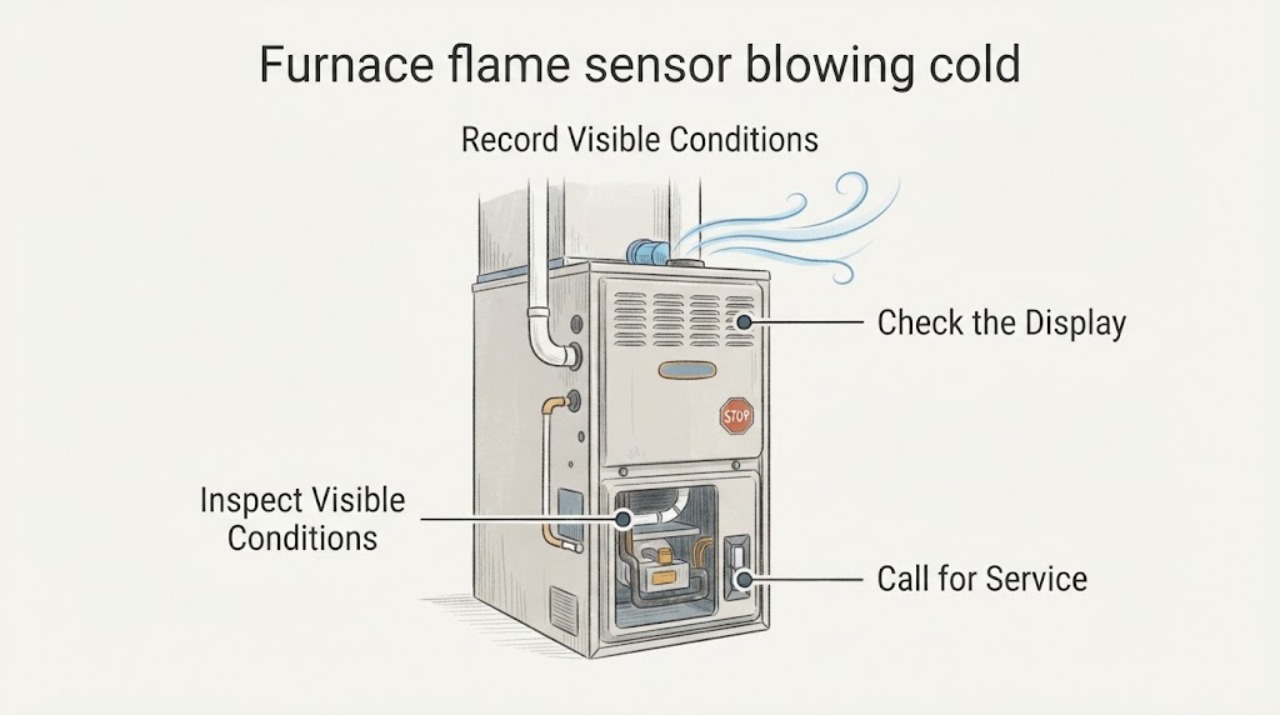
Work through in order
Diagnostic checks
Use only checks that match the exact appliance or system and its official guide.
-
Check 1
Set the thermostat to its normal heat request and observe from a safe distance whether the furnace starts, whether warm air ever arrives, and when the air turns cool; do not cycle it repeatedly.
Expected result: The unit may not start, ignite briefly then stop, run the blower without heat, or deliver heat normally for a period before cooling.
Next step: Record the sequence and arrange HVAC assessment.
Stop if: Stop immediately for gas odor, smoke, unusual flame, a CO alarm, dizziness, headache, or other illness.
Why this matters
Why: The sequence helps the technician separate a call-for-heat issue from burner-safety shutdown or airflow behavior, but does not identify a failed sensor.
-
Check 2
From outside the cabinet, note any normal status light or displayed fault code and photograph the furnace data label only if already visible; do not remove panels or defeat an interlock.
Expected result: A code may be present, absent, intermittent, or unavailable on the model.
Next step: Provide the code and model information to the HVAC technician.
Stop if: Do not reset a safety repeatedly, open the cabinet, or bridge a switch.
Why this matters
Why: The exact code and model can direct the technician to the relevant safety circuit, while no code does not clear the flame sensor or burner system.
-
Check 3
From safe access, note whether supply airflow is weak or normal and whether the return filter appears visibly loaded, without reaching into the furnace or changing settings beyond the manufacturer’s normal user controls.
Expected result: Airflow may be weak, restricted-looking, noisy, or normal while the air remains cool.
Next step: Record the observation and ask the technician to evaluate filter, blower, limit, and heat-operation conditions.
Stop if: Do not open the unit, handle the blower, or continue operation when overheating, smoke, or abnormal noise occurs.
Why this matters
Why: Restricted airflow can cause a safety control to stop heat, but a clean filter does not rule out internal airflow or combustion problems.
-
Check 4
From ground level and only where safe, look at exterior intake and exhaust openings for obvious blockage, snow, debris, or damage; do not climb, insert objects, or alter venting.
Expected result: Openings may appear clear, blocked, damaged, or inaccessible.
Next step: Photograph the safe view and report it before service.
Stop if: Do not enter restricted areas, touch vent components, or operate a fuel appliance with suspected venting failure.
Why this matters
Why: A blocked or damaged vent can affect combustion and safety, but a clear exterior does not rule out an internal vent or burner issue.
Use your observations
Decision map
Find the observation that best matches what you see, then follow the next safe action.
-
PATH 01Safety boundary
What you see
Has a carbon-monoxide alarm sounded, or does anyone have possible exposure symptoms?
Do this next
Leave immediately for fresh air, follow emergency guidance, and do not re-enter or operate the furnace until qualified responders and trained service personnel clear it.
Why this path and its safety boundary
Safety stop: Never investigate the furnace source while a CO alarm is sounding.
-
PATH 02Safety boundary
What you see
Does the burner ignite briefly and then stop while the blower continues?
Do this next
Report the timing and arrange prompt HVAC diagnosis of flame detection and other safety controls.
Why this path and its safety boundary
Safety stop: Do not clean, adjust, or replace the flame sensor yourself.
-
PATH 03Safety boundary
What you see
Is supply airflow weak, restricted, or unusually noisy?
Do this next
Stop if overheating or abnormal operation is present and request HVAC assessment of filter, blower, duct, and limit conditions.
Why this path and its safety boundary
Safety stop: Do not open the blower compartment or change combustion settings.
-
PATH 04Safety boundary
What you see
Is an exterior intake or exhaust visibly blocked or damaged?
Do this next
Leave the furnace off and arrange prompt qualified service; do not clear or modify the vent from an unsafe position.
Why this path and its safety boundary
Safety stop: Do not operate a fuel appliance with suspected venting or combustion failure.
Helpful context
Understand the symptom
Why the flame sensor is only one possibility
DOE defines a flame sensor as a device that detects whether a flame is present during a burner cycle and can shut the burner down when flame is not detected. That safety response can lead to cool air, but the same symptom can result from airflow or another control, so a flame-sensor replacement is not a safe diagnosis.
Treat combustion equipment as professional work
CPSC advises professional inspection and servicing of fuel-burning heating systems and warns against servicing without the proper knowledge, skill, and tools. Record the sequence and safety symptoms for a qualified HVAC technician instead of opening the furnace.
Only after diagnosis
Potential parts
- furnace flame sensor
Consider this category only after a qualified HVAC technician confirms the sensor and its installation are the cause.
Match exact furnace model, sensor type, mounting, and manufacturer instructions; do not bypass or substitute a safety component. - furnace igniter
Consider this category only if professional testing identifies an igniter fault rather than a flame-detection or airflow issue.
Confirm model, ignition system, electrical rating, and installation method with the technician. - furnace air filter
Consider this category only when the installed filter is due for replacement and the system instructions specify the size and type.
Confirm dimensions, airflow rating, and manufacturer guidance; a filter cannot fix combustion or safety-control faults.
When checks do not resolve it
Need a professional?
Arrange HVAC service when a furnace blows cold air after an ignition attempt, cycles off, shows a fault, has weak airflow, or has a suspected flame, gas, or venting issue. Treat a CO alarm, gas odor, unusual flame, smoke, or illness as an immediate safety emergency.
Safety scope: This article is observation-only. HVAC professionals handle cabinet access, flame-sensor and igniter testing, gas and electrical work, combustion analysis, venting, and safety controls.
Have this ready
- Furnace model and accessible fault indicator
- Thermostat call and burner/blower timing
- Warm versus cool-air sequence
- Filter and airflow observations
- Exterior vent view and any gas, flame, smoke, CO, or health symptom
Common questions
FAQ
Can a flame sensor cause cool air from a furnace?
It can shut the burner down when flame is not detected, but thermostat, airflow, fuel, venting, and other safety controls can produce similar symptoms. Professional testing is needed.
Should I clean the flame sensor?
Do not open the furnace or handle the sensor as a household test. Gas, combustion, electrical, and safety-control work belongs to a qualified HVAC technician.
What should I observe before service?
Record the thermostat call, burner and blower timing if safely visible, fault indicators, airflow, filter condition, exterior vent view, model, and any safety symptoms.
What if the carbon-monoxide alarm sounds?
Leave immediately for fresh air, follow emergency guidance, and do not re-enter or operate the furnace until qualified responders and trained service personnel clear it.
Read the exact guide
Official sources
- Weatherization Assistance Program Standardized Training Curricula GlossaryU.S. Department of Energy · Supports the explanation that a flame sensor detects flame during a burner cycle and can shut the burner down when flame is not detected.
- Carbon Monoxide Fact SheetU.S. Consumer Product Safety Commission · Supports professional inspection of fuel-burning heating systems, avoiding unqualified service, and immediate response to CO alarms or symptoms.
Community feedback
Share a repair observation
Share a plain-text repair observation. Accepted observations are published automatically; this page may take a moment to update.