
On this page
Start here
Quick answer
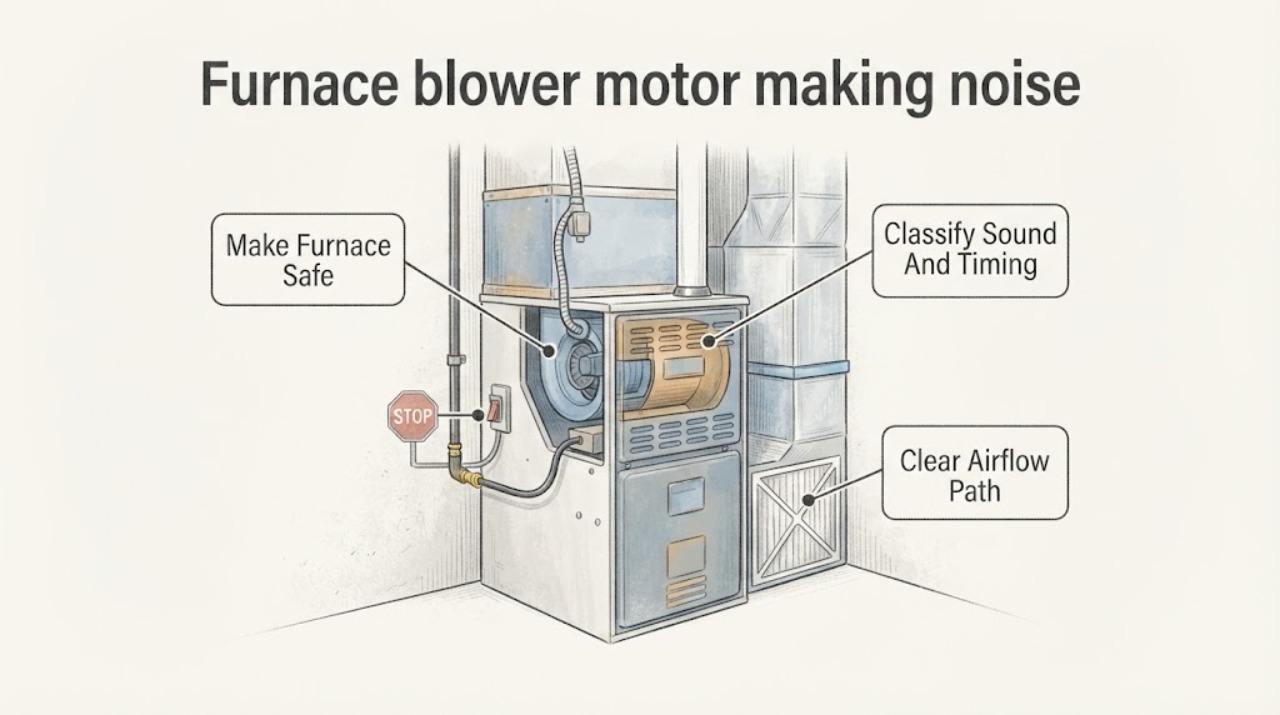
An Amana furnace blower motor that suddenly hums, rattles, scrapes, squeals, or vibrates may be reacting to restricted airflow, debris, a loose panel or duct, an unbalanced blower wheel, worn bearings, an electrical/control fault, or a motor that is overheating. First make a safe note of when the sound starts and whether it changes with the heating call, then check only the accessible filter, return and supply airflow, and exterior panels or ducts. Do not remove the furnace access panel, reach toward the blower, spin the wheel, test a capacitor, measure live voltage, adjust gas or pressure controls, or lubricate an unknown motor. A burning smell, smoke, sparking, gas odor, carbon-monoxide alarm, repeated shutdown, weak airflow, or a noise that is worsening is a stop-use condition. If the sound remains after the safe airflow and exterior checks, arrange a licensed HVAC inspection and provide the model number, sound recording, timing, filter history, and any display code.
Before you begin
Safety first
- This article supports ordinary-access observation only. A licensed HVAC professional handles furnace-panel access, blower-wheel and motor inspection, electrical testing, controls, gas combustion, venting, and any part replacement.
Work through in order
Diagnostic checks
Use only checks that match the exact appliance or system and its official guide.
-
Check 1
From outside the furnace cabinet, set the thermostat to a non-heating state and listen only from a safe distance; look for smoke, a burning or electrical odor, gas odor, flame abnormality, a carbon-monoxide alarm, water near electrical equipment, or a damaged cord or cabinet. Do not remove an access panel.
Expected result: The furnace is quiet and stable with no warning sign, or a warning sign, alarm, visible damage, or abnormal combustion/venting condition is present.
Next step: For gas odor, leave the area and contact the appropriate emergency or gas service from a safe location. For smoke, sparking, burning odor, carbon-monoxide alarm, or water near electrical parts, stop using the furnace and obtain emergency or licensed help. Otherwise continue with only the following ordinary-access checks.
Stop if: Do not restart the furnace to test a hazardous sound, enter the cabinet, touch wiring, or block or alter any vent pipe.
Why this matters
Why: No warning sign allows a limited exterior diagnosis. Smoke, gas or electrical odor, an alarm, or combustion or venting concern is a safety event, not a noise to reproduce.
-
Check 2
During one normal call only if there is no hazard, record the sound from a safe location and note whether it is a hum, buzz, rattle, scrape, squeal, vibration, or pulsing sound and whether it occurs at startup, at a speed change, throughout blower operation, or at shutdown.
Expected result: The sound is brief and unchanged from previous cycles, is new and continuous while the blower runs, follows a speed change, or appears even when there is no call for heat.
Next step: Save the recording and timing notes. Stop repeated tests and request licensed HVAC service for a new, continuous, worsening, or no-call sound.
Stop if: Do not put hands, tools, or a phone into the cabinet, touch the blower wheel, or continue a test if the sound changes to grinding, scraping, burning, or electrical arcing.
Why this matters
Why: A normal speed transition may sound different from a continuous mechanical noise. A new or worsening hum, buzz, rattle, clatter, or squeal can indicate loose parts, debris, imbalance, bearings, motor components, or airflow problems; noise without a call points to a control or another component rather than a simple heating-cycle sound.
-
Check 3
Inspect the filter and return and supply openings from their ordinary access points. If the filter is accessible as described by the model instructions, note whether it is visibly loaded and replace it only with the specified type and fit; confirm registers are not deliberately closed or blocked.
Expected result: The filter is visibly blocked, the return or supply path is obstructed, registers are closed, airflow is weak or noisy, or the air path appears clear.
Next step: Correct only a loose, ordinary-access obstruction or filter issue allowed by the manual, then make one brief normal observation. If noise or weak airflow remains, stop and arrange professional airflow and blower diagnosis.
Stop if: Do not remove ductwork, enlarge openings, run the furnace without its required filter, substitute an unapproved filter, or open the furnace to reach the blower.
Why this matters
Why: Restricted airflow can change pressure, air speed, noise, and blower loading. A clear path makes a local obstruction, duct vibration, blower-wheel imbalance, motor, control, or bearing issue more likely; it does not prove which one.
-
Check 4
With the furnace off and from a safe exterior position, observe whether the cabinet, nearby return grille, supply duct, or accessible trim visibly vibrates or rattles when the blower sound occurs; do not press on panels or loosen fasteners.
Expected result: The sound is localized to a loose-looking exterior panel or duct, travels through the ductwork, or is strongest at the blower cabinet with no visible exterior source.
Next step: Photograph the accessible vibration and include the sound recording with the service request. Do not attempt to secure a gas-furnace panel or duct connection if access requires removing covers.
Stop if: Do not brace the cabinet, wedge objects against a panel, remove screws, or reach into a moving or recently energized assembly.
Why this matters
Why: A panel or duct resonance can amplify a normal motor sound, while a sound strongest at the blower cabinet with no exterior source keeps the wheel, motor, bearings, mount, or control in question. Visual location alone cannot identify a failed part.
-
Check 5
From the thermostat and supply vents, note whether the furnace still heats normally, airflow is reduced, the blower stops or restarts, a display code appears, or the furnace shuts down after the noise; do not enter a service menu or reset a safety lockout repeatedly.
Expected result: Noise occurs with normal heat and airflow, noise accompanies weak airflow or cycling, the blower stops, a fault code appears, or the furnace repeatedly locks out.
Next step: Photograph the display without opening the cabinet, note the exact sequence, and leave the furnace off when a fault returns or heat and airflow are unreliable. Arrange licensed service.
Stop if: Do not bypass a limit or rollout device, change gas pressure, measure voltage, replace a fuse, or keep operating a furnace that repeatedly shuts down.
Why this matters
Why: Noise alone can be an early mechanical symptom, but reduced airflow, motor shutdown, over-temperature behavior, or a fault code raises the likelihood of a blower, filter/duct restriction, motor-control, voltage, or safety issue requiring diagnosis.
-
Check 6
Record the full Amana model and serial information, sound type and recording, timing in the cycle, filter and airflow observations, thermostat behavior, display code, recent maintenance or moves, and every warning sign before requesting service.
Expected result: The record shows a resolved filter or exterior obstruction with normal heat and airflow, or it documents persistent noise, poor airflow, shutdown, a code, or a safety concern.
Next step: Use the exact model literature and arrange licensed HVAC inspection for persistent or consequential noise. Keep the furnace off when a stop condition is present.
Stop if: Do not order or install a motor, capacitor, control board, belt, or wheel from a sound description alone, and do not perform wiring or gas work.
Why this matters
Why: A complete record helps a licensed technician separate duct or airflow resonance from a blower-wheel, motor, bearing, control, or safety diagnosis. It does not establish that a generic motor or capacitor will fit.
Use your observations
Decision map
Find the observation that best matches what you see, then follow the next safe action.
-
PATH 01Next step
What you see
The filter is loaded or the return, supply, or registers are visibly restricted, and the noise changes with the airflow correction while the furnace otherwise heats normally.
Do this next
Use only the model-approved filter and ordinary-access correction, then arrange service if noise, weak airflow, or cycling continues.
Why this path and its safety boundary
Why it matters: Restricted airflow is a plausible contributor, but a change in noise does not prove the blower motor is undamaged.
-
PATH 02Next step
What you see
The sound is a rattle or vibration localized to an accessible grille, panel, or duct, with normal airflow and no odor, alarm, or shutdown.
Do this next
Leave covers and fasteners undisturbed, document the location, and ask a licensed technician to inspect the panel, duct support, and blower assembly.
Why this path and its safety boundary
Why it matters: A loose-looking exterior or duct resonance may be amplifying the sound, but the furnace cabinet itself still needs professional inspection if the noise is new.
-
PATH 03Next step
What you see
The noise is strongest at the blower cabinet, persists through blower operation, or is a new scrape, squeal, grind, hum, or vibration despite a clear accessible airflow path.
Do this next
Stop repeated operation and arrange licensed HVAC service for a blower and motor inspection. Do not remove the access panel or spin the wheel.
Why this path and its safety boundary
Why it matters: Debris, an unbalanced wheel, mount, bearing, motor, or motor-control problem becomes more likely than a thermostat setting, but the sound cannot identify the failed component.
-
PATH 04Next step
What you see
Noise accompanies weak airflow, blower stopping or restarting, a fault display, reduced heat, or repeated furnace shutdown.
Do this next
Leave the furnace off when the fault returns, photograph the display, and obtain licensed HVAC diagnosis rather than resetting or bypassing a safety device.
Why this path and its safety boundary
Why it matters: The manufacturer troubleshooting path includes airflow restriction, blower obstruction, motor performance, over-temperature, voltage, and control conditions; this is not a normal noise-only branch.
-
PATH 05Next step
What you see
There is gas odor, smoke, sparking, a burning or electrical odor, carbon-monoxide alarm, abnormal flame, damaged wiring, water near electrical parts, or a blocked or damaged vent concern.
Do this next
Leave the area as appropriate, stop using the furnace, and contact the appropriate emergency, gas, or licensed HVAC service from a safe location. Do not inspect inside the cabinet.
Why this path and its safety boundary
Why it matters: Combustion, electrical, and venting hazards take priority over identifying the blower sound.
Helpful context
Understand the symptom
A new sound is a symptom, not a motor diagnosis
The blower moves air through the furnace and connected ductwork, but the sound heard near the cabinet may also be coming from a return grille, supply duct, cabinet panel, or another furnace component. Amana notes that the blower can be single-speed, multi-speed, or variable-speed, so a change in speed during a call can change the normal sound. The useful first distinction is whether the noise is a brief startup or shutdown sound, a steady sound while the blower runs, or a new sound that persists after the call ends. A recording from a safe distance and the exact timing are more useful than guessing at a replacement motor.
Separate airflow restriction from a mechanical or electrical fault
Amana's guidance says blocked filters, supply vents, intake ductwork, or closed registers can change air pressure and speed and make noise more noticeable. Its furnace troubleshooting charts also identify filter or duct blockage, blower obstructions, low delivered airflow, motor speed or performance, and over-temperature or voltage conditions as separate diagnostic paths. Check only what is accessible without opening the furnace. A clean filter does not prove the blower motor is healthy, and a noisy motor does not justify opening a gas furnace cabinet.
Gas-furnace safety limits the homeowner checks
A furnace contains line-voltage electrical parts, moving equipment, combustion components, and venting. Amana's carbon-monoxide guidance says combustion exhaust must be vented away from living spaces and recommends routine inspection by a qualified technician; a vent pipe must not be blocked, closed, or patched by a homeowner. If the noise occurs with a gas odor, a carbon-monoxide alarm, smoke, flame abnormality, or a venting concern, leave the area as appropriate and obtain emergency or licensed help. Do not keep restarting the furnace to reproduce the sound.
Use Amana literature for the exact model
Amana's literature library groups furnace product specifications and other model documentation. The topic does not identify a model, motor type, capacitor arrangement, filter access, or cabinet layout, so no generic motor-replacement or wiring procedure is safe to assume. Record the full model and serial information from the unit label and let a licensed HVAC professional use the matching documentation and the actual sound, airflow, and fault history to decide whether the blower wheel, motor, control, bearing, or duct system is involved.
Safety boundary
Stop conditions
- Stop using the furnace for gas odor, smoke, sparking, burning or electrical odor, a carbon-monoxide alarm, abnormal flame, or a venting concern; leave the area as appropriate and obtain emergency or licensed help.
- Do not remove furnace access panels, reach toward the blower, spin the wheel, test a capacitor, measure live voltage, change gas pressure, bypass a safety device, or replace wiring or controls.
- Do not block, close, patch, or alter vent pipes, and do not keep restarting a furnace that shuts down, displays a fault, loses airflow, or produces a worsening mechanical sound.
- If the noise remains after the model-approved filter and ordinary-access airflow checks, keep operation to a minimum and arrange licensed HVAC service.
Only after diagnosis
Potential parts
- furnace blower motor
Consider only if a licensed technician confirms the motor or its integrated electronics are the source after airflow, wheel, wiring, and control checks.
Confirm the complete Amana model, motor type, horsepower, electrical characteristics, mounting, and manufacturer fit information; never infer compatibility from sound or appearance. - blower wheel or mounting assembly
Consider only when professional inspection finds an unbalanced, damaged, obstructed, or poorly mounted wheel or assembly.
Wheel diameter, rotation, mounting, and cabinet arrangement are model-specific; the assembly must be selected and installed by a qualified technician. - blower motor control or capacitor
Consider only when the model's service diagnosis confirms a control or starting component fault; noise alone does not establish this part.
Confirm the exact electrical design and approved replacement for the model. Do not test or replace line-voltage components as a homeowner. - air filter
Consider only when the accessible filter is visibly loaded and the exact model documentation specifies a replacement filter of that fit and type.
Confirm the filter size, type, airflow suitability, and model instructions; a filter change does not repair a motor or wheel fault.
When checks do not resolve it
Need a professional?
Call a licensed HVAC professional for any persistent, new, worsening, or unexplained blower noise; weak airflow; repeated shutdown or restart; a display code; visible cabinet, duct, motor, or wiring damage; or any need to open the furnace. Treat gas odor, smoke, sparking, burning odor, carbon-monoxide alarm, abnormal flame, or venting concern as an immediate stop-use and emergency or licensed-service condition.
Safety scope: This article supports ordinary-access observation only. A licensed HVAC professional handles furnace-panel access, blower-wheel and motor inspection, electrical testing, controls, gas combustion, venting, and any part replacement.
Common questions
FAQ
Is a humming Amana furnace blower motor always failing?
No. A hum can be amplified by restricted airflow, a vibrating panel or duct, or a normal speed transition, but a new or louder hum can also indicate motor, bearing, wheel, or control trouble. Record when it occurs and check only the accessible filter and airflow path; persistent or worsening noise needs licensed HVAC inspection.
Can I remove the furnace panel to see whether the blower is rubbing?
Do not remove the panel or reach toward the blower as a homeowner. A gas furnace combines moving equipment, line-voltage electrical parts, combustion, and venting. Keep the furnace off for a persistent or hazardous sound and have a licensed technician inspect it.
Could a dirty filter make the blower noisy?
A blocked filter or restricted return and supply path can change air pressure, air speed, and blower loading and may increase noise. Replace an accessible filter only with the exact model-approved type and fit. If the noise, weak airflow, or cycling remains, the airflow system and blower need professional diagnosis.
When should I turn an Amana furnace off for blower noise?
Turn it off and seek help for smoke, gas or burning odor, sparking, a carbon-monoxide alarm, abnormal flame, venting concern, weak airflow, repeated shutdown, a fault code, or a worsening scrape, grind, squeal, or vibration. Do not repeatedly restart it to reproduce the sound.
Do I need the Amana model number before calling for service?
The model number is useful because blower motors, wheels, controls, filters, and access arrangements vary. Record the full model and serial information, the sound recording, timing, airflow result, and any display code, but do not delay emergency help for a gas odor, smoke, carbon-monoxide alarm, or electrical hazard.
Read the exact guide
Official sources
- HVAC Operation | Impacts on heating and cooling | Amana® brandAmana · Amana HVAC airflow, blower motor operation, abnormal sound clues, professional inspection, and gas-furnace venting and carbon-monoxide safety guidance
- Product Literature for Amana ProductsAmana · Amana product literature library and model-specific gas-furnace documentation
- TRoubleshooting ChartDaikin Comfort · Manufacturer furnace troubleshooting patterns for circulator blower airflow, obstruction, motor, control, voltage, and temperature conditions; use only as general manufacturer guidance when the exact Amana model manual is unavailable
Community feedback
Share a repair observation
Share a plain-text repair observation. Accepted observations are published automatically; this page may take a moment to update.