
On this page
Start here
Quick answer
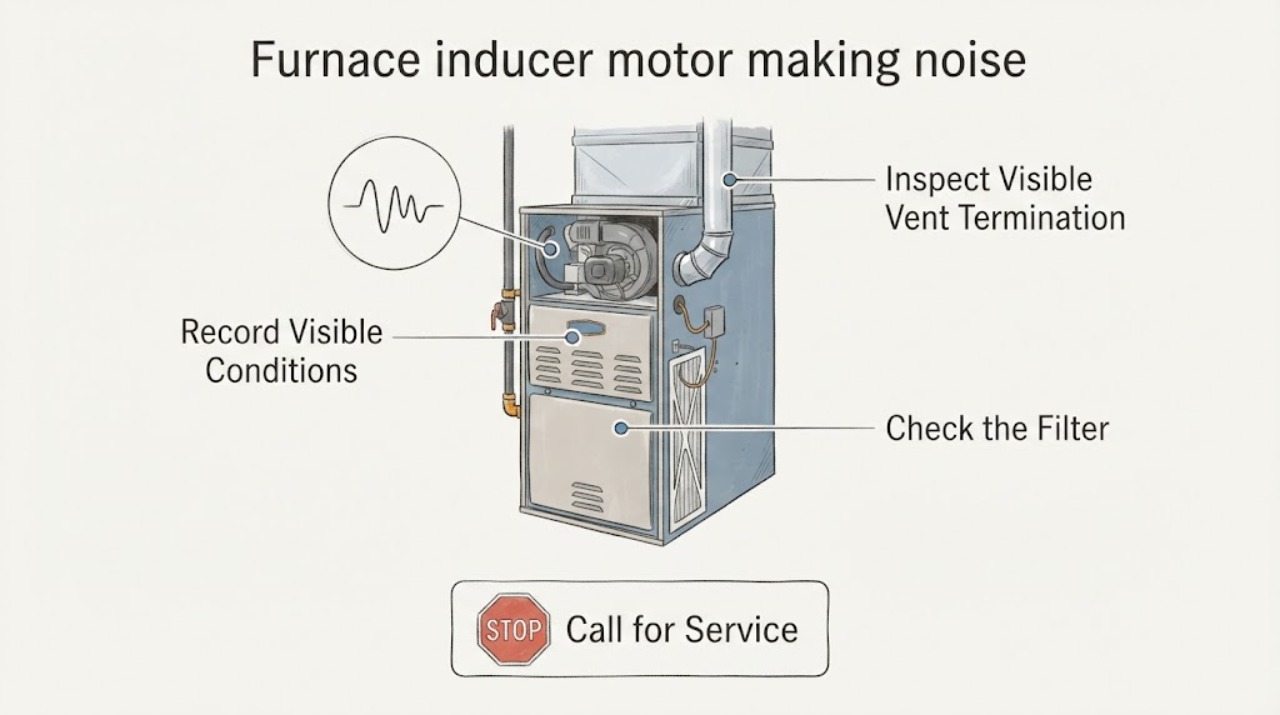
A furnace inducer motor normally runs at the beginning of a heating sequence to establish draft, but a new or unusually loud whine, squeal, grind, rattle, or vibration should not be treated as normal. First record exactly when the sound occurs and whether the furnace completes ignition, then check only the thermostat setting, accessible air filter, open vents, and any visible vent obstruction from a safe position. Do not open the furnace cabinet, touch the inducer, test the pressure switch, handle gas, or work on live electrical parts. If the inducer runs but burners do not light, the sound is worsening, a vent is blocked, a breaker trips, or you smell gas or combustion products, stop the furnace and arrange qualified HVAC service.
Work through in order
Diagnostic checks
Use only checks that match the exact appliance or system and its official guide.
-
Check 1
From outside the furnace cabinet, call for heat once and record the sound type, its location, and its timing: before ignition, while the inducer runs, when the burners light, at shutdown, or continuously. Note whether the furnace produces heat and whether the sound is new or louder than its usual startup sound.
Expected result: The sound is a high-pitched whine or squeal, grinding, rattling or vibration, a whistle, or a brief familiar hum; ignition may complete, fail, or stop shortly after starting.
Next step: Save a short recording if it can be made safely, note any status code visible through the normal indicator window, and use the next checks only if no hazard is present.
Stop if: Stop immediately for gas or flue odor, smoke, burning smell, banging at ignition, arcing, or a sound that becomes rapidly louder.
Why this matters
Why: A high-pitched or grinding sound keeps the inducer motor, wheel, bearing, or airflow in focus. Rattling can indicate loose ductwork or a loose component. A whistle can be airflow or filter related. An inducer that runs without ignition narrows the issue toward the ignition or draft-proving sequence, not just noise.
-
Check 2
Confirm the thermostat is calling for heat as intended and inspect the filter only at its normal user-accessible location. If the owner's manual permits it and the filter is visibly loaded, replace it with the specified type; also make sure return grilles and supply vents are not blocked.
Expected result: The thermostat mode or fan setting is wrong, the filter is visibly clogged, vents are blocked, or settings, filter, and accessible airflow are normal while the inducer noise remains.
Next step: Correct only the obvious thermostat, filter, or vent condition permitted by the manual, then make at most one controlled heating observation. If the noise remains, arrange service rather than opening the furnace.
Stop if: Stop for a wet filter, soot, unusual dust discharge, heat damage, or any need to remove an equipment panel.
Why this matters
Why: A loaded filter or blocked airflow can create whistling and make the furnace run under stress, but it does not prove the inducer motor is faulty. Normal accessible airflow with a mechanical inducer sound makes a motor, wheel, vent, or internal control assessment more likely.
-
Check 3
From ground level or another already safe position, look at the furnace exhaust or intake termination outside without climbing, probing, disassembling, or touching the pipe. Check for obvious snow, leaves, nests, ice, or another object covering the opening, and note whether the termination is damaged or disconnected.
Expected result: The termination is visibly clear and intact, or an obstruction, ice buildup, damage, or disconnection is visible; the furnace may also show a repeated start-and-stop or no-ignition pattern.
Next step: Do not reach into or modify the termination. Turn the furnace off if the vent is blocked or damaged and call qualified HVAC service to verify venting and combustion safety.
Stop if: Stop for flue-gas odor, soot, water or ice entering the furnace area, a loose pipe, or any unsafe outdoor access.
Why this matters
Why: A blocked or damaged vent can prevent the inducer from establishing the required draft and can cause the furnace to stop during its safety sequence. A clear termination does not rule out an internal blockage, condensate issue, pressure-switch issue, or motor fault.
-
Check 4
With the furnace access panels closed, read only the normal status light or display through its viewing window and compare the indicator with the exact owner manual. Do not remove a panel to inspect the inducer, pressure tubing, wiring, burner, or control board.
Expected result: The status is normal, a repeated fault or lockout is displayed, the inducer runs but ignition never follows, or the indicator is unavailable or unclear.
Next step: Photograph the indicator and provide the exact code, sound recording, and sequence to a qualified technician. Do not reset repeatedly or jumper a switch.
Stop if: Stop if the panel is loose, the indicator suggests rollout or overheating, or the furnace produces gas, smoke, or combustion odor.
Why this matters
Why: A repeated fault or an inducer-only sequence can support a draft, ignition, pressure-proving, or control diagnosis, but a code is not a license to bypass the safety or replace the inducer without testing. No visible code leaves the sound and sequence observations as the useful evidence.
-
Check 5
After one permitted filter or setting correction and only when no hazard is present, observe one heating call from a clear position. Stop the call at the thermostat if the noise returns or the furnace fails to establish heat; do not keep cycling the furnace to reproduce the sound.
Expected result: The furnace starts quietly and completes a heating cycle, the original noise returns, the inducer runs but burners do not light, or the furnace shuts down with a new odor, vibration, code, or abnormal sound.
Next step: Leave the furnace off when the noise or sequence fault returns and schedule HVAC service with the timing, recording, status code, filter result, and visible vent observations.
Stop if: Stop all testing for gas odor, carbon-monoxide alarm, smoke, flames, burning smell, arcing, loud ignition, or rapid worsening.
Why this matters
Why: A single quiet cycle supports monitoring but does not prove a worn motor or vent issue is gone. Recurring noise or incomplete ignition requires professional inspection of the inducer, venting, pressure proving, ignition, controls, and combustion safety.
Use your observations
Decision map
Find the observation that best matches what you see, then follow the next safe action.
-
PATH 01Safety boundary
What you see
A new high-pitched whine, squeal, grinding sound, or strong vibration is localized to the inducer area and appears while the inducer runs, with normal accessible filter and vents.
Do this next
Stop repeated heating calls and arrange qualified HVAC service to inspect the inducer assembly and related draft path.
Why this path and its safety boundary
Why it matters: Inducer motor, wheel, bearing, mounting, or an internal obstruction is more likely than a thermostat setting. The part cannot be identified safely by sound alone.
Safety stop: Do not lubricate, spin, remove, or reach into the inducer assembly with the furnace powered or unpowered.
-
PATH 02Safety boundary
What you see
The sound is a whistle or vibration, the filter is loaded or a return/supply path is blocked, and the inducer itself cannot be clearly localized as the source.
Do this next
Correct only the user-accessible filter or vent condition allowed by the manual and observe once; call for service if the sound returns or heating remains abnormal.
Why this path and its safety boundary
Why it matters: Airflow restriction or loose ductwork is more plausible than a failed inducer motor, but the furnace should still be checked if the sound continues after the accessible condition is corrected.
Safety stop: Do not remove duct or furnace panels to chase a vibration.
-
PATH 03Safety boundary
What you see
The inducer starts, but burners do not light or the furnace repeatedly stops before heating, especially with a status fault.
Do this next
Turn the furnace off and provide the technician with the sequence, code, timing, and any vent observations. Do not bypass a pressure or rollout safety.
Why this path and its safety boundary
Why it matters: An ignition, venting, draft-proving, pressure-switch, gas-control, or control-board condition is possible. This is not a safe inducer replacement decision for a homeowner.
Safety stop: Evacuate and contact the gas utility or emergency help for gas odor; stop for smoke, combustion odor, or a carbon-monoxide alarm.
-
PATH 04Safety boundary
What you see
An exterior exhaust or intake termination is visibly blocked, iced, damaged, or disconnected, or flue odor or soot is present near the furnace.
Do this next
Keep the furnace off and arrange qualified HVAC service to inspect and clear or repair the venting and verify safe operation.
Why this path and its safety boundary
Why it matters: The combustion-air or exhaust path may be unsafe or unable to establish draft. Continued operation can create a combustion or carbon-monoxide hazard.
Safety stop: Do not climb, probe the vent, remove a cap, or operate the furnace to see whether it clears itself.
Helpful context
Understand the symptom
Why the inducer sound matters
The inducer fan creates draft that moves combustion gases through the furnace exhaust path before the gas valve is allowed to open. A brief familiar startup sound may be part of normal operation, but a new high-pitched, grinding, rattling, or unusually loud sound can indicate a motor, wheel, bearing, loose-component, airflow, venting, or control problem. The sound alone cannot identify a replacement motor.
Use the heating sequence as the decision point
Listen once from a safe position and note whether the inducer starts, whether ignition follows, and whether the furnace shuts down. An inducer that runs while burners do not light can involve ignition or pressure-switch conditions. A rattle or squeal that continues with the inducer points more toward a mechanical or motor issue. A whistle may instead be airflow or filter related, so check the accessible filter before assuming the inducer is the source.
Keep combustion and electrical work professional
The furnace cabinet contains gas, ignition, moving parts, electrical controls, and safety devices. Homeowner checks should stay outside the cabinet: settings, a normally accessible filter, room vents, visible status indicators, and an exhaust termination that can be seen without climbing or touching it. Pressure-switch tests, inducer removal, wiring, gas valves, vent repairs, and combustion checks belong to a qualified HVAC technician.
Safety boundary
Stop conditions
- Stop for gas or flue odor, a carbon-monoxide alarm, smoke, flames, burning smell, arcing, loud ignition, soot, or rapidly worsening noise.
- Do not open furnace panels, touch the inducer, handle gas, test or bypass pressure/rollout switches, probe vents, or reset a tripped breaker repeatedly.
- If the inducer runs without ignition, the vent is blocked or damaged, or the noise returns after one safe observation, leave the furnace off and arrange qualified diagnosis.
Only after diagnosis
Potential parts
- furnace inducer motor assembly
Consider this only after a qualified technician confirms that the inducer assembly, rather than venting, pressure proving, ignition, airflow, or controls, is the cause of the noise.
Match the exact furnace model, fuel type, assembly revision, voltage, mounting, wheel, gasket, and vent connection; do not select by appearance or sound. - furnace air filter
Consider this only when the normal user-accessible filter is visibly loaded and the owner's manual permits replacement; a filter does not repair an inducer motor or combustion fault.
Confirm dimensions, airflow direction, filter type, and the furnace manufacturer's requirements before selecting one. - inducer gasket or seal
Consider this only when a qualified technician has removed the inducer assembly and confirmed a failed seal as part of the repair.
Match the exact furnace model, seal material, temperature rating, mounting pattern, and manufacturer service instructions.
When checks do not resolve it
Need a professional?
Call a qualified HVAC technician for any new or worsening inducer noise, grinding or vibration, an inducer that runs without ignition, a repeated fault or lockout, a blocked or damaged vent, a tripped breaker, or noise that remains after the accessible filter and vent checks.
Have this ready
- Sound recording and whether it occurs before ignition, during operation, or at shutdown
- Whether the inducer runs, burners light, heat is delivered, and the furnace shuts down
- Thermostat setting, filter condition, vent status, and any visible status code
- Any gas, flue, burning, electrical, soot, water, or carbon-monoxide warning
- Furnace manufacturer, model, fuel type, installation age, and recent service history
Common questions
FAQ
Is it normal for a furnace inducer motor to make noise?
A brief familiar startup sound can be part of a heating sequence, but a new or unusually loud whine, squeal, grind, rattle, or vibration should be assessed. The inducer is involved in establishing draft, so sound and ignition behavior should be considered together.
What does it mean if the inducer runs but the burners do not light?
That sequence can involve ignition, venting, draft-proving, pressure-switch, gas-control, or control-board conditions. It does not identify a failed inducer by itself. Turn the furnace off and have a qualified technician test the sequence.
Can a dirty furnace filter cause inducer noise?
A loaded filter or blocked airflow can contribute to whistling and abnormal furnace operation, but it does not prove the inducer motor is bad. Replace the accessible filter only as the manual permits, then escalate if the noise remains.
Should I lubricate or replace the inducer motor myself?
No. The inducer is part of a gas furnace's draft and combustion sequence, and replacement requires exact assembly compatibility, electrical work, vent sealing, and safety testing. Have a qualified HVAC technician diagnose it first.
When should I shut the furnace off?
Shut it off for gas or flue odor, a carbon-monoxide alarm, smoke, flames, burning smell, arcing, loud ignition, a blocked or damaged vent, repeated failure to ignite, or rapidly worsening noise. Leave the area and contact the gas utility or emergency help for suspected gas or combustion danger.
Read the exact guide
Official sources
- What Is a Furnace Gas Valve? | Expert Guide & TroubleshootingCarrier · Manufacturer gas-furnace sequence guidance; no homeowner should test gas-valve voltage, pressure, or internal controls.
- Furnace Making a Buzzing Noise? Learn Why and What to DoTrane · Manufacturer noise guidance used to distinguish normal operation from unusual motor, duct, airflow, or ignition sounds.
- Is This Normal? HVAC Smells and Sounds, ExplainedTrane · Manufacturer sound and safety guidance used to classify symptom patterns; the sound source must be confirmed for the installed furnace.
- Furnace Troubleshooting Guide | Fix a Furnace Not WorkingCarrier · Manufacturer homeowner troubleshooting guidance used for accessible settings, filter, vent, and safety checks; exact owner-manual instructions control.
- Understanding the Different Furnace Parts and Their FunctionsCarrier · Manufacturer component overview used to explain the inducer's role; exact furnace design and service requirements vary by model.
Community feedback
Share a repair observation
Share a plain-text repair observation. Accepted observations are published automatically; this page may take a moment to update.