
On this page
Start here
Quick answer
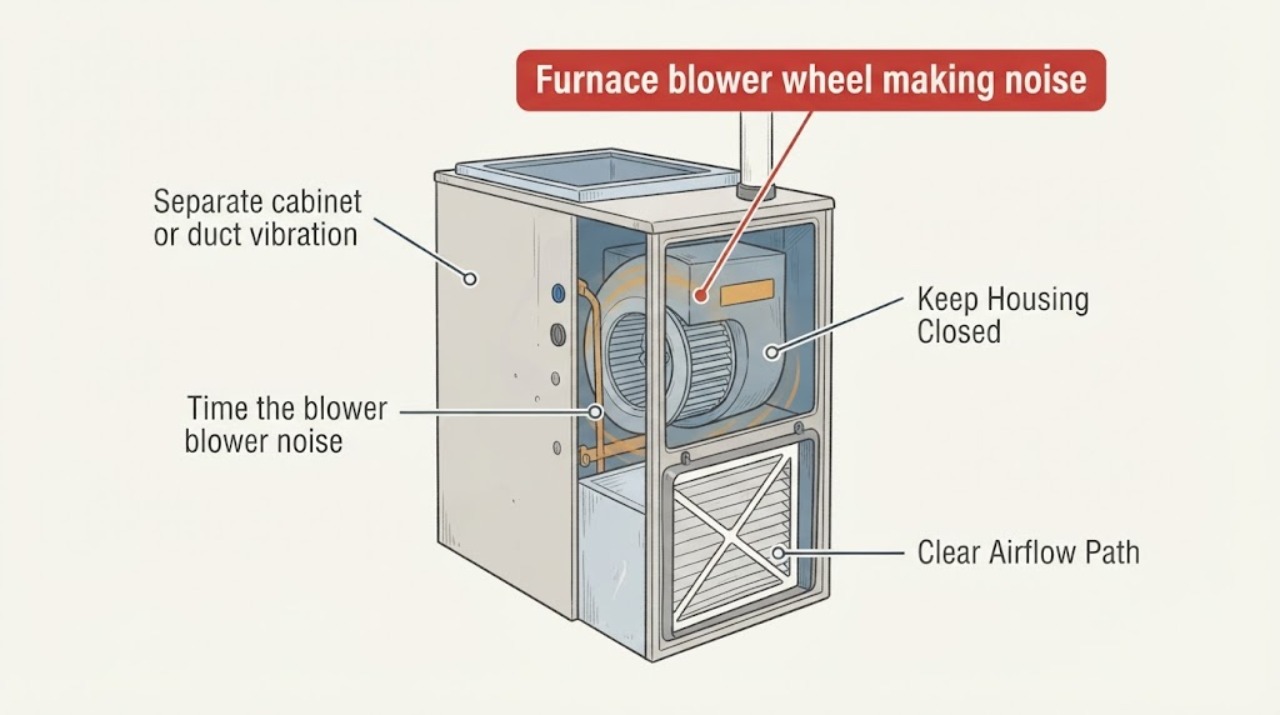
A new rattle, scrape, vibration, squeal, or hum from a furnace blower wheel is a stop-and-observe symptom, not a safe invitation to reach inside the cabinet. From outside the closed furnace, record when the sound occurs, check only the accessible filter and registers, and look for external cabinet or duct vibration. Stop using the furnace if the sound suggests metal contact, severe vibration, burning odor, smoke, or electrical trouble; the wheel, motor, shaft, bearings, capacitor, and housing require HVAC diagnosis with power isolated before service.
Work through in order
Diagnostic checks
Use only checks that match the exact appliance or system and its official guide.
-
Time the blower noise from outside the cabinet
From a safe position, note whether the sound begins at startup, continues at steady speed, changes as the blower ramps, or remains after the heat call ends. Record whether it sounds like rubbing, rattling, squealing, humming, thumping, or vibration; do not repeat cycles to provoke it.
Expected result: The noise is a brief normal-looking start or stop sound, a steady unusual sound, a periodic thump, a scrape, or a sound that changes with speed.
Next step: Make one short recording from a safe distance if it can be done without entering the equipment area, then stop further testing and provide the timing and sound description to HVAC service.
Stop if: Stop immediately for metal-on-metal contact, severe shaking, smoke, burning odor, gas odor, a combustion bang, or an alarm.
Why this matters
Why: A speed-related or periodic sound is useful evidence for a technician evaluating wheel balance, housing clearance, motor, bearings, or mounting. Trane notes that unusual loud sounds can have several mechanical causes and should not be reduced to a thermostat or filter adjustment.
-
Separate cabinet or duct vibration from the furnace
Without touching the running furnace, observe nearby duct panels, return grilles, supply registers, and the cabinet exterior for visible vibration or rattling. Do not press on panels, remove screws, insert a hand, or place an object against the unit.
Expected result: The sound is strongest at a duct or grille, the cabinet visibly vibrates, the whole furnace shakes, or the source cannot be localized safely.
Next step: Photograph the external location and tell the technician whether vibration is localized to ductwork, cabinet, or the entire unit.
Stop if: Stop if the cabinet shifts, a panel is ajar, a duct separates, vibration is worsening, or any hot, electrical, or combustion warning is present.
Why this matters
Why: A loose duct or cabinet can transmit or create noise, while whole-unit shaking increases concern about blower-wheel balance, mounting, or motor problems. The location of the sound is a clue, not permission to open the cabinet.
-
Check the accessible filter and airflow path
Turn the thermostat to its normal off or idle state before inspecting only the user-accessible filter and room return and supply openings. Note a visibly loaded filter, a missing or damaged filter, blocked return air, or a register obstruction; do not remove a furnace access panel or reach toward the blower.
Expected result: The filter is clean, loaded, missing, wet, or damaged, and the return or supply path is open or blocked.
Next step: Use the owner's documented filter specification for a straightforward user replacement only when the filter is safely accessible; otherwise leave it alone and report its condition. Request HVAC service if noise persists.
Stop if: Stop for a wet or damaged filter, exposed wiring, an inaccessible filter, a hot cabinet, or any need to open the equipment.
Why this matters
Why: Trane identifies clogged filters and blocked returns as airflow problems that can make a furnace run abnormally or trigger protection. Correct airflow observations may reduce a clue but do not repair a wheel, motor, bearing, shaft, or housing fault.
-
Note whether heating and airflow are also affected
From room registers and the thermostat display, observe whether airflow is normal, weak, intermittent, or absent and whether warm air arrives during an ordinary heat call. Do not increase the setpoint repeatedly, run the furnace with a panel removed, or test temperature by touching hot equipment.
Expected result: Noise occurs with normal airflow, airflow is weak, the blower starts and stops, the furnace overheats or cycles, or the unit does not produce heat.
Next step: Record the airflow and heat result beside the sound timing and arrange HVAC diagnosis rather than operating a worsening unit.
Stop if: Stop for a hot or burning smell, smoke, gas odor, a carbon-monoxide alarm, rapid cycling, no airflow with heat demand, or an electrical trip.
Why this matters
Why: Noise plus weak or cycling airflow can involve filter, duct, motor, wheel, control, or limit protection. Noise with otherwise normal airflow still warrants evaluation because a wheel or bearing can deteriorate before airflow is lost.
-
Prepare the blower-service handoff
Compile the sound recording, start/stop timing, noise character, vibration location, filter and register observations, airflow and heat result, model and fuel type from the exterior label, recent maintenance, and whether the sound is new or worsening. State that the cabinet, blower wheel, motor, wiring, and controls were not disturbed.
Expected result: The record indicates likely external duct vibration, an airflow clue, a speed-related mechanical noise, metal contact, or an unresolved safety issue.
Next step: Request HVAC service and tell the provider whether the furnace remains in use, has been shut down, or is showing a safety or heat-delivery problem.
Stop if: Do not remove panels, spin or clean the wheel, oil bearings, adjust belts, test live voltage, bypass a door switch, or run the furnace with guards or panels removed.
Why this matters
Why: The HVAC technician can isolate power, inspect the blower wheel, housing, shaft, motor, bearings, mounting, capacitor, controls, and ductwork safely instead of replacing a part from the noise description alone. Trane's maintenance guidance reserves blower-wheel cleaning for a qualified servicer.
Use your observations
Decision map
Find the observation that best matches what you see, then follow the next safe action.
-
PATH 01Safety boundary
What you see
The sound is scraping or banging, the unit shakes severely, or contact appears to occur inside the cabinet.
Do this next
Turn the furnace off using the normal user control if safe, keep clear, and request prompt HVAC service for inspection of wheel, housing, shaft, and motor.
Why this path and its safety boundary
Safety stop: Do not run the blower to see whether it clears, open the cabinet, or touch the wheel.
-
PATH 02Safety boundary
What you see
The sound is clearly strongest at an external grille, duct, or cabinet panel and there is no safety warning.
Do this next
Leave the equipment closed, document the vibration location, and ask HVAC service to inspect duct and cabinet mounting along with the blower assembly.
Why this path and its safety boundary
Safety stop: Do not press, tape, screw, or brace a moving panel while the unit operates.
-
PATH 03Safety boundary
What you see
The filter is loaded or the return/supply path is blocked and the noise occurs with weak or abnormal airflow.
Do this next
Correct only a clearly user-accessible filter or register issue using the owner instructions, then request service if the sound or airflow problem remains.
Why this path and its safety boundary
Safety stop: Do not open the cabinet or assume an airflow correction repaired a mechanical blower fault.
-
PATH 04Safety boundary
What you see
Burning odor, smoke, gas odor, carbon-monoxide alarm, delayed ignition, or an electrical trip occurs.
Do this next
Stop using the furnace, leave the area as appropriate, and contact the relevant emergency, gas, or HVAC service from a safe location.
Why this path and its safety boundary
Safety stop: Do not operate switches in a gas-filled area, relight, reset repeatedly, or re-enter before the hazard is cleared.
Helpful context
Understand the symptom
The blower wheel moves return air across the heat exchanger and into the supply ducts. Noise can result from a loose or unbalanced wheel, debris or contact in the housing, motor or bearing wear, a belt or shaft issue on applicable equipment, a loose cabinet, or duct vibration. Trane's guidance distinguishes ordinary operating sounds from loud or strange noises and directs unresolved blower problems to an HVAC professional.
Keep the blower wheel behind its closed cabinet. A spinning wheel stores motion, and the furnace also contains electrical, hot, and—in a gas unit—combustion hazards. A filter or register observation can identify an airflow clue, but it cannot prove that the wheel or motor is the cause. Do not oil, vacuum, straighten, spin, or touch anything inside the furnace.
Stop for contact, burning, or combustion warnings
If the sound is a metal scrape, becomes a heavy vibration, or is accompanied by burning odor, smoke, gas odor, a delayed-ignition bang, or an alarm, turn the system off using the normal user control if that can be done safely and leave the area as appropriate. Keep the cabinet closed and arrange prompt HVAC service.
Only after diagnosis
Potential parts
- furnace blower motor
A motor can contribute to blower noise, but the symptom may instead be wheel balance, bearing, mounting, duct, capacitor, or control related.
Match the exact furnace model, motor type, speed and control requirements through HVAC diagnosis; do not replace from sound alone. - furnace blower wheel
A wheel is relevant only after a technician confirms damage, imbalance, obstruction, or incorrect fit and identifies the assembly specification.
Confirm diameter, width, rotation, hub, shaft fit, housing clearance, and furnace model with the service provider; do not spin or straighten the wheel yourself. - furnace inducer motor
A sound attributed to the blower can originate in the inducer or another motor, especially near startup, so this category is conditional on professional localization.
Do not confuse the inducer with the indoor blower or substitute a motor without exact model and combustion-system verification.
When checks do not resolve it
Need a professional?
Request HVAC service for a new, worsening, speed-related, rattling, scraping, squealing, or vibrating blower-wheel noise, or any noise paired with weak airflow, cycling, or heat loss. Stop use and seek prompt help for metal contact, severe vibration, burning odor, smoke, gas odor, alarm, or electrical trip.
Common questions
FAQ
Can I vacuum the blower wheel myself?
Do not open the furnace or vacuum the wheel from this guide. Trane's maintenance guidance reserves blower-wheel and housing cleaning for a qualified service agency because the assembly and furnace contain moving, electrical, hot, and possibly combustion hazards.
Is a humming sound from the blower normal?
Some operating hum can be normal, but a new, louder, speed-related, vibrating, or changing hum needs observation and professional diagnosis. The sound alone cannot distinguish motor, wheel, mounting, duct, or control causes.
Can a dirty filter make the blower noisy?
A loaded filter can restrict airflow and contribute to abnormal operation, but it does not prove the wheel is clean or balanced. Inspect only the accessible filter and request service if the noise persists.
Should I oil the blower motor or tighten a panel?
No. Do not oil, tighten, brace, or remove equipment parts from this observation path. The motor, wheel, shaft, and panel may require isolation and model-specific service.
When should I call HVAC service for blower-wheel noise?
Call for any new or worsening blower noise, especially scraping, thumping, severe vibration, weak airflow, cycling, or heat loss. Stop use and seek prompt help for burning odor, smoke, gas odor, an alarm, or an electrical trip.
Read the exact guide
Official sources
- Furnace Making a Buzzing Noise? Learn Why and What to DoTrane · Supports recording the sound type, distinguishing normal and unusual sounds, and escalating blower, duct, bearing, and delayed-ignition clues to HVAC service.
- Furnace Blower Not Working: Causes and SolutionsTrane · Supports the blower's airflow role, normal fan run-on context, accessible filter and return observations, and professional escalation for remaining blower faults.
- Regular Dealer Maintenance: Indoor UnitsTrane · Supports keeping the cabinet and blower closed, reserving blower-wheel cleaning for qualified service, and treating igniter, combustion, and electrical warnings as professional work.
Community feedback
Share a repair observation
Share a plain-text repair observation. Accepted observations are published automatically; this page may take a moment to update.