
On this page
Start here
Quick answer
A noisy Carrier furnace can be reacting to restricted airflow, loose duct or cabinet connections, a blower wheel, motor, belt, or bearing problem, or a combustion and ignition fault. Whistling with weak airflow keeps a loaded filter or duct leak in consideration; rattling can come from a loose panel or duct connection; grinding, squealing, or banging can indicate blower or motor wear; and a bang or boom at ignition can indicate delayed burner ignition that needs professional attention. First note exactly when the sound occurs, check the thermostat, filter, and accessible registers with the furnace off, and observe only from a safe position. Do not open the burner or electrical compartments, touch a capacitor or belt, adjust gas controls, or keep running a furnace with smoke, gas odor, abnormal flame, repeated breaker trips, or a loud ignition bang. If the sound persists, changes, affects airflow or heat, or cannot be safely localized, arrange qualified HVAC service to inspect the blower, ducts, burners, ignition, heat exchanger, controls, and safety devices.
Before you begin
Safety first
- A qualified technician should inspect the blower motor, wheel, bearings, belt or capacitor if present, ducts and mounts, burners, igniter, flame sensor, gas controls, heat exchanger, wiring, and safety devices. Homeowner checks should remain limited to thermostat settings, an accessible documented filter, clear registers, safe exterior observations, and recording the sound.
Work through in order
Diagnostic checks
Use only checks that match the exact appliance or system and its official guide.
-
Check 1
Turn the Carrier furnace off and leave the home immediately if you smell persistent gas, see smoke, soot, flame rollout, or an abnormal flame, or a carbon-monoxide alarm sounds; do not operate switches or create flames in the affected area.
Expected result: There is no gas or combustion warning, or there is gas odor, a CO alarm, smoke, soot, rollout, or another immediate hazard.
Next step: For gas odor, leave and contact the gas utility or emergency services from a safe location; for a CO alarm, leave and follow emergency guidance. For other combustion hazards, keep the furnace off and arrange prompt qualified HVAC service.
Why this matters
Why: Without a warning, limited visual and airflow checks may be possible. Gas and combustion warnings can indicate fire, explosion, or poisoning risk and are not noise problems to reproduce.
-
Check 2
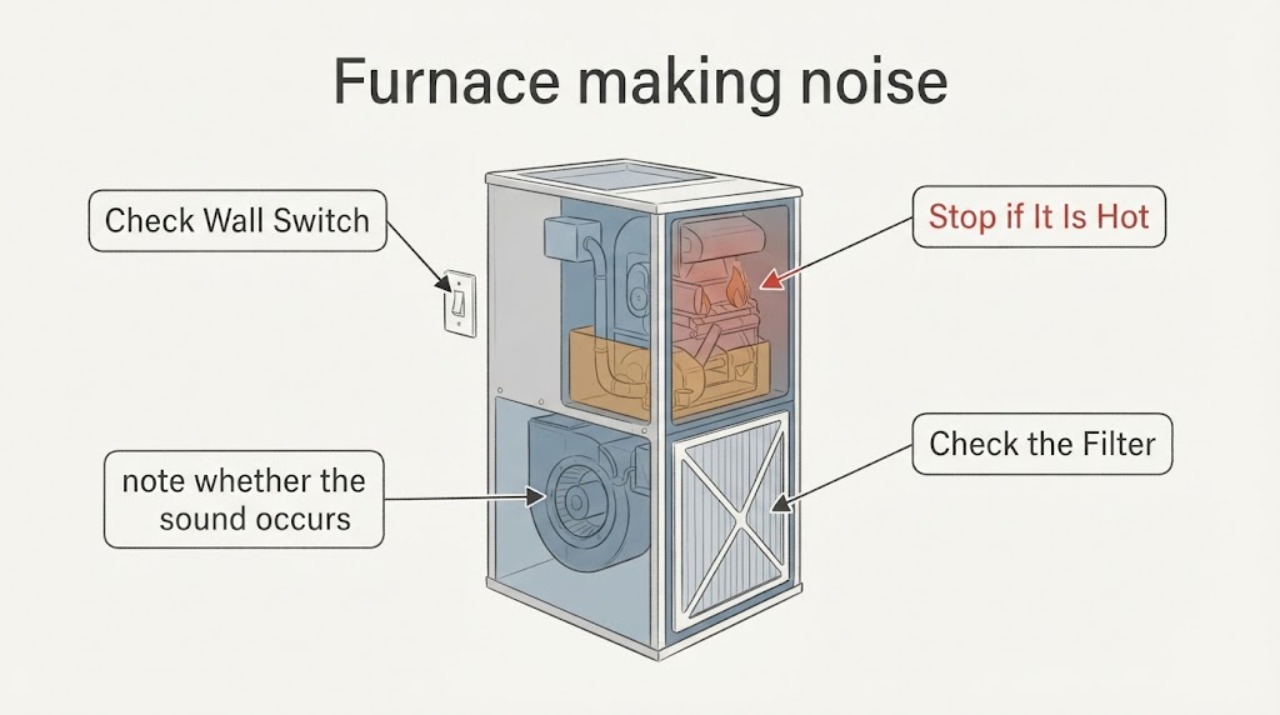
From outside the equipment area, note whether the sound occurs at thermostat call, blower startup, burner ignition, steady heating, burner shutdown, or fan-only operation; do not remove an access panel to listen closer.
Expected result: The sound is a whistle, rattle, hum, squeal, grind, scrape, bang, or pop, and it occurs before ignition, during airflow, at ignition, or after shutdown.
Next step: Stop operation for a bang, pop, grind, smoke, or worsening sound. Otherwise record the timing and sound type for the technician and continue only with the furnace-off filter and register checks.
Why this matters
Why: Airflow timing keeps filter, register, duct, and blower causes in consideration. A rattle that follows startup keeps a loose panel or connection in consideration. A bang or boom at ignition points toward burner or ignition delay; grinding or squealing during airflow keeps motor, bearing, belt, or wheel wear in consideration.
-
Check 3
With the furnace off, inspect the accessible air filter and make sure return and supply registers are open and unobstructed; replace a dirty filter only with the exact type and size specified for the Carrier installation.
Expected result: The filter is gray, loaded, wet, damaged, missing, or not seated; registers are blocked; airflow is weak; or these accessible items look normal.
Next step: Install the documented filter with the furnace off and clear obvious register obstructions. If noise, weak airflow, or overheating continues, stop using the furnace and arrange professional diagnosis; never operate without a filter.
Why this matters
Why: Restricted airflow can create whistling, strain the blower, and cause overheating or shutdown. Normal filter and registers make duct, blower, cabinet, motor, ignition, or combustion causes more likely.
-
Check 4
From a safe position, inspect visible exterior cabinet seams, accessible duct connections, and the area around the furnace for loose-looking panels, vibration marks, corrosion, water, or objects contacting the cabinet; do not tighten internal or load-bearing hardware.
Expected result: A panel or duct vibrates, a visible connection has a gap, something contacts the cabinet, corrosion or water is present, or no exterior defect is visible.
Next step: Remove only a loose object that is clearly outside the furnace and safe to handle. Do not open the cabinet, tighten a burner or blower assembly, or cover a gap with tape; arrange service for persistent vibration, corrosion, water, or internal noise.
Why this matters
Why: Loose panels or duct connections can rattle as air moves, while contact or corrosion can transmit vibration and indicate a broader equipment issue. A clear exterior does not rule out a blower wheel, bearing, belt, heat exchanger, or internal control problem.
-
Check 5
Observe one normal heat call only if there is no safety warning and the system has been moving safely; note whether the blower starts, the sound changes with fan speed, the burners ignite quietly, and warm air reaches the registers without touching the furnace or flame.
Expected result: The noise follows blower operation, the blower is silent or weak, the burners ignite with a bang or fail to stay lit, warm air is normal, or heat and airflow are poor.
Next step: Stop for loud ignition, no blower, repeated ignition failure, poor heat, grinding, or escalating noise and arrange qualified service. Do not clean burners, touch a capacitor or belt, adjust gas controls, or bypass a safety.
Why this matters
Why: A blower-related sound keeps motor, bearing, belt, wheel, filter, and airflow causes in consideration. A bang or failed ignition keeps burner, igniter, flame-sensing, gas, or safety causes in consideration. Normal heat with a room-specific noise keeps duct or panel vibration more likely but does not clear the furnace.
-
Check 6
Check the furnace switch and breaker only from a dry, safe location and record any repeated trip, status light, error code, or recent filter, duct, thermostat, electrical, or maintenance work; do not repeatedly reset a breaker or lockout.
Expected result: The switch is off, the breaker is tripped, it trips again, a code or lockout appears, or power and indicators are normal.
Next step: Correct only an obvious switch position without opening equipment. If the breaker trips again, a code persists, or the noise returns, leave the furnace off and arrange qualified HVAC service.
Why this matters
Why: An off switch can stop the blower and create unusual restart behavior. A repeated trip, code, or lockout points to an electrical, motor, ignition, or safety fault rather than a harmless loose panel.
-
Check 7
Gather the Carrier model and serial information from paperwork or an exterior label, sound recording from a safe location, timing, filter details, airflow and heat observations, error codes, gas or CO symptoms, recent work, and whether the issue is intermittent.
Expected result: The sound began after maintenance or installation, occurs only at ignition, happens only with fan airflow, increases with heating demand, affects particular rooms, or has no clear trigger.
Next step: Give the record to a qualified HVAC technician and request inspection of the blower, motor, wheel, belt if present, ducts, filters, burners, ignition, heat exchanger, gas controls, and safety devices. Do not order a motor, capacitor, burner, or control board from the sound alone.
Why this matters
Why: Post-work onset keeps loose panels, duct connections, filter seating, wiring, or installation issues in consideration. Ignition-only noise keeps combustion and burner diagnosis in focus; fan-only noise keeps blower and duct issues in focus; room-specific noise keeps distribution and duct vibration in focus.
Use your observations
Decision map
Find the observation that best matches what you see, then follow the next safe action.
-
PATH 01Next step
What you see
A whistle occurs with airflow, the filter is loaded or registers are blocked, and heat otherwise starts normally.
Do this next
With the furnace off, install the correct filter and clear accessible registers. If the whistle or weak airflow remains, arrange duct and blower inspection rather than increasing fan settings or opening the cabinet.
Why this path and its safety boundary
Why it matters: Restricted filter or airflow is more likely than a burner or ignition fault, although a duct gap can produce a similar whistle.
-
PATH 02Next step
What you see
A rattle follows blower startup and visible exterior panels or duct connections vibrate, but there is no heat or gas warning.
Do this next
Keep hands and tools out of the cabinet and arrange qualified service for the vibration source. Do not remove panels, tighten internal mounts, or let a persistent rattle continue until it becomes a grind.
Why this path and its safety boundary
Why it matters: A loose panel, duct connection, mounting point, blower wheel, or motor component is more likely than a normal ignition sound.
-
PATH 03Next step
What you see
A bang or boom occurs when the burners ignite, or noise is joined by soot, abnormal flame, repeated ignition attempts, or a gas odor.
Do this next
Turn the furnace off and arrange prompt qualified HVAC service; leave for persistent gas odor and contact the gas utility or emergency services from a safe location. Do not clean burners or adjust gas controls.
Why this path and its safety boundary
Why it matters: Delayed ignition or another combustion, gas, burner, or safety fault is more likely than a loose duct, and continued operation can be dangerous.
-
PATH 04Next step
What you see
Grinding, squealing, or banging occurs during blower operation, airflow is weak or uneven, or the blower is slow or silent.
Do this next
Stop the furnace for escalating noise, no blower, smoke, overheating, or breaker trips and arrange professional motor and airflow diagnosis. Do not touch a capacitor, belt, wiring, or blower assembly.
Why this path and its safety boundary
Why it matters: Blower motor, bearing, belt, wheel, capacitor, filter, or airflow restriction is more likely, with electrical strain possible if breakers trip.
-
PATH 05Next step
What you see
Noise persists after the exact filter and accessible-register checks, returns after a temporary change, or occurs with poor heat, lockout, water, corrosion, or a status code.
Do this next
Keep the furnace off when safety or performance is affected and arrange qualified HVAC service with the timing and recording. Request diagnosis of the complete system before replacing a part.
Why this path and its safety boundary
Why it matters: An internal blower, duct, ignition, heat-exchanger, control, motor, or safety issue remains possible and cannot be narrowed safely by sound alone.
Helpful context
Understand the symptom
The sound and timing are more useful than the volume alone
A whistle while air is moving, a rattle that changes when the blower starts, a scrape or grind that follows the blower wheel, and a bang at ignition point to different areas. Note whether the noise occurs before ignition, during heating, after the burners shut off, or only when the fan runs. A sudden change, loud ignition, or sound with poor heat is more significant than a long-standing mild airflow noise.
Start with airflow and accessible hardware
A loaded filter can restrict airflow and strain the blower; blocked registers or duct gaps can add whistling and rattling. With power off, inspect only the accessible filter and registers and look for obvious loose exterior panels. Do not remove furnace panels to reach the blower, burner, belt, capacitor, or wiring simply to identify the noise.
Combustion sounds are a professional boundary
A bang or boom when the burners ignite can indicate delayed ignition, while soot, abnormal flame, gas odor, or repeated ignition attempts may indicate a combustion or safety fault. Do not clean burners, adjust gas valves, relight an unfamiliar pilot, or bypass a limit or rollout control. Turn the furnace off and arrange qualified service when the sound is combustion-related.
Quiet operation after one check does not prove the fault is fixed
A filter change may reduce a whistle but not repair a blower bearing, duct leak, loose bracket, or combustion problem. A sound that returns under heat load, shifts from rattle to grind, or is joined by weak airflow, overheating, or breaker events needs full diagnosis. Verify the original sound and heating symptom after professional service rather than repeatedly cycling the furnace.
Safety boundary
Stop conditions
- Leave the home and contact the gas utility or emergency services from a safe location for persistent gas odor; leave and follow emergency guidance for a carbon-monoxide alarm. Do not operate switches or create flames in the affected area.
- Turn the furnace off and arrange prompt service for a bang or boom at ignition, abnormal flame, smoke, soot, rollout, grinding, overheating, water near controls, repeated lockout, or a breaker that trips again.
- Do not open the furnace cabinet, touch capacitors, belts, burners, heat exchangers, gas valves, or live wiring; do not clean or adjust combustion parts, bypass a safety, or repeatedly reset a breaker or lockout.
- Arrange qualified HVAC diagnosis when unusual noise persists after the documented filter and accessible-register checks, affects heat or airflow, returns after a temporary change, or the sound cannot be safely localized.
Only after diagnosis
Potential parts
- furnace air filter
Consider this only when the accessible filter is loaded, damaged, missing, or the Carrier documentation specifies replacement; a filter cannot repair a blower, duct, ignition, or combustion fault.
Confirm the exact Carrier furnace or filter-rack model, dimensions, airflow direction, and documented filter type before replacement. - furnace blower motor or wheel
Consider this only after professional testing confirms worn bearings, a damaged wheel, or a failed motor is causing the noise or weak airflow.
Match the exact Carrier indoor-unit model, motor type, wheel dimensions, control method, rotation, and airflow setup; electrical and moving-part access is professional service. - furnace belt, bearing, or capacitor
Consider this only when the furnace design includes the component and a technician confirms wear or failure; noise alone cannot distinguish a belt, bearing, capacitor, wheel, or motor.
Verify the exact motor and blower assembly, electrical ratings, belt dimensions, mounting, and manufacturer procedure; do not touch a capacitor or live wiring. - furnace igniter, flame sensor, or burner component
Consider this only after a qualified technician confirms an ignition, flame-sensing, or burner fault causing an ignition bang or repeated loss of flame.
Match the exact Carrier furnace, ignition system, burner arrangement, connector, and combustion setup; do not select or install combustion parts from sound alone. - furnace control or safety switch
Consider this only after professional testing confirms a failed limit, rollout, pressure, or control component and the underlying airflow or combustion cause is addressed.
Verify exact model, switch function and rating, control generation, wiring, and safety sequence; never bypass a furnace safety.
When checks do not resolve it
Need a professional?
Safety scope: A qualified technician should inspect the blower motor, wheel, bearings, belt or capacitor if present, ducts and mounts, burners, igniter, flame sensor, gas controls, heat exchanger, wiring, and safety devices. Homeowner checks should remain limited to thermostat settings, an accessible documented filter, clear registers, safe exterior observations, and recording the sound.
Common questions
FAQ
Why is my Carrier furnace making noise?
The sound may come from restricted airflow, a loose panel or duct connection, a blower motor, wheel, belt, bearing, or a combustion and ignition issue. Whistling, rattling, grinding, squealing, and a bang at ignition point to different paths. Note the timing and check only the accessible filter and registers before arranging service for persistent or unsafe noise.
What does a whistling Carrier furnace mean?
Carrier associates whistling with a clogged filter or gaps in ductwork. With the furnace off, inspect the accessible filter and make sure registers are open and unobstructed. If the whistle remains, airflow is weak, or the sound comes from inside the cabinet, arrange professional filter, duct, and blower diagnosis.
Why does my Carrier furnace rattle when it runs?
A rattle can come from a loose duct connection or panel, vibration at the blower, or a worn or loose internal component. Look only at accessible exterior seams and ducts with the furnace off. Do not open the cabinet or tighten internal mounts; persistent rattling or any grinding needs qualified inspection.
Is a bang when a Carrier furnace starts dangerous?
A bang or boom at ignition can indicate delayed ignition from a burner problem and requires professional attention. Turn the furnace off for loud ignition, abnormal flame, soot, smoke, or gas odor. Leave for persistent gas odor and contact the gas utility or emergency services from a safe location; do not clean burners or adjust gas controls.
Can a dirty filter make a Carrier furnace noisy?
Yes. A loaded filter can restrict airflow, making whistling more likely, straining the blower, and contributing to overheating or shutdown. Replace it only with the exact documented filter while the furnace is off. If noise, weak airflow, or overheating remains, a technician should check the blower, ducts, and safety controls.
When should I stop using a noisy Carrier furnace?
Stop for a bang at ignition, grinding, smoke, soot, abnormal flame, gas odor, a carbon-monoxide alarm, overheating, water near controls, repeated lockout, weak or absent blower, or a breaker that trips again. Also arrange service when unusual noise persists after the accessible filter and register checks or affects heat and airflow.
Read the exact guide
Official sources
- Changing Furnace Filters: A Guide to Home Comfort & EfficiencyCarrier · Carrier explains that dirty filters restrict airflow and strain the system, and says to turn the system off and use the correct compatible filter before changing it.
- Furnace Blower Motor Repair & Replacement GuideCarrier · Carrier relates grinding, squealing, banging, weak airflow, breaker trips, and overheating to possible blower motor or component problems and warns that electrical repair is professional work.
- Gas Furnace Repair Services & Troubleshooting TipsCarrier · Carrier identifies strange noises and smells as service clues, supports filter, register, access-panel, and intake or exhaust checks, and directs gas, electrical, banging, and grinding issues to professionals.
- Furnace Troubleshooting GuideCarrier · Carrier identifies whistling, loud ignition, and rattling clues and provides accessible filter, thermostat, register, power, and gas-safety boundaries.
Community feedback
Share a repair observation
Share a plain-text repair observation. Accepted observations are published automatically; this page may take a moment to update.