
On this page
Start here
Quick answer
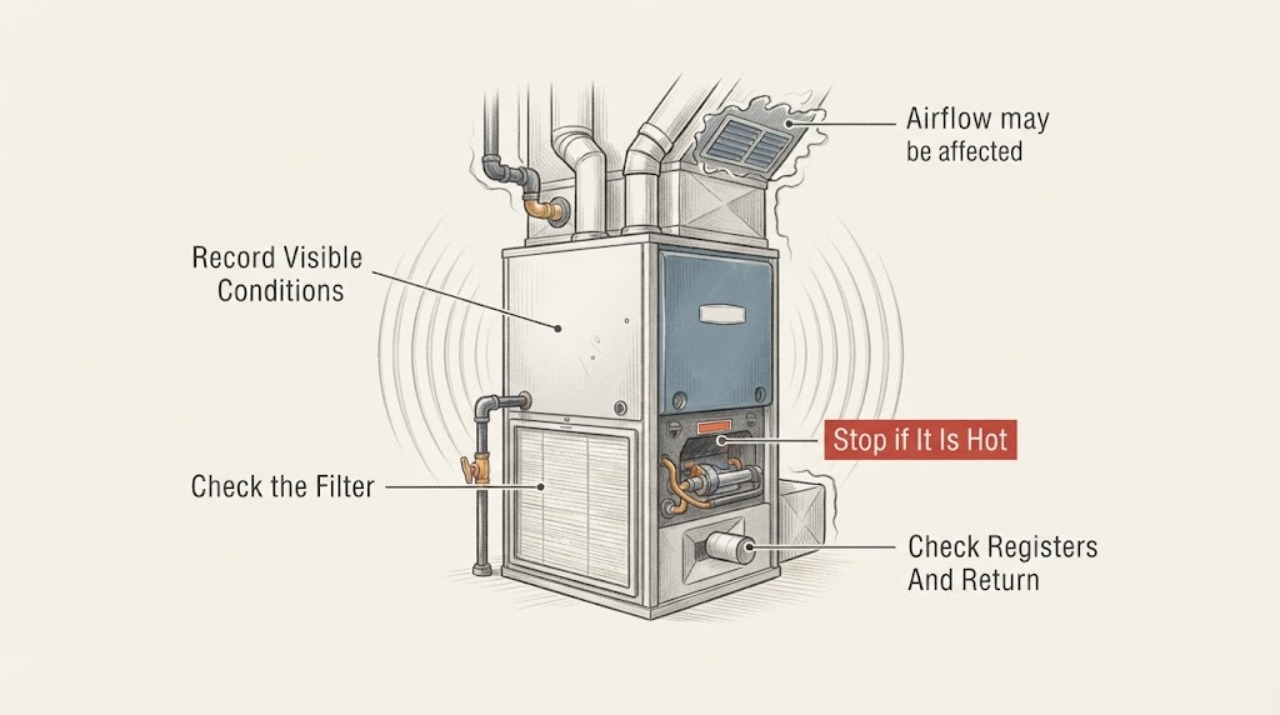
If a furnace starts making an unfamiliar noise and airflow changes, first stop the heating call if the sound is metallic, scraping, grinding, banging, or accompanied by a burning smell. From a safe position, note whether the sound occurs at startup, while the blower runs, or as the system shuts down; inspect only the normally accessible filter and supply and return grilles. A loaded filter or blocked return can reduce airflow and make the system work harder, while a loose panel or duct can rattle, and a blower, inducer, burner, belt, or electrical fault can require professional diagnosis. Do not reach into the furnace, remove a blower or burner panel, touch a capacitor or wiring, or relight or adjust gas components to chase a noise.
Work through in order
Diagnostic checks
Use only checks that match the exact appliance or system and its official guide.
-
Check 1
From a safe location, listen during one ordinary heating cycle and record whether the noise is at the furnace cabinet, a nearby duct or grille, or elsewhere, and whether it starts at ignition, when the blower begins, while airflow continues, or at shutdown. Do not restart repeatedly to reproduce it.
Expected result: Record a brief normal startup sound, a whistle, rattle, hum, squeal, grinding or scraping, a bang or boom at ignition, or a sound that persists after the cycle; also record whether airflow is weak, pulsing, or unchanged.
Next step: Leave the furnace off and arrange qualified HVAC service for any new, harsh, persistent, metallic, or ignition-related sound. For a mild airflow-linked whistle with no safety symptom, continue only with the accessible filter and grille checks below.
Stop if: Stop immediately for metal-on-metal contact, smoke, burning smell, gas odor, a bang or boom at ignition, severe vibration, or unexpected movement.
Why this matters
Why: A whistle with changed airflow makes a filter, return, register, or duct restriction more likely. A rattle near a panel or duct makes a loose connection more likely. Grinding, scraping, repeated squealing, a harsh hum, or a bang at ignition points toward a moving, electrical, inducer, burner, or other mechanical issue that cannot be safely identified by sound alone.
-
Check 2
Turn the thermostat to off and let the furnace stop. Inspect the filter only through its normal user access, noting its size, airflow arrow, fit, and visible loading; do not remove a blower door or reach into the cabinet.
Expected result: Record a clean, correctly seated filter; a visibly gray or dust-loaded filter; a wet, damaged, collapsed, or backwards filter; or a filter slot that requires tools or cabinet access.
Next step: If the manufacturer-specified replacement is clearly due and the access is ordinary and safe, replace it in the marked airflow direction, restore the access cover, and observe one cycle. If the noise or airflow change remains, stop and request HVAC service.
Stop if: Do not run the furnace with the filter removed, force a stuck panel, use an unapproved filter size, or open the blower compartment.
Why this matters
Why: A dirty or improperly installed filter can restrict airflow, increase furnace run time, and strain the blower. A wet or damaged filter, an inaccessible filter, or continued weak airflow after a correct filter change needs professional assessment rather than a higher-restriction substitute or operation without a filter.
-
Check 3
With the heating call off, walk the accessible rooms and check that supply registers and return grilles are open and not covered by furniture, rugs, drapes, or stored items. Do not remove grilles or probe ducts.
Expected result: Record all grilles open and clear; one or more closed or covered; a return that is unusually noisy; or a grille that is loose, damaged, or inaccessible.
Next step: Move only an obvious household obstruction and open a mistakenly closed register, then observe whether airflow and sound normalize on one cycle. If the noise persists, airflow remains uneven, or the return is blocked inside, leave the system off and call an HVAC technician.
Stop if: Do not reach into a return, cut ductwork, remove a register to retrieve an object, or operate the furnace when a loose part is being drawn into the airflow.
Why this matters
Why: A blocked supply or return can alter system pressure, reduce airflow, and create a whistle or rushing sound. A loose grille may vibrate, but a noise from inside the duct or a restriction that is not visible requires duct or equipment inspection.
-
Check 4
After the safe filter and grille checks, observe one normal call without opening the furnace: note whether air comes from the registers, whether it is noticeably weaker or pulsing than before, whether the blower sound changes with the airflow, and whether the furnace starts and stops normally.
Expected result: Record normal steady airflow; weak airflow at every register; one-room or one-branch weakness; pulsing airflow; a blower that hums or squeals; or repeated starts and stops with a changed sound.
Next step: Turn the furnace off and request qualified HVAC service for weak or pulsing airflow, a blower noise, repeated cycling, or any sound that worsens. Do not diagnose the motor, limit switch, capacitor, or heat exchanger yourself.
Stop if: Stop for smoke, burning odor, gas odor, a hot cabinet, severe vibration, a metallic scrape, or a furnace that repeatedly shuts down.
Why this matters
Why: Weak airflow throughout the home makes a loaded filter, blocked return, blower, coil, duct, control, or safety path relevant. A single-room change makes a local register or branch-duct issue more likely. A motor sound with little airflow can indicate a blower or electrical fault; rapid cycling can occur when restricted airflow causes overheating and a safety shutdown.
-
Check 5
From outside the furnace cabinet and without removing panels, look for a visibly loose access-panel edge, duct joint, or register trim that could vibrate, and note any unusual odor, moisture, scorch mark, or error display. Do not tighten or remove equipment panels unless the owner manual explicitly makes that user access safe.
Expected result: Record no visible issue; a loose-looking external grille or duct seam; moisture; soot or scorching; a burning smell; gas odor; or an error or lockout indication.
Next step: Leave the furnace off and call qualified HVAC service for any unresolved loose component, error, moisture, odor, soot, or scorch mark. If gas is smelled, leave the building without operating switches and contact the gas utility or emergency services from a safe location.
Stop if: Do not open the furnace, touch wiring, relight a pilot, adjust a gas valve, bypass a safety, or operate near smoke, gas, or wet electrical equipment.
Why this matters
Why: A loose panel or duct connection can rattle, but a burning smell, soot, gas odor, moisture, or lockout is not a cosmetic noise issue. These patterns can involve combustion, electrical, heat-exchanger, condensate, or safety faults and require immediate escalation.
-
Check 6
Prepare the service request with the furnace model if visible from ordinary access, fuel type if known, thermostat setting, noise location and timing, airflow change, filter and grille observations, cycle behavior, odor or moisture, and any display message. Keep all panels closed and components undisturbed.
Expected result: Confirm that the record contains external observations only and that no blower wheel, belt, capacitor, burner, inducer, wiring, gas component, or heat exchanger was touched.
Next step: Request qualified HVAC diagnosis when the noise or airflow change remains after the safe checks, and tell the technician whether the noise is at startup, during blower operation, or at shutdown. Let the technician test and repair internal, gas, electrical, and combustion components.
Stop if: Stop all homeowner troubleshooting when the next step requires cabinet access, electrical measurement, moving-part access, combustion testing, gas work, or refrigerant or condensate-system work.
Why this matters
Why: A timeline helps the technician separate airflow restriction and duct vibration from blower, inducer, burner, ignition, control, and safety faults without asking the homeowner to make a hazardous diagnosis.
Use your observations
Decision map
Find the observation that best matches what you see, then follow the next safe action.
-
PATH 01Next step
What you see
The sound is a whistle or rushing noise, airflow changed throughout the home, and the accessible filter is visibly loaded or a return or register is blocked.
Do this next
Correct only the obvious accessible filter or grille issue using the manufacturer instructions, then observe one cycle. If airflow or noise does not normalize, stop the furnace and arrange HVAC service.
Why this path and its safety boundary
Why it matters: The pattern makes an airflow restriction more likely than an isolated internal rattle, but it does not prove that the blower or heat exchanger is healthy.
-
PATH 02Next step
What you see
The sound is a rattle or vibration localized to an external panel, grille, or duct, with steady airflow and no odor, smoke, overheating, or metallic contact.
Do this next
Leave the equipment closed; if the sound persists or the suspected loose part is on the furnace cabinet, request HVAC service rather than tightening or removing the panel yourself.
Why this path and its safety boundary
Why it matters: A loose panel, grille, or duct connection is more plausible than a filter-only issue, but vibration can also transmit from a moving internal component.
-
PATH 03Next step
What you see
Airflow is weak or pulsing at most registers, the blower hums, squeals, grinds, or does not start normally, and the filter and grilles are clear.
Do this next
Turn the furnace off and arrange qualified HVAC diagnosis. Do not remove the blower door, touch a capacitor or belt, or try to spin the wheel.
Why this path and its safety boundary
Why it matters: A blower motor, wheel, belt where fitted, control, coil, duct, or safety path becomes more likely; the clear filter does not identify which component failed.
-
PATH 04Next step
What you see
The noise is a bang or boom at ignition, there is a repeated ignition attempt, or the furnace has soot, flame irregularity, or a gas or burning odor.
Do this next
Stop using the furnace and contact qualified HVAC service. If gas is smelled, leave without operating switches and contact the gas utility or emergency services from a safe location.
Why this path and its safety boundary
Why it matters: The pattern makes a burner, ignition, combustion, or gas-safety problem more likely and is outside safe homeowner troubleshooting.
-
PATH 05Next step
What you see
The noise is grinding, scraping, metal-on-metal, or rapidly worsening, or it accompanies smoke, a burning smell, scorching, severe vibration, a hot cabinet, or a repeated safety shutdown.
Do this next
Leave the furnace off and keep clear while arranging qualified HVAC service. Use emergency or electrical assistance as appropriate for smoke, fire, arcing, or an unsafe electrical condition.
Why this path and its safety boundary
Why it matters: An internal moving, electrical, combustion, or overheating fault may be damaging the equipment or creating a hazard; airflow observations cannot make continued operation safe.
Helpful context
Understand the symptom
The timing and airflow change matter more than the label of the noise
A furnace can sound different during the inducer or burner start, the indoor blower run, or the shutdown period. Record the location, timing, and whether airflow is weaker, stronger, pulsing, or unchanged. A whistling sound with reduced airflow makes a filter, return, register, or duct restriction more relevant; a rattle that follows vibration makes a loose panel, duct connection, or internal moving part more relevant. These are symptom patterns, not a reason to open the cabinet.
Airflow restrictions can change both comfort and sound
The filter protects the furnace motor and a dirty or clogged filter can dramatically reduce airflow, increase run time, and add motor wear. Closed or covered registers and blocked returns can also change pressure and noise. Check only the accessible filter and grilles, use the size and direction specified for the system, and do not run a furnace with its filter removed. If the filter is clean but airflow or noise remains abnormal, a technician should evaluate the blower, ductwork, coil, and controls.
Ignition and electrical sounds are not homeowner repair points
A single normal startup sound is different from a new bang, boom, grinding, scraping, squeal, or repeated clicking. Carrier identifies loud ignition as a burner condition that needs an expert, while unusual blower noises can indicate worn bearings or loose components. Gas, ignition, motor, belt, capacitor, and control work involves hazards and model-specific procedures; the useful homeowner contribution is to stop on the unsafe pattern and give the technician a precise symptom record.
Safety boundary
Stop conditions
- Stop the furnace for metal-on-metal contact, grinding, scraping, a harsh or worsening noise, severe vibration, smoke, burning odor, scorching, or a hot cabinet.
- If gas is smelled, leave the building without operating switches or creating an ignition source and contact the gas utility or emergency services from a safe location.
- Do not open the furnace cabinet, reach into a blower or inducer, touch a capacitor or wiring, adjust gas or ignition components, bypass a safety device, or operate the furnace without its specified filter and access panels in place.
Only after diagnosis
Potential parts
- furnace blower motor
Consider this only if a qualified technician confirms a blower motor fault after checking the filter, wheel, belt where fitted, controls, and airflow path; a changed noise does not identify the motor.
Confirm the exact furnace model, motor type, electrical specifications, mounting, and manufacturer-approved fit before selecting any replacement. - furnace blower wheel
Consider this only when a technician confirms a damaged, obstructed, or imbalanced blower wheel as the cause of the noise or airflow change.
Match the exact model and wheel dimensions, rotation, and mounting through the manufacturer or technician; do not reach into or remove the wheel as a homeowner. - furnace inducer motor
Consider this only after a qualified technician identifies the inducer assembly as the source of a startup or draft-related noise; a bang at ignition may instead be a burner or ignition issue.
Confirm the exact furnace model, venting configuration, electrical rating, pressure-switch arrangement, and approved replacement with the technician.
When checks do not resolve it
Need a professional?
Call a qualified HVAC technician when a new furnace noise or airflow change remains after the accessible filter and grille checks, or when airflow is weak or pulsing, the blower or inducer sounds abnormal, the system cycles repeatedly, or a panel or duct continues to vibrate. Stop using the furnace immediately for metal contact, grinding, scraping, a bang at ignition, smoke, burning or gas odor, scorching, severe vibration, a hot cabinet, moisture near electrical equipment, or a repeated safety shutdown.
Have this ready
- Provide the furnace model if safely visible, fuel type if known, thermostat setting, noise description and location, timing in the cycle, airflow change, filter and grille observations, cycle behavior, odor or moisture, and any display message. State that no cabinet, blower, burner, gas, wiring, or capacitor component was disturbed.
Common questions
FAQ
Why does my furnace get louder when the airflow changes?
A loaded filter, blocked return or register, or duct restriction can change air pressure and make a whistle or rushing sound. If airflow is weak or pulsing after the accessible filter and grille checks, the blower, wheel, coil, duct, control, or safety path needs professional diagnosis.
Is a rattling furnace always a loose panel?
No. A loose panel, grille, or duct can rattle, but vibration can also be transmitted from a blower, inducer, belt, or another moving component. Keep panels closed and arrange HVAC service if the sound persists, worsens, or is accompanied by changed airflow.
Can I keep running the furnace to hear where the noise comes from?
Only observe a normal cycle from a safe position if there is no hazardous symptom. Stop the furnace for grinding, scraping, metal contact, a bang at ignition, burning or gas odor, smoke, severe vibration, a hot cabinet, or repeated shutdown; repeated restarts can worsen the fault.
Can I open the furnace and lubricate or repair the noisy blower?
Do not open the cabinet or touch the blower, belt, capacitor, wiring, burner, inducer, or gas components as a homeowner. These parts can involve moving, electrical, combustion, and high-temperature hazards; provide the technician with the timing, sound, and airflow observations instead.
What should I tell the HVAC technician about a noisy furnace?
Give the model if safely visible, fuel type if known, the sound and its location, whether it occurs at ignition, blower operation, or shutdown, how airflow changed, filter and grille observations, cycle behavior, any odor or moisture, and any display message. Say whether the furnace was left closed and undisturbed.
Read the exact guide
Official sources
- Heater Not Working? Try Our Furnace Troubleshooting GuideCarrier · Carrier residential furnace troubleshooting used for general symptom interpretation and safe escalation, not model-specific repair instructions.
- Oil Furnace TroubleshootingTrane · Trane oil-furnace troubleshooting used for general furnace symptom timing and airflow/noise escalation; fuel-specific procedures are not generalized to another model.
- Furnace Blower Motor Repair & Replacement GuideCarrier · Carrier residential blower guidance used for symptom interpretation and professional boundary; no model-specific component fit is inferred.
- HVAC Proper Installation of FiltersU.S. Department of Energy, Building Science Education · U.S. Department of Energy HVAC filter guidance used for general airflow mechanism and safe user-access planning, not furnace-specific maintenance intervals.
- Furnace Filter ReplacementCarrier · Carrier filter guidance used for ordinary accessible filter checks; the owner's manual and exact furnace design govern access and replacement.
Community feedback
Share a repair observation
Share a plain-text repair observation. Accepted observations are published automatically; this page may take a moment to update.