
On this page
Start here
Quick answer
Start by deciding whether the problem is low pressure or low flow: compare several faucets, hot versus cold, and an outdoor hose connection if one is available. A single weak fixture often has a blocked screen or local valve, while weak flow everywhere points to a partly closed main valve, leak, pressure regulator, filter or softener restriction, or a utility disruption. Check only accessible valves and visible plumbing without forcing anything; use a plumber for leaks, a stiff valve, pressure-regulator work, or a problem that affects the whole property.
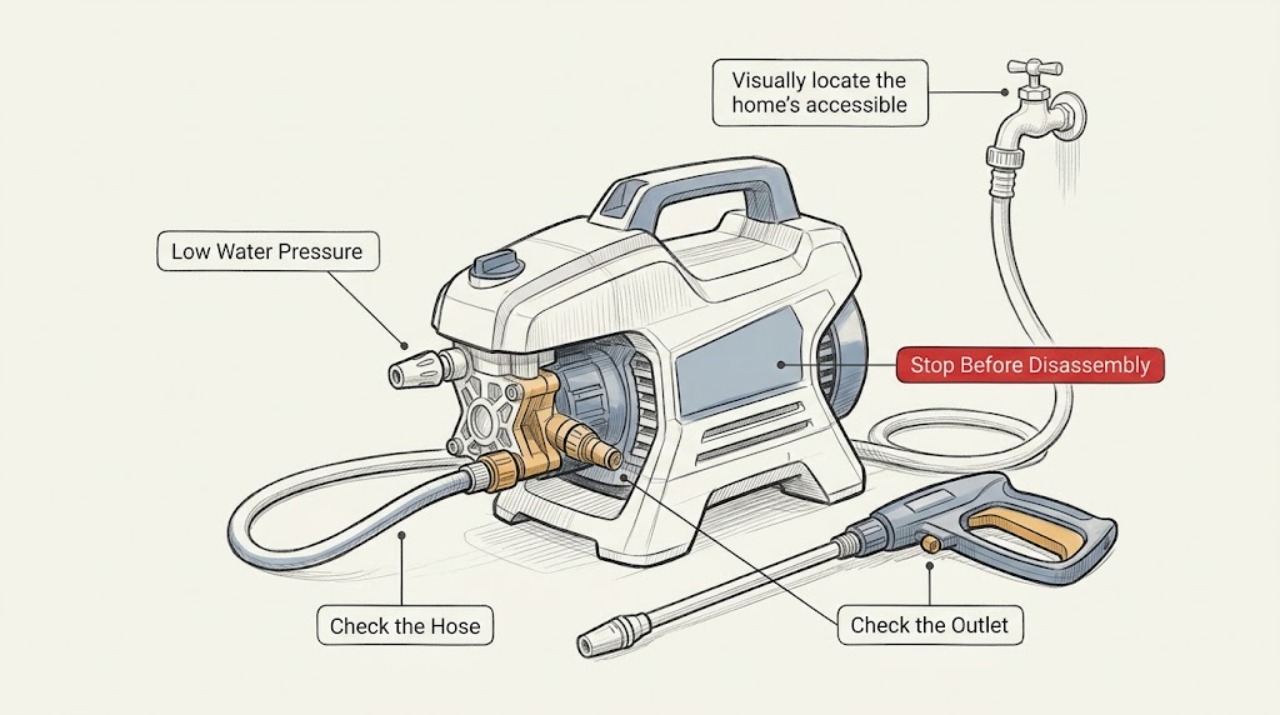
Work through in order
Diagnostic checks
Use only checks that match the exact appliance or system and its official guide.
-
Check 1
Run water briefly at several indoor faucets, compare hot with cold, and check an outdoor hose connection if it is safely accessible; do not leave fixtures running unattended.
Expected result: Only one outlet is weak, only hot water is weak, some outlets are normal while others are weak, or flow is weak everywhere.
Next step: Follow the matching branch below instead of treating every low-flow symptom as a failed pressure regulator.
Why this matters
Why: A single weak outlet usually indicates a local screen, valve, or fixture restriction. Hot-only weakness points toward the hot-water side. Weak flow at every outlet, including outside, points toward the main supply, a leak, a pressure-control device, or a utility event.
-
Check 2
At a single weak faucet or shower, inspect the accessible outlet screen or showerhead for visible sediment and confirm the nearby fixture valve is open without forcing it.
Expected result: The screen is visibly clogged, the local valve is partly closed, or the outlet remains weak with a clean screen and open-looking valve.
Next step: Clean or service only the accessible outlet component according to its instructions. If the valve is stiff, leaking, or the outlet remains weak, stop and arrange plumbing help rather than dismantling the supply connection.
Why this matters
Why: Sediment and a partly closed local valve can restrict flow at one fixture while the rest of the home remains normal. A clean screen and normal valve move the suspicion toward the fixture, branch piping, or an upstream restriction.
-
Check 3
Visually locate the home's accessible main or house valve and, if it is clearly designed for hand operation and moves easily, check whether it appears fully open; do not use tools on a stuck or damaged valve.
Expected result: The valve was left partly closed after work, the valve is fully open, or the handle is stiff, corroded, damaged, or leaking.
Next step: If the valve is safe to operate and its position was the only issue, recheck several fixtures. If it is stiff, damaged, or leaking, leave it alone and call a plumber; do not compensate by changing the regulator.
Why this matters
Why: A partly closed house valve can restrict the whole property. A normal open position shifts attention to a leak, regulator, filter, softener, utility supply, or internal pipe restriction. A stiff or damaged valve can break internally if forced.
-
Check 4
With every faucet, appliance, irrigation outlet, and other water use off, inspect accessible pipes and fixtures for dampness and observe the water meter's leak indicator or reading during a no-use interval.
Expected result: There is visible moisture, the leak indicator or reading changes despite no intended use, or the meter remains still and no leak is visible.
Next step: For a visible or confirmed leak, stop using the affected area and arrange prompt plumbing service; use a known safe shutoff only if it operates normally. If no leak is found, continue with the regulator, filter, and utility checks.
Why this matters
Why: Visible water or continued meter movement supports a leak that can reduce available pressure and cause property damage. A still meter and dry accessible plumbing do not rule out a concealed or intermittent leak, but they make other branches more likely.
-
Check 5
If all outlets are weak, identify whether the home has an accessible pressure-reducing valve, whole-house filter, or water softener and look for an obvious fault indicator or a recent service that may have left a valve restricted; do not adjust the regulator yourself.
Expected result: The pressure-control device or filter is known to be faulty or overdue for service, a softener was recently worked on, or no obvious device issue is visible.
Next step: Have a qualified plumber inspect and adjust or service the pressure-control equipment. If the issue began suddenly without an indoor cause, also check for a utility disruption or contact the property manager.
Why this matters
Why: A failed or incorrectly adjusted regulator, clogged filter, or incompletely reopened softener valve can restrict whole-home flow. Correct pressure-control adjustment requires a measured diagnosis; a visual check cannot establish the right setting.
-
Check 6
Ask whether nearby homes or other units have the same change, and look for a utility shutoff notice, nearby water-main work, or a time-of-day pattern while recording when the pressure changes.
Expected result: The change is shared by neighbors or the building, follows a local work notice, or occurs only during peak demand; otherwise it is isolated to this property.
Next step: Report a suspected utility event to the water utility or building manager. For an isolated property problem, arrange a plumber, especially if the meter, main valve, or pressure regulator needs testing.
Why this matters
Why: Main breaks, service events, and peak demand can cause temporary pressure changes outside the home's plumbing. An isolated, persistent problem is more likely to require a property-side plumbing diagnosis.
Use your observations
Decision map
Find the observation that best matches what you see, then follow the next safe action.
-
PATH 01Next step
What you see
Only one faucet or shower is weak and other outlets have normal flow.
Do this next
Inspect its accessible screen and nearby valve for sediment or restriction. If it remains weak or the local valve is damaged, use a plumber for the fixture or branch line.
-
PATH 02Next step
What you see
Cold flow is normal but hot flow is reduced at multiple outlets.
Do this next
Treat the hot-water side as the distinct branch: look for a visible water-heater leak or failure and have a plumber or property manager investigate if the cause is not obvious.
-
PATH 03Next step
What you see
Flow is weak at indoor and outdoor outlets, or several unrelated fixtures changed together.
Do this next
Check for a safe, accessible main-valve position and visible leak evidence, then have a plumber assess the pressure regulator, filter, softener, and service line. Do not adjust pressure controls by guesswork.
-
PATH 04Next step
What you see
Neighbors or other units share the sudden drop, or a water-main event is reported.
Do this next
Contact the water utility or property manager for the service event and avoid changing private plumbing until the shared supply is confirmed normal.
-
PATH 05Next step
What you see
A visible leak is present or the meter indicates water use when all intended use is off.
Do this next
Stop using the affected plumbing, protect the area from further water damage, and arrange prompt plumbing service. Do not open walls or dismantle pressurized fittings to locate the leak.
Helpful context
Understand the symptom
Pressure versus flow
Pressure is the force available in the supply; flow is how much water actually comes through a fixture. A clogged faucet screen, corroded pipe, or local valve can reduce flow even when the home's pressure is normal. That is why the first useful test compares locations and temperatures rather than immediately changing a regulator.
Stay on the accessible side of the plumbing
Do not force a stiff main or fixture valve, open a wall or meter-box fitting, disconnect pressurized piping, or adjust a pressure regulator by guesswork. Stop for an active leak, water near electrical equipment, structural wetness, or a valve that will not move normally.
Safety boundary
Stop conditions
- Stop user-level checks for an active leak, water entering a wall or ceiling, wet conditions near electrical equipment, a stiff or damaged valve, a failed pressure-control device, or any need to open concealed piping or disconnect pressurized fittings. Do not force valves, adjust a pressure regulator by guesswork, or continue using a fixture that is causing property damage.
Only after diagnosis
Potential parts
- faucet aerator or showerhead screen
Consider this only when one outlet is weak and visible sediment or a blocked screen is confirmed.
Confirm the fixture's thread and model information before selecting a replacement; a local screen cannot solve whole-home low pressure. - pressure-reducing valve
Consider this only after measured diagnosis shows the regulator is faulty or unsuitable for the home's supply conditions.
Selection, adjustment, and local code requirements are system-specific; have a qualified plumber confirm the correct equipment. - whole-house filter cartridge
Consider this only if the home's filter is confirmed clogged or due for service and the filter is the source of the restriction.
Confirm the filter housing and cartridge fit before selection, and follow the housing manufacturer's isolation and pressure-release instructions.
When checks do not resolve it
Need a professional?
Call a qualified plumber for a confirmed or suspected leak, persistent whole-home low pressure, a stiff or damaged main valve, pressure-regulator or filter problems, concealed pipe restrictions, or a hot-water-side issue that is not obvious. Contact the water utility or property manager when the change affects neighbors or other units or follows a reported service event.
Common questions
FAQ
Is low water pressure actually low flow?
Often it is low flow from a clogged aerator, showerhead screen, local valve, or restricted pipe. Compare several fixtures, hot and cold water, and an outdoor outlet before diagnosing a whole-home pressure fault.
What should I check first when every faucet is weak?
Look for a safe, accessible main-valve position, visible leaks, a meter indication during a no-use interval, a filter or softener restriction, and a pressure-regulator issue. Do not force a valve or adjust a regulator without a measured diagnosis.
When is low water pressure a plumbing emergency?
Treat it as urgent when there is an active leak, water entering a wall or ceiling, a damaged or stuck valve, or meter movement when all intended water use is off. Stop using the affected plumbing and arrange prompt professional help.
Could the water utility be causing the drop?
Yes. A water-main break, service event, or peak-demand period can temporarily change pressure. If neighbors or other units have the same symptom, contact the utility or property manager before changing private plumbing.
Read the exact guide
Official sources
- Home MaintenanceU.S. Environmental Protection Agency WaterSense · EPA WaterSense guidance on checking a meter during no-use periods, visible leaks, service pressure testing, pressure-regulating valves, and professional help for adjustment.
- Property Owners and ContractorsCity of Fresno Water Division · Official city guidance on partly closed main valves, local aerator restrictions, softener restrictions, and risks of forcing old valves.
- Troubleshooting water pressure and flowCity of Portland · Official water-utility guide distinguishing pressure from flow and comparing fixtures, temperatures, indoor/outdoor outlets, leaks, valves, filters, regulators, and utility events.
- Water PressureEast Valley Water District · Official district guidance on valves, leaks, peak demand, pressure regulators, softeners, mineral deposits, and qualified-plumber adjustment.
Community feedback
Share a repair observation
Share a plain-text repair observation. Accepted observations are published automatically; this page may take a moment to update.