
On this page
Start here
Quick answer
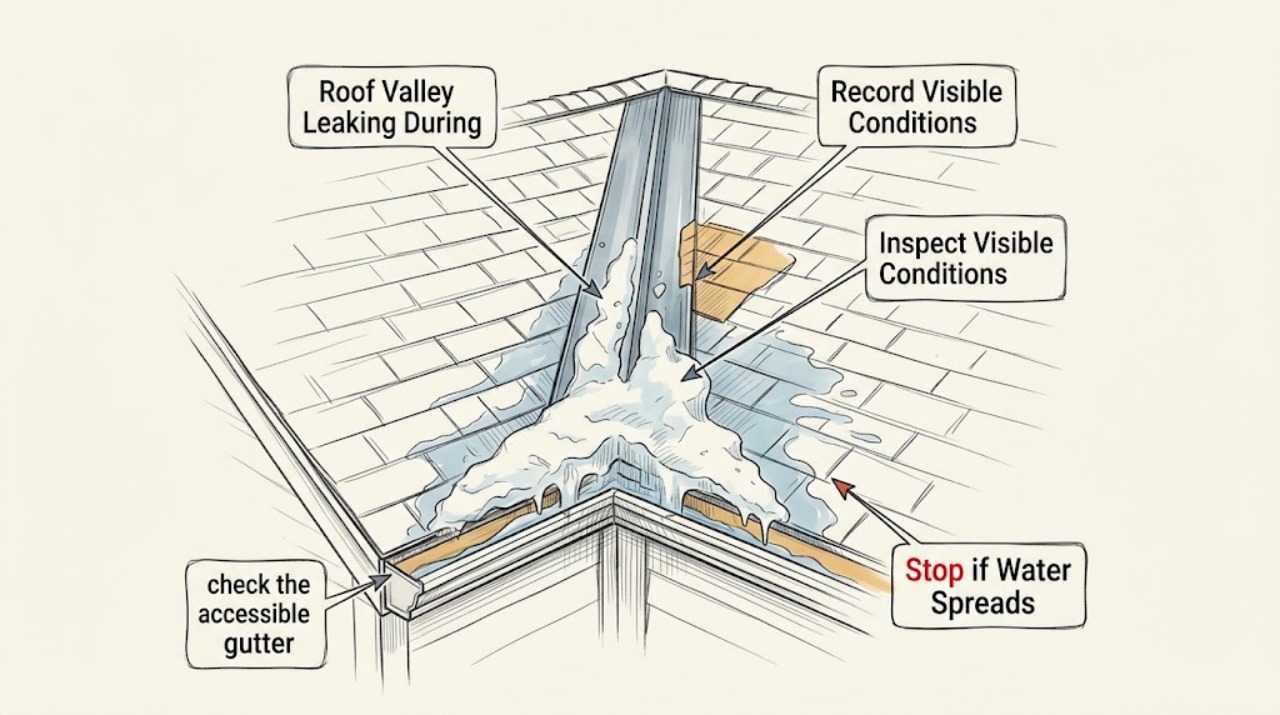
A roof valley that leaks during an ice dam is usually experiencing meltwater backup under the roofing, a damaged or open metal valley-flashing detail, or both. Do not assume the visible metal is the only failure: first establish whether the leak follows a freeze-thaw event, then have a qualified roofer inspect the valley lining, laps, fasteners, adjacent shingles, and underlayment after the roof is safe to access.
Work through in order
Diagnostic checks
Use only checks that match the exact appliance or system and its official guide.
-
Check 1
From inside the building, record when the stain or drip appears and look from a safe attic access point for wet roof sheathing or insulation below the valley; do not enter a wet or unsafe roof space.
Expected result: The leak starts during a freeze-thaw period and the moisture trail points down from the valley, or it appears only after ordinary rain.
Next step: Photograph the location and timing, keep the area below protected, and give the pattern to a qualified roofer for the valley inspection.
Why this matters
Why: A freeze-thaw-only pattern raises the likelihood of ice-dam backup, while a rain-only pattern makes a flashing, shingle, penetration, or underlayment defect more likely; either pattern still needs the roof assembly checked rather than a ceiling patch alone.
-
Check 2
From the ground, use binoculars or a camera zoom to inspect the valley and eave without climbing; look for packed snow or ice, debris, exposed or corroded metal, lifted or missing shingles, and visible gaps at the valley edges.
Expected result: Ice or debris blocks the valley flow, or the metal and adjacent roofing show corrosion, displacement, damage, or an open edge.
Next step: Do not chip, pry, or scrape the roof surface; keep people clear of the drop zone and arrange a roofer to remove the blockage and assess the underlying layers safely.
Why this matters
Why: A blocked flow can explain short-term backup, but damaged metal, shingles, or edges indicate a water-shedding defect that a thaw may expose even after the ice disappears.
-
Check 3
After the weather is safe, check the accessible gutter and downspout discharge from the ground and note whether snow, ice, leaves, or other debris prevents water leaving the valley area.
Expected result: The gutter or downspout is blocked or iced over, or it drains normally while the valley still leaks.
Next step: Clear only reachable ground-level debris without disturbing the roof; have a professional inspect the roof layers if the leak persists or the drainage cannot be safely restored.
Why this matters
Why: A drainage blockage can increase water backup at the eave, but normal drainage with a continuing valley leak points more strongly toward the valley flashing, underlayment, adjacent shingles, or another roof intersection.
-
Check 4
Ask a qualified roofer to inspect the metal valley flashing or lining, its laps and fasteners, the valley edges, the underlayment beneath the roofing, and nearby penetrations once ice and snow no longer make access hazardous.
Expected result: The inspection finds loose or missing fasteners, open laps, corrosion, punctures, displaced flashing, failed underlayment, or an obstruction in the valley.
Next step: Request a written repair scope that identifies the failed layer and how the new flashing, underlayment, and roofing will lap and shed water; do not order a generic metal piece before fit and local requirements are confirmed.
Why this matters
Why: A confirmed defect means the valley assembly needs a repair or replacement designed for the existing roof system; adding surface sealant alone may hide the symptom without restoring drainage.
Use your observations
Decision map
Find the observation that best matches what you see, then follow the next safe action.
-
PATH 01Next step
What you see
The leak coincides with a visible ice dam or packed snow in the valley.
Do this next
Treat the immediate risk as ice-dam backup: stay off the roof, keep people away from falling ice, and arrange safe snow/ice management and a valley inspection. Afterward, assess attic heat loss and ventilation so the dam does not recur.
-
PATH 02Next step
What you see
There is no ice dam, but the valley leaks during ordinary rain.
Do this next
Have the roofer trace the water path through the valley metal, laps, adjacent shingles, underlayment, and nearby roof or wall penetrations; do not assume replacing visible caulk will solve it.
-
PATH 03Next step
What you see
The valley looks intact from the ground but moisture reaches the attic or ceiling.
Do this next
Treat the issue as an unresolved concealed-layer failure and stop surface-only repairs. A roofer should inspect under the valley covering and check neighboring roof intersections when safe.
-
PATH 04Next step
What you see
Water is near electrical equipment, the ceiling is sagging, or falling ice and roof access create an immediate hazard.
Do this next
Leave the affected area, avoid touching wet electrical equipment, and contact the appropriate qualified professional; use emergency services when there is an immediate danger to people or the structure.
Helpful context
Understand the symptom
Why an ice dam can make a valley leak
When snow-covered roof areas warm above freezing, meltwater runs toward colder areas and can refreeze in a valley or at the eave. The growing ice blocks drainage, so water can collect and work back beneath shingles or through a weak flashing or underlayment detail. Roofs with multiple valleys are harder to air-seal, insulate, and ventilate, which can make one valley repeatedly warmer than the surrounding roof.
Safe temporary response
Keep people and equipment away from falling ice and dripping water. From the ground, document the valley, eaves, gutters, and the room or attic area below with photographs if conditions permit. Do not climb onto an icy roof, chip at the dam, pull off shingles, or rely on a bead of caulk as a permanent repair.
What should be repaired
A roofer should determine whether the failure is limited to a blockage and temporary backup or whether the valley assembly is damaged. The inspection should include the exposed metal or valley lining, its end laps and edges, fasteners, the roofing immediately beside the valley, the underlayment below it, and any nearby wall or roof penetrations. A durable repair has to restore the water-shedding layers and drainage path; surface sealant by itself is not a substitute for sound flashing and laps.
Reducing repeat ice dams
After the immediate leak is controlled, ask the roofer or an insulation professional to assess attic air sealing, insulation continuity at the exterior wall plates, soffit-to-ridge airflow, and gutter or downspout blockage. Keeping gutters clear and limiting roof snow from the ground where appropriate can reduce the amount of water available to refreeze, but those steps do not repair failed valley flashing.
Only after diagnosis
Potential parts
- valley flashing or valley lining
Consider this only if a qualified roofer confirms corrosion, an open lap, displacement, puncture, or another failed valley-lining detail; an ice dam alone does not prove the metal needs replacement.
Match the existing roof covering, valley geometry, underlayment, local requirements, and manufacturer installation instructions before ordering any material.
When checks do not resolve it
Need a professional?
Call when safe ground-level checks cannot identify the source, the flashing is damaged, or any roof access or interior moisture creates a hazard.
Have this ready
- Provide photographs, the room and attic location, whether the leak follows freeze-thaw or rain, and whether the valley, gutter, or downspout showed ice or blockage.
Common questions
FAQ
Does an ice dam prove the metal valley flashing is bad?
No. The dam can cause water backup even when the visible metal is intact, but it can also expose an open lap, corrosion, damaged edge, or failed underlayment. A roofer needs to inspect the complete valley water-shedding path.
Can I fix the leak by adding roof cement or caulk?
Treat sealant as, at most, a temporary measure directed by a professional. It does not replace correctly lapped flashing, underlayment, shingles, and a clear drainage path, and the EPA guidance specifically cautions against depending on sealants alone for rainwater control.
What information should I give the roofer?
Give the timing of the leak, whether it follows freeze-thaw or ordinary rain, photographs from the ground and interior, the location of the stain relative to the valley, and any visible gutter or downspout blockage.
Read the exact guide
Official sources
- Construct Roofs and Attics for Ice Dam PreventionU.S. Department of Energy Building America Solution Center · Residential roofs with snow, ice dams, and valleys
- Preventing Roof Ice DamsNational Weather Service, Grand Rapids · Residential roofs with snow, ice dams, gutters, and downspouts
- Moisture Control Guidance for Building Design, Construction and MaintenanceU.S. Environmental Protection Agency · Building roof assemblies and inspection of flashings, valleys, and drainage systems
Community feedback
Share a repair observation
Share a plain-text repair observation. Accepted observations are published automatically; this page may take a moment to update.