
On this page
Start here
Quick answer
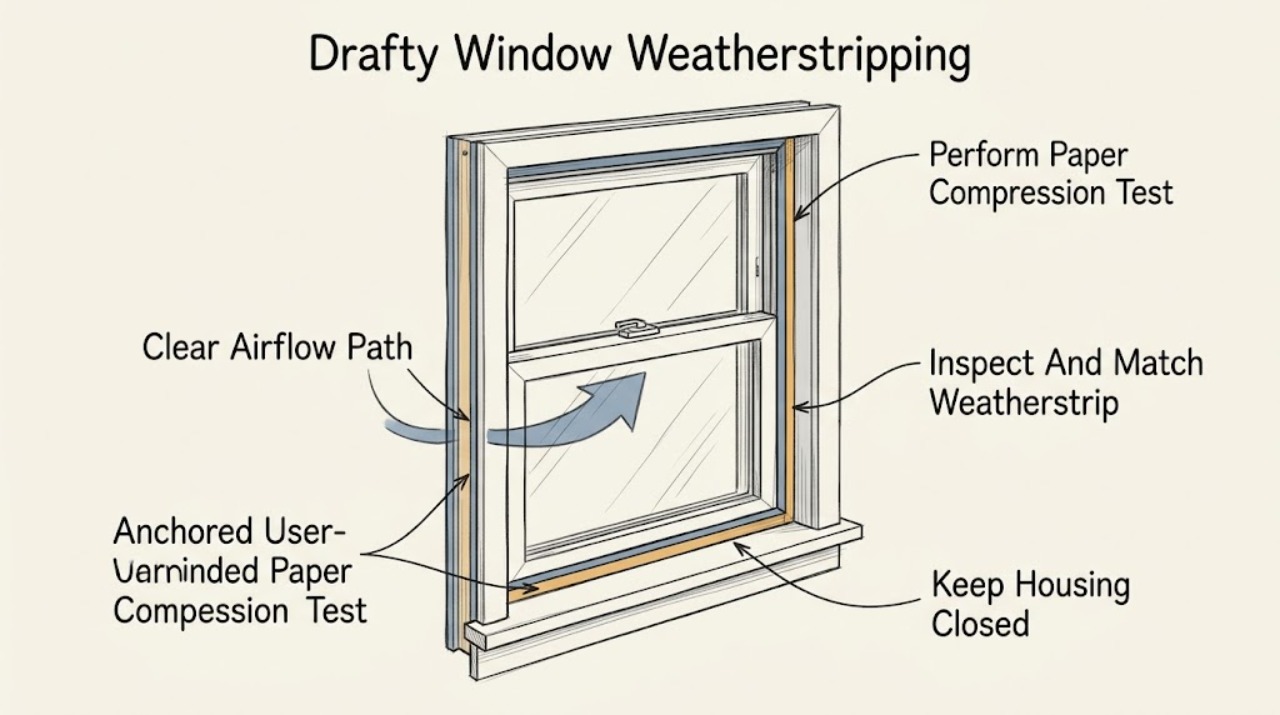
To fix a drafty window, first locate whether air is passing the moving sash or through a stationary gap around the frame. A paper test on a closed, latched window can reveal weak compression: if the paper slides out easily, the weatherstrip or closure is not sealing well. Replace only the seal profile that matches the window, and use caulk for an accessible stationary crack rather than weatherstripping. If the draft comes from behind complicated trim, a damaged or rotten frame, water intrusion, an inaccessible upper window, or a leak that remains after the accessible seal is corrected, stop and call a qualified window or home-energy professional.
Work through in order
Diagnostic checks
Use only checks that match the exact appliance or system and its official guide.
-
Check 1
With the window closed and latched on a calm, safe day, feel for moving air around the sash perimeter, meeting rails, locks and trim; mark the strongest location without removing anything.
Expected result: Air at the sash-to-frame joint follows the moving seal, while air at the trim or wall junction points to a stationary gap. A draft that appears at several unrelated locations may not be from this window alone.
Next step: Use the paper test on the moving joint if the window is reachable. For a stationary gap, inspect only the accessible surface and use the appropriate caulk or professional air-sealing branch.
Stop if: Stop if the sash is loose, the frame is visibly rotten or distorted, glass is cracked, or the window cannot be reached without unsafe climbing.
Why this matters
Why: The observed path decides whether to investigate weatherstripping, a frame gap or a broader building air-leak pattern.
-
Check 2
Place a sheet of paper across the suspected sash seal, close and latch the window over it, then try to pull the paper out gently at several points.
Expected result: If the paper moves out easily at one section, that part of the sash is not compressing the seal well; if resistance is consistent, the draft may be at another seam or opening.
Next step: If one section is loose, compare the existing weatherstrip’s shape and installation position before choosing a like-for-like replacement. If the result is even but the draft remains, return to the marked air path and inspect the frame or trim.
Stop if: Do not force the lock or sash to make the paper test pass; stop if operation becomes stiff, the sash will not latch, or the seal is part of a damaged glazing system.
Why this matters
Why: The test indicates local sealing pressure, but it does not identify the correct replacement profile or prove that the surrounding wall is airtight.
-
Check 3
Inspect the accessible weatherstrip with the window open only as far as normal operation allows; clean loose dirt from the contact area and note whether the seal is flattened, torn, detached or missing.
Expected result: A worn or displaced strip at the moving joint is different from a gap at the frame-to-wall trim. The window type and seal channel determine the replacement shape; a generic strip may prevent closure.
Next step: Measure and identify the existing profile from the window documentation or a qualified supplier, then fit it without covering drainage openings or changing sash alignment. If the strip is integrated, inaccessible or the sash remains loose, arrange service.
Stop if: Stop before prying glass, removing glazing beads, altering hardware or forcing a strip into a channel that does not match.
Why this matters
Why: A failed seal can be replaced conditionally, but compatibility depends on the window’s construction and the existing mounting method rather than on appearance alone.
-
Check 4
Inspect the visible joint between the fixed frame, jamb and interior trim for a cracked or missing seal, keeping the sash tracks, weep openings and drainage paths clear.
Expected result: A crack at the stationary frame or trim can admit air even when the sash weatherstrip passes the paper test. Dampness, staining, soft wood or a gap that disappears behind trim suggests a larger installation or water-management issue.
Next step: For a small, reachable surface crack on sound material, use a compatible caulk according to its instructions. If the gap is behind trim, the trim is complicated, or moisture or damage is present, stop and call a window or building-envelope professional.
Stop if: Do not seal over active water entry, rotten wood, blocked drainage holes or trim that may contain hazardous old paint.
Why this matters
Why: Weatherstripping is not the correct treatment for a fixed-frame gap; deeper sealing behind trim may require careful air-sealing work and can expose hidden damage.
-
Check 5
After any accessible seal correction has cured or settled as directed, close and latch the window, repeat the paper test at the original points and compare the indoor draft during similar wind conditions.
Expected result: Less air at the same marked seam supports a successful local seal. A persistent draft, condensation, water stain, rattling sash or air that appears around the trim indicates that the repair did not address the whole path.
Next step: If the draft persists or the opening is hard to diagnose, arrange a qualified window inspection or a home-energy assessment; provide the marked location and test results.
Stop if: Leave the window out of service and seek prompt professional help if it cannot lock, admits water, has damaged glass or frame movement, or requires work at height.
Why this matters
Why: A local retest can confirm a changed seal but cannot certify the entire opening; persistent symptoms warrant diagnosis instead of adding layers of weatherstrip.
Use your observations
Decision map
Find the observation that best matches what you see, then follow the next safe action.
-
PATH 01Next step
What you see
The paper slips easily at the sash-to-frame contact and the weatherstrip is visibly worn or missing.
Do this next
Identify the window type and matching seal profile, fit only an accessible compatible replacement, then repeat the paper and draft checks.
Why this path and its safety boundary
Why it matters: Weak compression at a moving joint is consistent with a weatherstripping problem.
-
PATH 02Next step
What you see
The paper test is firm but air is visible or felt at the trim or frame-to-wall seam.
Do this next
Use suitable caulk only for a small, reachable crack on sound material; escalate hidden, broad or damaged gaps to a professional.
Why this path and its safety boundary
Why it matters: The leak is stationary and weatherstripping alone will not seal it.
-
PATH 03Next step
What you see
The draft occurs at multiple windows or changes substantially with wind and room pressure.
Do this next
Prioritize a qualified home-energy assessment or blower-door-based diagnosis instead of replacing seals at random.
Why this path and its safety boundary
Why it matters: The window may be one part of a larger pressure-boundary leak.
-
PATH 04Next step
What you see
The frame is rotten, wet, distorted, loose, or the glass or lock is damaged.
Do this next
Stop sealing work and arrange a qualified window or building-envelope inspection.
Why this path and its safety boundary
Why it matters: A seal replacement cannot correct the structural or water-management problem and may hide deterioration.
-
PATH 05Next step
What you see
The opening is high, inaccessible, has complicated trim, or disturbing painted trim may create hazardous dust.
Do this next
Use a qualified professional with appropriate access and renovation-safety controls.
Why this path and its safety boundary
Why it matters: The access or health risk exceeds a simple accessible weatherstrip check.
Helpful context
Understand the symptom
The leak location determines the repair
Weatherstripping belongs at a joint that opens and closes, such as the sash-to-frame contact. A crack between a fixed frame and the surrounding wall is a different air path and generally calls for an appropriate caulk or other air-sealing treatment. Sealing the wrong surface can stop the window from latching, block drainage paths or hide a damaged frame.
Keep accessible work small
Limit do-it-yourself work to a reachable, sound window and a seal that can be removed and refitted without forcing the sash. Do not work from an unsafe ladder or roof, pry complicated trim, inject foam into sash tracks or weep openings, or disturb old painted trim if it may create hazardous dust.
Drafts are not always a weatherstrip failure
A draft that changes with wind can be at the sash, trim, rough opening, wall penetration or another part of the home. If a careful local seal correction does not change the result, an energy assessment or window professional can separate the window leak from pressure-driven leaks elsewhere.
Only after diagnosis
Potential parts
- window sash weatherstrip or gasket
Weatherstrip shape, mounting method and compression vary by window construction; a visually similar strip may not seal or allow the sash to latch.
Confirm the window type, channel or adhesive method and dimensions from the documentation or a qualified supplier before ordering. - compatible caulk or foam backer rod for a stationary frame gap
Caulk is for an appropriate surface crack; a larger rough-opening gap may need backer rod and careful air sealing, not weatherstrip at the sash.
Do not cover weep holes, sash tracks, glazing edges or active water damage; hidden or broad gaps should be assessed professionally.
When checks do not resolve it
Need a professional?
Call a qualified window or home-energy professional if the draft remains after the accessible weatherstrip and frame checks, if the leak is behind complicated trim, if the frame, lock or glass is damaged, if water or rot is present, if the opening is high or inaccessible, or if old painted trim may be disturbed.
Common questions
FAQ
How do I know whether a drafty window needs weatherstripping or caulk?
Weatherstripping seals a moving sash-to-frame joint. Caulk is for an appropriate crack at a stationary frame or trim. Locate the air path first so the repair does not interfere with the sash or drainage.
What does the paper test show?
Close and latch a sheet of paper in the suspected sash seal. If it pulls out easily at a section, the window could be tighter there. The result is a local compression clue, not proof that the whole opening is sealed.
Can I use any weatherstrip from a hardware store?
No universal fit should be assumed. Window construction, seal profile and mounting method matter, and an incorrect strip can stop the sash from closing or latching. Match the existing profile and documentation first.
Why is the draft still there after replacing the strip?
The air may be entering at the trim, rough opening, a damaged frame or another building leak. Recheck the original marked path; if it is hidden, broad or associated with moisture, arrange professional diagnosis rather than adding more strip.
Read the exact guide
Official sources
- Consumer Guide to Air Sealing the HomeU.S. Department of Energy · DOE guidance on drafts, obvious versus hard-to-detect leaks, professional energy assessment and weatherstripping materials.
- Sealing Behind Window & Door Trim ProjectENERGY STAR · Signs of drafts, paper test, trim-gap sealing, weatherstripping improvement and professional boundaries.
- Energy-Efficient Home Improvement Credit Insulation and Air-Sealing EssentialsU.S. Department of Energy · DOE distinction between caulk for stationary cracks and weatherstripping for moving doors and operable windows, plus window and door frame sealing.
- Rough Opening Flashing: Air SealingU.S. Department of Energy Building Science Education · DOE building-science guidance on gaps between window units and framing, caulk, low-expansion foam and backer rod.
Community feedback
Share a repair observation
Share a plain-text repair observation. Accepted observations are published automatically; this page may take a moment to update.