
On this page
Start here
Quick answer
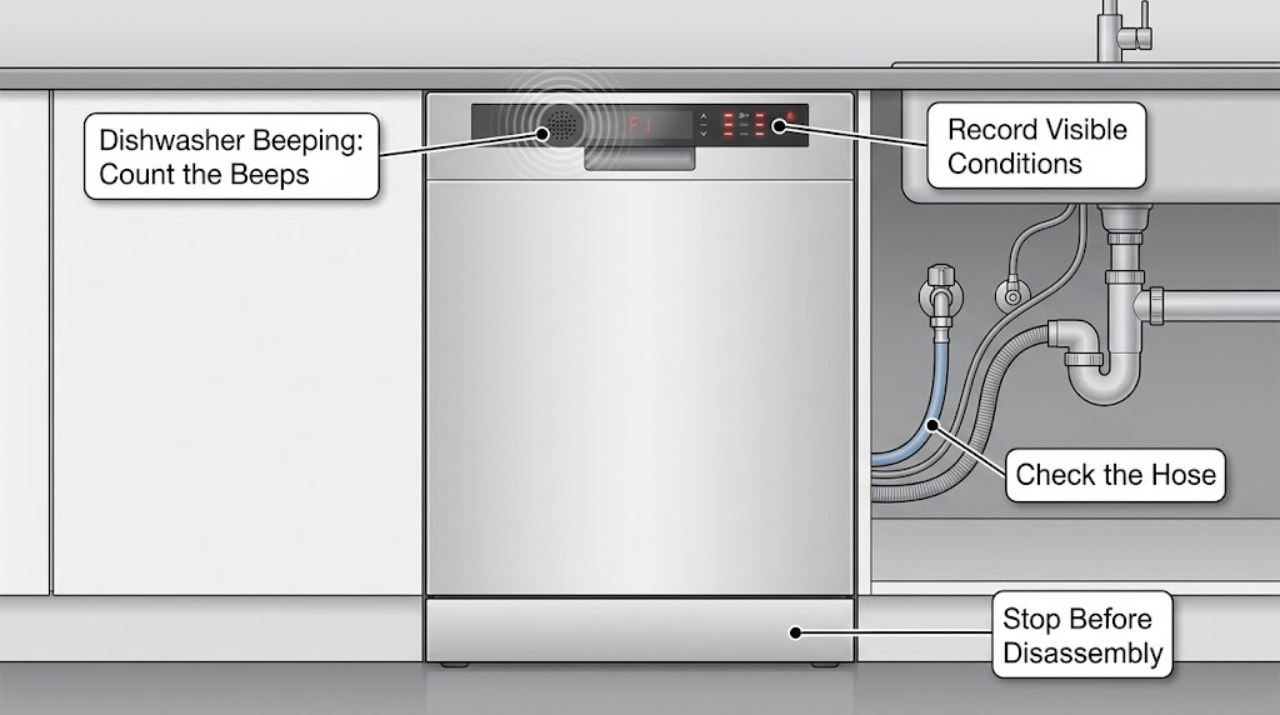
Do not treat every AEG dishwasher beep as the same fault. First record the exact number of beeps or flashes, the display code, when the sound occurs, and whether the dishwasher fills, drains, washes, or leaks. AEG's support map associates one beep with an inlet problem, two with a drain problem, three with leak detection, and four with a pressure-sensor or water-level problem; an i50-family code points to a wash-motor or pump malfunction. These signals vary by model, so use the exact AEG manual. You can make only the model-approved external checks for the matching pattern. If there is water leaking, a damaged hose, a persistent alarm, or a programme that will not complete, close the water tap where appropriate, keep the appliance off, and arrange authorised service. Do not open electrical covers or test live parts.
Before you begin
Safety first
- The owner scope is limited to reading the display, observing the sound and programme stage, and performing only external or exact-manual checks with water and power safely isolated. It excludes cabinet, base, pump, sensor, control-board, wiring, live electrical, and anti-flood bypass work.
Work through in order
Diagnostic checks
Use only checks that match the exact appliance or system and its official guide.
-
Check 1
From the normal control panel, record the AEG model number, the exact display code, the number of beeps in one sequence, any matching LED flashes, and the programme stage when it occurs. Note whether the dishwasher is filling, draining, circulating water, heating, or stopping. Do not press undocumented button combinations just to reproduce the alarm.
Expected result: The appliance shows one, two, three, or four beeps or flashes with a matching code; it shows an i50-family code; it makes an uncountable continuous sound; or it gives no code and no clear pattern.
Next step: Use the matching pattern below and the exact model manual. For an unknown or conflicting pattern, stop after documenting it and request AEG-authorised diagnosis if the programme will not complete.
Stop if: Do not remove panels, access wiring, or test electrical parts while the dishwasher is connected to power.
Why this matters
Why: AEG uses different signals for inlet, drain, leak, pressure or water-level, and wash-motor or pump conditions. An unknown pattern cannot be assigned safely to one part or fault family.
-
Check 2
If the pattern is one beep or an inlet-related code, check only the normal water tap and the visible inlet hose for an obvious closed tap, kink, twist, or damage. If the hose or connection must be disturbed, turn off the water supply and power first and follow the model manual; do not loosen a damaged connection.
Expected result: The tap is closed, household water flow is absent, another appliance is using the supply, the hose is kinked or damaged, the inlet filter is restricted, or the external supply looks normal but the dishwasher still alarms.
Next step: Restore only an obvious closed tap or external supply condition that the manual permits, then run one suitable programme. If the signal returns, the hose is damaged, or no water enters, keep the appliance off and arrange service.
Stop if: Do not perform a pressure test, dismantle the inlet valve, or continue operating with a leaking or damaged hose.
Why this matters
Why: AEG associates one beep and i10/i11-family indications with insufficient or absent water entering the dishwasher. A damaged hose or unresolved alarm needs service; a normal visible supply does not prove the inlet valve or internal water path is good.
-
Check 3
If the pattern is two beeps or a drain-related code, check the tub for standing water, the user-accessible filter area for obvious food debris or foam, and the visible drain hose and sink connection for a kink or blockage. Use gloves and the exact AEG manual for filter access; never reach into an unknown obstruction or dismantle the pump.
Expected result: Water remains in the tub, filters or sump are visibly obstructed, the drain hose is kinked or incorrectly connected, a recently installed unit still has a sink blanking plug, or the drain path looks clear but the alarm returns.
Next step: Correct only the external or manual-approved restriction, refit filters correctly, and run one programme. If water remains, the alarm returns, or the pump only hums without draining, stop using the dishwasher and request service.
Stop if: Do not remove the pump, insert tools into it, run repeated cycles with standing water, or work on a hose connection without shutting off water and power.
Why this matters
Why: AEG associates two beeps and i20/C2/F2/AL6-family indications with a drainage problem. A visible drain restriction may be user-correctable, but a clear path with a returning alarm can indicate a pump, sensor, or control problem that cannot be identified from the beep alone.
-
Check 4
If the pattern is three beeps, a leak indication, or a pump that runs continuously, look and listen from a safe position for water under or around the dishwasher. Close the dishwasher's water tap and leave the appliance off if there is a leak or an i30-type indication. Do not tip out or open the appliance to find the base water.
Expected result: Water is visible, the pump runs continuously, the door seal or loading appears to direct spray abnormally, the area is dry but the three-beep alarm returns, or the pattern is not confirmed.
Next step: Keep the water supply closed and arrange an authorised service visit for a leak or recurring three-beep alarm. Protect the surrounding cabinet and floor from further water; do not restore operation for a test.
Stop if: Do not use the dishwasher with a leak, remove the base, bypass anti-flood protection, or energise it while water or damage is present.
Why this matters
Why: AEG associates three beeps and i30 with leak detection or water collected in the appliance base. A dry floor does not rule out an internal leak, and repeated anti-flood operation is not a normal sound to troubleshoot by repeated starts.
-
Check 5
If the pattern is four beeps or an i40/i43/i44-family code, check only the user-accessible filters and sump for foam or debris if the AEG manual permits. If the display shows an i50-family code or the dishwasher beeps while failing to wash, note whether the cycle stops and whether filters or foam were involved; do not access the motor or pump.
Expected result: Filters or sump contain foam or debris, the cycle runs normally after a manual-approved clean and single reset, the four-beep signal returns, or an i50-family code remains with no washing action.
Next step: If the manual-approved clean and one restart resolve the signal, monitor the next programme. If the alarm returns, the programme stops, or the dishwasher cannot circulate water, leave it off and arrange authorised service.
Stop if: Do not test the pressure sensor, motor, pump, control board, or wiring, and do not repeatedly reset a fault that returns.
Why this matters
Why: AEG associates four beeps with a possible pressure-sensor or water-level-control issue, and i50-family codes with a wash-motor or pump malfunction. Foam or debris can be a temporary trigger in the documented checks, but a returning signal needs professional diagnosis.
Use your observations
Decision map
Find the observation that best matches what you see, then follow the next safe action.
-
PATH 01Next step
What you see
The beep is a brief, normal operating sound with no warning flash or code, and the dishwasher fills, washes, drains, and completes the programme normally.
Do this next
Monitor the timing and loading. Request service if the sound becomes new, loud, repetitive, or is joined by a code or loss of performance.
Why this path and its safety boundary
Why it matters: AEG describes humming during filling, spraying during washing, and pumping during draining as normal operating sounds; sound alone is not an error.
-
PATH 02Next step
What you see
One beep or a matching inlet code occurs while the dishwasher does not fill, and the tap or visible inlet hose has a supply restriction.
Do this next
Correct only the manual-approved external restriction with water and power safely isolated. If the beep returns or the hose is damaged, keep the unit off and book service.
Why this path and its safety boundary
Why it matters: The pattern is consistent with AEG's water-inlet fault family, and an external supply restriction is more plausible than an immediately proven internal component failure.
-
PATH 03Next step
What you see
Two beeps occur with standing water or a visible drain restriction, or the dishwasher makes a drain-pump sound without removing water.
Do this next
Perform only the filter, hose, and connection checks permitted by the exact manual. If standing water or two beeps remain, stop using the dishwasher and request service.
Why this path and its safety boundary
Why it matters: This matches AEG's drain-fault family more closely than a simple end-of-cycle sound, but a clear drain path with a returning alarm can require pump or sensor diagnosis.
-
PATH 04Next step
What you see
Three beeps, water around the appliance, or a continuously running pump appears, or the alarm returns after the water supply is closed and the appliance is left off.
Do this next
Keep the water tap closed and the dishwasher off. Arrange leak diagnosis and do not bypass or repeatedly reset the anti-flood condition.
Why this path and its safety boundary
Why it matters: AEG's i30 guidance treats this as possible leak detection and recommends authorised service; a dry external floor does not exclude water in the base.
-
PATH 05Next step
What you see
Four beeps, an i50-family code, or repeated beeping is accompanied by failure to wash, a programme that stops, an error display, or a signal that cannot be mapped to the model manual.
Do this next
Leave the dishwasher off after the manual-approved external checks and arrange authorised service. Provide the model, complete code, beep or flash count, programme stage, water state, and any visible leak or hose issue.
Why this path and its safety boundary
Why it matters: AEG links these patterns to pressure or water-level sensing, wash-motor or pump malfunction, or another model-specific monitored condition. The signal narrows the system but does not prove a replaceable part.
Helpful context
Understand the symptom
A beep is a signal, not a diagnosis
AEG says a dishwasher can communicate a potential issue through an error code, flashing LEDs, or beeps. The same word—beeping—can therefore describe different user experiences. Count one sequence rather than guessing from a continuous sound, photograph or write down the display, and note whether the event happens at filling, washing, draining, or the end of a programme. The model number and its manual decide which pattern applies to your control panel.
Use the signal to choose a narrow, safe check
AEG's published mappings make the first decision useful: one beep is associated with water inlet trouble, two with drainage, three with leak detection, and four with pressure sensing or water-level control. AEG also has separate guidance for i50-family wash-motor or pump faults. These are diagnostic directions, not proof that a named component has failed. Start with user-accessible water, drain, filter, loading, and display observations; stop when the check reaches a hose connection, leak, wiring, pump, or control that requires service.
Separate normal operating sounds from an alarm
A humming sound while the dishwasher fills, splashing while spray arms circulate water, or pumping near the end of a cycle can be normal. A new, repetitive, unusually loud sound, a beep paired with an error code, or a beep paired with failed filling, draining, washing, or a leak is not safely explained by normal operation alone. If the sound cannot be counted or the dishwasher's behaviour is abnormal, preserve the observation for service instead of repeatedly restarting it.
When checks do not resolve it
Need a professional?
Arrange authorised AEG service when a beep or flash pattern returns after the model-approved external checks, when the programme will not complete, when there is a leak or a continuously running pump, when a hose is damaged, or when an i40/i50-family or other code remains. Close the water tap for a leak or suspected water-inlet problem and keep the dishwasher off. Do not open electrical covers, access pumps or sensors, bypass anti-flood protection, or test live wiring.
Safety scope: The owner scope is limited to reading the display, observing the sound and programme stage, and performing only external or exact-manual checks with water and power safely isolated. It excludes cabinet, base, pump, sensor, control-board, wiring, live electrical, and anti-flood bypass work.
Common questions
FAQ
What does one beep mean on an AEG dishwasher?
AEG associates one beep or a single warning flash with an inlet-related problem such as insufficient water entering the dishwasher. Record the full code, then check only the tap and visible inlet hose for an obvious restriction. If the hose is damaged or the signal returns, keep the appliance off and arrange service.
What do two or three beeps mean on an AEG dishwasher?
AEG maps two beeps to a drain-related indication and three beeps to a possible leak-detection indication. Standing water or a blocked visible drain path supports the two-beep branch. Water around the appliance, a continuously running pump, or a returning three-beep alarm calls for closing the water tap, leaving the dishwasher off, and arranging service.
Can I silence or reset an AEG dishwasher that keeps beeping?
Do not silence or repeatedly reset an alarm before recording the code and beep pattern. AEG provides model-specific reset and filter checks for some codes, but a recurring alarm, leak, failed programme, or i50-family or pressure-sensor indication needs authorised diagnosis. Never bypass a leak-protection condition or test internal parts.
Read the exact guide
Official sources
- Dishwasher displays error code i30 | AEGAEG · Official AEG support article for integrated and freestanding dishwashers; leak access and recovery steps are model dependent.
- Dishwasher displays error code i50 | AEGAEG · Official AEG support article for integrated and freestanding dishwashers; the code family covers multiple exact model variants.
- Dishwasher displays error code i10, i11, AL5, C1, beeps once, or the warning light flashes once | AEGAEG · Official AEG support article for integrated and freestanding dishwashers; use the exact model manual for access and installation differences.
- Dishwasher displays error code i40, i43 or i44 | AEGAEG · Official AEG support article for integrated and freestanding dishwashers; reset and filter instructions must be checked against the exact model.
- Fix Dishwasher Not Draining | Error I20 Guide | AEGAEG · Official AEG support article for integrated and freestanding dishwashers; hose routing and filter access are model and installation dependent.
- Dishwasher Making Noises – Normal Sounds and Faults | AEGAEG · Official AEG dishwasher sound guidance; the exact sound profile varies by programme, loading, and model.
- Dishwasher displays an error code, how to fix it? | AEGAEG · Official AEG dishwasher support article; exact code behavior depends on the model and its display or LED interface.
Community feedback
Share a repair observation
Share a plain-text repair observation. Accepted observations are published automatically; this page may take a moment to update.