
On this page
Start here
Quick answer
First note whether the sound is a single end-of-cycle tone, a tone whenever a key is touched, a beep every 30 seconds or every minute, or a repeating beep with a blinking light or displayed code. GE says a beep every 30 seconds or minute usually means the door was unlatched during a cycle: close and latch it, then press Start if the model requires that. A blinking Start or Start/Reset light can simply mean the dishwasher is finishing a reset, with the timing varying by model. For other beeps or blinking lights, press Start/Reset once and wait; if the issue remains and there is no leak or electrical hazard, use the exact model's documented 30-second breaker reset once. Check that the door is not blocked by a rack, dish, cabinet, or misalignment. Read any code rather than guessing: GE says common codes can represent drain, water, detergent-cup, temperature, pressure, or leak conditions, and not all codes apply to every model. If LEAK DETECTED, water under the dishwasher, smoke, a burning odor, sparks, a hot cord or outlet, or repeated breaker trips are present, stop using it and disconnect power from a safe position until qualified service. Do not defeat the latch, reach under the unit, remove panels, or perform live tests.
Before you begin
Safety first
- Do not defeat the latch, reach under the dishwasher, remove panels or leak sensors, probe wiring, bypass protection, or repeatedly reset a breaker or leak alert. Stop for LEAK DETECTED, water near electrical parts, smoke, burning odor, sparks, abnormal heat, a hot or damaged cord or outlet, or repeated breaker trips.
Work through in order
Diagnostic checks
Use only checks that match the exact appliance or system and its official guide.
-
Check 1
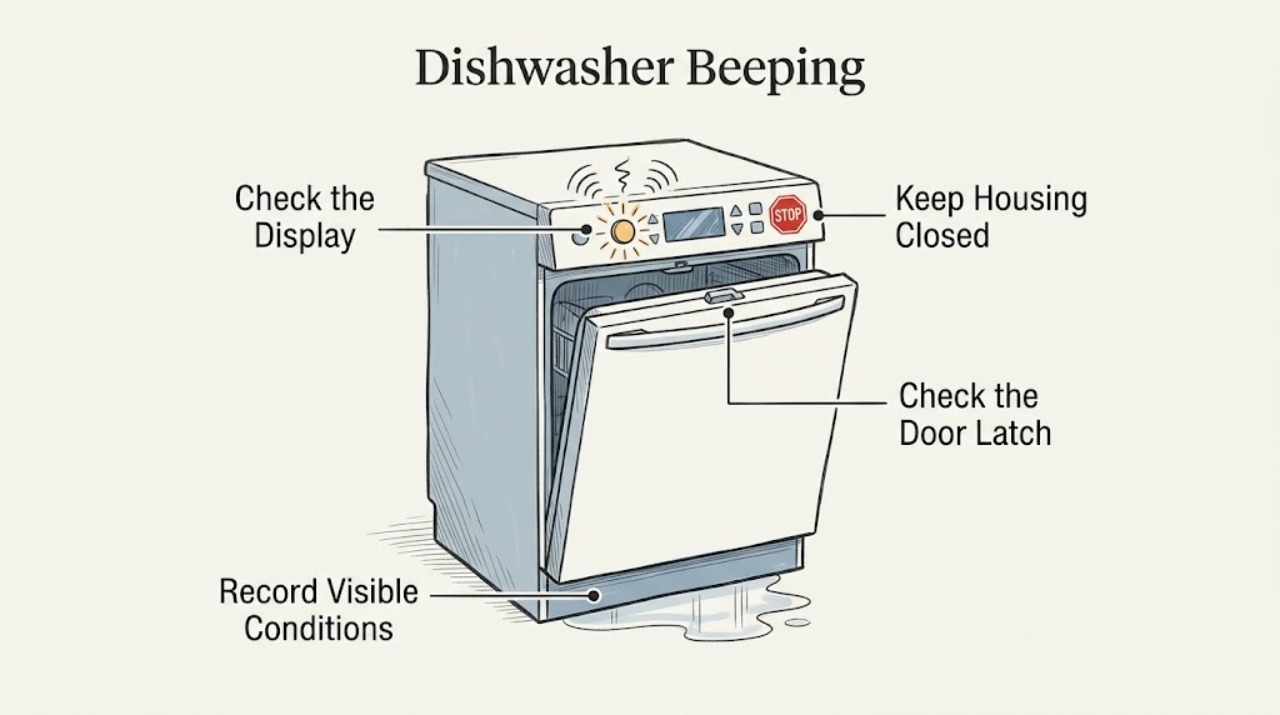
From outside the dishwasher, record the exact model and serial information from the label or paperwork. Without opening the door repeatedly, note whether the beep is once at cycle completion, on every key press, every 30 seconds or minute, continuous, or paired with a blinking light or display code.
Expected result: The beep occurs only at the end; follows a door opening; happens when a control is touched; repeats while Start or another light blinks; or accompanies a code, standing water, or a leak alert.
Next step: Continue with the branch matching the interval and display. If the model label requires moving the appliance or touching a wet area, stop and arrange help.
Stop if: Stop immediately for water under the dishwasher, LEAK DETECTED, smoke, burning odor, sparks, abnormal heat, a hot or damaged cord or outlet, or repeated breaker trips.
Why this matters
Why: Timing separates a normal completion or key tone from an interrupted-cycle reminder and from a fault condition. GE says sound and light meanings vary by model, so the exact manual—not a generic tone-silence sequence—controls the next check.
-
Check 2
If beeping began during a wash or dry cycle, check from the front that the door is fully closed and latched. Look only for a rack, pan, utensil, or cabinet edge preventing closure; do not force the door or remove the latch. Close it once and press Start only if the exact model uses Start to resume.
Expected result: The beep stops after the door latches; it continues with the door closed; the door springs back or will not latch; or the cycle has ended with a Clean or end-of-cycle indication.
Next step: Remove only a visible loading obstruction and resume once. Arrange service for a door that will not latch, a recurring reminder with a closed door, or a cycle that does not resume.
Stop if: Do not defeat the latch, hold the door shut with a tool, reach into a moving or heated tub, or continue if water leaks from the door.
Why this matters
Why: GE identifies a beep every 30 seconds or minute as an unlatched door during a cycle. A door that cannot latch points to obstruction, rack position, installation, alignment, or latch service rather than a tone setting. A completed-cycle tone is a different condition.
-
Check 3
If the dishwasher beeps only when a key is touched or at the end of a completed cycle, compare the display and Clean light with the exact manual. Do not press a model-specific tone sequence unless the model number matches the documented family; leave the controls alone if the tub is hot or wet.
Expected result: A tone occurs only with a key press; a double beep occurs with a completed cycle and Clean light; the beep is accompanied by blinking or a code; or the sound is continuous without a user input or end-of-cycle state.
Next step: Use the exact manual to change an optional tone only if desired and documented. For unexplained or persistent beeping, continue to the code and reset checks rather than repeatedly pressing pads.
Stop if: Do not use a button sequence copied from another GE model, open the control panel, or operate through smoke, heat, water, or an electrical odor.
Why this matters
Why: GE lists normal control tones on certain model-number families and an optional end-of-cycle beep on applicable models. Persistent sound outside those states is not proven normal and needs the model's troubleshooting path.
-
Check 4
Read and record every visible display code or message before resetting. Note whether the tub contains water, the detergent cup is blocked, the cycle was delayed, the machine failed to fill or drain, or a leak alert is shown. Check only visible rack and door-area obstructions; do not remove the sump, float, hose, or lower panels.
Expected result: The display shows a delay or power-failure state; a drain, water, detergent-cup, temperature, pressure, or leak code; no code but a blinking Start light; or no water and no visible obstruction.
Next step: Follow only the exact model's documented user correction. For LEAK DETECTED, water under the unit, or a persistent code, stop and arrange service; do not order a part from the code alone.
Stop if: Do not reach below the tub, tap a float through an opening, remove hoses, or run a cycle when a leak alert or water near electrical parts is present.
Why this matters
Why: GE says fault-code availability and meanings vary by model. Some codes have a user-level correction, while persistent drain, pressure, temperature, leak, or control conditions require service. A code is more useful than the beep alone for selecting the branch.
-
Check 5
If there is no leak, smoke, heat, damaged power part, or other hazard, press Start/Reset once as GE describes for other blinking or beeping states and wait the model's stated interval. If the issue persists and the exact manual permits a power reset, switch the dishwasher's circuit breaker off for about 30 seconds and back on once; do not repeatedly cycle power.
Expected result: The beep and blinking stop; the Start or Start/Reset light continues its reset sequence; the code returns; the dishwasher will not start; or the breaker trips again.
Next step: Try one normal cycle only if the reset clears the condition and there is no water or electrical concern. Arrange qualified service for a returning alert, no-start, or repeat trip.
Stop if: Do not reset a leak alert, repeatedly reset a breaker, bypass protection, or reconnect an appliance with a hot or damaged cord or outlet.
Why this matters
Why: A reset can clear a transient control state or power-surge symptom, but it does not prove that a door, drain, sensor, leak, or control fault is repaired. A returning code, no-start condition, or repeat breaker trip requires service.
-
Check 6
Record the exact model, beep interval, door state, lights, code, water in the tub or under the unit, reset performed, and whether the sound returned. Do not run another cycle just to reproduce a fault or leak.
Expected result: The beep was a documented door reminder or optional tone and stops normally; the alert returns; the cycle remains incomplete; water or a leak message appears; or an electrical hazard develops.
Next step: Arrange qualified GE dishwasher service and provide the observation record. Use qualified plumbing or electrical help when the evidence points outside the appliance.
Stop if: Stop immediately for LEAK DETECTED, water under the dishwasher, smoke, burning odor, sparks, abnormal heat, damaged power parts, or repeated breaker trips.
Why this matters
Why: A stable result after closing the door or a documented reset supports a cycle-state correction, not a universal repair. A returning beep, incomplete cycle, fault code, leak, or electrical symptom needs model-specific diagnosis.
Use your observations
Decision map
Find the observation that best matches what you see, then follow the next safe action.
-
PATH 01Safety boundary
What you see
The dishwasher beeps every 30 seconds or minute after the door was opened or appears not to be fully latched during a cycle.
Do this next
Remove only a visible obstruction, close and latch the door, and press Start if the exact model requires it. Arrange service if the sound returns with a closed door or the latch will not hold.
Why this path and its safety boundary
Why it matters: GE identifies this interval as a door-unlatched reminder. A rack, dish, cabinet edge, alignment problem, or latch issue may prevent the machine from recognizing closure.
Safety stop: Do not defeat the latch, force the door, or continue if water leaks around it.
-
PATH 02Safety boundary
What you see
The dishwasher beeps only when a key is pressed or gives a documented tone at cycle completion with the Clean indication and no fault symptoms.
Do this next
Leave the setting alone or use the exact model manual to change its tone option. Escalate if the sound occurs outside key presses or completion, or if the cycle is incomplete.
Why this path and its safety boundary
Why it matters: GE documents control tones and an end-of-cycle beep on applicable model families. This is not the same as an unexplained repeating beep during a failed cycle.
Safety stop: Do not apply a tone-silence sequence from another model or open the console.
-
PATH 03Safety boundary
What you see
A Start or Start/Reset light blinks, or the dishwasher beeps with a displayed code, incomplete cycle, standing water, or a no-start condition.
Do this next
Record the code and follow the exact manual. Use one documented Start/Reset or power reset only when no hazard is present; arrange service for a returning code or incomplete cycle.
Why this path and its safety boundary
Why it matters: A Start light can be finishing a reset, but GE's fault guidance also covers drain, fill, detergent-cup, temperature, pressure, power-failure, and other model-dependent conditions. The code and water state determine whether a user correction is possible.
Safety stop: Do not remove panels, reach into the sump or float, or keep resetting an alert that returns.
-
PATH 04Safety boundary
What you see
The display says LEAK DETECTED, water is visible under the dishwasher, or beeping accompanies a leak-protection response.
Do this next
Stop using the dishwasher and disconnect power only from a dry, safe position. Arrange qualified appliance service and address any household plumbing leak with qualified help.
Why this path and its safety boundary
Why it matters: GE says applicable leak-protection models can cancel the cycle, pump out, and alert when moisture is detected; a beeping leak alert requires disconnecting power until repair. This is not a tone-setting problem.
Safety stop: Do not run another cycle, reach under the unit, remove the pan or sensor, or touch wet electrical parts.
-
PATH 05Safety boundary
What you see
The beep persists after the exact door, code, and one-safe-reset checks, or the dishwasher has smoke, burning odor, sparks, abnormal heat, damaged power parts, or a breaker that trips again.
Do this next
Leave the dishwasher disconnected and arrange qualified appliance or electrical service as appropriate. Provide the model, beep pattern, code, water state, and reset result.
Why this path and its safety boundary
Why it matters: An internal latch, sensor, drain, valve, control, wiring, or power fault may be present. Repeated operation or resetting can increase risk and does not identify a compatible replacement part.
Safety stop: Do not bypass protection, open panels, perform live tests, or reconnect to reproduce the symptom.
Helpful context
Understand the symptom
The interval and display matter more than the loudness
A GE dishwasher can beep because a cycle was interrupted, because a normal end-of-cycle tone is enabled, because a key was touched, or because a fault needs attention. GE's support guidance warns that meanings differ by model. Record the exact model, the interval, the lights, whether water remains in the tub, and every visible code before resetting anything. A beep that repeats while the door is not fully latched is a different path from a single tone after the Clean light appears.
Door interruption, normal tone, and fault alert are separate branches
If the dishwasher was opened mid-cycle, GE says it can beep every 30 seconds or minute until the door is latched and Start is pressed. A double beep with a completed cycle and Clean light may be an end-of-cycle signal on certain model families. A displayed code, persistent blinking, leak alert, or a cycle that will not start has a different meaning and should be read against the exact manual rather than silenced blindly.
Treat a leak or electrical symptom as a stop condition
Do not reach under a dishwasher, defeat the door latch, or remove the toe-kick or control panel to silence a beep. If LEAK DETECTED, water under the unit, smoke, sparks, a burning odor, a hot or damaged cord or outlet, or repeated breaker trips appears, stop using it and disconnect power only from a dry, safe position. Do not reset a leak alert repeatedly or run another cycle to see whether the water returns.
When checks do not resolve it
Need a professional?
Call qualified GE dishwasher service for a beep that returns with a closed door, a no-latch or alignment problem, any persistent or returning fault code, an incomplete cycle, drain or fill failure, LEAK DETECTED, or water under the unit. Stop immediately for smoke, burning odor, sparks, abnormal heat, damaged power parts, water near electrical parts, or repeated breaker trips.
Safety scope: Do not defeat the latch, reach under the dishwasher, remove panels or leak sensors, probe wiring, bypass protection, or repeatedly reset a breaker or leak alert. Stop for LEAK DETECTED, water near electrical parts, smoke, burning odor, sparks, abnormal heat, a hot or damaged cord or outlet, or repeated breaker trips.
Have this ready
- Exact model and serial information, beep interval, door and cycle state, blinking lights, every displayed code, whether water remains in the tub or appears underneath, reset steps and result, and any smoke, odor, heat, spark, or breaker symptom.
Common questions
FAQ
Why does my GE dishwasher beep every minute?
GE says a beep every 30 seconds or every minute usually means the door was unlatched during the cycle. Check for a visible rack or dish obstruction, close and latch the door, and press Start if your model requires it. If it continues with the door closed, arrange service.
How do I stop a GE dishwasher end-of-cycle beep?
Some GE model families use an end-of-cycle beep and have a documented tone setting. Identify the exact model and follow its manual; do not use a button sequence from another GE dishwasher. A beep outside cycle completion or with a code is a troubleshooting symptom, not merely a sound setting.
What does it mean when my GE dishwasher beeps with LEAK DETECTED?
Treat it as a leak-protection alert. GE says the cycle may be canceled and a beeping dishwasher with this message should be disconnected from power until repaired. Do not run another cycle or reach under the unit; arrange qualified service.
Read the exact guide
Official sources
- Dishwasher - Floor Protect / Leak Protection FeatureGE Appliances · Only dishwasher models equipped with Floor Protect or Floor Protect with Alert
- Dishwasher - Blinking Lights or Beeping SoundsGE Appliances · GE dishwasher electronic-control guidance; exact model manual controls the applicable sound and reset behavior
- Dishwasher - Sounds and TonesGE Appliances · Only applicable GE dishwasher model-number families; do not transfer the button sequence to an unknown model
- GE Appliance - Resetting Your Circuit BreakerGE Appliances · General GE appliance power guidance; only reset when no electrical hazard is present
- Dishwasher - Error, Fault or Function CodesGE Appliances · Electronic-control GE dishwasher models; codes and user corrections vary and are not all present on every model
- Dishwasher - End-of-Cycle BeepGE Appliances · Applicable GE model families beginning GDF, GDT, PDT, CDT, DDT, ADT, or ZDT; exact model determines controls
- Dishwasher - Door Does Not Close ProperlyGE Appliances · GE dishwasher door closure guidance; exact installation and rack design remain model-specific
- Dishwasher - Normal / Abnormal NoisesGE Appliances · GE dishwasher sound guidance, including mid-cycle beeping when opened
Community feedback
Share a repair observation
Share a plain-text repair observation. Accepted observations are published automatically; this page may take a moment to update.