
On this page
Start here
Quick answer
For a Bosch ice maker built into a refrigerator or freezer, first confirm that the ice-maker control is on and that the ice container is fully seated and not visibly jammed. Then check the visible water supply, shutoff position, hose condition, and filter status, and confirm that the freezer door closes and the compartment is cold enough for the model. A newly switched-on ice maker may need about 24 hours before its first batch, and a large recent ice draw can also require recovery time. Bosch's opened guidance does not establish that these checks apply to a standalone ice maker, so identify the product and use its exact manual before applying refrigerator-integrated steps. Do not open covers, defeat a safety control, or perform internal electrical or plumbing tests; arrange qualified service for persistent failure, leaks, damaged wiring, or abnormal heat or smell.
Before you begin
Safety first
- This article covers identification, accessible controls, container seating, visible water conditions, model-directed filter handling, door closure, and symptom recording. A qualified technician must handle internal electrical, water-valve, sensor, motor, heater, wiring, refrigerant, and cabinet work.
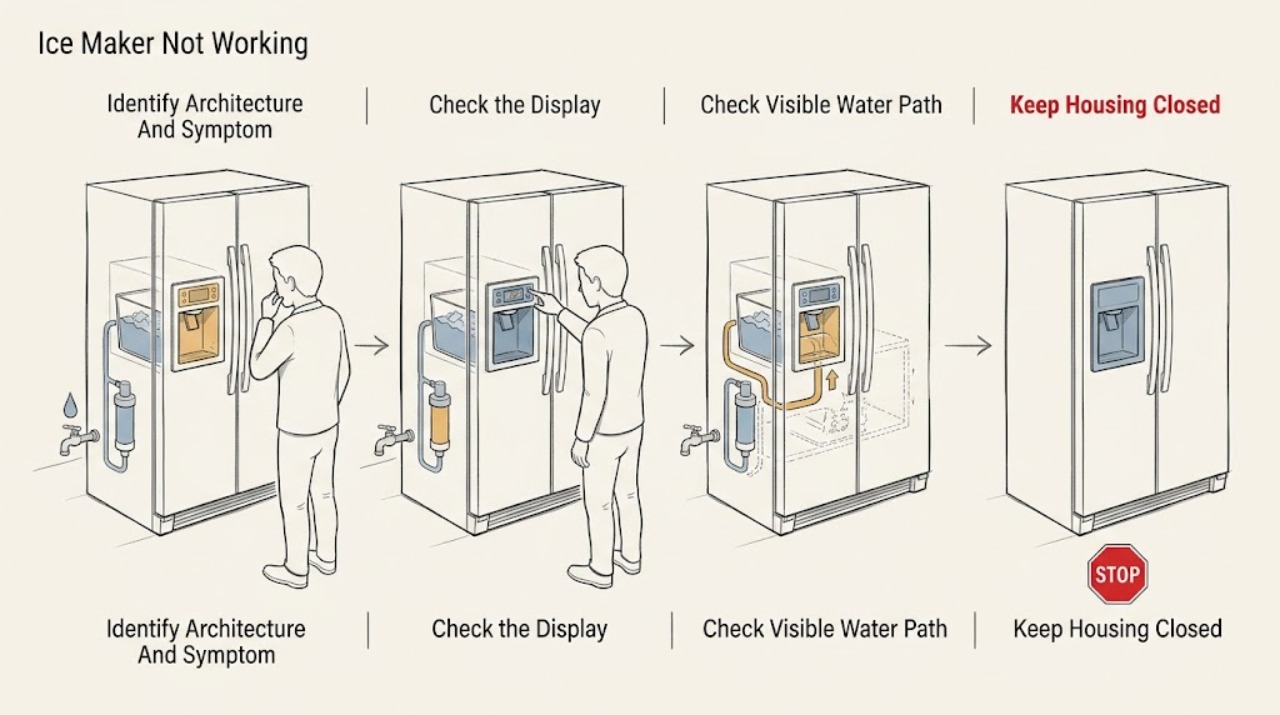
Work through in order
Diagnostic checks
Use only checks that match the exact appliance or system and its official guide.
-
Check 1
Identify whether the ice maker is built into a Bosch refrigerator/freezer or is a separate appliance, and record the exact model from its rating plate or manual. On an integrated unit, note whether the display or ice-maker control responds, whether the bin is empty or partly full, and whether the complaint is no ice, no water, a stuck mechanism, or no control response.
Expected result: The unit is clearly refrigerator-integrated, clearly standalone, or its architecture or model cannot be confirmed; the control may also be responsive, off, or unresponsive.
Next step: If the unit is standalone or uncertain, stop and follow its exact manual or arrange model-specific service. If it is integrated, continue with the control and container checks while keeping the recorded symptom and model available for service.
Stop if: Do not remove panels or attempt internal electrical diagnosis to identify the architecture.
Why this matters
Why: The opened Bosch evidence is specific to refrigerator-integrated ice makers. A standalone or unidentified unit may use a different water, bin, and control design, so an apparent no-ice symptom cannot be assigned to the integrated checks. A control with no response also needs a power and service decision rather than a parts guess.
-
Check 2
For a confirmed integrated unit, use the exact Bosch manual to verify that the ice-maker control is on and that the ice container is installed, seated, and locked as designed. Look only at accessible ice in the container and ejector area; if cubes are visibly fused or obstructing the ejector, use the manual's safe clearing method and do not force the mechanism.
Expected result: The control is off, the container is absent or mis-seated, the bin contains fused cubes or a visible obstruction, or the control and container appear normal.
Next step: Correct only an obviously off control or mis-seated container according to the model manual, then allow the normal cycle. Remove only accessible loose ice with the manual-approved method; if the mechanism remains stuck or the control does not respond, stop and arrange service.
Stop if: Do not pry the ejector, insert tools into moving parts, bypass a sensor, or dismantle the ice-maker assembly.
Why this matters
Why: An off control, missing container, or a visible jam can prevent an integrated ice maker from operating without proving that the motor or control assembly has failed. A normal control and seated container shift attention toward water supply, temperature, filter, or an internal fault.
-
Check 3
With the integrated appliance in its normal installed position, check the visible water supply connection and shutoff position, if accessible, and look for a kink or crush point in an accessible hose. Follow the exact model manual for filter status or replacement; do not disconnect a water connection or measure household pressure as a home diagnostic.
Expected result: The water supply is off or interrupted, an accessible hose is visibly kinked or damaged, the filter is due or restricted according to the manual, or the visible path appears normal.
Next step: Restore only an obviously closed accessible shutoff or the hose position permitted by the installation instructions. Replace a filter only with the exact model-approved type and procedure. If the hose or connection leaks, is damaged, or the ice maker still receives no water, close the shutoff if safe and arrange qualified service.
Stop if: Do not loosen pressurized fittings, work on hidden plumbing, or continue if water reaches electrical parts.
Why this matters
Why: No water, a restricted hose, low supply pressure, or a filter issue can stop an integrated ice maker even when its control is on. A normal visible path does not rule out an inlet valve, internal line, filter housing, or control fault.
-
Check 4
Confirm that the integrated freezer door closes fully, the bin and door are not preventing closure, and the freezer is at the model's normal operating condition. Note whether the ice maker was recently installed, switched on, power-cycled, or emptied after a large harvest; use the exact manual for the recovery interval.
Expected result: The door is not closing, the compartment is warmer than normal, the ice maker was recently started or heavily emptied, or the freezer conditions and timing are normal.
Next step: Correct only an obvious obstruction to door closure, keep the door closed, and allow the model-specific recovery period. If the freezer remains warm or the ice maker still does not operate after recovery, arrange service rather than changing unrelated controls.
Stop if: Do not remove freezer panels, adjust sealed-system components, or attempt to speed recovery with an improvised heat source.
Why this matters
Why: A warm freezer or an open door can prevent or delay ice production. Bosch's opened material describes about 24 hours for initial ice after startup and a longer period for a full bin; recent startup or a large draw can therefore look like a failure before the normal cycle has recovered.
-
Check 5
After the integrated-unit checks, record whether the control responds, the container is seated, water is visibly available, the freezer is operating normally, and any fault repeats after the documented recovery period. Use the exact model manual's reset or service instructions only if they are explicitly provided for that model.
Expected result: The ice maker resumes after a control, container, water, temperature, or recovery correction, or it remains inactive despite normal visible conditions; there may also be a leak, unusual heat, smell, noise, or damaged cord.
Next step: If it resumes, monitor one normal cycle and keep the model record. If it remains inactive, or any hazard is present, stop using the ice maker and arrange qualified Bosch or appliance service with the observations and exact model.
Stop if: Do not repeatedly cycle power, bypass the ice-maker control, open the cabinet, or perform internal electrical or water testing.
Why this matters
Why: A repeatable failure with normal accessible conditions points to an internal valve, sensor, motor, heater, control, wiring, or water-path issue, but these symptoms do not identify a replaceable part. A leak or electrical warning is a safety stop rather than a diagnosis.
Use your observations
Decision map
Find the observation that best matches what you see, then follow the next safe action.
-
PATH 01Safety boundary
What you see
The product is standalone or the model and architecture cannot be confirmed.
Do this next
Use the exact standalone manual or have a qualified technician identify the product before troubleshooting further.
Why this path and its safety boundary
Why it matters: The opened Bosch sources document refrigerator-integrated ice makers, so their container, freezer, water-path, and timing instructions may not map to this unit.
Safety stop: Do not transfer integrated-refrigerator procedures to a standalone unit.
-
PATH 02Safety boundary
What you see
A confirmed integrated unit has an off ice-maker control, a missing or mis-seated bin, or visible fused cubes at the accessible ejector path.
Do this next
Use the exact manual to turn the control on or seat the container, clear only accessible loose ice with the approved method, and allow a normal cycle. Arrange service if the mechanism remains stuck or the control does not respond.
Why this path and its safety boundary
Why it matters: A control, container, or accessible ice obstruction is more likely than a confirmed failed motor or electronic board.
Safety stop: Do not force the ejector, bypass a sensor, or dismantle the assembly.
-
PATH 03Safety boundary
What you see
The integrated control and container are normal, but the visible water supply is off or interrupted, an accessible hose is kinked, or the model manual indicates a filter or pressure issue.
Do this next
Restore only a safe accessible supply condition or fit the model-approved filter as documented. Stop for leaks or damaged connections and arrange qualified service if water delivery does not return.
Why this path and its safety boundary
Why it matters: A water-delivery restriction is more likely than a bin or control setting problem, although an internal valve or line fault remains possible.
Safety stop: Do not loosen pressurized connections or inspect hidden plumbing.
-
PATH 04Next step
What you see
The integrated freezer is warm, the door is not closing, or the ice maker was recently started, power-cycled, or emptied heavily.
Do this next
Remove only an obvious door obstruction, keep the freezer closed, and allow the exact model's documented recovery period. Escalate if the freezer remains warm or no ice operation returns.
Why this path and its safety boundary
Why it matters: Temperature or normal recovery time can explain delayed production; this does not by itself prove a failed ice-maker assembly.
-
PATH 05Safety boundary
What you see
The unit is confirmed integrated, the control and container are normal, visible water conditions and freezer operation are normal, and the ice maker remains inactive after the model-specific recovery period.
Do this next
Stop repeated resets and arrange qualified Bosch or appliance service. Give the technician the exact model, symptom pattern, water and filter observations, freezer condition, and time since startup or last harvest.
Why this path and its safety boundary
Why it matters: An internal water valve, sensor, motor, heater, wiring, or control problem is more likely, but the symptom does not safely identify which component has failed.
Safety stop: Do not open panels or carry out internal electrical, refrigerant, or water-path tests.
-
PATH 06Safety boundary
What you see
There is an active leak, water near electrical parts, a damaged cord, exposed wiring, burning smell, unusual heat, smoke, or sparking.
Do this next
Stop using the appliance, keep clear, and arrange qualified appliance or electrical service. Isolate power or water only when it can be done without contacting the hazard.
Why this path and its safety boundary
Why it matters: The immediate issue is a safety hazard, not a user-level ice-production diagnosis.
Safety stop: Do not touch wet electrical areas, remove covers, or attempt a live check.
Helpful context
Understand the symptom
Confirm the architecture before troubleshooting
The Bosch material used here covers an automatic ice maker installed inside a Bosch refrigerator or freezer. A standalone appliance can have different controls, water connections, bin sensing, and temperature management. Check the rating plate and the exact model manual first; if the product is standalone or the architecture is uncertain, stop at identification and use that product's documentation rather than transferring an integrated-refrigerator procedure.
Keep electrical and pressurized-water work out of a home check
Only inspect accessible controls, the container, visible hose sections, and the filter procedure allowed by the exact manual. If water is leaking or an electrical area is wet, keep clear and isolate the appliance only if it can be done without touching the hazard. Do not remove covers, defeat the ice-maker switch or door interlock, reach into moving parts, open refrigerant or internal water circuits, or use a live electrical test as a user check.
Safety boundary
Stop conditions
- Stop using the appliance for an active water leak, water near electrical parts, damaged cord, exposed wiring, burning smell, smoke, sparking, or unusual heat.
- Do not transfer refrigerator-integrated instructions to a standalone or unidentified ice maker.
- Do not defeat a door or ice-maker safety control, force a jammed mechanism, remove panels, or perform internal electrical, refrigerant, or pressurized-water checks.
- Isolate water or power only when the shutoff or disconnect can be reached without contacting a hazard; otherwise keep clear and call qualified service.
Only after diagnosis
Potential parts
- Bosch ice-maker assembly
Consider this only if qualified diagnosis confirms an internal integrated ice-maker mechanism fault; an off control, mis-seated bin, water restriction, filter issue, warm freezer, or normal recovery period can create the same symptom.
Confirm the exact Bosch refrigerator model and the manufacturer's fit information before ordering; do not assume a standalone or another refrigerator family's assembly fits. - Bosch refrigerator water filter
Consider this only when the exact model documentation identifies a due or restricted filter and the filter condition is consistent with the water-delivery symptom; a filter is not a universal fix for no operation.
Use only the filter specification listed for the exact Bosch model and follow the model's replacement and reset instructions.
When checks do not resolve it
Need a professional?
Safety scope: This article covers identification, accessible controls, container seating, visible water conditions, model-directed filter handling, door closure, and symptom recording. A qualified technician must handle internal electrical, water-valve, sensor, motor, heater, wiring, refrigerant, and cabinet work.
Common questions
FAQ
Why is my Bosch refrigerator ice maker not working?
For a refrigerator-integrated Bosch ice maker, check the ice-maker control, container seating, visible water supply, filter condition, freezer temperature, door closure, recent startup, and a visible ejector obstruction. These checks do not establish the cause for a standalone ice maker, which needs its own model manual.
How long should a Bosch ice maker take to start making ice?
Bosch's opened refrigerator manuals and support guidance indicate that an integrated ice maker may need about 24 hours after startup before the first batch, with longer time to fill the container. Follow the timing for the exact model and avoid repeated resets during that recovery period.
Can a Bosch ice maker stop working because the bin is not seated?
Yes. Bosch's integrated-refrigerator documentation describes the ice container as needing to be installed and seated correctly. Refit it only as the exact model manual shows; do not force the bin or bypass a sensor if it will not lock into place.
What should I check if a Bosch ice maker has water but makes no ice?
For an integrated unit, check the ice-maker control, container, freezer temperature and door closure, filter guidance, and whether cubes are visibly obstructing the ejector. A normal visible supply does not prove that an internal valve, sensor, motor, heater, or control is working, so persistent failure needs qualified service.
Are these Bosch ice-maker checks valid for a standalone ice maker?
Not necessarily. The opened Bosch sources cover ice makers integrated into refrigerators or freezers and do not establish the controls or water path of a standalone unit. Identify the exact model and use its manual or arrange model-specific service before troubleshooting.
Read the exact guide
Official sources
- CIB Instruction for UseBosch · Bosch integrated refrigerator model family represented by the opened CIB manual; verify the exact model before applying a control or service instruction.
- Fridge is not making iceBosch · Bosch refrigerator/freezer-integrated ice makers; use the exact model manual for controls and architecture-specific steps.
- W10577849A Ice and Water Refrigerator ManualBosch · Bosch ice-and-water refrigerator family described by the opened manual; controls, filter, temperature, and water connection details remain model-specific.
Community feedback
Share a repair observation
Share a plain-text repair observation. Accepted observations are published automatically; this page may take a moment to update.