
On this page
Start here
Quick answer
First identify whether the GE ice maker is a standalone appliance or an ice maker installed inside a refrigerator; GE publishes separate troubleshooting for those architectures. For a refrigerator ice maker, confirm the exact model's ice control or feeler arm is on, the freezer is cold enough, the water supply is open, and a filter is not restricting flow. For a standalone GE ice maker, check its power control, household breaker, water status indicator, and the Owner's Manual; a flashing Check Water light or overloaded auger has different implications from a refrigerator ice maker. On either type, a newly installed unit may need time to cool and purge air from the water line. Look only for an accessible full bin, stuck cubes, or a freely moving feeler arm or paddle; do not reach into the mold, auger, valve, or wiring. If the unit has power and water but still does not cycle, fill, freeze, harvest, or repeatedly trips power, leaks, or shows a persistent fault, stop and arrange qualified appliance service. Do not merge standalone and refrigerator instructions or order a valve, mold, motor, or control without the exact model.
Before you begin
Safety first
- This article supports architecture identification and ordinary-access checks only. Do not remove the icemaker, probe a fill tube, access a valve or auger, test live wiring, touch a hot mold, or operate a wet, leaking, smoking, or damaged appliance.
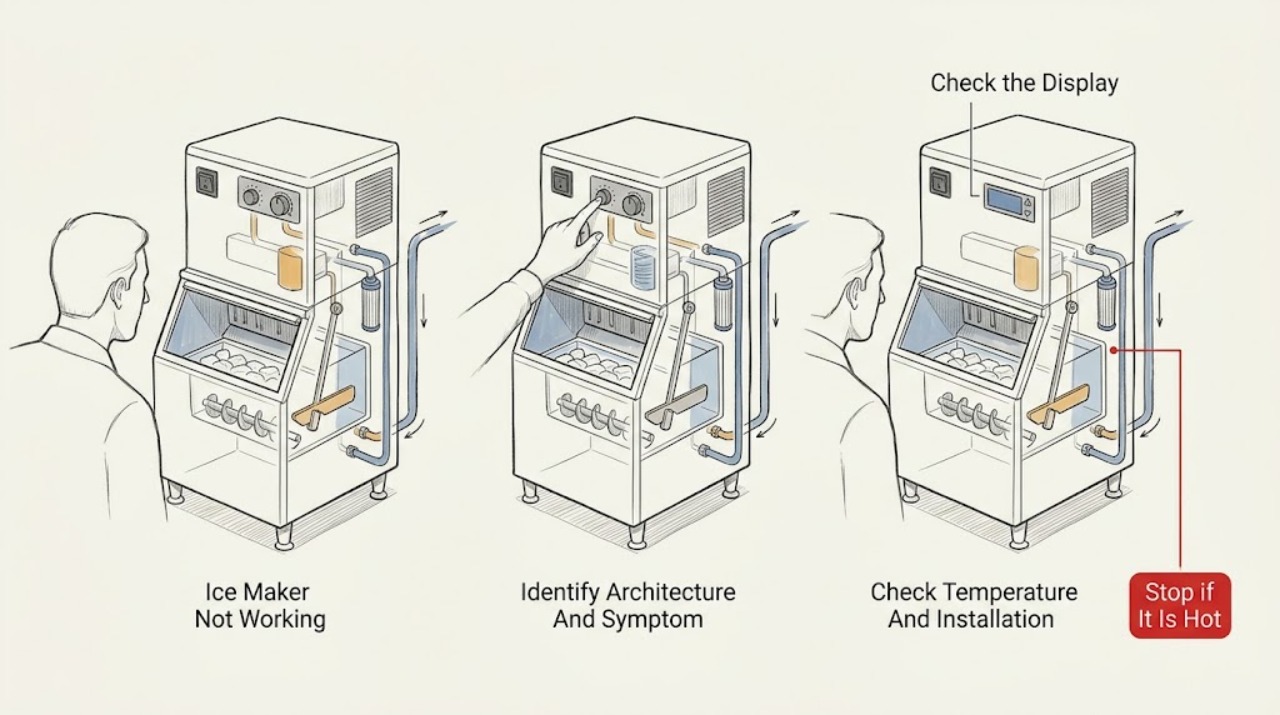
Work through in order
Diagnostic checks
Use only checks that match the exact appliance or system and its official guide.
-
Check 1
Record the complete model and determine whether the GE ice maker is standalone or installed inside a refrigerator; describe whether it has no power, no water fill, no freezing, no harvest, a stuck bin, or no ice output.
Expected result: Record a standalone cabinet with its own reservoir and controls, a refrigerator freezer icemaker, a new installation, a powered unit with no cycle, or a unit with a visible warning light or message.
Next step: Use only the matching branch below and the exact model manual; do not apply standalone auger steps to a refrigerator icemaker or refrigerator feeler-arm steps to a standalone unit.
Stop if: Stop if the cabinet, cord, plug, water connection, bin, or surrounding floor is wet, hot, damaged, or showing smoke or electrical odor.
Why this matters
Why: GE provides separate procedures for standalone and refrigerator icemakers. The product architecture determines whether a breaker and water-status light, or a freezer temperature, feeler arm, filter, and refrigerator water line, are relevant.
-
Check 2
From a dry, safe position, confirm the standalone unit's power control and household breaker, or the refrigerator icemaker's exact on/off control, feeler arm, toggle, slide switch, or dispenser setting as shown in its manual.
Expected result: Record no appliance power, a tripped breaker, a standalone Check Water or warning light, a refrigerator icemaker set off, an arm or paddle held by ice, an off or blinking indicator, or an enabled control with no cycle.
Next step: Restore only a clearly off user control or a single safely reset breaker according to the model instructions; if the state remains abnormal, preserve the indicator pattern for service.
Stop if: Do not bypass a switch, force a feeler arm or paddle, reset a repeatedly tripping breaker, or remove a control cover.
Why this matters
Why: GE says a standalone no-ice condition can be caused by power, breaker, low water indication, or an overloaded auger. Refrigerator controls vary by type, and a full bin or obstructed paddle pauses production; an enabled control with no cycle needs the next temperature and water checks.
-
Check 3
For a refrigerator icemaker, check the freezer's displayed or manual-specified temperature and whether the refrigerator or icemaker was recently installed; for a standalone unit, follow its model-specific start-up and ambient-temperature requirements.
Expected result: Record a new installation, a freezer that is warmer than its normal setting, normal cold conditions, a low food load affecting stability, or a standalone unit outside its manual's operating conditions.
Next step: Allow the exact model's installation and cooling period, keep doors closed as practical, and reassess; arrange service if the appliance cannot reach or hold its normal temperature.
Stop if: Do not dismantle the freezer, adjust sealed-system components, block vents, or use heat to accelerate ice production.
Why this matters
Why: GE says refrigerator ice production waits for sufficiently cold conditions and that new installations may need time before the first cycle. Warm or unstable conditions can delay or prevent ice without a failed valve or motor.
-
Check 4
For a refrigerator icemaker, verify from ordinary access that the refrigerator water-supply valve is open, the visible line is not kinked, and an installed filter is correctly seated and not overdue; for a standalone unit, check only the water status and reservoir procedure in its manual.
Expected result: Record no water connection, a closed or uncertain valve, a kinked line, slow dispenser flow, a recently changed filter, a standalone low-water or Check Water indication, or normal water availability with no fill.
Next step: Correct only a clearly closed user-accessible supply valve or follow the exact filter replacement procedure; if flow is still absent or the fill tube may be frozen, stop and arrange service.
Stop if: Do not disconnect tubing, probe a fill tube, remove an icemaker, open a water valve body, or work around water near electrical parts.
Why this matters
Why: GE links restricted filter flow, closed supply, air in a new line, and low water status to no fill or no ice. A refrigerator dispenser may still work when an icemaker fill tube is frozen, so dispenser flow alone does not clear the fill path.
-
Check 5
With the ice maker off through its user control and only when the manual permits, inspect the accessible bin, paddle or feeler-arm path, and visible ice mold for cubes blocking movement; do not reach into the mechanism or remove covers.
Expected result: Record a full bin, cubes blocking the paddle or rake, a clear bin and mold, a stuck rake, a hot mold or heater area, or an obstruction that cannot be removed without disassembly.
Next step: Remove only loose ice that is safely accessible without force and restore the bin or paddle as the manual shows; if the rake, mold, or fill path remains blocked, call service.
Stop if: Do not chip ice, use a tool, force a rake or tray, touch a warm mold or heater, or remove the icemaker body.
Why this matters
Why: GE says a full bin or blocked feeler arm can pause production, and a stuck rake can prevent harvest. The mold may be hot, and a hidden or frozen fill tube or internal obstruction is not a user-level clearing step.
-
Check 6
After the architecture, power, control, temperature, water, filter, and accessible-obstruction checks, document whether the unit powers, fills, freezes, harvests, or produces ice and whether any warning or fault remains.
Expected result: Record normal production after a permitted correction, persistent no cycle, no fill with normal water, no freezing despite cold conditions, no harvest, a flashing indicator, auger overload, leak, smoke, abnormal heat, or repeated breaker trips.
Next step: Arrange qualified appliance service with the model, architecture, indicator pattern, cycle stage, temperature, water, filter, and obstruction observations; use qualified plumbing or electrical service for external hazards.
Stop if: Do not open the housing, test live wiring, energize a disconnected valve, handle refrigerant, bypass a safety control, or continue operation after smoke, leak, burning odor, or abnormal heat.
Why this matters
Why: A persistent failure after external checks may involve a valve, fill tube, heater, mold, rake, motor, auger, sensor, control, or wiring fault. GE directs unresolved refrigerator and standalone no-ice conditions to service; safety symptoms require immediate cessation.
Use your observations
Decision map
Find the observation that best matches what you see, then follow the next safe action.
-
PATH 01Safety boundary
What you see
The GE ice maker is standalone and has no power, a tripped breaker, a low-water or Check Water indication, or an overloaded auger warning.
Do this next
Use the standalone model's power and water controls and Owner's Manual; if the warning or no-ice condition remains, arrange service.
Why this path and its safety boundary
Why it matters: GE's standalone guidance treats power, water status, and auger overload as separate user-level conditions rather than refrigerator freezer or feeler-arm problems.
Safety stop: Do not open the standalone housing, reach into the auger, or reset a repeatedly tripping circuit.
-
PATH 02Safety boundary
What you see
The ice maker is in a refrigerator and its control is off, its feeler arm or paddle is held up by a full bin or cubes, or its indicator is off in a type that uses an indicator light.
Do this next
Use the exact manual to enable the icemaker and restore free movement without forcing the arm or paddle; allow a normal cycle to occur.
Why this path and its safety boundary
Why it matters: GE says refrigerator icemakers can be disabled by a model-dependent control or by a full bin or obstructed paddle.
Safety stop: Do not apply a slide-switch, toggle, or dispenser sequence from another refrigerator style.
-
PATH 03Safety boundary
What you see
The refrigerator or icemaker was recently installed, or the freezer has not reached its normal cold condition.
Do this next
Follow the exact installation manual, keep the unit enabled and supplied as instructed, and reassess after the model's start-up period.
Why this path and its safety boundary
Why it matters: GE says a new unit may need time to cool, and an icemaker will not begin until its mold reaches the required cold condition; a new water line may also purge air before filling.
Safety stop: Do not use heat, remove panels, or assume a new unit has a failed valve before its required start-up conditions are met.
-
PATH 04Safety boundary
What you see
A refrigerator icemaker has no or slow fill, a closed or uncertain water valve, a kinked line, low dispenser flow, or a filter that may be restricted.
Do this next
Correct only an obvious accessible valve or model-approved filter condition; arrange service if flow does not return or the fill tube may be frozen.
Why this path and its safety boundary
Why it matters: GE identifies the filter, water line, supply valve, and new-line air as possible causes of insufficient fill; a frozen internal fill tube remains a service condition.
Safety stop: Do not disconnect tubing, probe the fill tube, remove the icemaker, or work near water and electricity.
-
PATH 05Safety boundary
What you see
The mold or rake is blocked by ice, or a refrigerator icemaker's green indicator is blinking in a model where that indicates stuck cubes.
Do this next
Turn the icemaker off and clear only loose, safely accessible ice as the exact manual allows; call service if the blockage is hard, hot, hidden, or returns.
Why this path and its safety boundary
Why it matters: GE says stuck cubes can prevent the rake from completing harvest and can produce a blinking indicator on applicable models; the mold may be hot.
Safety stop: Do not chip ice, force the rake, touch a hot mold, or disassemble the icemaker.
-
PATH 06Safety boundary
What you see
Power, controls, temperature, water, and accessible obstructions are normal, but the unit still does not fill, freeze, harvest, or make ice, or it leaks, overheats, smokes, sparks, or trips power.
Do this next
Stop user troubleshooting and arrange qualified appliance service, with qualified plumbing or electrical service for external water or power hazards.
Why this path and its safety boundary
Why it matters: An internal valve, fill tube, heater, motor, auger, sensor, control, wiring, or another fault may be present; the architecture and model are required to choose a repair.
Safety stop: Do not open the housing, run a live test, bypass protection, handle refrigerant, or continue using a leaking, smoking, or overheated unit.
Helpful context
Understand the symptom
Identify standalone versus refrigerator architecture
A countertop or undercounter GE ice maker is not diagnosed like an ice maker inside a refrigerator. GE's standalone guidance starts with its power button, breaker, water indicator, and auger; its refrigerator guidance starts with the freezer temperature, ice-maker switch or feeler arm, water line, filter, and ice mold. Before changing a setting, record the complete model and whether the ice maker shares a refrigerator freezer or has its own cabinet, reservoir, and bin.
Confirm the unit is enabled and can complete a cycle
GE refrigerator icemakers may use a feeler arm, toggle switch, slide switch, or dispenser control, while a standalone unit uses its own power control. A full bin or blocked paddle can pause a refrigerator icemaker. A green light that is off or blinking also has model-dependent meanings. Use the exact Owner's Manual and do not force an arm, switch, ice tray, or control.
Check temperature and water without entering the mechanism
For refrigerator icemakers, GE says ice production depends on the freezer reaching the model's required temperature; a new installation may need additional cooling time. Water supply valves, a clogged filter, low flow, air in a new line, and a frozen fill tube can all affect filling. GE says a frozen fill tube requires icemaker removal and service inspection, so a user should not probe or thaw an internal tube.
Use service when the cycle itself is the fault
If the unit is on, cold, supplied with water, and free of an accessible bin or paddle obstruction but it never fills, freezes, harvests, or produces ice, the remaining possibilities include an internal valve, heater, motor, auger, sensor, control, or wiring problem. A standalone machine may also stop because its auger is overloaded or its water status is not satisfied. These are model-specific service diagnoses, not permission to open the housing or run a live test.
Safety boundary
Stop conditions
- Do not mix standalone and refrigerator icemaker instructions or use a control sequence from a different model or architecture.
- Do not remove an icemaker, probe or thaw an internal fill tube, open a water valve, reach into an auger, or perform live electrical tests.
- Do not chip ice, force a rake, tray, feeler arm, paddle, switch, or bin, and do not touch a potentially hot mold or heater.
- Stop for smoke, sparks, burning odor, abnormal heat, a damaged cord or plug, a leak near electrical parts, or a breaker that trips again.
- Do not order or replace a valve, motor, heater, mold, auger, sensor, or control without the exact model and qualified diagnosis.
When checks do not resolve it
Need a professional?
Arrange qualified appliance service when a GE refrigerator or standalone ice maker remains inactive after the architecture-specific power, control, temperature, water, filter, and accessible-obstruction checks; when a fill tube, valve, heater, motor, auger, sensor, or control would need access; or when a warning or indicator persists. Use qualified plumbing service for a supply-line or valve problem and electrical service for a damaged cord, outlet, wiring, or repeated breaker trip. Stop immediately for smoke, sparks, burning odor, abnormal heat, or water near electricity.
Safety scope: This article supports architecture identification and ordinary-access checks only. Do not remove the icemaker, probe a fill tube, access a valve or auger, test live wiring, touch a hot mold, or operate a wet, leaking, smoking, or damaged appliance.
Common questions
FAQ
How do I know whether my GE ice maker is standalone or part of a refrigerator?
A standalone unit has its own cabinet, reservoir, controls, and bin. A refrigerator icemaker sits in a freezer or refrigerator compartment and uses the refrigerator's water and temperature system. GE publishes separate troubleshooting for the two; identify the model before using a procedure.
Why is my GE refrigerator ice maker not making ice?
Check the model-specific on/off control, freezer temperature, water supply, filter flow, full-bin or paddle obstruction, and whether it is newly installed. If those are normal and no cycle starts, arrange service rather than opening the icemaker.
Why does my standalone GE ice maker show Check Water?
GE's standalone guidance treats a flashing Check Water light as a low-water condition. Follow the exact standalone manual's water procedure; do not apply refrigerator water-line or feeler-arm steps to the standalone machine.
Can a full ice bin stop a GE refrigerator icemaker?
Yes. GE says cubes high enough to hold the feeler arm or paddle can signal the refrigerator icemaker to pause. Restore free movement without forcing the arm, tray, or rake.
How long should a new GE refrigerator ice maker take to start?
GE says a newly installed icemaker needs time to reach its required cold condition, and a new water line may purge air through several cycles. Follow the exact model manual and do not dismantle the fill path during start-up.
When should I call for GE ice-maker service?
Call when power, controls, temperature, water, filter, and accessible-bin checks do not restore production; when the fill tube, valve, motor, heater, mold, or wiring would need access; or for a leak, smoke, abnormal heat, burning odor, or repeated breaker trip.
Read the exact guide
Official sources
- Ice Maker - No Ice ProductionGE Appliances · GE Appliances explicitly states this guidance is for a standalone ice maker, not an icemaker installed in a refrigerator; consult the exact Owner's Manual.
- Refrigerator - New Icemaker Not Producing IceGE Appliances · GE Appliances guidance for a new refrigerator or newly installed refrigerator icemaker; exact manual controls installation and start-up.
- Refrigerator - Icemaker Does Not Fill With WaterGE Appliances · GE Appliances guidance for refrigerator icemakers; switch, water path, door location, filter, and fill-tube arrangement are model-dependent.
- Refrigerator - Icemaker Not Producing IceGE Appliances · GE Appliances guidance for an icemaker installed in a refrigerator; exact control, temperature, filter, and mold architecture varies by model.
- Refrigerator - Icemaker Power Light Not Lit or BlinkingGE Appliances · GE Appliances guidance for refrigerator icemakers equipped with a green indicator light; not every model has this light.
- Refrigerator - How to Turn Icemaker On or OffGE Appliances · GE Appliances control reference; the exact refrigerator style and icemaker type determine which on/off method applies.
Community feedback
Share a repair observation
Share a plain-text repair observation. Accepted observations are published automatically; this page may take a moment to update.