
On this page
Start here
Quick answer
First identify the stage that is failing instead of treating every empty ice bin as the same fault. Confirm that the exact Frigidaire refrigerator has an ice maker and that it is switched on. Then separate four paths: the maker is off or not enabled; it is enabled but not filling with water; it fills but does not freeze or harvest ice; or ice is already being made but will not leave the bin through the dispenser. Frigidaire's guidance points to model-specific on/off controls, water supply and filter condition, a kinked line, freezer temperature, installation air in the water line, bin position, and ice jams as different checks. If the unit has a leak, water near electrical parts, damaged wiring, repeated power loss, or needs an internal valve, motor, sensor, or control accessed, stop and arrange qualified service. Do not force a harvest cycle, reach into moving parts, or apply a reset from another model.
Before you begin
Safety first
- The user may identify the model, observe controls, inspect visible supply and freezer conditions, and perform only owner-removable filter/bin care described by the exact manual. Internal valves, motors, augers, sensors, controls, wiring, rear covers, pressurized plumbing, forced harvest cycles, and live electrical tests are for qualified professionals.
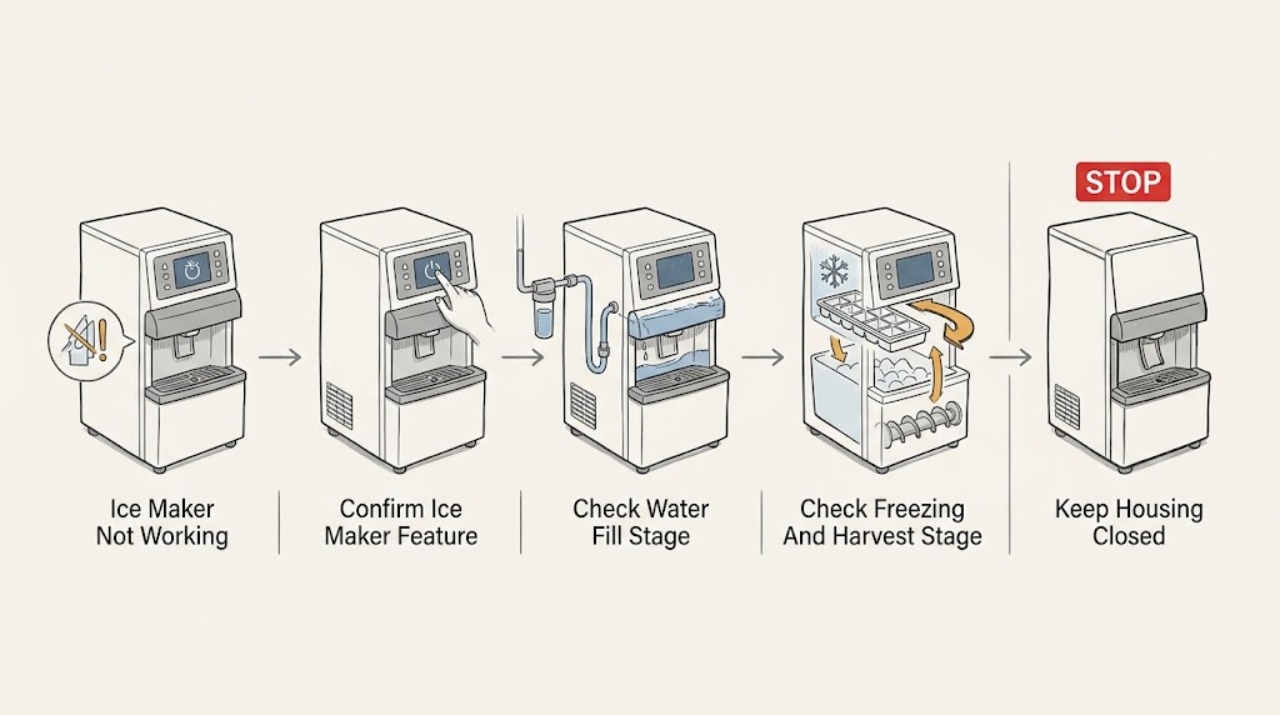
Work through in order
Diagnostic checks
Use only checks that match the exact appliance or system and its official guide.
-
Check 1
Read the complete refrigerator model number and confirm from its owner's manual or product information that an ice maker is fitted. Check the documented ice-maker control, switch, or signal arm without reaching into the mechanism, and note whether the feature is on, off, locked, or not present.
Expected result: The refrigerator has no fitted ice maker; the maker is off; the maker is on; the control is locked or unresponsive; or the control layout is different from the guide being used.
Next step: Use only the exact model's documented control instruction, then classify whether the maker receives water, creates new ice, or dispenses existing ice. Do not use another model's switch or reset sequence.
Stop if: Do not insert fingers, tools, or objects into the ice maker or force a signal arm/ejector.
Why this matters
Why: A missing feature or wrong guide cannot be diagnosed as an ice-maker failure. An enabled maker moves the diagnosis to water, freezing/harvest, or delivery; an unresponsive control may be a control or power issue rather than a water problem.
-
Check 2
If the maker is on but no ice tray appears to fill, check from outside that the refrigerator has water, the household water valve is open, the accessible supply line is not kinked or restricted, and the water filter is correctly installed and not overdue, frozen, or cracked where the exact model uses one.
Expected result: There is no water supply; the line is pinched; the filter indicator or filter condition is abnormal; the unit was recently installed or filtered; or external water conditions appear normal but the tray still does not fill.
Next step: Correct only an obvious external condition and follow the exact guide's priming or filter instructions. If the tray still does not fill, stop and arrange service rather than opening a water or electrical connection.
Stop if: Stop for a leak, water near wiring, a frozen or damaged line, or any need to disconnect pressurized tubing.
Why this matters
Why: Frigidaire identifies supply, line restriction, filter condition, and trapped air after installation or filter replacement as possible causes of no or low ice. Normal external conditions shift attention to an internal inlet valve, fill tube, sensor, or control diagnosis.
-
Check 3
If water reaches the maker but no usable ice appears, inspect only the freezer's visible condition and the amount of newly produced ice. Note whether the freezer is too warm, doors are being opened frequently, the unit was recently installed, or the maker produces a tray but does not release it. Do not force an ejector or remove internal covers.
Expected result: The freezer is warm; the unit is newly installed; a small amount of ice is eventually made; water enters but the tray does not freeze or harvest; or no new ice appears after the model's documented stabilization period.
Next step: Use the exact manual's temperature and installation guidance and allow its stated stabilization period. If production does not resume, arrange service for the ice-maker, freezer, sensor, or control system.
Stop if: Do not heat the freezer, pry frozen components, force a cycle, or bypass temperature or safety controls.
Why this matters
Why: Frigidaire identifies freezer temperature, heavy door traffic, and installation air as factors that can reduce or delay production. Water entry without freezing or harvest points beyond the simple supply check and needs model-specific diagnosis.
-
Check 4
If new ice is being made, determine whether the complaint is delivery rather than production. Check the display lock and door closure, confirm ice is in the bin, and inspect for a visible clump or jam. If the exact guide allows bin removal, remove, empty, wipe dry, and reseat it as instructed; avoid rotating the auger unless the guide specifically explains alignment.
Expected result: The display is locked; the door is not fully closed; the bin is empty; ice is clumped or jammed; the bin is mis-seated; or the bin contains loose ice but the dispenser still does not move it.
Next step: Correct only the documented lock, door, bin, or visible-jam condition and perform one normal delivery attempt. If delivery still fails, arrange service; do not infer a motor or auger part from the symptom alone.
Stop if: Do not reach into the auger, force the bin, chip ice against the mechanism, or run the dispenser continuously to overcome a jam.
Why this matters
Why: Frigidaire separates locked controls, door position, empty bins, prolonged paddle use, ice clumps, and auger/bin alignment from an ice-production failure. A correctly seated bin with new ice but no delivery suggests a dispenser or auger-side service issue.
-
Check 5
Record the model, ice-maker location and control state, water-fill result, freezer/production result, bin and dispenser result, filter or installation history, and any display code. If a leak, electrical warning, damaged cord, repeated power loss, or internal access is involved, leave the refrigerator off and prepare the information for service.
Expected result: The maker works after an external correction; no water enters; water enters but no ice is produced; ice is produced but not delivered; or a code/control/power fault persists.
Next step: Contact Frigidaire or a qualified appliance technician with the complete model and stage observations. Have a qualified professional evaluate a suspect outlet, electrical fault, water valve, auger, sensor, control, or sealed system.
Stop if: Do not remove rear covers, test energized circuits, open water valves, bypass controls, or order an internal part from the broad symptom.
Why this matters
Why: The first failed stage narrows the technician's path without claiming a specific part. Persistent failure after the documented user checks is an appliance diagnosis, not a reason to keep resetting or dismantling the unit.
Use your observations
Decision map
Find the observation that best matches what you see, then follow the next safe action.
-
PATH 01Safety boundary
What you see
The exact refrigerator has no fitted ice maker, the maker is switched off, or the control layout does not match the guide being used.
Do this next
Confirm the model and use its owner's manual to enable the feature if fitted. If the control is present but unresponsive, arrange service rather than forcing a switch or arm.
Why this path and its safety boundary
Why it matters: A feature or model-identity issue is more likely than a failed water valve or freezer sensor. A control layout or missing component from a different model cannot be used to diagnose this refrigerator.
Safety stop: Do not install an ice maker or bypass its controls based on a generic diagram.
-
PATH 02Safety boundary
What you see
The maker is enabled, but the tray does not fill and the water valve, line, filter, or recent installation history shows an external issue.
Do this next
Correct the visible condition or follow the exact model's prime/purge or filter procedure. Escalate if no fill remains.
Why this path and its safety boundary
Why it matters: A water-supply, filter, line-restriction, or trapped-air condition is more likely than a harvest or dispenser problem. Normal external supply with no fill needs internal service.
Safety stop: Do not open pressurized tubing or access the internal inlet valve.
-
PATH 03Safety boundary
What you see
Water reaches the ice maker, but the freezer is warm, the unit is newly installed, production remains delayed, or no ice is harvested.
Do this next
Follow the exact model's temperature and installation guidance and allow its documented stabilization period. Arrange service for persistent no-production.
Why this path and its safety boundary
Why it matters: Freezer temperature, installation air, door traffic, freezing, harvest, sensor, or control conditions are more likely than a simple closed water valve.
Safety stop: Do not force the ejector, heat the freezer, or bypass controls.
-
PATH 04Safety boundary
What you see
New ice is present in the bin, but delivery fails while the display/door state or bin/jam condition is abnormal—or all visible conditions are normal.
Do this next
Use the exact guide for the lock, bin, and visible-jam checks. If a full, correctly seated bin still will not dispense, arrange model-specific service.
Why this path and its safety boundary
Why it matters: Lock, door closure, a clump or jam, bin seating, paddle shutoff, or an auger/dispenser-side fault is more likely than an ice-production fault.
Safety stop: Do not force or rotate the auger, run the paddle continuously, or dismantle the dispenser.
-
PATH 05Safety boundary
What you see
The ice-maker control is unresponsive, a display or power code persists, the refrigerator loses power, or the unit has a leak or electrical warning.
Do this next
Leave the unit off for a hazard or repeat fault and arrange qualified appliance/electrical service. Provide the stage record and exact model information.
Why this path and its safety boundary
Why it matters: A power, control, wiring, sensor, or water-related appliance fault is possible, and it cannot be safely isolated by a generic ice-maker reset.
Safety stop: Do not repeatedly cycle power, open panels, make live measurements, or continue using a leaking or damaged refrigerator.
Helpful context
Understand the symptom
Find the first failed stage
‘Ice maker not working’ can mean the feature is disabled, the maker is not receiving water, water enters but no ice is harvested, or a full bin cannot dispense. Check the maker's status, water entry, new ice production, and bin delivery as separate observations. That first split determines whether to move toward the supply path, freezing conditions, or the bin and dispenser.
Not every Frigidaire refrigerator has the same ice-maker layout
Frigidaire publishes ice-maker guidance across several refrigerator layouts, but the controls, signal arm, bin, dispenser, and water filter arrangement vary. Confirm that the exact model has the feature and use its owner's manual before interpreting a missing switch or bin as a failure.
New installations and filters can change the first result
Frigidaire notes that air in newly installed plumbing or after a filter change can create empty ice-making cycles or uneven dispenser flow. Prime and purge only as the exact model guide says. Do not treat an installation delay as permission to open the appliance or repeatedly cycle power.
The dispenser is downstream of ice production
A dispenser complaint is not proof that the ice maker itself is broken. If the bin is empty because no new ice is being made, follow the production branch. If the bin contains ice but delivery fails, look only at the documented lock, door, bin seating, visible jam, and dispenser conditions before seeking service.
When checks do not resolve it
Need a professional?
Arrange Frigidaire or qualified appliance service when the maker remains enabled but will not fill, freeze, harvest, or dispense after the exact model's safe external checks; when a control remains unresponsive; or when a full bin still will not deliver ice. Stop using the refrigerator and obtain prompt help for a leak near electrical parts, damaged cord, burning smell, smoke, repeated power loss, or any need to open the appliance or water system.
Safety scope: The user may identify the model, observe controls, inspect visible supply and freezer conditions, and perform only owner-removable filter/bin care described by the exact manual. Internal valves, motors, augers, sensors, controls, wiring, rear covers, pressurized plumbing, forced harvest cycles, and live electrical tests are for qualified professionals.
Common questions
FAQ
What should I check first when a Frigidaire ice maker is not working?
First confirm the exact refrigerator has an ice maker and that it is enabled. Then determine whether the maker is not filling, fills but does not make ice, or makes ice that will not dispense. That stage split is more useful than immediately replacing a valve or ice-maker assembly.
Why is the ice maker on but not filling with water?
Check the external water supply, visible line restriction, filter condition, and recent installation or filter-change history as the exact model permits. Frigidaire identifies these as possible supply or trapped-air causes; if they are normal and the tray still does not fill, arrange service.
How long should a new Frigidaire ice maker take to start making ice?
A new installation can produce empty cycles while air is cleared from the water line, and Frigidaire says the refrigerator must cool after installation before normal production. Follow the exact model guidance and do not force a harvest or reset while waiting.
What if the ice bin has ice but the Frigidaire dispenser does not work?
Treat that as a delivery-stage complaint. Check the documented display lock, closed doors, bin seating, and visible clumping or ice jam. If a full, correctly seated bin still will not deliver ice, arrange model-specific dispenser service.
Can a water filter stop a Frigidaire ice maker?
On applicable models, Frigidaire identifies a clogged, overdue, frozen, cracked, or incorrectly installed filter as a possible reason for slow or absent water and reduced ice production. Confirm the exact filter and follow the model's replacement and priming instructions; do not assume one filter fits every model.
When should I call service for a Frigidaire ice maker?
Call when the maker remains enabled but will not fill, freeze, harvest, or dispense after safe model-specific checks, or when a control is unresponsive. Stop promptly for a leak near electrical parts, damaged wiring, repeated power loss, or any need to open the appliance, water system, or rear cover.
Read the exact guide
Official sources
- How To Fix Your French Door Refrigerator Ice Maker Not WorkingFrigidaire · Frigidaire French Door refrigerator ice-maker topic; exact model documentation governs the actual controls and procedure.
- What should I do if the dispenser on my refrigerator is not dispensing ice?Frigidaire · Frigidaire Refrigerators, French Door Refrigerators, Side by Side Refrigerators, and Top Freezer Refrigerators with the applicable ice dispenser.
- Refrigerator Prime and Purge GuideFrigidaire · Frigidaire refrigerators with connected water and ice systems covered by the guide.
- What should I do if my ice maker is not making enough ice in my refrigerator?Frigidaire · Frigidaire Refrigerators, French Door Refrigerators, Side by Side Refrigerators, and Top Freezer Refrigerators covered by the article.
- Refrigerator Error Code DI SP or DISP - Ice JamFrigidaire · Only refrigerator models using the DI SP or DISP display behavior; exact use-and-care guidance governs.
- Service & RepairFrigidaire · Frigidaire appliances, including refrigeration products and their ice-making systems.
- Refrigerators - No WaterFrigidaire · Frigidaire refrigerators with water/ice systems covered by the support article.
Community feedback
Share a repair observation
Share a plain-text repair observation. Accepted observations are published automatically; this page may take a moment to update.