
On this page
Start here
Quick answer
If a Frigidaire gas oven is not igniting, first confirm that Bake is selected correctly, the controls are not locked, and no error is displayed. Check the gas shutoff and the behavior of another gas burner only when both are safely accessible and there is no gas odor; never open a fitting or remove a panel. During one normal start attempt, observe the bake area only through the intended viewing opening if your model permits it. No glow or ignition, repeated clicking without a flame, or an oven that stays cold after a full preheat points to a gas, igniter, burner, safety-valve, sensor, or control fault that needs qualified diagnosis. Stop immediately for gas odor, smoke, sparking, a yellow or unstable flame, or a burning electrical smell, and follow local emergency gas guidance.
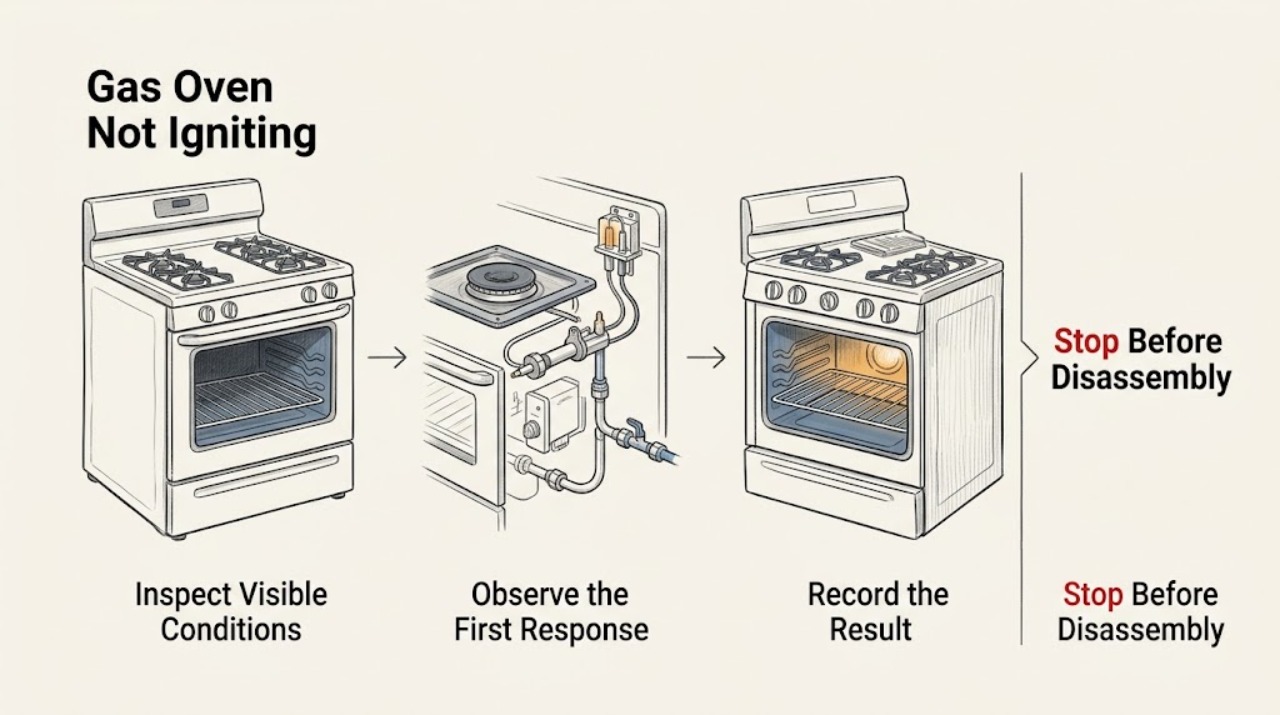
Work through in order
Diagnostic checks
Use only checks that match the exact appliance or system and its official guide.
-
Check 1
Set the oven to Bake using the exact model controls and observe the display, preheat indicator, lock state, and any error code. Keep the oven empty and the door closed during the start attempt; do not repeatedly restart a faulting appliance.
Expected result: The display is locked or shows an error, the preheat indication never starts, or the controls respond normally while the oven remains cold.
Next step: Follow the exact model manual for the lock or error. If Bake is correctly selected and the cavity remains cold, continue with the safe supply and visible ignition checks.
Why this matters
Why: A lock or error can prevent ignition commands; normal controls with no heat move the investigation toward gas supply, ignition, burner, or control components.
-
Check 2
From outside the appliance, confirm that the gas shutoff is in its normal open position only if it is clearly accessible and safe to inspect. If the range has separate surface burners, observe whether another burner operates normally without relighting it for this test; do not loosen fittings or work on the gas line.
Expected result: The shutoff appears closed, other gas burners also fail, the connection shows damage, or the supply appears normal and only the oven fails.
Next step: For a suspected supply interruption or damaged connection, stop and contact the gas provider or qualified service. If the supply appears normal and there is no odor, continue only with the model-safe viewing check.
Why this matters
Why: A broader supply interruption can prevent oven ignition; a damaged connection or gas odor is unsafe; normal surface-burner behavior makes an oven-specific ignition or control fault more likely.
-
Check 3
If the exact model permits it, observe one Bake start attempt through the normal oven window or intended viewing opening. Do not reach inside, remove the oven floor, hold a flame near the burner, or touch the igniter or burner.
Expected result: The bake burner ignites, repeated clicking occurs without ignition, no ignition is visible, or a flame is yellow, unstable, smoky, or accompanied by odor.
Next step: Stop immediately for gas odor, smoke, sparking, or an abnormal flame. For no ignition without a hazard, leave the oven off and arrange qualified service rather than opening the burner area.
Why this matters
Why: Visible ignition indicates the system operated for that attempt; clicking or no ignition points toward an igniter, burner, valve, or control issue; an abnormal flame or odor is a safety stop.
-
Check 4
Check the door from the outside for a visibly damaged or displaced gasket and make sure it closes fully. Allow the exact model's complete preheat sequence before judging heat; do not pull the gasket or keep the door open while heating.
Expected result: The door does not close squarely, the gasket is torn or detached, the oven warms after full preheat, or it remains cold despite a good seal.
Next step: Use the model manual for permitted seal or temperature guidance and request service for damage. If the oven remains cold, stop using it and arrange qualified gas-appliance service.
Why this matters
Why: A compromised seal can lose heat but does not explain absent ignition; a good seal with no temperature rise makes ignition or gas-control diagnosis more likely.
-
Check 5
Record the complete model number, Bake setting, display or error state, gas-supply observation, surface-burner comparison if available, visible ignition result, preheat behavior, door-seal condition, and any sound or odor. Do not open the cabinet or work on live wiring.
Expected result: Ignition fails repeatedly, the oven stays cold after correct settings and supply, an error returns, or there is gas odor, smoke, sparking, an abnormal flame, or a hot electrical smell.
Next step: Leave the oven out of service and provide the record to a qualified Frigidaire technician. Follow local emergency gas guidance for an odor rather than continuing tests.
Why this matters
Why: A repeatable no-ignition condition needs model-specific gas and control diagnosis; a gas, fire, or electrical symptom is an immediate stop boundary.
Use your observations
Decision map
Find the observation that best matches what you see, then follow the next safe action.
-
PATH 01Next step
What you see
The bake burner ignites and the oven warms after the exact model's full preheat sequence.
Do this next
Use the exact manual's preheat and temperature guidance and monitor for a change. Request service if ignition later fails or the oven cannot maintain temperature.
Why this path and its safety boundary
Why it matters: A complete ignition failure is not established; the original symptom may have been normal cycling or insufficient preheat time.
-
PATH 02Next step
What you see
The controls work and gas supply appears normal, but the bake burner repeatedly clicks or never ignites without a gas odor.
Do this next
Leave the oven off and arrange qualified Frigidaire service. Do not remove panels or attempt internal gas repair.
Why this path and its safety boundary
Why it matters: An oven igniter, burner, safety valve, sensor, or control fault is possible.
-
PATH 03Next step
What you see
Other gas burners also fail or the appliance gas shutoff appears closed or damaged.
Do this next
Stop using the range and contact the gas provider or qualified service through the appropriate safe channel. Do not alter fittings or attempt ignition around an odor.
Why this path and its safety boundary
Why it matters: A household gas-supply or connection problem may prevent the oven from igniting.
-
PATH 04Next step
What you see
The display shows an oven lock or error condition.
Do this next
Use only the exact model's unlock, reset, and error guidance. If the code returns or the oven remains cold, request service rather than repeatedly resetting it.
Why this path and its safety boundary
Why it matters: The control state or detected fault may be preventing ignition.
-
PATH 05Next step
What you see
There is gas odor, smoke, sparking, a yellow or unstable flame, burning electrical smell, or a damaged gas connection.
Do this next
Turn controls off only if safe, do not operate switches or create a flame around gas odor, leave the area, and follow local emergency guidance. Arrange qualified service before using the oven again.
Why this path and its safety boundary
Why it matters: This is an immediate gas, fire, or electrical safety stop.
Helpful context
Understand the symptom
Confirm an ignition failure, not just a slow preheat
A gas oven may cycle its burner while maintaining temperature, so a flame is not expected to remain on continuously. The useful distinction is whether the bake burner ever ignites and whether the cavity warms after the exact model's preheat sequence. A dark display, lock state, or error changes the first check; a powered oven with no ignition needs a gas-appliance safety boundary.
Use visible checks only
Observe the controls, supply condition, door position, and bake ignition only through the normal viewing area. Do not remove the oven bottom, burner shield, rear cover, control panel, or sealed gas components. The igniter, safety valve, burner, sensor, and wiring require model-specific diagnosis by a qualified technician.
Gas odor overrides troubleshooting
If you smell gas, do not press controls, operate switches, light a flame, or keep trying to ignite the oven. Leave the area and follow local emergency and gas-safety instructions. Stop for smoke, sparking, a yellow or unstable flame, or a hot electrical smell even if the oven briefly appears to work.
Only after diagnosis
Potential parts
- oven bake igniter
Consider this category only if qualified diagnosis confirms that the gas supply and controls are correct but the bake burner does not ignite.
Confirm the complete Frigidaire model and manufacturer's fit information before ordering; clicking or no ignition alone does not identify an igniter. - gas safety valve or bake burner
Consider this category only after qualified service confirms an internal gas-flow or burner fault following safe supply and ignition checks.
Do not open gas fittings or choose a valve from a symptom description. Verify exact model compatibility through qualified service. - oven sensor or control component
Consider this category only when the oven can ignite but cannot regulate, or when a repeatable control error prevents ignition and a qualified diagnosis identifies that path.
Use model-specific diagnosis and fitment information; do not work on live wiring or gas controls.
When checks do not resolve it
Need a professional?
Call qualified Frigidaire gas-appliance service when the bake burner will not ignite after correct Bake selection and a safe supply check, an error or lock returns, the oven stays cold after full preheat, or internal gas, ignition, sensor, control, or wiring diagnosis is required. Stop immediately for gas odor, smoke, sparking, abnormal flame, burning electrical smell, or a damaged gas connection.
Common questions
FAQ
Why does my Frigidaire gas oven click but not ignite?
Repeated clicking without a bake flame can indicate an ignition, burner, gas-supply, valve, or control issue. Leave the oven off and arrange qualified service; do not open the burner area or hold a flame near it.
How can I tell whether my Frigidaire gas oven is igniting?
Use only the normal model-permitted viewing area during one Bake start attempt. A qualified technician should handle internal diagnosis; stop immediately for gas odor, smoke, sparking, or an abnormal flame.
What should I do if I smell gas while the oven will not ignite?
Stop testing, do not operate switches or create a flame, leave the area, and follow local gas-emergency guidance. Arrange qualified service before using the range again.
Read the exact guide
Official sources
- Oven Error Codes and Alarms GuideFrigidaire · Frigidaire oven lock, error, reset, thermal, and model-manual boundaries
- Oven - Is Not Hot EnoughFrigidaire · Frigidaire oven heat-loss, door-gasket, preheat, calibration, and service boundary; apply gas-specific component conclusions only through the exact model manual
- How To Fix Gas Burner That Won't Light or HeatFrigidaire · Frigidaire gas range ignition, burner, gas-supply, and manual/service boundary used to frame oven ignition safety
- Baking with Your Gas RangeFrigidaire · Frigidaire gas oven operation, control selection, and model manual boundary
- Oven - Is too HotFrigidaire · Frigidaire oven preheat, closed-door, manual, and model-specific temperature checks; gas ignition conclusions remain model-specific
- What To Do If Your Gas Range Won't StartFrigidaire · Frigidaire gas range control, gas supply, model manual, and service boundary relevant to an oven that will not ignite
Community feedback
Share a repair observation
Share a plain-text repair observation. Accepted observations are published automatically; this page may take a moment to update.