
On this page
Start here
Quick answer
A GE gas oven that will not ignite usually needs one of a few checks: confirm Bake or Broil is selected correctly, verify the range has electrical power and gas supply, and observe whether the oven's glow-bar igniter becomes visibly hot. If there is any smell of unburned gas, do not keep trying to ignite the oven, use a flame, or operate electrical controls; leave the area and contact the gas utility or emergency service from a safe location. A powered oven with no glow, a glow without ignition, repeated clicking, an abnormal flame, or an oven that still will not heat after the basic checks needs qualified service. GE states that its electric-ignition gas oven cannot be lit manually during a power outage.
Before you begin
Safety first
- Do not open the appliance, adjust gas components, manually light an electric-ignition oven, test energized wiring, or bypass an ignition safety device.
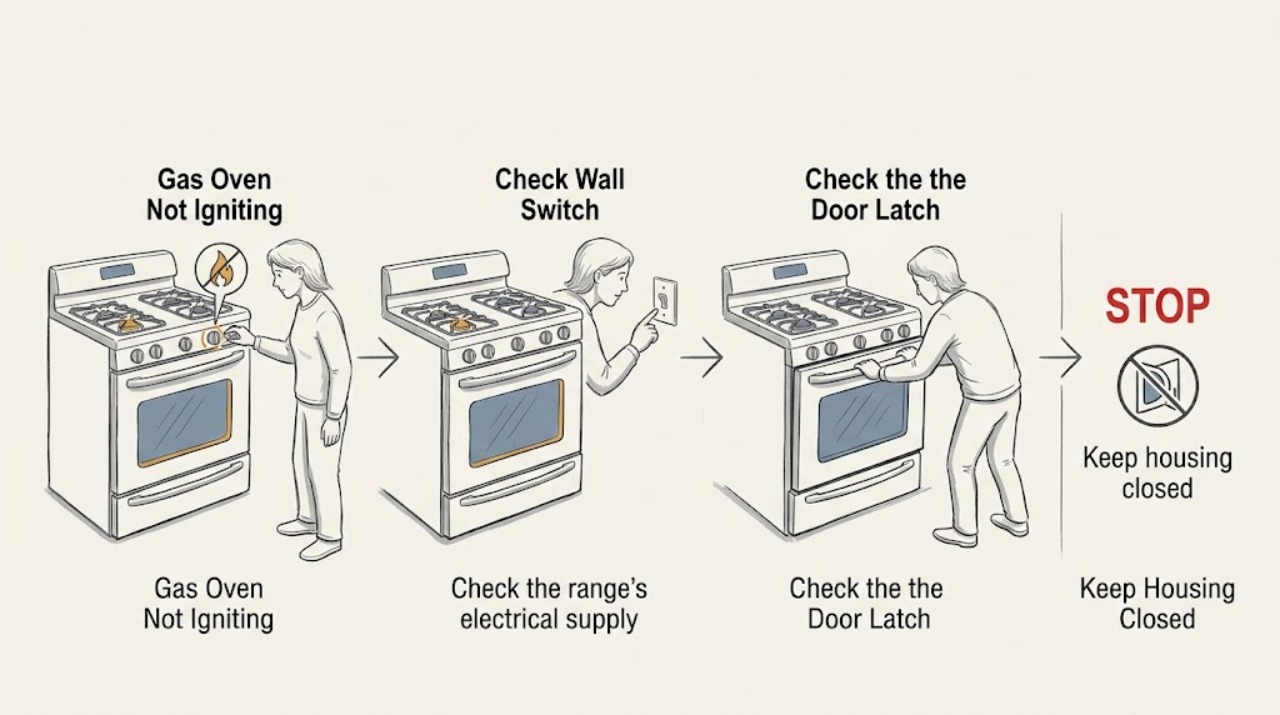
Work through in order
Diagnostic checks
Use only checks that match the exact appliance or system and its official guide.
-
Check 1
Before any further test, check from a safe position whether there is an odor of unburned gas, hissing, smoke, or a flame that went out and may have left gas flowing; if so, do not operate the oven, use a flame, or touch electrical switches.
Expected result: There is no gas odor or immediate hazard, or a gas odor or other hazard is present or uncertain.
Next step: If gas may be present, leave the area and contact the gas utility or emergency service from a safe location. Only continue with the remaining checks when the area has been declared safe.
Why this matters
Why: An odor or uncertain condition is a gas-safety event, not an ignition troubleshooting step. Continuing to cycle the controls could add an ignition source or release more gas.
-
Check 2
With no gas odor and the oven off, set the controls for the intended Bake or Broil function and confirm that any applicable self-clean door latch is fully unlocked; if the model has Sabbath Mode or control lock, check the owner's instructions for that setting.
Expected result: The function or temperature control was mis-set, the latch was locked, or a special mode was active; alternatively, the controls were already correct and the oven still does not ignite.
Next step: Correct only the setting identified in the model instructions and try one normal cycle. If settings are correct and there is still no ignition, check power before investigating gas components.
Why this matters
Why: A wrong function, locked latch, or special mode can prevent a normal heating cycle without proving that an igniter or gas valve has failed.
-
Check 3
Check the range's electrical supply without opening the appliance: verify the dedicated house breaker or fuse is normal and, where it can be reached without moving the range or entering a hazardous area, confirm the power cord is fully seated.
Expected result: The breaker is tripped, the fuse is open, or the plug is loose; alternatively, the supply appears normal and the clock or display still operates but the oven will not ignite.
Next step: Restore a safe, correctly rated supply only if the house protection has not repeatedly tripped. Do not keep resetting a breaker that trips again; arrange electrical or appliance service.
Why this matters
Why: GE electric-ignition gas ovens need electrical power for the igniter and gas valve. A working clock does not by itself prove that the heating circuit is healthy, while a tripped supply can explain a completely inactive ignition sequence.
-
Check 4
If there is no gas odor and the model's installation allows a safe external check, visually confirm that the appliance gas shutoff is open; on a newly installed range, have the installer or a qualified technician verify the regulator setup rather than removing or adjusting it yourself.
Expected result: The accessible shutoff is closed, or the top burners work while the oven does not on a new installation; alternatively, the supply appears open and the oven still fails to ignite.
Next step: If the valve position is uncertain or the symptom started after installation, stop and ask the installer or qualified service to verify the gas setup. Do not turn a valve repeatedly or remove the regulator to experiment.
Why this matters
Why: A closed supply can prevent ignition. GE also notes that a regulator setting can affect an oven while surface burners still work, but regulator access and adjustment are not a user repair.
-
Check 5
With the oven empty of loose items and no gas odor, start one normal Bake request and look only through the open oven door for the expected glow from the Glo-Bar igniter; do not reach into the cavity or attempt to light the burner manually.
Expected result: A visible glow appears but the burner does not ignite, or no glow appears at all.
Next step: Stop the cycle if it does not ignite promptly or if any gas odor develops. Record whether there was a glow and arrange qualified service for the corresponding ignition or gas-side diagnosis.
Why this matters
Why: GE says no glow can indicate a Glo-Bar, oven control, or other electrical problem. A glow without ignition shifts attention to gas delivery, the safety valve, burner condition, or a control fault; neither result is a reason to dismantle the oven.
-
Check 6
If there is no gas odor and the controls remain responsive, perform only the model-appropriate electronic reset described by GE: switch the oven circuit off at the breaker, wait briefly, and restore it once; do not reset a breaker that trips again.
Expected result: The control returns and the oven ignites normally, or the oven still will not ignite, the display shows a fault, or the breaker trips again.
Next step: If the reset does not restore ignition, leave the appliance off and schedule qualified service. Do not bypass a breaker, test live wiring, or continue cycling the oven.
Why this matters
Why: A single reset can clear a control state on models equipped for it, but a recurring trip or persistent no-ignition symptom indicates an underlying electrical, ignition, or gas-control fault.
Use your observations
Decision map
Find the observation that best matches what you see, then follow the next safe action.
-
PATH 01Next step
What you see
Gas odor, hissing, smoke, or an uncertain possibility of unburned gas is present
Do this next
Do not operate controls or use a flame; leave the area and contact the gas utility or emergency service from a safe location.
-
PATH 02Next step
What you see
The oven function, latch, Sabbath Mode, or control setting was incorrect
Do this next
Correct the setting using the model instructions and make one normal attempt. If it still does not ignite, continue with the power check.
-
PATH 03Next step
What you see
The breaker, fuse, or power connection is abnormal, or the oven is in a power outage
Do this next
Restore safe household power only when appropriate. Do not manually light an electric-ignition gas oven during an outage; call service if power protection trips again.
-
PATH 04Next step
What you see
Power is present but no Glo-Bar glow is visible
Do this next
Stop repeated ignition attempts and arrange service for the igniter, control, wiring, or related electrical diagnosis.
-
PATH 05Next step
What you see
The Glo-Bar glows but the burner does not ignite, or the oven still fails after the basic checks
Do this next
Leave the oven off and have qualified service evaluate gas supply, the safety valve, burner area, and controls. Do not remove the oven bottom or adjust gas components.
Helpful context
Understand the symptom
Safety comes before another ignition attempt
If you smell unburned gas, stop. Do not turn the oven on again, light anything, or use electrical switches in the affected area. Leave and contact the gas utility or emergency service from a safe location. The checks below are for a no-ignition symptom when there is no gas odor, no smoke, and no other immediate hazard.
What the GE ignition sequence tells you
A GE electric-ignition gas oven needs both electrical power and gas supply. The control calls for heat, the glow-bar igniter heats, and the burner should then ignite. A missing glow points toward power, the igniter, controls, or related wiring; a visible glow without ignition points toward gas supply, the safety valve, burner area, or another fault that needs professional diagnosis.
Checks that do not require opening the appliance
Use the controls and inspect accessible indicators only. Check the house breaker or fuse, the range plug where safely accessible, the oven settings, and the door latch position on applicable self-clean models. Do not remove the oven bottom, reach near the burner, adjust a regulator, or attempt to light an electric-ignition oven with a match.
When to stop and call
Stop for gas odor, a delayed ignition with gas odor, repeated clicking, smoke, abnormal flames, scorching, a damaged cord, or a control that fails to respond. GE directs owners to service when the glow-bar or electrical components may be malfunctioning and when the basic checks do not restore operation.
Safety boundary
Stop conditions
- Stop immediately and leave the area for any gas odor, hissing, smoke, or uncertainty about whether gas is present.
- Do not light an electric-ignition gas oven with a match, use a flame to test it, or keep cycling the controls after a failed ignition.
- Stop for repeated clicking, abnormal flame, scorching, a damaged cord, a breaker that trips again, or a display fault.
- Do not remove the oven bottom, open the control area, adjust the regulator or safety valve, test live wiring, or bypass a safety device.
Only after diagnosis
Potential parts
- oven glow-bar igniter
Only consider this component after safe diagnosis shows the oven has power but the Glo-Bar does not glow; a model-specific service diagnosis is still required.
Confirm the exact GE model and approved fitment with the manufacturer or technician before ordering any part. - oven safety gas valve
Only consider this component if a qualified technician confirms that the igniter glows but the oven burner still does not receive or admit gas.
Gas-valve fit and safe installation are model-specific; use qualified service rather than selecting or installing this component from the symptom alone.
When checks do not resolve it
Need a professional?
Contact the gas utility or emergency service from a safe location for any possible unburned-gas odor., Request qualified GE or appliance service when the Glo-Bar does not glow, glows without ignition, the burner repeatedly fails, or basic settings and power checks do not restore operation., Provide the model number, whether surface burners work, whether the display has power, whether a Glo-Bar glow was visible, any fault indication, and whether the symptom began after installation or a power event.
Safety scope: Do not open the appliance, adjust gas components, manually light an electric-ignition oven, test energized wiring, or bypass an ignition safety device.
Common questions
FAQ
Why does my GE gas oven have power but not ignite?
Check the selected oven function, gas supply, and whether the Glo-Bar becomes visibly hot. No glow can indicate the igniter, control, or electrical components; a glow without ignition needs gas-side or control diagnosis by qualified service.
Can I light a GE electric-ignition gas oven with a match?
No. GE says the gas oven's Glo-Bar and gas valve require electrical power, so the oven cannot be manually lit during a power outage. Do not use a flame to test a failed ignition.
What if the surface burners work but the oven does not?
Confirm the oven settings and, especially after installation, have the gas regulator setup checked by an installer or qualified technician. Then observe the Glo-Bar only as a visual check; do not remove or adjust gas components yourself.
What should I do if I smell gas when the oven will not ignite?
Stop trying to ignite it. Do not operate the oven, use a flame, or touch electrical switches in the affected area. Leave and contact the gas utility or emergency service from a safe location.
Read the exact guide
Official sources
- Gas Range - Oven Does Not Heat, But The Burners HeatGE Appliances · GE gas-range oven no-heat diagnosis, regulator context, controls, Glo-Bar observation, and service boundary
- Gas Range & Cooktop - Electric Ignition for Surface BurnersGE Appliances · GE gas-appliance electric ignition safety and stop-use service guidance
- Gas Range & Wall Oven - Oven Will Not Come OnGE Appliances · GE gas range and wall-oven settings, power, gas supply, Glo-Bar, reset, latch, and service checks
- Range, Cooktop & Wall Oven - Power Outage Tips and OperationGE Appliances · GE gas and dual-fuel oven electrical-power and power-outage operation
Community feedback
Share a repair observation
Share a plain-text repair observation. Accepted observations are published automatically; this page may take a moment to update.