
On this page
Start here
Quick answer
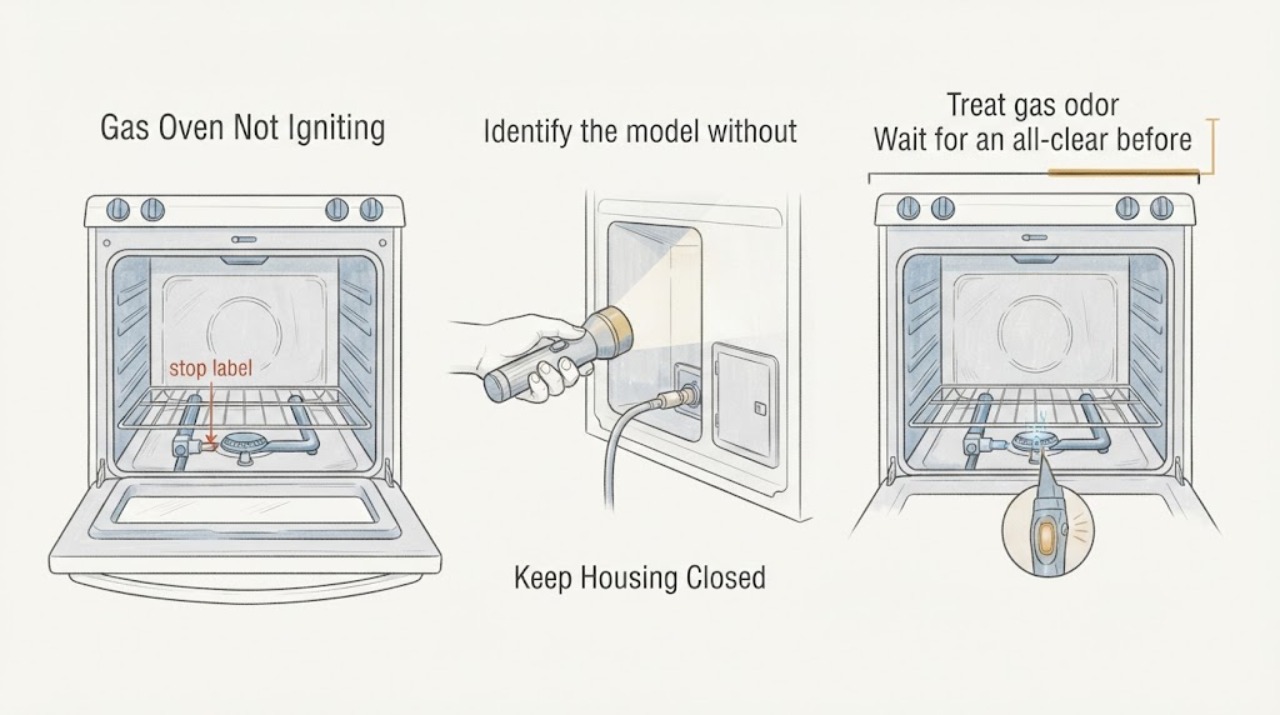
A Kenmore gas oven that will not ignite needs a safe distinction between a spark-electrode model and a glow-igniter model; the brand alone does not identify the design. If gas odor is present, a burner lights late, a flare or whoosh occurs, smoke appears, or a flame is abnormal, stop immediately: do not use electrical controls or flames, do not open the door to investigate, and leave to contact the gas supplier or emergency services from a safe location. After an all-clear, record the exact model and use its manual to identify whether the oven uses spark or glow ignition. Check only the external power and control state, recent installation or supply interruption, and unobstructed visible vent area. Do not remove the oven bottom, adjust the gas valve, handle the igniter, or repeat an ignition attempt. A no-ignition condition after safe external checks needs qualified gas or appliance service.
Before you begin
Safety first
- Do not operate controls during active gas odor, relight the burner, open the oven door after suspected delayed ignition, move the range, inspect or replace the connector, remove panels or the oven bottom, adjust valves or regulators, handle igniter wiring, use leak-detection fluid, or repeat ignition tests.
Work through in order
Diagnostic checks
Use only checks that match the exact appliance or system and its official guide.
-
Treat gas odor or a flare as an emergency first
If the Kenmore oven smells of gas, hisses, produces a flare, emits smoke, or has a flame outside the intended burner, stop. Do not turn knobs, lights, switches, fans, or other electrical equipment on or off; do not light a match or use a phone inside; do not open the oven door or move the range. Leave immediately and contact the gas supplier or emergency services from outside or a neighbor's location.
Expected result: Gas odor or another hazardous symptom is present now; or the area is odor-free and the gas supplier, fire department, or other appropriate responder has cleared the home and appliance.
Next step: For active odor, stay out and follow the responder's instructions; do not re-enter until cleared. Only after an all-clear may you perform the documentation steps below, without starting the oven.
Stop if: Stop and leave for gas odor, hissing, delayed ignition, flare, smoke, abnormal flame, burning smell, or an alarm. Do not return to the appliance to obtain a closer view.
Why this matters
Why: An oven that does not ignite can release unburned gas. CPSC identifies gas accumulation and delayed ignition as capable of causing fireballs or explosions, so the safety path overrides all ignition troubleshooting.
-
Wait for an all-clear before inspecting the appliance
Remain outside while the gas supplier, fire department, or other qualified responder determines whether the home and appliance are safe. Do not operate a range hood, open or close electrical switches, or use a phone inside to clear the smell. A fading odor is not proof that the leak or ignition fault is fixed.
Expected result: The home or appliance is not cleared, the odor returns, the responder finds a leak or unsafe condition, or the area is cleared and the oven is cool, intact, and odor-free.
Next step: Stay out until cleared. If cleared, keep the oven off and proceed only to model identification and no-movement checks. If declared unsafe, leave it isolated and arrange qualified repair.
Stop if: Do not re-enter or operate any switch, knob, fan, or appliance while odor, hissing, smoke, heat, or an unresolved warning remains.
Why this matters
Why: Gas can disperse below the level a person notices while an unsafe supply or ignition condition remains. An all-clear permits only limited external documentation; it does not authorize a test ignition.
-
Identify the Kenmore model without moving the range
After an all-clear and with the oven cool and odor-free, photograph the model and serial label from its normal accessible location. Record whether it is a freestanding or slide-in range or a wall oven, and whether the fuel is natural gas or propane if the label or manual states it. Use Kenmore's official manual finder for that exact model. Do not pull the range out or remove a drawer, panel, connector, or oven bottom solely to find information.
Expected result: The model and fuel configuration are clear; the label cannot be reached without moving the appliance; or the manual does not match the controls or installation.
Next step: Use the exact manual or provide the visible information to qualified service. If obtaining the label requires moving the range, stop and do not move it.
Stop if: Do not move the appliance, bend or inspect its connector, open a rear cover, or continue if gas odor, heat, damage, or a responder warning returns.
Why this matters
Why: Kenmore states that manuals are located by model number and cover ovens and ranges. CPSC warns that even slight movement can cause an older weakened gas connector to fail, so an inaccessible label is a service task.
-
Use the manual to distinguish spark and glow ignition
From a safe location, use the exact Kenmore manual to determine whether the oven ignition description refers to a spark electrode, an electrically heated glow igniter, or another model-specific system. Record whether the oven previously clicked, sparked, glowed, or simply failed to produce a flame. Do not remove the oven floor, burner cover, door, control panel, or wiring to look for the igniter.
Expected result: The manual clearly identifies a spark system, a glow-igniter system, another configuration, or does not provide enough information to identify the system.
Next step: Follow only model-specific external instructions that do not require an ignition attempt. If the system is unclear, leave the oven off and provide the model to qualified appliance service.
Stop if: Do not expose the burner, probe wiring, bypass a safety device, or start the oven to compare spark and glow behavior. Stop if odor, delay, flare, smoke, or an abnormal flame occurs.
Why this matters
Why: CPSC explains that many gas ovens use electrically heated igniters, but ignition design varies. A no-spark observation does not prove a failed igniter on a glow model, and a glow observation does not prove that the gas valve or burner is safe.
-
Check visible power and control state without igniting
With the appliance cool, dry, intact, and odor-free, record whether the clock or control display works, whether a breaker has opened, whether the control is locked or in a delayed-start state, and whether a recent installation or power interruption occurred. Inspect only the visible plug, cord, and control panel for damage; do not reset repeatedly, touch wiring, or turn Bake on to watch the igniter.
Expected result: The display is blank, the breaker is open or trips again, the control is locked or delayed, the visible supply is damaged, or the controls appear normal but the oven still has no ignition history.
Next step: Use only the exact manual's safe control or power guidance when no gas or damage symptom exists. Leave the oven off and arrange electrical or appliance service for a repeat trip, damaged connection, blank display, or unresolved no-ignition condition.
Stop if: Do not open electrical covers, probe circuits, use an adapter or extension cord, reset protection repeatedly, or operate after odor, smoke, sparks, burning smell, abnormal heat, or damaged wiring.
Why this matters
Why: Gas ovens can still require electrical power for controls and ignition. A supply or control problem can prevent ignition, while a normal display does not clear a gas valve, burner, igniter, or delayed-ignition problem.
-
Record supply and installation context without touching gas components
After an all-clear, note whether the range or wall oven was recently installed, reconnected, converted between fuel types, serviced, or affected by a utility interruption. From the normal user position, record whether the appliance appears level and whether the oven vent or surrounding area is visibly blocked. Do not manipulate the gas shutoff, regulator, connector, burner, vent, or range position as a test.
Expected result: The no-ignition began after installation or reconnection, fuel conversion, service, or supply interruption; the visible vent area is blocked; or no external context is found.
Next step: Keep the oven off and have the installation, fuel supply, venting, and ignition system checked by qualified gas or appliance service. Remove only a plainly external stored item when safe; do not move or relight the appliance.
Stop if: Do not move the range, open a gas valve housing, adjust a regulator, remove a burner, operate a hood to compare airflow, or continue after odor, delayed ignition, flare, smoke, or abnormal flame.
Why this matters
Why: Installation, fuel configuration, supply, airflow, and ignition timing can interact. CPSC's delayed-ignition work found that gas accumulation and air-moving equipment can affect combustion, but only a qualified professional can verify a Kenmore installation or gas system.
-
Stop and give service the complete no-ignition record
Compile the model and serial information, range or wall-oven identity, fuel type, ignition type from the manual, display and breaker state, programme selected before the event, whether any click or glow was observed previously, timing of any gas odor or delay, visible damage, recent installation or service, and responder findings. Do not perform a final ignition test and do not choose a part from the symptom alone.
Expected result: The oven remains unable to ignite, a code or control fault returns, ignition is delayed, the flame is abnormal, the odor returns, or the cause cannot be confirmed by safe external information.
Next step: Leave the oven unused and arrange qualified gas or appliance service. If odor returns before the visit, repeat the emergency response and contact the gas supplier or emergency services from outside.
Stop if: Do not relight, disassemble, leak-test, adjust, bypass, or continue operating after gas odor, delayed ignition, flare, smoke, burning smell, abnormal flame, heat damage, or a repeated electrical trip.
Why this matters
Why: A no-ignition symptom can involve the power path, control, spark or glow igniter, valve, burner, fuel supply, venting, or installation. These components require model-specific diagnosis and safe gas isolation.
Use your observations
Decision map
Find the observation that best matches what you see, then follow the next safe action.
-
PATH 01Next step
What you see
Gas odor, hissing, delayed ignition, flare, smoke, or abnormal flame is present
Do this next
Leave immediately, avoid switches, electrical equipment, phones, and flames inside, and contact the gas supplier or emergency services from outside or a neighbor's location. Do not re-enter until cleared.
-
PATH 02Next step
What you see
The gas supplier, fire department, or other appropriate responder has not cleared the home and appliance
Do this next
Remain out and do not inspect, ventilate with electrical equipment, move the range, operate the oven, or restore power.
-
PATH 03Next step
What you see
The model, fuel configuration, or spark-versus-glow ignition type cannot be confirmed safely
Do this next
Do not remove panels or start the oven. Use Kenmore's manual route or provide the visible model information to qualified service.
-
PATH 04Next step
What you see
The display is blank, a breaker is open or trips again, controls are locked or delayed, or visible electrical damage is present
Do this next
Keep the oven off and arrange qualified electrical or appliance diagnosis. Do not repeatedly reset protection or touch wiring.
-
PATH 05Next step
What you see
No ignition began after installation, reconnection, fuel conversion, service, or a gas-supply interruption
Do this next
Do not manipulate the connector, valve, regulator, or burner. Keep the oven off and arrange qualified gas or appliance service to verify installation and supply.
-
PATH 06Next step
What you see
The oven does not ignite, there is no current odor or damage, and the model-specific external information does not identify a safe user correction
Do this next
Do not run another ignition attempt. Provide the model, ignition type, display state, and prior click or glow observation to qualified gas or appliance service.
-
PATH 07Next step
What you see
The no-ignition condition, odor, delay, flare, or control fault returns after any model-approved external step
Do this next
Leave the oven unused; repeat the emergency path if gas odor is present and arrange qualified gas or appliance service with the complete record.
Helpful context
Understand the symptom
No spark and no glow are different observations
Some gas-oven configurations use a spark electrode; others use an electrically heated glow igniter that opens the oven gas valve after it reaches the required condition. Do not assume that a Kenmore oven should click, spark, or glow based on the model family. Use the exact manual and never remove panels or expose the burner to determine the design. The safe user-level question is whether the oven establishes a prompt, stable flame without gas odor or a flare—not which part to replace.
Delayed ignition is a stop condition
CPSC documents that gas can accumulate in an oven when ignition is delayed and that opening the door or operating an air-moving appliance can be associated with a flare-up. If the oven smells of gas, lights late, makes a whoosh, or produces a flame outside the intended burner, stop and leave the area. Do not open the door, turn on a hood or light, or make another ignition attempt.
When checks do not resolve it
Need a professional?
For active or returning gas odor, leave and contact the gas supplier or emergency services from outside. After an all-clear, keep the Kenmore oven off and arrange qualified gas or appliance service for no ignition, delayed ignition, abnormal flame, unknown ignition type, installation concerns, or any unresolved fault.
Safety scope: Do not operate controls during active gas odor, relight the burner, open the oven door after suspected delayed ignition, move the range, inspect or replace the connector, remove panels or the oven bottom, adjust valves or regulators, handle igniter wiring, use leak-detection fluid, or repeat ignition tests.
Have this ready
- Provide the exact Kenmore model and serial information if safely accessible, range or wall-oven configuration, natural-gas or propane designation, ignition type from the manual, display and breaker state, selected programme, prior click or glow observation, odor and delay timing, recent installation or service, visible damage, and responder findings.
Common questions
FAQ
What should I do if my Kenmore gas oven will not ignite and I smell gas?
Stop immediately and leave the home. Do not use lights, switches, phones, fans, flames, or the oven controls inside, and do not open the oven door or move the range. Contact the gas supplier or emergency services from outside or a neighbor's location and do not re-enter until cleared.
How do I know whether my Kenmore oven uses a spark or glow igniter?
Use the exact model and owner's manual; do not infer the design from the Kenmore name or remove the oven floor to look. CPSC notes that many gas ovens use electrically heated igniters, while other configurations may use spark ignition. A qualified technician can identify the system safely when the manual is unclear.
Is it safe to open the oven door when the burner did not light?
Not if there may be delayed ignition or gas accumulation. CPSC documents hazardous flare-ups associated with gas that accumulates in an oven and ignition when the door is opened. If ignition was delayed, there was a whoosh, or gas odor is present, do not open the door or retry; leave and obtain qualified help.
Can I replace the Kenmore oven igniter because it will not light?
Do not choose or replace an igniter from the symptom alone. A no-ignition condition can involve a spark or glow system, gas valve, control, power, burner, supply, venting, or installation. Keep the oven off and have qualified gas or appliance service identify the model-specific fault.
Can I pull my Kenmore range out to check the gas connection?
No. CPSC warns that moving an appliance even slightly can cause an older weakened connector to fail. Do not pull the range, bend the connector, or remove a rear panel. After an all-clear, use an accessible model label and have a qualified professional inspect the gas connection.
Read the exact guide
Official sources
- Certain Older Gas Connectors May Be DangerousU.S. Consumer Product Safety Commission · General household gas-appliance safety; follow local gas supplier and emergency responder instructions
- Customer Care & SupportKenmore · Kenmore appliances; use current model-specific safety and repair information
- Kenmore ManualsKenmore · Kenmore appliances; confirm the exact gas-oven or range model and fuel configuration
- Gas Range Delayed Ignitions - Tests and Examinations of RangesU.S. Consumer Product Safety Commission · General household gas ranges and ovens; not a Kenmore model manual
Community feedback
Share a repair observation
Share a plain-text repair observation. Accepted observations are published automatically; this page may take a moment to update.