
On this page
Start here
Quick answer
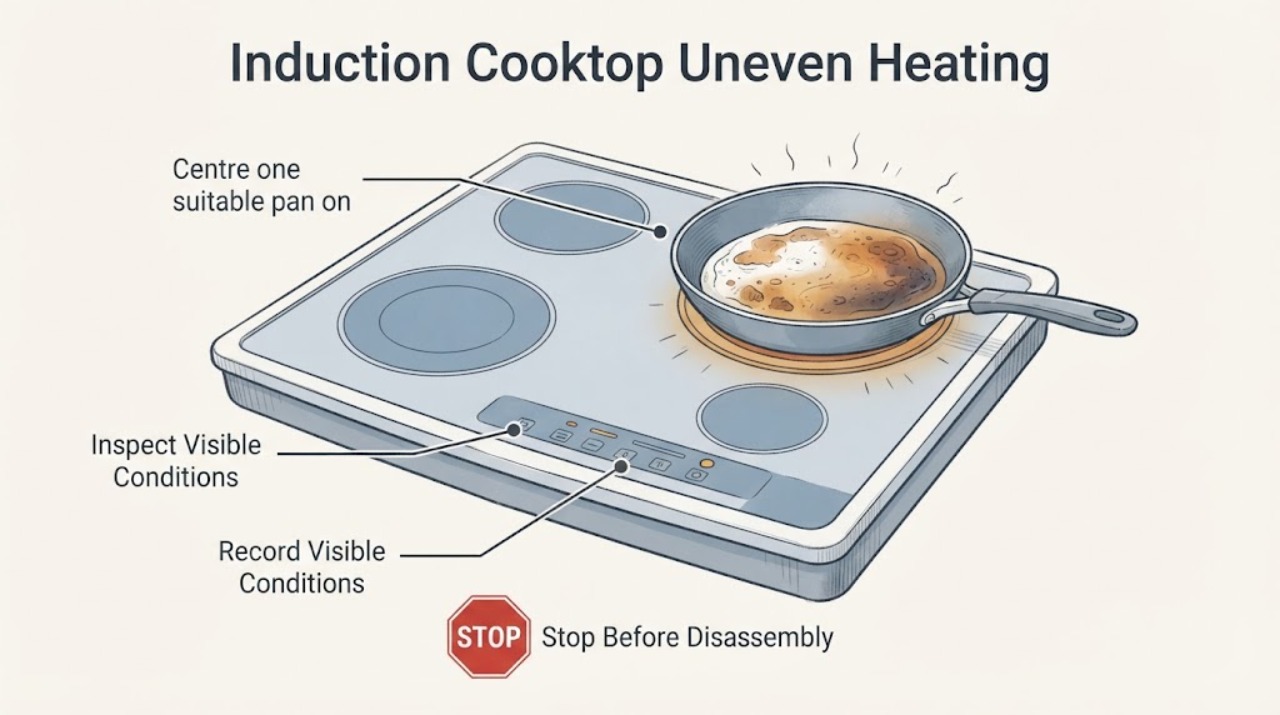
Uneven food heating on a Frigidaire Gallery induction cooktop does not automatically mean the cooktop has a failed coil. Start with the pan: use induction-suitable cookware with a flat, stable, medium-to-heavy base, confirm that a magnet sticks, and centre the base over the marked zone. Frigidaire says its induction pan-size recognition is intended to adapt to pan size for more even cooking, while lightweight or uneven cookware can cook food unevenly. Compare the same pan and cooking setup on another zone. If the uneven pattern follows the pan, correct the cookware or technique; if it stays with one zone across suitable pans, stop trying to compensate with higher power and arrange model-specific service. Stop immediately for smoke, sparking, electrical burning smell, cracked glass, or a repeated breaker trip.
Work through in order
Diagnostic checks
Use only checks that match the exact appliance or system and its official guide.
-
Check 1
With the cooktop off and the pan cool enough to handle, inspect the pan base and the cooking surface for a visible wobble, heavy residue, a rough or damaged base, or a crack in the glass. Use a household magnet on the pan base if the exact Gallery manual does not prohibit that check, and record whether it sticks across the usable base.
Expected result: The base is flat, clean, stable, and magnetic, or it is warped, very light, rough, damaged, nonmagnetic, or visibly contaminated.
Next step: Repeat the comparison with a known induction-suitable, flat, medium-to-heavy pan. If the pan is damaged or unsuitable, replace the cookware only after confirming the exact manual's requirements; do not diagnose an internal part from this result.
Stop if: Do not slide rough cast iron across the glass, polish a damaged surface with abrasive material, or test a cracked cooktop under power.
Why this matters
Why: Frigidaire recommends heavy-gauge induction cookware and uses magnetic detection to identify suitable material. A pan that is not flat, stable, or consistently magnetic can transfer heat unevenly even when the zone itself is operating.
-
Check 2
Centre one suitable pan on the marked zone and compare its base diameter with the zone marking. Use the same pan, the same food quantity, and the same preparation on one other zone when the cooktop is safe to use; stop the heat before moving a hot pan. Note whether the pan is smaller than the active area, overhangs it, or sits off-centre.
Expected result: The pan is centred and appropriately sized, or the uneven result changes when the pan size or position changes.
Next step: Use the exact Gallery manual's zone and cookware guidance and keep the pan centred. If the same setup remains uneven, continue with the pan-versus-zone comparison instead of simply raising the power level.
Stop if: Do not move a pan while oil or boiling liquid is unstable, bridge zones, or use an improvised metal plate to enlarge the active area.
Why this matters
Why: Frigidaire says pan-size recognition adapts induction zones to pan sizes for more even cooking, while its support guidance says cookware affects heat distribution. A result that changes with size or position points first to cookware coupling or transfer rather than a confirmed failed zone.
-
Check 3
Compare the same suitable pan and a repeatable, low-risk cooking setup on a second zone. Observe whether the hot and cool pattern follows the pan when the pan is moved, stays in the same part of the pan on different zones, or remains tied to one marked zone. Do not use bare hands to judge temperature and do not deliberately overheat oil.
Expected result: The pattern follows the pan, changes with position or pan size, or stays with one zone across a suitable pan and the same setup.
Next step: For a pan-following result, correct the cookware or cooking setup. For a zone-following result, record the zone, pan, setting, and result, then arrange qualified Frigidaire or appliance service rather than opening the cooktop.
Stop if: Stop the comparison for smoke, sparking, electrical odor, cracked glass, a hot control area, or any sign that the pan or cooktop is overheating abnormally.
Why this matters
Why: A pan-following pattern makes cookware or heat transfer more likely. A pattern that stays with one zone after a controlled comparison raises a zone-specific sensing or power issue, but it still does not identify a replaceable part without model-specific diagnosis.
-
Check 4
Separate normal induction behavior from a cooking defect. During one supervised use of a suitable pan, note whether the pan heats while the glass stays comparatively cooler and whether there is a hum, buzz, click, or fan sound. Compare that with the actual food result and with any display, lock, no-pan, or error indication.
Expected result: The pan heats and the food result improves with a suitable pan, or the pan remains cold, the zone reports an error, the cycle stops, or the uneven result is unchanged across suitable pans.
Next step: If cooking is even with suitable cookware, continue using the exact Gallery manual. If the pan stays cold, the zone shows an error, or unevenness stays with one zone, stop user testing and arrange qualified service.
Stop if: Do not remove the glass, test live inverter or coil wiring, bypass pan detection, or keep increasing heat to force a response.
Why this matters
Why: Frigidaire identifies humming, buzzing, clicking, and a cooler induction surface as normal possibilities. Persistent uneven cooking with suitable cookware, especially when confined to one zone, is different from those normal sounds and needs model-specific assessment.
Use your observations
Decision map
Find the observation that best matches what you see, then follow the next safe action.
-
PATH 01Next step
What you see
The hot and cool pattern changes or follows the pan when the same suitable pan is moved to another zone, and the pan base is flat, clean, and magnetic only where the manual permits that check.
Do this next
Use a flat, medium-to-heavy induction pan that matches the exact Gallery manual and keep it centred. If the complaint disappears, monitor the cookware rather than ordering a cooktop part.
Why this path and its safety boundary
Why it matters: The result makes cookware heat transfer, pan construction, size, or placement more likely than a confirmed cooktop-zone failure. Frigidaire specifically links cookware weight and shape to even heat distribution.
-
PATH 02Next step
What you see
The same suitable pan and cooking setup produce an uneven result only on one marked zone, while another zone heats the pan more evenly.
Do this next
Stop compensating with higher settings, record the affected zone and pan comparison, and arrange qualified Frigidaire or appliance service using the exact Gallery model information.
Why this path and its safety boundary
Why it matters: A zone-specific sensing, power, or control issue becomes more plausible than a general pan-design explanation, but the observation does not identify a coil, sensor, inverter, or board by itself.
-
PATH 03Next step
What you see
The pan heats normally, the food result is acceptable with suitable cookware, and the glass stays comparatively cool while a hum, buzz, click, or fan sound occurs.
Do this next
Continue normal use according to the exact Gallery manual and monitor for a change in the food result, controls, or zone behavior.
Why this path and its safety boundary
Why it matters: Frigidaire identifies those sounds and a cooler induction surface as normal operating behavior. They do not establish uneven heating or a failed part when the pan and food heat normally.
-
PATH 04Next step
What you see
The pan remains cold, a no-pan or error indication persists, the display is unresponsive, or uneven cooking is accompanied by smoke, sparking, electrical odor, cracked glass, or repeated breaker trips.
Do this next
Stop using the cooktop. From a safe, dry position, isolate the circuit only if accessible, and arrange qualified appliance or electrical service. Provide the exact Gallery model, affected zone, cookware details, and any displayed indication.
Why this path and its safety boundary
Why it matters: This is no longer a cookware-evenness question. Persistent no-heating or a physical electrical or glass hazard requires a professional boundary rather than more cooking tests.
Helpful context
Understand the symptom
Uneven food is different from no induction output
A zone that never heats a suitable pan is a no-heating problem. Uneven browning or a hot and cool pattern within a pan can instead come from the pan base, its size, its position, or the way heat is transferred into the food. Frigidaire says induction heats the pan, uses magnetic detection, and can recognize pan size for more even cooking. The first useful question is whether the pattern follows the pan or stays with the cooktop zone.
What Frigidaire means by suitable cookware
Frigidaire recommends high-quality heavy-gauge cookware for induction and says a magnet sticking to the base indicates a suitable material. Not all stainless steel is magnetic, and a rough cast-iron base can scratch the glass. A pan can be magnetic yet still transfer heat unevenly if its base is warped, very light, poorly matched to the zone, or not centred.
Why sound or a cooler glass surface is not the same as uneven cooking
Frigidaire says some induction cookware can hum or buzz and that clicks can occur as controls work to create even cooking temperatures. Induction heats the pan rather than the glass, so a comparatively cooler surface is expected. Judge the complaint by the food and the pan comparison, not by whether the glass glows or the unit makes a quiet operating sound.
When checks do not resolve it
Need a professional?
Arrange qualified Frigidaire or appliance service when the same suitable pan remains uneven only on one zone, the pan stays cold, a no-pan or error indication persists, the controls are unresponsive, or the issue remains after the exact Gallery manual's cookware and placement checks. Stop immediately for smoke, sparking, electrical burning smell, cracked glass, a hot control area, or a repeated breaker trip; isolate power only from a safe, accessible position. Provide the exact model and serial information, affected zone, pan material and base condition, pan position, cooking setup, and comparison result. Do not order an induction coil, sensor, inverter, or control board from uneven cooking alone.
Common questions
FAQ
Does uneven cooking mean my Frigidaire Gallery induction cooktop is defective?
Not necessarily. Frigidaire says cookware weight, base condition, magnetic material, size, and placement affect induction performance and even heat distribution. Compare the same suitable pan on another zone before treating the result as a zone fault.
Why is one part of my induction pan hotter than another?
A warped, light, poorly matched, or off-centre pan can transfer heat unevenly even when the zone responds. Start with a flat, medium-to-heavy induction pan, centre it, and see whether the pattern follows the pan when it is moved to another zone.
Is humming or a cool glass surface proof of uneven heating?
No. Frigidaire says some induction cookware can hum or buzz, controls can click, and the glass can remain cooler because induction heats the pan. Judge the complaint by the food and pan comparison; service is appropriate when a suitable pan remains uneven on one zone or stays cold.
Read the exact guide
Official sources
- Ranges - What type of cookware do I use with Induction?Frigidaire Owner Center · Frigidaire induction cookware material, magnetic-base, weight, and surface-care guidance.
- Owner Center Resource LibraryFrigidaire Owner Center · Frigidaire Gallery Series and Induction Appliances product-support collections; use the exact Gallery model for its manual and troubleshooting limits.
- Why does my Induction Range make noises when I’m cooking?Frigidaire Owner Center · Frigidaire induction range and induction cooktop normal hum, buzz, click, and fan behavior.
- Ranges - No HeatingFrigidaire Owner Center · Frigidaire glass-cooktop no-heating and cookware heat-distribution support.
- Induction Ranges - What are the benefits of Induction?Frigidaire Owner Center · Frigidaire induction range and induction cooking behavior, including magnetic and pan-size detection.
Community feedback
Share a repair observation
Share a plain-text repair observation. Accepted observations are published automatically; this page may take a moment to update.