
On this page
Start here
Quick answer
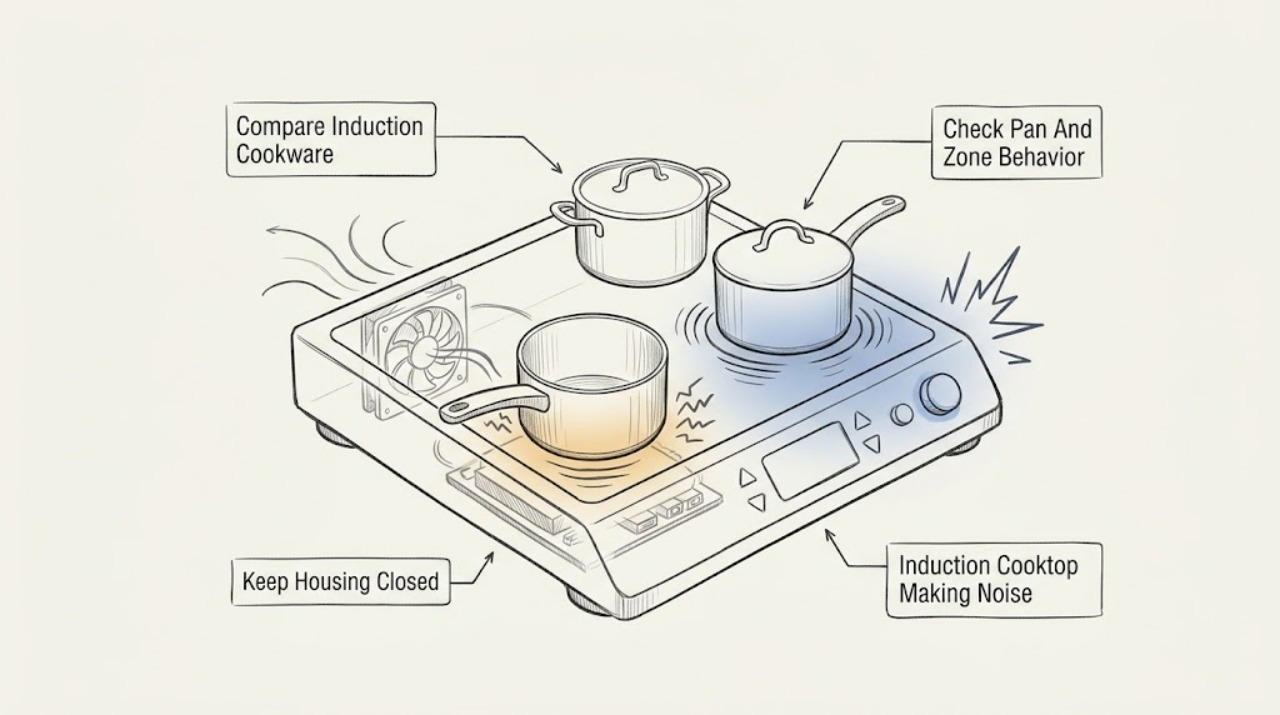
Some noise from a Frigidaire induction cooktop is expected: cookware can hum or buzz, controls can make short operating sounds, parts can expand or contract as temperatures change, and cooling fans may continue after cooking. First identify whether the sound changes with one pan or one zone, and whether it stops after the appliance cools. Use only cookware and placement approved by the exact manual; a flat, induction-suitable pan can help distinguish pan vibration from the cooktop. Stop using the cooktop for smoke, sparks, burning odor, a cracked glass surface, a damaged cord, repeated electrical trips, or a harsh new sound with heat or control problems. Do not open the cooktop, test live wiring, or keep resetting it. If the sound remains with compatible cookware, occurs with no pan, or is accompanied by uneven heating or an error, arrange Frigidaire-authorized service.
Before you begin
Safety first
- This article covers ordinary-access listening, cool cookware comparison, visible surface inspection, and normal-control observation only. A qualified technician must handle glass removal, internal fan or power diagnosis, wiring, live measurement, and induction-system work.
Work through in order
Diagnostic checks
Use only checks that match the exact appliance or system and its official guide.
-
Check 1
From a safe position, note whether the sound is a hum or buzz only while a pan is heating, a short control or expansion sound, a fan-like airflow sound after cooking, or a harsh new sound that occurs with no pan; do not touch a hot surface or place an ear near the appliance.
Expected result: Record the sound type, the active zone, whether it changes with power level or pan position, whether it continues after the zone is off, and whether smoke, burning odor, sparks, a warning, or uneven heating is present.
Next step: If smoke, sparks, burning odor, a cracked surface, a damaged cord, or repeated electrical trips are present, stop using the cooktop and arrange professional service. If not, let it cool and continue with the cookware comparison.
Stop if: Do not keep operating to reproduce a harsh sound, open the cooktop, or touch surfaces or cookware that may be hot.
Why this matters
Why: Pan-dependent hum or buzz, brief temperature-change sounds, and cooling-fan operation can be normal according to Frigidaire. A sound independent of cookware or combined with a safety or heating symptom is not established as normal.
-
Check 2
When the surface and pan are cool, check the pan's base and manufacturer markings for induction suitability, use a magnet on the base only if the manual permits that simple check, and compare with one other flat, suitable pan without sliding rough cookware across the glass.
Expected result: Record whether the pan attracts the magnet, sits flat and centered, has a warped or rough base, or produces the sound only on one pan or one zone.
Next step: Use the exact manual's cookware guidance and continue only if the comparison is quiet and free of danger signs. Stop and arrange service if the sound remains with suitable cookware or the glass is damaged.
Stop if: Do not use a pan that is warped, cracked, unstable, or unsuitable for induction, and do not slide rough cast iron across the glass.
Why this matters
Why: Frigidaire says compatible cookware can be checked by whether a magnet sticks and notes that cookware can hum or buzz during induction. A sound that follows one pan supports cookware vibration or coupling; a sound with several suitable pans keeps the cooktop in scope.
-
Check 3
With a suitable pan centered on the affected zone and the controls used normally, observe whether the sound follows the pan, follows the zone, changes with a different power level, or appears when the pan is removed; do not run an empty zone as a prolonged test.
Expected result: Record one-pan noise, all-pan noise on one zone, noise across zones, a sound only during high power, or a sound with no cookware; also note heating consistency and any display warning.
Next step: Use the quieter compatible setup only if cooking performance and safety remain normal. For a sound across pans or zones, uneven heating, a warning, or no-pan noise, stop and request authorized diagnosis.
Stop if: Do not operate a zone without the manual-approved cookware, defeat pan detection, or continue after a warning, overheating, sparks, or abnormal heating.
Why this matters
Why: A pan-specific sound is more consistent with cookware interaction. A zone-specific or pan-independent sound, especially with uneven heating or a warning, suggests a cooktop or control issue that cannot be diagnosed safely from the surface.
-
Check 4
After cooking ends, switch the zone off through its normal control and observe from nearby whether an airflow or fan sound continues briefly while the surface and surrounding parts cool; keep vents and the area around the appliance unobstructed.
Expected result: Record a smooth fan-like sound that fades during cool-down, a grinding or rattling sound, a fan that never stops, or a noise accompanied by heat, odor, a warning, or a fault.
Next step: Allow a normal cool-down when the sound is smooth and fades. Stop using the cooktop and arrange service if the sound is harsh, the unit remains excessively hot, or the cooling behavior is accompanied by another fault.
Stop if: Do not block vents, insert objects into openings, remove a fan cover, or reach inside while the appliance is powered or hot.
Why this matters
Why: Frigidaire says different fans can run to cool range parts even when the appliance is off. A harsh mechanical sound, persistent operation with abnormal heat, or a fan symptom that is new for the model needs service rather than a cover removal.
-
Check 5
With the cooktop cool and powered off, inspect the visible glass for cracks, chips, loose trim, or a pan-supporting surface that is unstable; also note whether the appliance was recently installed or moved and whether the installation appears to match its manual.
Expected result: Record an intact, stable surface and normal installation, or a crack, chip, loose trim, unstable fit, exposed edge, or new sound that began after installation or movement.
Next step: Keep cookware off a cracked or unstable surface and arrange qualified service or installer assessment. Do not lift the cooktop, tighten hidden hardware, or attempt a glass repair.
Stop if: Do not use a cracked glass surface, exposed or damaged cable, loose installation, or any cooktop requiring counter removal or internal access.
Why this matters
Why: Surface damage or installation movement can create vibration and an electrical safety concern. Frigidaire notes that a recently installed glass cooktop with heating or wiring symptoms needs attention; visual inspection cannot confirm internal safety.
-
Check 6
Only when the surface is intact, no danger sign exists, and a suitable pan is quiet enough for safe cooking, make one brief supervised comparison on the affected zone using normal controls; stop immediately if the sound escalates or heating changes.
Expected result: Record normal induction operation, a repeat pan-specific hum, noise with multiple compatible pans, noise without cookware, uneven heating, a warning, smoke, sparks, odor, or a protection trip.
Next step: Leave the cooktop out of service for recurring abnormal noise or any associated fault and provide the technician the pan, zone, power level, timing, and observed symptoms.
Stop if: Do not repeat tests to reproduce sparks, smoke, harsh noise, overheating, or electrical trips, and do not open the cooktop.
Why this matters
Why: A repeat pan-specific hum with normal heating can be an expected cookware interaction. A repeat sound across compatible pans or with no pan, or any safety or performance symptom, is not a user-level repair diagnosis.
Use your observations
Decision map
Find the observation that best matches what you see, then follow the next safe action.
-
PATH 01Safety boundary
What you see
A smooth hum or buzz occurs only with one suitable pan, heating is even, the glass is intact, and no warning, odor, smoke, or electrical symptom appears.
Do this next
Use cookware approved by the manual, keep it centered and stable, and monitor for a change without modifying the cooktop.
Why this path and its safety boundary
Why it matters: Frigidaire identifies cookware hum or buzz as a normal induction sound in some setups.
Safety stop: Stop if the sound becomes harsh, occurs with several suitable pans or no pan, or is accompanied by abnormal heat or controls.
-
PATH 02Safety boundary
What you see
A smooth airflow or fan sound continues after cooking and fades as the cooktop cools, with no abnormal heat, odor, warning, or surface damage.
Do this next
Allow the normal cool-down and keep accessible vents clear; do not interrupt or dismantle the fan path.
Why this path and its safety boundary
Why it matters: Frigidaire says fans can run to cool parts of the range even when it is off.
Safety stop: Arrange service for grinding, rattling, persistent abnormal heat, a fan that behaves differently from the manual, or a returning fault.
-
PATH 03Safety boundary
What you see
The noise follows one warped, rough, unsuitable, or poorly centered pan and becomes quieter with a suitable flat pan.
Do this next
Use only the exact manual's induction cookware guidance and avoid sliding rough cookware across the glass.
Why this path and its safety boundary
Why it matters: The cookware interaction is a plausible contributor, not proof that every pan is safe or compatible.
Safety stop: Do not use cracked, unstable, or unsuitable cookware, and stop if the glass is scratched, chipped, or cracked.
-
PATH 04Safety boundary
What you see
The sound remains with multiple suitable pans, occurs with no cookware, follows one zone regardless of pan, or is accompanied by uneven heating, a warning, or a control problem.
Do this next
Stop using the affected cooktop and arrange Frigidaire-authorized diagnosis with the sound timing, zone, pan comparison, power setting, and warning details.
Why this path and its safety boundary
Why it matters: A fan, power module, control, wiring, or other internal issue remains possible and cannot be identified safely from the glass surface.
Safety stop: Do not open the chassis, test live wiring, bypass pan detection, or replace a control or fan based on sound alone.
-
PATH 05Safety boundary
What you see
Smoke, sparks, burning odor, a cracked glass surface, damaged cord, repeated electrical trip, uncontrolled heating, or unsafe surface heat is present.
Do this next
Stop using the cooktop, keep clear, disconnect it only through a normally accessible point if safe, and arrange professional service; if a fire starts, leave and contact emergency services.
Why this path and its safety boundary
Why it matters: This is a potential electrical, fire, or burn hazard outside safe user troubleshooting.
Safety stop: Do not touch damaged glass or wiring, restart the appliance, pour liquid on it, or investigate under the surface.
Helpful context
Understand the symptom
The sound's timing is more useful than its volume alone
Frigidaire lists several normal induction sounds: a pan may hum or buzz, surface controls may make operating sounds, temperature changes can create expansion and contraction noises, and fans can run to cool different parts even after the appliance is off. A sound that appears only with one pan or fades during cool-down has a different decision path from a harsh sound that occurs with no pan, follows a power or heating problem, or is accompanied by smoke or an electrical odor.
Use the pan as a comparison, not as a reason to modify the cooktop
Induction transfers energy through compatible cookware, so pan material, base shape, and placement can change the sound. Frigidaire recommends cookware intended for induction and says a magnet can help check whether the base material is suitable; it also warns that rough cast iron can scratch the glass. Compare a cool, compatible pan only as the manual permits, keep the pan centered, and never slide or strike it across the surface.
Persistent noise belongs to service diagnosis
If a suitable pan does not change the sound, the sound continues with no cookware, or heating and controls also behave abnormally, the cause may be a cooling fan, power module, control, wiring, or another internal part. Frigidaire's support guidance treats unresolved range faults as a service matter. Do not remove the glass, open the chassis, measure live voltage, or substitute a part based on the sound alone.
Safety boundary
Stop conditions
- Stop immediately for smoke, sparks, burning odor, a cracked or chipped glass surface, damaged cord, repeated electrical trips, uncontrolled heating, or unsafe surface heat.
- Do not open the cooktop, remove glass or fan covers, perform live electrical tests, bypass pan detection, or alter safety controls.
- Do not use cracked, warped, unstable, or unsuitable cookware, slide rough cast iron across the glass, or run a zone empty as a prolonged test.
- Do not block cooling vents, insert objects into openings, pour liquid into the appliance, or touch hot cookware or surfaces while investigating noise.
- Do not keep repeating cycles after the sound remains with suitable pans, appears with no pan, or is accompanied by uneven heating, a warning, abnormal heat, odor, or electrical symptoms.
Only after diagnosis
Potential parts
- cooling fan or airflow assembly
Consider this category only after qualified diagnosis confirms a fan or airflow fault when the sound is pan-independent or the cool-down behavior is abnormal.
Confirm the exact Frigidaire model and manufacturer's fit information; do not remove a fan cover or reach into the appliance. - induction power module
Consider this category only when professional testing identifies a power-electronics fault after suitable cookware, surface, and external-use conditions are ruled out.
Confirm the exact model and technician diagnosis before selecting a part; internal electrical access is not a user troubleshooting step. - control or sensor assembly
Consider this category only if service diagnosis links the noise to a control or sensing fault accompanied by a zone, display, or heating abnormality.
Confirm the exact model and professional diagnosis; never bypass pan detection or substitute a control by appearance.
When checks do not resolve it
Need a professional?
Arrange Frigidaire-authorized service when noise remains with suitable cookware, occurs with no pan, follows a zone across multiple pans, continues abnormally after cool-down, or is accompanied by uneven heating, a warning, smoke, sparks, burning odor, cracked glass, damaged cord, repeated electrical trips, or unsafe heat. Internal fan, power module, control, wiring, glass, and induction-system diagnosis is professional work.
Safety scope: This article covers ordinary-access listening, cool cookware comparison, visible surface inspection, and normal-control observation only. A qualified technician must handle glass removal, internal fan or power diagnosis, wiring, live measurement, and induction-system work.
Common questions
FAQ
Is humming or buzzing normal on a Frigidaire induction cooktop?
It can be. Frigidaire says some cookware may hum or buzz during induction cooking. Compare a cool, suitable pan only as the manual permits; stop for harsh noise, smoke, odor, abnormal heat, or uneven heating.
Why does my Frigidaire induction cooktop make noise after I turn it off?
Frigidaire says cooling fans can run to cool parts of the range even when it is off. A smooth sound that fades during cool-down can be normal; grinding, rattling, persistent abnormal heat, or a new fault needs service.
Can the pan cause an induction cooktop to buzz?
Yes. Pan material, base condition, and placement can affect induction sound. Frigidaire recommends induction-suitable cookware and says a magnet can help check the base; do not use a warped or rough pan on the glass.
Should I open a noisy induction cooktop to find the fan or power board?
No. Do not remove the glass or cabinet, test live wiring, bypass pan detection, or reach into cooling or power areas. Persistent pan-independent noise or a heating or control fault needs authorized diagnosis.
When should a noisy Frigidaire induction cooktop get professional service?
Arrange service when the sound remains with several suitable pans, occurs with no pan, follows one zone, continues abnormally after cool-down, or accompanies uneven heating, a warning, smoke, sparks, burning odor, cracked glass, damaged cord, repeated electrical trips, or unsafe heat.
Read the exact guide
Official sources
- Ranges - What type of cookware do I use with Induction?Frigidaire · Frigidaire support guidance for induction cooking zones; exact cookware and surface requirements remain in the owner's manual.
- Ranges - No HeatingFrigidaire · Frigidaire support guidance for electric and glass cooktops; it is supporting safety and service guidance, not a substitute for the exact induction model manual.
- Why does my Induction Range make noises when I’m cooking?Frigidaire · Frigidaire support guidance explicitly applying to induction ranges and induction cooktops; the exact model manual controls sound and cooling behavior.
Community feedback
Share a repair observation
Share a plain-text repair observation. Accepted observations are published automatically; this page may take a moment to update.