
On this page
Start here
Quick answer
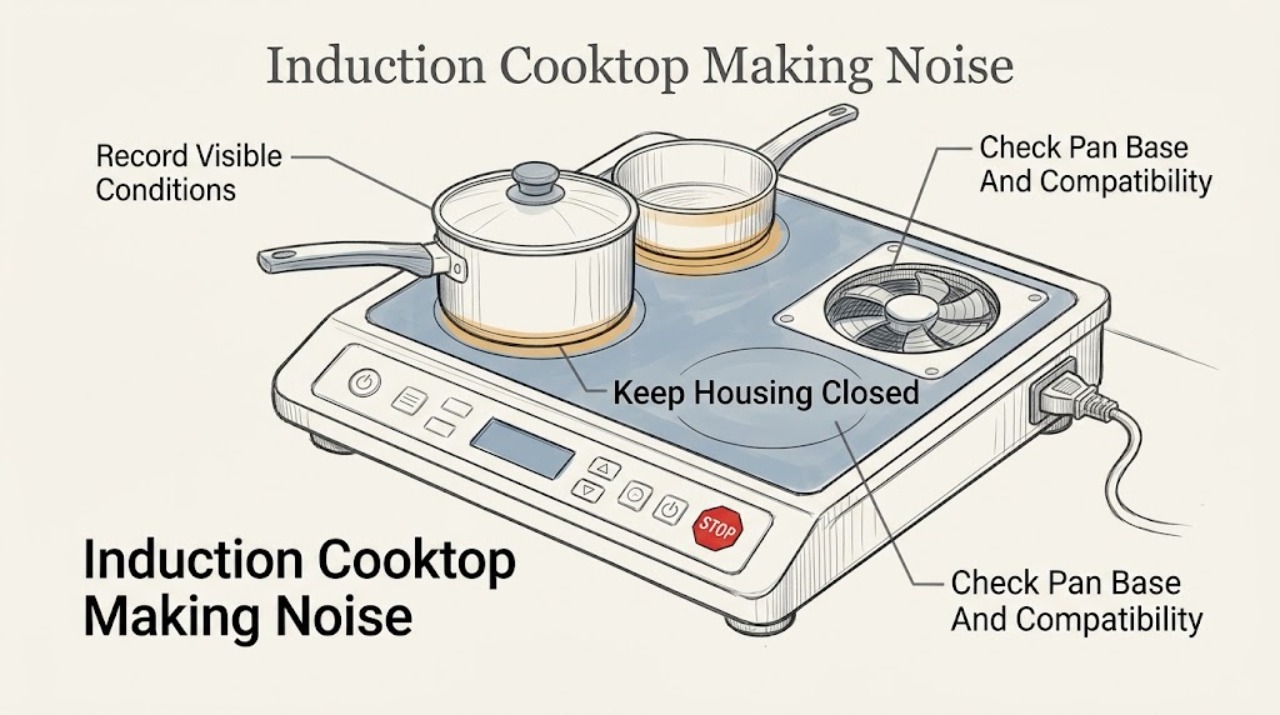
A Thermador induction cooktop can make a hum, buzz, or crackle from the cookware and cooking method, and its cooling fan can continue after shutoff while the electronics are hot. Thermador also says a whistle can occur with empty cookware on an active zone. Turn the controls off, keep the glass and pan handles safe, and let the unit cool before checking the pan base, position, load, and control-panel clearance. A single brief click at a power change may be a transient switching sound, but a new continuous squeal, harsh grinding, repeated popping, smoke, burning odor, visible arcing, cracked glass, or a breaker trip is not a sound to normalize. Stop using the cooktop and arrange qualified service for those symptoms or for noise that persists with no cookware and after cooling.
Work through in order
Diagnostic checks
Use only checks that match the exact appliance or system and its official guide.
-
Check 1
Turn every cooking zone off and move people and loose items away from hot cookware. From a safe position, record the sound with a short video and note whether it is humming, buzzing, crackling, whistling, clicking, fan-like, grinding, or popping; do not touch hot glass to locate the sound.
Expected result: The sound stops when all zones are off, continues briefly as air movement, remains with no cookware, or is accompanied by smoke, burning odor, visible arcing, a cracked surface, or a breaker trip.
Next step: For smoke, arcing, burning odor, cracked glass, or a breaker trip, stop using the cooktop and arrange qualified evaluation. Otherwise let it cool completely, then continue with the non-invasive checks.
Stop if: Do not keep cooking to make a popping, grinding, or electrical sound louder, and do not open the cooktop to locate it.
Why this matters
Why: A sound tied to active cooking or cooling can have a documented cookware or fan explanation. A sound with a hazard sign or one that remains after cooling and removal of cookware is not a normal-use diagnosis.
-
Check 2
After the cooktop and cookware are cool, test only as the owner manual allows: use one stable pan at a time, place it centrally on the intended zone, and compare the sound with the pan removed and with another suitable pan. Do not run an empty pan on an active zone.
Expected result: The noise follows one pan, one zone, a pan position, or a particular power level; disappears with no pan; or remains across pans and zones.
Next step: Stop using the noisy pan if its base is warped, damaged, or unstable. If the sound remains with suitable cookware removed, leave the cooktop off and document the result for service.
Stop if: Do not strike, clamp, modify, or heat an empty pan to test the sound.
Why this matters
Why: Thermador says humming, buzzing, and crackling can come from cookware and that food quantity and cooking method affect intensity. A noise that follows one pan or position points first to cookware interaction; a sound across zones with no pan needs service assessment.
-
Check 3
With the pan cool and off the glass, inspect its base for warping, embossing, rough damage, trapped debris, or a loose layer. If the manual permits, hold a magnet to the base and record whether it attracts; do not scrape the cooktop or use a damaged pan for another test.
Expected result: The base is flat and magnetic, visibly warped or rough, non-magnetic, or the sound occurs only with one construction or pan size.
Next step: Use only cookware the manual identifies as suitable and stable. If the sound continues with a suitable pan, stop comparing pans and use the service branch.
Stop if: Do not use a pan with a loose base, sharp damage, or instability, and do not place metal objects on an active zone.
Why this matters
Why: Thermador recommends suitable induction cookware and identifies deformed bases as a source of abnormal pan interaction. A pan-specific sound is less evidence of a cooktop fault than the same sound with a known suitable, stable pan.
-
Check 4
During a normal, supervised use with a suitable pan, observe whether the noise changes when the pan is centered, when nearby pans are moved farther apart, when the power level changes, or when food or liquid is present; do not place hot pans over the control panel.
Expected result: The sound changes with pan spacing, position, power level, food load, or proximity to the control panel, or it remains unchanged.
Next step: Keep pans centered and clear of the control area, and avoid unattended empty cookware. If the sound is still harsh, continuous, or unrelated to cookware position, stop using the cooktop and request service.
Stop if: Stop if the pan vibrates violently, walks on the surface, spills, scorches, smokes, or causes any electrical warning.
Why this matters
Why: Thermador states that cooking method and food amount can change cookware noise, that closely placed pans can affect display recognition, and that hot cookware near the control panel can heat the electronics. A sound unaffected by these conditions is less likely to be a simple cookware-position issue.
-
Check 5
If the sound is a whistle and a pan is on an active zone, turn the zone off and let the pan cool; do not add food or water to a dangerously hot or unstable pan just to test the noise.
Expected result: The whistle occurs only with empty cookware on an active zone, disappears when the zone is off or the pan contains a normal cooking load, or continues with no active zone.
Next step: Avoid empty-pan operation and follow the manual’s cookware guidance. If the whistle persists without an active zone or suitable cookware, leave the cooktop off and arrange service.
Stop if: Do not deliberately overheat an empty pan, add liquid to a pan that may be dangerously hot, or continue if the sound becomes a pop, crack, or electrical buzz.
Why this matters
Why: Thermador specifically associates whistling with empty cookware on an active heating element. A whistle that continues with all zones off and the cooktop cool is not explained by that documented condition.
-
Check 6
After all zones are off, listen from a safe position for a smooth air-moving fan sound and note whether it fades as the cooktop cools. Separately note any single brief click when a power level changes, without removing covers or trying to access a relay.
Expected result: The fan sound continues only while the unit is warm and fades, a click is brief and tied to a control change, or the sound is continuous, grinding, rattling, or increasing while the unit is cool.
Next step: Keep the cooling path and accessible ventilation clear without dismantling the unit. If the fan never settles after cooling, becomes rough or grinding, or abnormal noise remains with no cookware, request qualified service.
Stop if: Do not block vents, touch the fan, remove the glass, or probe for a relay or energized component.
Why this matters
Why: Thermador says the cooling fan may continue after shutoff when electronics remain too hot. Its public guidance does not identify every click as a relay diagnosis, so a brief click should be documented rather than assigned to a part; persistent mechanical or electrical noise needs inspection.
-
Check 7
Record whether the noise coincides with an error display, loss of heating, a flicker, a power interruption, or a tripped breaker. Do not repeatedly reset the breaker or change the hardwired connection; provide the model and video to an authorized servicer or qualified electrician.
Expected result: The noise is isolated to cookware with no warning, or it accompanies a code, multiple-zone failure, flicker, power loss, repeated breaker trip, smoke, arcing, or burning odor.
Next step: For a power or safety symptom, leave the cooktop off and arrange qualified service or electrical evaluation. For a persistent sound with no clear cookware trigger, give the servicer the exact model, zone, pan, power level, temperature state, and recording.
Stop if: Do not operate through repeated breaker trips, smoke, arcing, burning odor, cracked glass, or visible damage, and do not test live electrical parts.
Why this matters
Why: A cookware-linked sound without other symptoms can follow the documented normal-sound path. Noise paired with a power or safety symptom cannot be safely assigned to a pan, fan, or relay by listening alone.
Use your observations
Decision map
Find the observation that best matches what you see, then follow the next safe action.
-
PATH 01Next step
What you see
The cooktop smokes, arcs, smells burnt, has cracked or fractured glass, spills into controls, or trips a breaker.
Do this next
Stop using it and keep clear of the damaged or wet area. Arrange qualified appliance or electrical evaluation before re-energizing; do not bypass a breaker or repair the glass.
-
PATH 02Next step
What you see
The hum, buzz, or crackle follows one pan, power level, cooking method, load, or position and disappears with suitable cookware removed.
Do this next
Use stable, suitable cookware centered on the zone, keep hot pans away from the control panel, and stop using a warped or damaged pan. Escalate if the sound changes character or persists without cookware.
-
PATH 03Next step
What you see
A whistle occurs only while empty cookware is on an active zone.
Do this next
Turn the zone off, avoid empty-pan operation, and follow the exact model’s cookware guidance. A whistle with no active zone or after cooling needs service assessment.
-
PATH 04Next step
What you see
A smooth fan-like sound continues after cooking and fades as the electronics cool.
Do this next
Keep accessible ventilation clear and allow normal cooling. Request service if the fan becomes rough, grinding, continuous after cooling, or is paired with an error or overheating symptom.
-
PATH 05Next step
What you see
A single brief click occurs when a power level changes, with no warning, damage, or abnormal heating.
Do this next
Document the pattern and compare it with the exact model manual. Do not label it a failed relay without inspection; escalate if it becomes repeated, loud, grinding, or associated with a code or power fault.
-
PATH 06Next step
What you see
The sound remains with cookware removed and the unit cool, occurs across zones, or accompanies a code, flicker, loss of heat, breaker trip, smoke, arcing, or burning odor.
Do this next
Leave the cooktop off and arrange qualified appliance or electrical service. Provide the complete sound recording, model, zone, display, and event sequence.
Helpful context
Understand the symptom
Describe the sound before trying to fix it
Note whether the sound is a low hum, buzz, intermittent crackle, whistle, brief click, fan-like air movement, vibration, or a harsh continuous tone. Also record whether it changes with one pan, one zone, the power level, the amount of food, or the cooktop temperature. Thermador says the intensity of humming, buzzing, and crackling can vary with cookware and cooking method, so the same sound is not automatically a failed component.
Normal does not mean every loud sound is safe
A documented cookware or fan sound should diminish when its trigger is removed. A whistle linked to an empty pan should stop when the pan is no longer being heated, and a fan may continue after shutoff while the electronics cool. Smoke, burning odor, arcing, a cracked surface, a repeated breaker trip, harsh mechanical noise, or a sound that remains with the surface cool and cookware removed moves the problem to the stop-use and service branch.
Safety boundary
Stop conditions
- smoke, burning odor, or arcing
- cracked or fractured glass
- repeated breaker trip or flicker
- liquid entering controls
- harsh grinding or repeated popping
- noise that persists after cooling with cookware removed
When checks do not resolve it
Need a professional?
Call qualified service for noise that persists with cookware removed and the cooktop cool, rough or grinding fan noise, repeated popping or electrical buzzing, an error display, loss of heating, flicker, or multiple-zone behavior. Stop immediately for smoke, burning odor, arcing, cracked glass, visible damage, or a breaker that trips again.
Common questions
FAQ
Is a humming or buzzing sound normal on a Thermador induction cooktop?
Thermador says humming, buzzing, and crackling can come from the cookware and vary with food quantity and cooking method. If the sound follows one pan or active zone and disappears when cookware is removed, use suitable stable cookware. A harsh sound with damage, smoke, arcing, or a power fault needs service.
Why does the cooktop whistle?
Thermador associates whistling with empty cookware on an active heating element. Turn the zone off and avoid deliberately heating an empty pan. If the whistle continues with no active zone after the cooktop cools, it is not explained by that documented condition and should be assessed.
Why does a fan keep running after the cooktop is turned off?
Thermador says the cooling fan may continue after shutoff while the electronics are still too hot. A smooth sound that fades as the cooktop cools can follow that path; rough, grinding, or persistent noise after cooling needs qualified service.
Read the exact guide
Official sources
- Induction Cooktops – Parts, Accessories & CleanersThermador · Thermador induction cooktops when a noise follows a pan, pan base, or cookware material
- Troubleshooting | Induction Cooktops Support | ThermadorThermador · Thermador induction cooktops when distinguishing documented cookware and cooling sounds from persistent or abnormal noise
- Error Codes | Induction Cooktops Support | ThermadorThermador · Thermador induction cooktops when noise occurs with a code, overheat condition, or supply-voltage warning
- Cleaning & Care | Induction Cooktops Support | ThermadorThermador · Thermador glass induction cooktops when checking visible damage or cleaning only after cooling
- Appliance Features | Induction Cooktops Support | ThermadorThermador · Thermador induction cooktops when sound changes with cookware load, position, or heat-protection features
Community feedback
Share a repair observation
Share a plain-text repair observation. Accepted observations are published automatically; this page may take a moment to update.