
On this page
Start here
Quick answer
Many Bosch induction-cooktop sounds are normal: a deep hum can occur at high power, a quiet whistle can occur with empty cookware, multilayer or mixed cookware can crackle, and the cooling fan can run during or after cooking. First identify when the sound occurs, try the manufacturer's cookware and power-setting checks, and keep the control panel and ventilation area clear. If the noise is new, harsh, accompanied by an error code, overheating, a cracked glass surface, a burning smell, smoke, or a fan that behaves abnormally, stop using the cooktop and arrange qualified appliance or electrical service; do not open the appliance or perform live electrical testing.
Before you begin
Safety first
- This article supports only ordinary surface observation, manual-approved cookware and control checks, and visible ventilation inspection. Do not open the appliance, access wiring, test energized circuits, bypass protection, or repair the fan or power electronics.
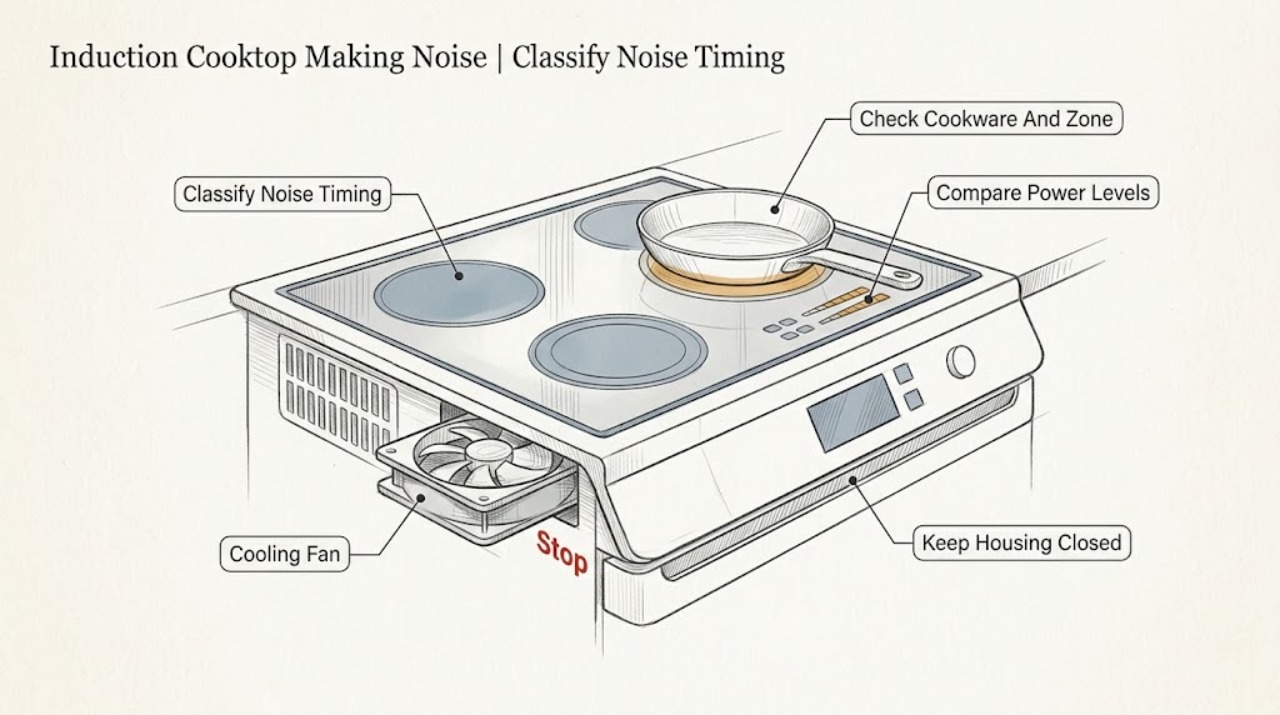
Work through in order
Diagnostic checks
Use only checks that match the exact appliance or system and its official guide.
-
Check 1
From a safe position, listen briefly and record whether the noise occurs only while a cooking zone is active, only with a particular pan, while two zones run, or after the cooktop has been switched off. Do not touch hot cookware or place an ear near the appliance.
Expected result: Describe the sound as a low hum, quiet whistle, loud whistle, crackle, fan airflow, click, harsh mechanical noise, or an unidentified sound; note its zone, power setting, cookware, and whether it stops after cooling.
Next step: Use the pattern to select the cookware, power, ventilation, or error-indication check below; keep the appliance off if the sound is accompanied by heat damage, smoke, odor, or electrical symptoms.
Stop if: Do not remove the cooktop, lift the glass, or probe the appliance to locate the sound.
Why this matters
Why: A cookware- or power-dependent hum, whistle, or crackle can match Bosch's documented normal induction sounds. A harsh sound unrelated to cookware or a sound that persists abnormally when the cooktop is cool moves the diagnosis toward a fan, control, or power-system inspection.
-
Check 2
With the cooktop controls off and cookware safe to handle, check that the pan is suitable for induction, centered on the selected zone, stable, and not empty when investigating a whistle. If the manual permits, compare the same pan on another zone without moving hot cookware by hand.
Expected result: Note whether the noise follows one pan, one zone, an empty pan, or a combination of different pan sizes or layered materials; record whether adding food or water, when safe and appropriate for the recipe, changes the whistle.
Next step: Use the cookware specified by the Bosch manual and stop using a pan that is warped, unstable, damaged, or unsuitable. If the same abnormal noise remains with suitable cookware across zones, continue to the power and ventilation checks and consider service.
Stop if: Do not test with a damaged pan, touch hot cookware, place metal objects on the surface, or modify the pan or cooking zone.
Why this matters
Why: Bosch identifies pan-base properties, empty cookware, and different layered or mixed cookware as causes of normal induction noise. A sound that follows one pan is less evidence of a failed cooktop than a sound that occurs with suitable cookware on every zone.
-
Check 3
If the glass and controls are intact and no hazard is present, reduce the active zone's power using the normal controls and observe whether the sound changes; when safe, avoid running multiple zones at their highest setting during this comparison.
Expected result: Record whether a deep hum or high-pitched whistle becomes quieter at a lower setting, whether it appears only when two zones are active, or whether it is unchanged at every setting.
Next step: Use a lower setting when it gives the desired cooking result. If the sound remains harsh or is accompanied by overheating, display errors, or a zone shutting down, stop cooking and arrange service.
Stop if: Do not repeatedly operate a cooktop that overheats, shuts down unexpectedly, smells burned, or shows damage just to reproduce the noise.
Why this matters
Why: Bosch's manual says high power can produce a deep hum and simultaneous highest-power zones can produce a louder whistle; a sound that responds to lower power fits that documented operating behavior. An unchanged harsh noise is not explained by that normal pattern.
-
Check 4
After switching the cooktop off normally and allowing hot cookware to be handled safely, observe whether the sound is airflow from the cooling fan and check only the visible ventilation area for an obstruction, following the Bosch installation and use instructions.
Expected result: Note whether the fan starts at high temperature, continues briefly after shutdown, sounds smooth, is blocked, rattles, grinds, or fails to run while the cooktop is unusually hot.
Next step: Keep the visible ventilation path clear as the installation instructions allow. Stop using the cooktop and arrange qualified service for abnormal fan noise, overheating, or repeated shutdown.
Stop if: Do not insert objects, spray cleaner into vents, remove guards, or access the fan, wiring, or underside components.
Why this matters
Why: Bosch describes automatic fan operation at high temperatures and continued fan operation after switch-off as normal possibilities. A grinding or rattling fan, blocked ventilation, or overheating with no normal airflow is a service symptom rather than a reason to open the underside.
-
Check 5
When the cooktop is off and cool enough to handle, inspect the control panel for liquid, food residue, objects, or a displayed error indication; wipe the accessible surface dry with a suitable cloth only as the manual permits.
Expected result: Record whether the panel is wet or obstructed, whether all displays flash or beep, which error code appears, and whether the noise stops after the panel is clear and the controls are used normally.
Next step: Remove only the visible object or moisture from the surface and consult the exact Bosch manual for the displayed code. If the code returns, the sound remains, or the panel behaves erratically, stop using the cooktop and arrange service.
Stop if: Do not pour liquid over the panel, use a sharp tool, press controls with wet hands, or access the control electronics.
Why this matters
Why: Bosch says liquid or objects on the control panel can cause flashing displays and signals, while an error code or repeated fault may require the model-specific troubleshooting procedure or service. Clearing the surface does not authorize opening the electrical system.
-
Check 6
With the appliance off, inspect the visible glass surface and surrounding trim for cracks, chips, scorching, smoke residue, or signs that a component has overheated; note whether the noise recurs with no cookware or after the accessible checks.
Expected result: Classify the surface and appliance as intact and quiet, intact but persistently noisy, cracked or chipped, visibly overheated, smoking, or associated with a burning smell or repeated error.
Next step: Stop using the cooktop for any damage, smoke, burning odor, repeated overheating, or persistent unexplained noise, and arrange qualified appliance or electrical service with the model and observed code or sound pattern.
Stop if: Do not use a cracked glass cooktop, bypass a safety shutdown, open the appliance, or perform energized electrical tests.
Why this matters
Why: A quiet, cookware-dependent sound can be normal. Persistent noise with an intact surface may need model-specific diagnosis; a crack, overheating, smoke, burning odor, or repeated error creates a safety and service boundary rather than a replacement-part guess.
Use your observations
Decision map
Find the observation that best matches what you see, then follow the next safe action.
-
PATH 01Safety boundary
What you see
The hum, whistle, or crackle appears only with a particular pan or power setting and becomes quieter when the pan or setting changes.
Do this next
Use suitable, stable cookware and the lower power setting that still cooks properly; continue monitoring for a new or harsher sound.
Why this path and its safety boundary
Why it matters: The pattern matches Bosch's documented induction operating sounds more closely than a confirmed component fault.
Safety stop: Stop if overheating, smoke, odor, damage, error indications, or abnormal shutdown appears.
-
PATH 02Safety boundary
What you see
A smooth airflow sound starts at high temperature and continues for a while after the cooktop is switched off.
Do this next
Keep the ventilation area clear and allow the appliance to cool according to its instructions.
Why this path and its safety boundary
Why it matters: Bosch documents automatic fan operation and continued fan operation while measured temperature remains high.
Safety stop: Arrange service if the fan grinds, rattles, fails while the cooktop overheats, or the sound is accompanied by smoke or a burning odor.
-
PATH 03Safety boundary
What you see
The control panel is wet or covered by an object and the cooktop flashes, beeps, or reacts unexpectedly.
Do this next
Switch the appliance off normally, remove only the visible object or moisture from the surface, and retest only when dry and safe.
Why this path and its safety boundary
Why it matters: Bosch identifies moisture or objects on the panel as an operating cause for flashing displays or audible signals.
Safety stop: Stop and arrange service if the behavior returns with a dry, clear panel or if liquid entered the appliance.
-
PATH 04Safety boundary
What you see
Noise is accompanied by an error code, overheating, repeated shutdown, or an active high-temperature warning.
Do this next
Stop cooking, record the exact code and conditions, allow safe cooling, and follow the Bosch manual or arrange qualified service if the code returns.
Why this path and its safety boundary
Why it matters: The sound is no longer a cookware-only question; the control or protection system is reporting a condition that requires model-specific handling.
Safety stop: Do not repeatedly power-cycle, bypass protection, open the appliance, or test electrical components.
-
PATH 05Safety boundary
What you see
The noise is harsh, grinding, rattling, or unchanged with suitable cookware and ordinary power-setting checks.
Do this next
Stop using the cooktop and arrange qualified appliance service; provide the model number, sound timing, zone, cookware, power setting, and any error or heat symptoms.
Why this path and its safety boundary
Why it matters: The documented normal cookware and power patterns do not explain the sound; a fan, control, power, or mounting issue may require inspection.
Safety stop: Do not remove the glass or underside, lubricate a fan, tighten internal parts, or perform live electrical testing.
-
PATH 06Safety boundary
What you see
The glass is cracked or chipped, or there is smoke, a burning odor, visible scorching, or evidence of electrical damage.
Do this next
Stop using the cooktop, keep clear of the damaged area, and arrange qualified appliance or electrical service.
Why this path and its safety boundary
Why it matters: This is a safety and appliance-service condition, not a normal induction sound.
Safety stop: Do not cook on cracked glass, touch exposed conductors, attempt a glass repair, or restore use by bypassing a shutdown.
Helpful context
Understand the symptom
Start by classifying the sound
A sound that changes with the pan or power level is different from a harsh noise that continues with no cookware, occurs while the cooktop is idle, or comes with a fault indication. Bosch's use-and-care guidance describes several cookware-dependent sounds as normal for induction, including a transformer-like hum, a whistle with empty cookware, crackling from layered or mixed cookware, and a cooling fan that may continue after shutdown. The timing and response to a safe setting change are more useful than guessing a failed part from sound alone.
Keep the checks at the surface and controls
Use only cookware and controls that the owner's manual permits. A centered, suitable pan, a lower power setting, and an unobstructed control panel can change a normal induction sound or clear a simple operating condition. Do not put fingers, tools, liquids, or cleaning products into vents or gaps, and do not remove the glass, control panel, or underside cover to listen for the source.
Know when noise is a service symptom
Noise with overheating, repeated error indications, a cracked surface, smoke, a burning odor, or abnormal fan behavior is not a routine cookware adjustment. Stop using the appliance and arrange qualified service. Bosch's support guidance directs owners to the model-specific manual and professional support when troubleshooting does not resolve the issue; an internal fan, power component, sensor, or wiring fault is not an ordinary user repair.
Safety boundary
Stop conditions
- Do not open the cooktop, remove the glass or underside cover, or probe internal parts to locate a noise.
- Do not perform energized electrical testing, bypass safety protection, alter wiring, or attempt internal fan or power-component repair.
- Stop using the appliance for a cracked or chipped surface, smoke, burning odor, visible scorching, liquid inside the appliance, or repeated overheating.
- Stop and arrange service when an error code returns, the fan grinds or rattles, a zone shuts down unexpectedly, or persistent noise is unchanged by suitable cookware and ordinary settings.
- Keep hot cookware, liquids, sharp tools, and cleaning products away from the controls and ventilation openings.
When checks do not resolve it
Need a professional?
Arrange qualified Bosch appliance or electrical service for persistent harsh, grinding, or rattling noise; noise that remains with suitable cookware and ordinary settings; repeated error codes, overheating, unexpected shutdown, abnormal fan behavior, a cracked or chipped surface, smoke, burning odor, liquid inside the appliance, or any diagnosis requiring access to wiring, controls, the fan, or power electronics.
Safety scope: This article supports only ordinary surface observation, manual-approved cookware and control checks, and visible ventilation inspection. Do not open the appliance, access wiring, test energized circuits, bypass protection, or repair the fan or power electronics.
Common questions
FAQ
Is a humming sound from a Bosch induction cooktop normal?
Often, yes. Bosch describes a deep transformer-like hum at high power as a normal induction sound that becomes quieter when the power setting is reduced. If the hum is harsh, new, persistent with suitable cookware, or accompanied by overheating, odor, damage, or an error code, stop using the cooktop and arrange service.
Why does my Bosch induction cooktop whistle?
A quiet whistle can occur with empty cookware, and a louder whistle can occur when two zones are used at the highest setting. Cookware base materials and different pan sizes can also affect the sound. Try suitable cookware and a lower setting; persistent harsh noise needs service.
Why does the Bosch cooktop fan keep running after I turn it off?
Bosch says the fan can start automatically at high temperatures and may continue after shutdown while the measured temperature is still high. A smooth cooling sound can therefore be normal. Grinding, rattling, overheating, smoke, or failure to cool is a reason to stop using the appliance and arrange service.
Can I open a Bosch induction cooktop to find the noise?
No. Keep troubleshooting at the surface: identify the sound, check suitable cookware and ordinary power settings, and inspect only visible ventilation or control-panel conditions as the manual allows. Opening the appliance or testing its wiring is a professional service task.
Read the exact guide
Official sources
- Use and Care Manual NITP660SUC, NITP660UCBosch · Bosch use-and-care manual for specified induction cooktop models; the exact model manual controls a different Bosch cooktop.
- Bosch Induction Cooktop Error CodesBosch · Bosch induction-cooktop error-code guidance; exact code meanings and resets depend on the model manual.
- Bosch Gas Cooktop Troubleshooting & Repair | Bosch – Fix Cooktops Not Heating, Overheating, Uneven Heating & MoreBosch · Bosch owner-support troubleshooting guidance for induction cooktops; the installed model's manual controls exact procedures.
Community feedback
Share a repair observation
Share a plain-text repair observation. Accepted observations are published automatically; this page may take a moment to update.