
On this page
Start here
Quick answer
Many induction-cooktop hums, buzzes, clicks, crackles, and whirs are normal reactions to cookware, power level, adjacent zones, or the cooling fan. With the surface cool and safe, identify whether the sound occurs only while a pan heats, after cooking, or with no pan. Try one suitable, flat, magnetic pan on one zone and change the power level once. A sound that is loud, new, grinding, arcing, accompanied by a cracked glass surface, burning odor, smoke, repeated power loss, or uncontrolled heating is not a cookware adjustment: turn the cooktop off, isolate the hazard if safe, and arrange qualified service.
Before you begin
Safety first
- This article supports safe observation, use of a known suitable pan, a limited power comparison, and cool-surface inspection only. A qualified professional should handle the underside, glass, induction coil, fan, control electronics, wiring, supply, and any damaged component.
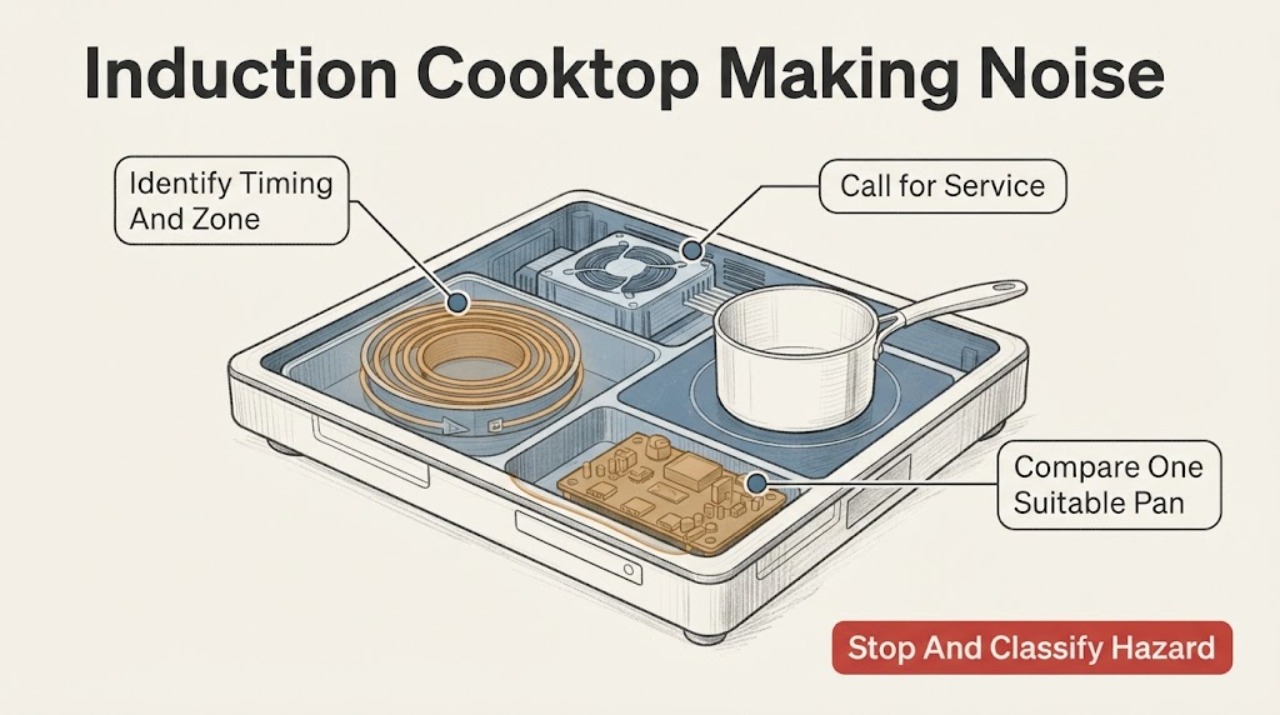
Work through in order
Diagnostic checks
Use only checks that match the exact appliance or system and its official guide.
-
Check 1
Turn the induction cooktop off and keep hands, cookware, and cloth away from the surface until it is safe to observe; if there is smoke, visible arcing, a burning or melting odor, cracked glass, a hot connection, or heating that will not stop, use the emergency or service branch.
Expected result: Record whether the sound is a hum, buzz, whistle, crackle, click, fan-like whir, grinding sound, impact, or intermittent pop, and note whether any odor, glass damage, error indication, breaker trip, or uncontrolled heat occurred.
Next step: For smoke, active fire, or a suspected electrical hazard, leave the area and use local emergency help from a safe location; otherwise continue only after the glass and controls are cool and visibly safe.
Stop if: Do not touch cracked glass, keep resetting a tripped circuit, operate controls near smoke or a burning odor, or run another test to reproduce a hazardous sound.
Why this matters
Why: A sound without a hazard may be a cookware or cooling behavior, but a sound with smoke, arcing, damage, repeated power loss, or uncontrolled heat is not a normal sound comparison.
-
Check 2
With the cooktop off and cool, note which zone made the sound, whether a pan was present, the selected power level, whether another zone was active, and whether the sound continued after cooking ended.
Expected result: Classify the timing as pan-on cooking, high-power cooking, two-zone cooking, control-lock standby, cooling after use, or noise with no active zone; note whether it stops when the cooktop cools or is powered down normally.
Next step: Use the matching cookware, power, fan, or persistent-noise branch and consult the exact model manual for indicators or normal post-cooking fan behavior.
Stop if: Do not remove panels, defeat a control lock, or continue a high-power test if the surface is damaged, unusually hot, or the sound is accompanied by an odor or electrical symptom.
Why this matters
Why: Timing separates pan vibration and energy-transfer sounds from the cooling fan or a standby control hum; a sound that persists abnormally with no heat needs service rather than a pan change.
-
Check 3
When the glass is cool, place one stable, flat pan that the exact manual approves for induction on one zone, centered over its ring; if the manual permits a magnet suitability check, use it on the cool pan rather than testing with an unsuitable load.
Expected result: Note whether the sound is absent, softer, louder, or different with the single pan, and whether the pan remains stable, is recognized consistently, and heats normally without an error indication.
Next step: If the pan is unsuitable, warped, unstable, or only partly magnetic, use a model-approved pan; if the same abnormal sound remains with a suitable pan, continue to the power and fan checks without opening the appliance.
Stop if: Do not use a pan with a sharp, rough, damaged, or badly warped base, put metal objects on the glass, or continue if the surface cracks, overheats, or arcs.
Why this matters
Why: A sound that follows one pan or changes with pan construction supports cookware vibration; a sound from the appliance with no pan or with every suitable pan points away from a single pan base.
-
Check 4
If there is no hazard and the pan is suitable, use the normal controls to lower the power one step once, then compare the sound with only that zone active; stop the comparison if the exact manual warns against the condition or an abnormal symptom appears.
Expected result: Record whether the sound quiets at lower power, changes when a neighboring zone is turned off, or remains equally loud at every setting; note any pan movement, crackle, impact, error, or uneven heating.
Next step: Use the quieter setting or a different pan only for a normal, stable sound; arrange service when the sound is new, harsh, persistent, or paired with poor heating or an error.
Stop if: Do not keep cycling power on a cooktop that sparks, smells hot, trips the breaker, or cannot regulate heat, and do not bypass a safety control.
Why this matters
Why: A power-dependent hum is consistent with energy transfer, and a change with adjacent zones is consistent with pan or zone interaction; an equally loud mechanical or electrical sound is not explained by power level alone.
-
Check 5
After the zone is switched off, leave the cooktop undisturbed and listen from a safe distance for a short normal cool-down; once it is cool, inspect the glass, control area, and accessible ventilation openings for liquid, objects, residue, or visible damage.
Expected result: Determine whether the sound is a smooth fan-like whir that fades as the internal parts cool, a low standby hum with no heat, or a grinding, scraping, rattling, or impact sound that does not follow cooling.
Next step: Keep ventilation openings clear and clean only accessible cool surfaces as the manual allows; arrange service for persistent, rough, or newly loud fan or internal sounds.
Stop if: Do not insert tools into vents, open the cooktop, spray liquid into controls, or touch the underside while the unit is energized or hot.
Why this matters
Why: Samsung describes a cooling fan that can continue after cooking, but a harsh mechanical sound, visible damage, or a noise that does not settle with cooling needs professional diagnosis.
-
Check 6
After the sound has been classified and no hazard was found, make at most one supervised low-to-normal-power check with the known suitable pan, then turn the zone off normally and record the result; do not retest an unresolved hazardous condition.
Expected result: Record whether the sound is a repeatable soft hum or fan that follows the expected condition, whether cooking remains stable, or whether the noise is louder, new, erratic, or accompanied by an error, poor heating, heat after shutoff, or electrical symptom.
Next step: Use the cooktop only when the sound remains within the model's normal behavior; otherwise keep it off and arrange qualified induction-cooktop service with the model and recording.
Stop if: Do not continue cycling zones, run an unattended test, remove the glass, probe live parts, or replace a control or coil based only on sound.
Why this matters
Why: A repeatable, condition-dependent sound with normal operation is usually an operating characteristic; a persistent abnormal sound or a second symptom means the cooktop needs diagnosis.
Use your observations
Decision map
Find the observation that best matches what you see, then follow the next safe action.
-
PATH 01Safety boundary
What you see
The hum, buzz, whistle, or crackle occurs only while a suitable pan is heating and changes with pan material, food, power, or an adjacent zone.
Do this next
Center a stable, model-approved pan and use a quieter pan or lower setting if desired; continue only while heating and controls remain normal.
Why this path and its safety boundary
Why it matters: The sound is consistent with vibration or energy transfer between the induction system and cookware.
Safety stop: Stop if the sound becomes harsh or is joined by smoke, arcing, glass damage, burning odor, or uncontrolled heat.
-
PATH 02Safety boundary
What you see
The noise becomes louder at high power or changes when a neighboring zone is turned off or its setting changes.
Do this next
Use the exact manual's power and cookware guidance, lower or balance settings, and avoid unstable or poorly fitting pans.
Why this path and its safety boundary
Why it matters: Energy level and interaction between cookware or zones are influencing the audible vibration.
Safety stop: Do not accept a power-related explanation if the noise is accompanied by an error, poor heating, sparks, odor, or abnormal surface heat.
-
PATH 03Safety boundary
What you see
A smooth whir or blowing sound begins during use and continues for a while after the zone is off, then fades as the cooktop cools.
Do this next
Keep the accessible ventilation area clear and allow the fan to finish its cool-down; use the model manual if its timing or indicator differs.
Why this path and its safety boundary
Why it matters: The sound is consistent with an internal cooling fan protecting the electronics after operation.
Safety stop: Arrange service if the fan grinds, scrapes, rattles, smells hot, runs abnormally long with no heat, or the cooktop loses control.
-
PATH 04Safety boundary
What you see
A faint hum is heard while the cooktop is not heating and the controls or lock indicator are in standby.
Do this next
Use the exact manual to confirm the indicator and lock setting; do not open the unit to chase a faint, stable sound.
Why this path and its safety boundary
Why it matters: Some induction cooktops can produce a low standby hum associated with the control-lock function.
Safety stop: Stop and arrange service if the standby noise is new, loud, accompanied by heat, odor, error indications, or a power problem.
-
PATH 05Safety boundary
What you see
There is visible arcing, smoke, burning or melting odor, repeated breaker operation, a hot connection, cracked or lifting glass, or heat that continues after controls are off.
Do this next
Turn the appliance off if it is safe to do so, keep clear, and arrange qualified electrical or appliance service; for active smoke or fire, leave and use local emergency help from a safe location.
Why this path and its safety boundary
Why it matters: This may be an electrical, glass, thermal-control, or fire hazard rather than normal induction cookware noise.
Safety stop: Do not touch damaged glass, reset the breaker repeatedly, open the appliance, or use the cooktop again until it is assessed.
-
PATH 06Safety boundary
What you see
The sound remains loud, rough, erratic, or present with every suitable pan and setting, or it is paired with poor heating, errors, or unstable operation.
Do this next
Keep the induction cooktop off and arrange qualified service with the exact model, affected zone, timing, power setting, pan type, and any error or safety symptom.
Why this path and its safety boundary
Why it matters: A fan, coil, power-electronics, control, glass, or other internal fault remains possible and cannot be identified safely by sound alone.
Safety stop: Do not remove the glass, probe live circuits, bypass a safety control, or order an internal part solely from the noise description.
Helpful context
Understand the symptom
First separate a normal induction sound from a fault
Induction transfers energy through a magnetic field into the pan, so the pan itself can vibrate or hum. A low hum that follows the selected power, a buzz that changes with pan material, a whistle when neighboring zones run, or a fan that continues briefly after cooking can be expected. The useful diagnostic question is whether the sound changes with a safe pan or power setting and whether it is accompanied by heat, smoke, glass damage, or loss of control.
Cookware can be the sound source
Layered or lightweight pans can make more noise than heavier cookware. A warped base, an unsuitable magnetic area, an off-center pan, or two different pan constructions on adjacent zones can change the vibration. Use only cookware approved by the exact manual, keep the base stable and centered, and do not slide a pan across the glass while investigating.
When to stop
A normal hum should not be confused with an electrical or mechanical hazard. Stop using the cooktop for smoke, a burning or melting odor, visible arcing, a hot or damaged connection, repeated breaker trips, a cracked or lifting glass surface, a loud grinding or impact sound, or heat that continues after controls are turned off. Do not open the glass or electronics to locate a noise; induction power electronics and cooling systems require qualified diagnosis.
Safety boundary
Stop conditions
- Stop using the cooktop for smoke, flame, visible arcing, a burning or melting odor, a hot or damaged connection, repeated breaker trips, or uncontrolled heating.
- Keep the cooktop off for cracked, lifting, or shattered glass, liquid under the glass, or a control panel that behaves erratically.
- Do not open the cooktop, remove the glass, probe live parts, insert tools into ventilation openings, or bypass a thermal or control safety.
- Do not keep testing a loud grinding, scraping, impact, or erratic sound, especially when it is paired with an error, poor heating, or abnormal heat.
- Arrange qualified induction-cooktop service when safe pan and power checks do not explain the sound or the noise returns after a normal cool-down.
Only after diagnosis
Potential parts
- induction cooktop cooling fan
Consider this category only after a qualified diagnosis confirms that a persistent rough or failed cooling-fan sound is the cause.
Confirm the exact cooktop model and professional diagnosis; do not open the appliance or substitute a fan based only on noise. - induction cooktop power or control assembly
Consider this category only when a qualified technician identifies an internal power or control fault after cookware, setting, and safety checks.
Confirm the exact model and diagnosis; induction power electronics require qualified service and must not be bypassed.
When checks do not resolve it
Need a professional?
Arrange qualified induction-cooktop service for a new or persistently loud hum, grinding, scraping, rattling, or impact sound; a sound with an error, poor heating, uncontrolled heat, visible damage, smoke, odor, arcing, or repeated power loss; or any condition requiring access below the glass. Give the technician the exact model, affected zone, pan material and size, power setting, whether another zone was active, when the sound starts and stops, and any safety symptoms.
Safety scope: This article supports safe observation, use of a known suitable pan, a limited power comparison, and cool-surface inspection only. A qualified professional should handle the underside, glass, induction coil, fan, control electronics, wiring, supply, and any damaged component.
Common questions
FAQ
Is a humming sound from an induction cooktop normal?
Often. A hum can follow the power level or the pan's material and construction. Compare one stable, model-approved pan at a lower setting once. Smoke, arcing, burning odor, cracked glass, uncontrolled heat, or an unusually loud new sound needs service.
Why does my induction cooktop buzz with one pan but not another?
Induction energy can make cookware vibrate, especially with certain layered, lightweight, or partly magnetic bases. Use cookware approved by the exact manual, keep it stable and centered, and stop if the glass or appliance shows a hazard.
Why does the noise change when two induction zones are on?
Adjacent zones and different pan constructions can interact acoustically. Compare with only one zone active and change a power setting once. If the noise is harsh, affects heating, or is accompanied by an error, arrange service rather than continuing tests.
Why does my induction cooktop keep humming after I turn it off?
A smooth whir or blowing sound can be the cooling fan running after cooking until internal components cool. A faint standby hum can also be associated with a control-lock feature on some models. Grinding, scraping, odor, heat, or an unusually long or loud sound needs diagnosis.
When should an induction-cooktop noise be treated as dangerous?
Turn it off and stop testing for smoke, visible arcing, burning or melting odor, repeated breaker trips, a hot connection, cracked or lifting glass, uncontrolled heating, or a loud mechanical sound with poor operation. Leave active smoke or fire and seek local emergency help from a safe location; otherwise arrange qualified service.
Read the exact guide
Official sources
- Electric Range & Cooktop - Induction Cooktop Humming SoundGE Appliances · Official GE Appliances technical support guidance for general induction sound behavior; model-specific cookware requirements control.
- Humming or Crackling Noise on an Induction Cooktop - Product Help | WhirlpoolWhirlpool Corporation · Official Whirlpool Product Help guidance for induction cookware sound behavior; exact model instructions control.
- Samsung cooktop and range: common sounds and operational noisesSamsung Electronics · Official Samsung support guidance for cooktop and range operating sounds; exact model manual controls when features differ.
- Humming - Induction Cooktop - Product Help | WhirlpoolWhirlpool Corporation · Official Whirlpool Product Help guidance for induction cooktops; exact model manual controls and cookware requirements.
Community feedback
Share a repair observation
Share a plain-text repair observation. Accepted observations are published automatically; this page may take a moment to update.