
On this page
Start here
Quick answer
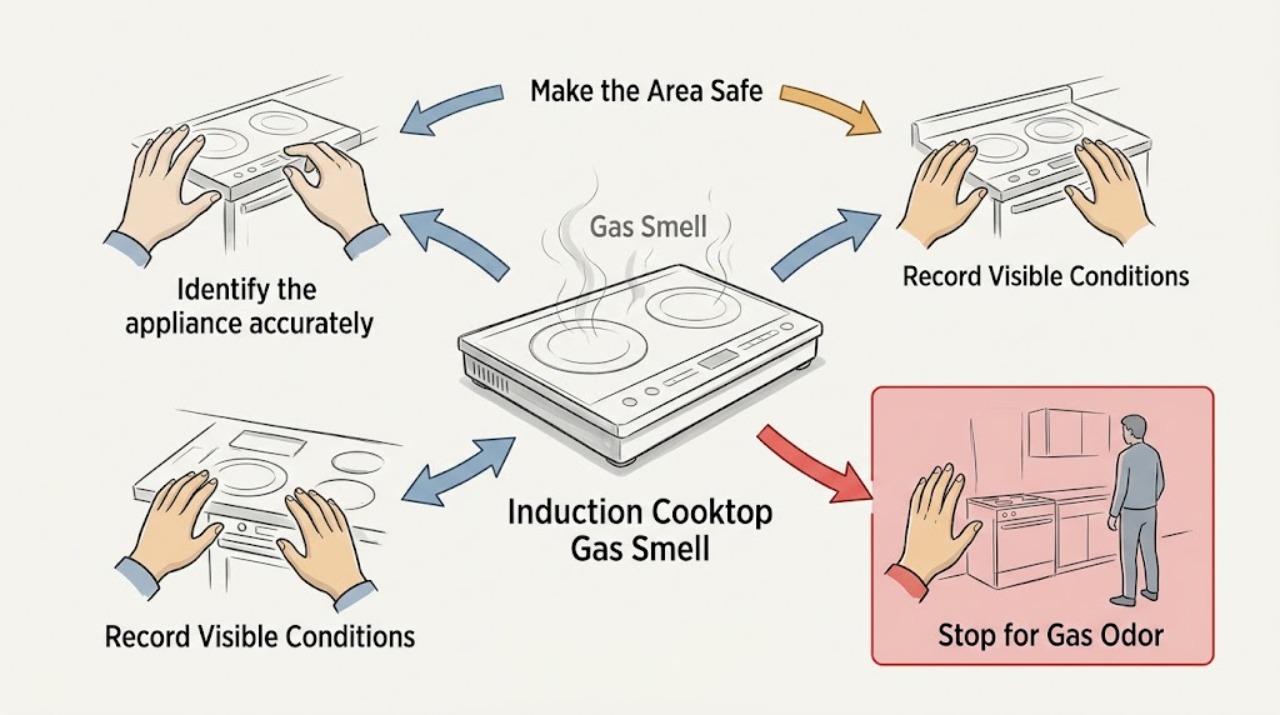
A Thermador induction cooktop heats cookware with electrical inductors and has no gas burner or cooktop gas supply described by Thermador. A gas or sulfur-like odor near it should therefore be treated as a possible leak from another gas appliance, a pipe, or the building supply—not as an induction-cooktop fault to locate by trial. Do not turn lights or appliances on or off, use a flame, or use a phone inside the area. Leave immediately and contact local gas authorities or emergency services from outside. Do not search for or operate a gas valve belonging to the induction cooktop. After qualified authorities declare the area safe, an appliance technician can inspect the induction unit if it also has an electrical, smoke, heat, or odor symptom.
Work through in order
Diagnostic checks
Use only checks that match the exact appliance or system and its official guide.
-
Check 1
If a gas or sulfur-like odor or a hissing sound is present, leave the area immediately without operating the induction controls or other electronics inside.
Expected result: The odor may be persistent or intermittent, and you may hear escaping gas; there may also be smoke, fire, or no visible appliance symptom.
Next step: Leave by the safest available route, avoid flames and electrical switches, and contact local gas authorities or emergency services from outside. Do not re-enter until qualified authorities declare it safe.
Stop if: Do not use a phone, light switch, hood control, induction control, lighter, match, or vehicle ignition inside the affected area.
Why this matters
Why: A gas odor is an environmental safety signal, not evidence that the induction cooktop has a gas burner. It cannot be safely diagnosed by turning equipment on or off.
-
Check 2
Once outside and safe, identify the appliance accurately from memory or from a safe distance rather than searching the cooktop for a gas valve.
Expected result: A Thermador induction cooktop has a glass cooking surface with electronic controls and cooking zones; it has no visible flame, burner cap, or cooktop gas control described on Thermador's induction product page.
Next step: Tell the gas authority that the odor is near an induction cooktop and list any nearby fuel-burning appliances without approaching or operating them. Do not manipulate a valve or appliance to isolate the source.
Stop if: Do not enter the area to take photographs, read a label, smell-test a cabinet, or search for an induction gas shutoff.
Why this matters
Why: This confirms the gas-smell report should not be routed to a nonexistent induction gas path. Nearby ranges, ovens, water heaters, furnaces, pipes, or building supply may require gas-authority inspection.
-
Check 3
After qualified authorities clear the gas hazard, record whether the Thermador cooktop has its own electrical symptoms while it remains off.
Expected result: There may be a hot-plastic or smoke odor, visible discoloration or cracking, a spark, unusual heat at the controls, or a breaker trip; there may also be no cooktop symptom once the gas hazard is resolved.
Next step: Leave the cooktop off if any electrical or heat symptom exists and arrange qualified appliance or electrical service. If there is no cooktop symptom, do not restart it until the gas authority's instructions and the appliance's normal safety checks permit use.
Stop if: Do not touch a wet, hot, scorched, cracked, or sparking cooktop, and do not remove panels or the glass surface.
Why this matters
Why: An electrical or heat symptom is a separate induction-appliance service issue. No cooktop symptom supports treating the gas event as external rather than inventing a cooktop gas fault.
-
Check 4
Give the technician or gas authority a concise event record without performing another powered or fuel test.
Expected result: Record when the odor began, whether it followed cooking or a spill, whether it was near the cooktop or another appliance, whether anyone heard hissing, and whether the induction cooktop showed an error, heat, smoke, or breaker event.
Next step: Keep the induction cooktop and nearby fuel appliances off until the responsible qualified professional gives clearance. Provide the model information only from a safe, cleared location.
Stop if: Do not return inside to reproduce, sniff, or narrow the odor source, and do not relight any gas appliance.
Why this matters
Why: Timing and location help professionals separate a building gas investigation from an electrical-appliance inspection while preserving the safety boundary.
Use your observations
Decision map
Find the observation that best matches what you see, then follow the next safe action.
-
PATH 01Next step
What you see
Gas odor or hissing is present now, whether or not the induction cooktop is operating.
Do this next
Evacuate immediately, avoid electronics and ignition sources, and contact local gas authorities or emergency services from outside. Do not operate an induction control or search for a cooktop gas valve.
-
PATH 02Next step
What you see
The odor is gone, but the cooktop also has smoke, hot-plastic odor, sparking, discoloration, abnormal heat, or a breaker trip after the area is cleared.
Do this next
Leave the induction cooktop off and arrange qualified appliance or electrical service. Do not perform a powered test or open the unit.
-
PATH 03Next step
What you see
Qualified authorities clear the gas event and the Thermador induction cooktop has no separate electrical or heat symptom.
Do this next
Follow the gas authority's clearance instructions and the cooktop's own owner guidance before normal use. If the odor returns, leave again and report it; do not assume it is from induction.
-
PATH 04Next step
What you see
The user cannot tell whether the smell is gas, sulfur-like, burning plastic, or food residue.
Do this next
Treat uncertainty as a gas-safety concern: leave, avoid switches and flames, and seek outside professional guidance. Do not test by turning the cooktop on.
-
PATH 05Next step
What you see
The smell was reported only by a nearby fuel appliance or building area, not by the induction unit itself.
Do this next
Keep all potentially affected fuel appliances off and have the gas authority or qualified technician inspect the source. The induction cooktop does not become a gas appliance because it is nearby.
Helpful context
Understand the symptom
Do not troubleshoot the induction surface as if it were a gas appliance
Thermador describes its induction collection in terms of inductors, power levels, and cooking zones. It does not describe a gas burner or gas valve for that cooktop. That means a gas odor near the cooktop must be handled as a building or nearby-fuel-appliance hazard. The safe response is evacuation and outside help, not switching the induction controls or trying to identify the source by smell.
Gas odor safety comes first
If you smell gas or hear escaping gas, do not operate lights, the induction controls, ventilation switches, or a phone inside. Leave immediately and contact local gas authorities or emergency services from outside. Do not relight nearby fuel appliances or re-enter to inspect a valve.
When the area has been cleared
Only after qualified authorities say it is safe should you determine whether the induction cooktop has a separate electrical problem. A hot-plastic or smoke odor, visible discoloration, sparking, or a breaker trip warrants leaving the cooktop off and arranging qualified appliance or electrical service. Never open the glass top or cabinet to look for a gas part that the induction design does not use.
Safety boundary
Stop conditions
- If gas odor or hissing is present, leave immediately and do not operate lights, electronics, induction controls, flames, or phones inside; contact local gas authorities or emergency services from outside.
- Do not search for, close, or adjust a gas valve belonging to the induction cooktop; Thermador's induction product information does not describe a cooktop gas path.
- Do not re-enter, relight nearby fuel appliances, or restart the cooktop until qualified authorities clear the gas hazard.
- If the cooktop has smoke, hot-plastic odor, sparking, visible heat damage, cracking, or abnormal electrical behavior after clearance, keep it off and call qualified appliance or electrical service.
- Do not open the glass top, cabinet, controls, or electrical enclosure.
When checks do not resolve it
Need a professional?
A gas odor or hissing requires immediate evacuation and outside contact with local gas authorities or emergency services. After the area is cleared, arrange qualified appliance or electrical service for any independent smoke, burning-plastic odor, sparking, heat damage, or breaker symptom from the induction cooktop. Do not troubleshoot the gas event at the cooktop.
Common questions
FAQ
Can a Thermador induction cooktop itself produce a gas smell?
Thermador describes this appliance as an induction cooktop using inductors and electronic cooking zones, not a gas-burner cooktop. Treat a gas or sulfur-like odor nearby as a possible leak from another appliance, pipe, or the building supply and evacuate rather than searching the induction surface.
Should I turn on the hood or induction controls to clear the smell?
No. If gas odor or hissing is present, do not operate lights, hood controls, induction controls, or other electronics inside. Leave immediately and contact local gas authorities or emergency services from outside.
Where is the gas shutoff for a Thermador induction cooktop?
Do not search for a cooktop gas shutoff. Thermador's induction product information does not describe a gas path for the induction unit. A nearby gas appliance or building supply may still be involved; let qualified gas authorities identify and isolate it.
When can I use the induction cooktop again?
Wait until qualified authorities clear the gas hazard. If the cooktop separately has smoke, hot-plastic odor, sparking, visible damage, abnormal heat, or a breaker symptom, leave it off and arrange qualified appliance or electrical service before reuse.
Read the exact guide
Official sources
- How to Protect Your Family from CO Poisoning and Other Post-Storm Dangers this Hurricane SeasonU.S. Consumer Product Safety Commission · Gas odor or escaping-gas safety; evacuation, avoiding electronics, and outside contact with local gas authorities
- Induction CooktopsThermador · Thermador induction cooktops; induction cooking zones, inductors, electronic controls, and power features
Community feedback
Share a repair observation
Share a plain-text repair observation. Accepted observations are published automatically; this page may take a moment to update.