
On this page
Start here
Quick answer
A Samsung induction cooktop is an electric appliance, so a genuine raw-gas odor is not a normal burner smell from the induction surface. If the odor could be gas, is strong or spreading, or you cannot identify it, do not operate the cooktop, touch electrical switches, or start a fan in the area; leave and contact the gas utility or emergency service from a safe location. If the smell is clearly a food or cleaning spill, turn the cooktop off, let it cool, and clean the glass and pan bottoms. A burning-electrical smell, smoke, crack, liquid intrusion, or a smell that returns when the cooktop operates is a stop-use condition requiring qualified service.
Before you begin
Safety first
- Do not remove the glass or chassis, test energized wiring, bypass a safety device, or continue operating the appliance to reproduce the odor.
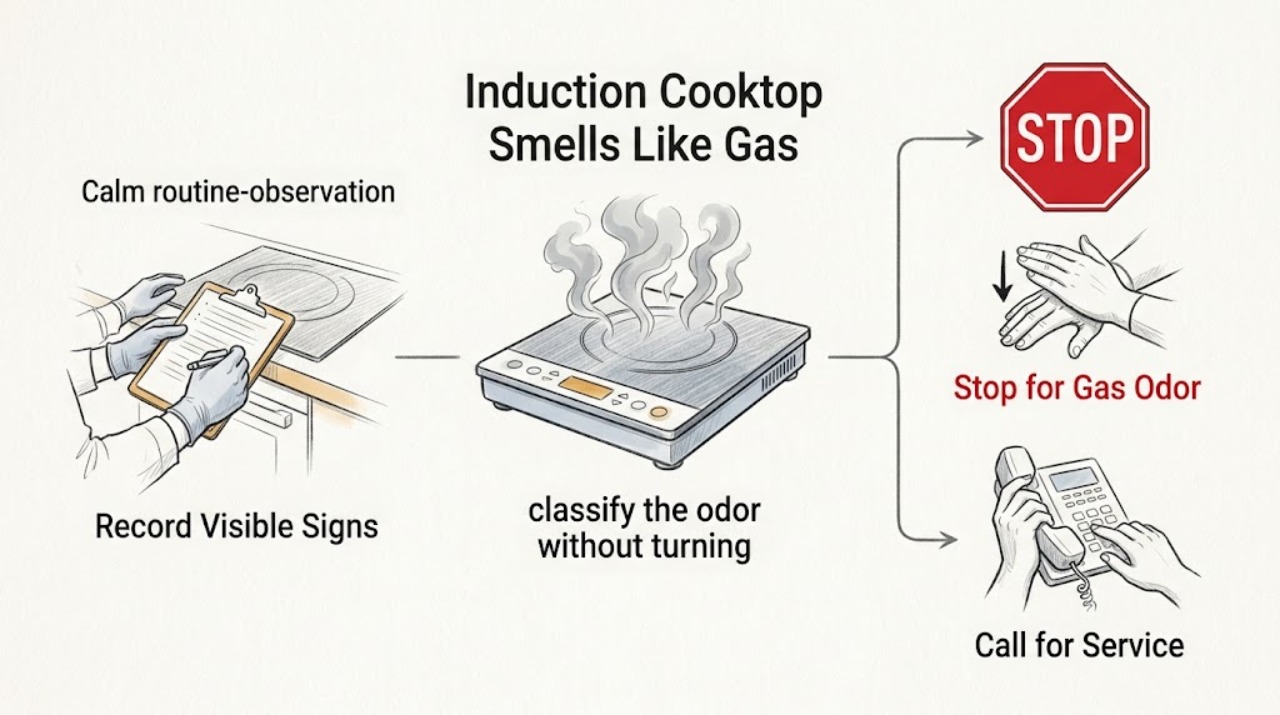
Work through in order
Diagnostic checks
Use only checks that match the exact appliance or system and its official guide.
-
Check 1
From a safe distance, classify the odor without turning on the cooktop or another appliance: decide whether it resembles raw fuel gas, hot food or cleaner, or burning plastic/electrical insulation.
Expected result: A raw-gas odor is sharp or fuel-like; a food or cleaner odor follows a spill; a burning-electrical odor is often acrid and may accompany heat, smoke, discoloration, or a malfunction.
Next step: If the odor is raw gas, strong, spreading, or uncertain, follow the emergency branch immediately. If it is clearly a spill, wait until the cooktop is cool before cleaning. If it is burning or electrical, stop use and arrange service.
Why this matters
Why: A raw-gas or unknown odor must be handled as a possible gas leak, while a localized spill or an electrical symptom follows a different path. Do not assume the induction surface is the gas source.
-
Check 2
If there is any possibility of raw gas, do not operate the cooktop, touch light switches or controls, start an exhaust fan, or use a flame to test the area; move everyone away from the building or affected area.
Expected result: The odor is gone only after leaving the area, or it remains present or becomes stronger; do not return to investigate while the gas concern remains.
Next step: From a safe location, contact the gas utility or emergency service and follow its instructions. Do not resume use until the source has been cleared by the appropriate professional.
Why this matters
Why: An odor that might be gas is an environmental safety issue, not a normal induction-cooktop troubleshooting result. A spark from a switch, control, motor, or appliance could ignite accumulated gas.
-
Check 3
After the gas-emergency possibility has been ruled out and the surface is cool, remove the pan and inspect the glass, pan bottom, and nearby control area for food residue, sugary spill, cleaner film, or moisture; wipe the surface with a cooktop-safe method.
Expected result: The odor disappears after the residue is removed and does not return during later normal use, or it returns as soon as the surface heats or controls are used.
Next step: If the odor remains gone, keep pan bottoms dry and continue normal care. If it returns, stop using the cooktop and use the service branch; do not open the cooktop to search for the source.
Why this matters
Why: A disappearing odor supports a surface or cookware residue as the likely source. A returning odor points to a continuing heat or electrical problem and should not be masked with more cleaner.
-
Check 4
Only when there is no odor and the surface is clean and intact, note whether the symptom occurs before power is applied, while an induction zone is heating, or after the zone is switched off; do not repeat the test if any burning smell or smoke appears.
Expected result: A smell that exists before the cooktop is used suggests a nearby room or gas source; a smell that begins with heating or controls suggests the cooktop, cookware, residue, or electrical installation; a smell after shutdown that includes only fan noise but no odor is a different symptom.
Next step: Record the timing and any display or control behavior for the technician. Do not continue cycling the zone to reproduce an odor, and do not remove covers or test live wiring.
Why this matters
Why: Timing helps separate an environmental odor from an appliance-generated symptom, but it cannot prove that a gas odor is safe. Repeated cooktop-related odor is enough reason to stop and obtain service.
-
Check 5
If the symptom is actually a sound, compare it with normal induction operation only after confirming that there is no odor: listen for a low hum, buzz, or cooling-fan sound, and check whether heating and controls otherwise behave normally.
Expected result: A hum or buzz that changes with cookware or power level and has no odor can be normal induction operation. Clicking or whistling associated with a gas burner does not describe an induction zone.
Next step: Leave a normal sound alone if there is no odor or other fault. If an odor accompanies the sound or the sound is unusually loud with a malfunction, stop using the cooktop and request qualified diagnosis.
Why this matters
Why: A normal induction sound is not evidence of a gas leak. An odor, smoke, abnormal heat, visible damage, or a much louder new sound changes the result to stop-use and service.
-
Check 6
Before any later cooking, confirm that the glass is intact, the controls are dry, no liquid has entered the appliance, and no burning smell, smoke, discoloration, or repeated fault remains; do not use the cooktop if any item is abnormal.
Expected result: Everything is dry and intact with no returning odor, or a crack, liquid intrusion, smoke, burning smell, or malfunction is present.
Next step: For any abnormal finding, leave the appliance off, disconnect power only if it can be done without entering a gas-smelling area or touching a hazard, and contact Samsung support or a qualified appliance technician.
Why this matters
Why: A clean, intact surface with no recurring odor supports resuming ordinary care. Any damage or electrical symptom creates shock or fire risk and cannot be cleared by a user-level reset.
Use your observations
Decision map
Find the observation that best matches what you see, then follow the next safe action.
-
PATH 01Next step
What you see
Raw-gas odor, strong or spreading odor, or the source cannot be identified
Do this next
Do not touch the cooktop, switches, plugs, or fans; evacuate and call the gas utility or emergency service from a safe location. Do not return until cleared.
-
PATH 02Next step
What you see
A food, sugary spill, pan residue, or cleaner film clearly caused the odor and it disappears after cool-down and cleaning
Do this next
Keep the cooktop off until cool, clean it with a suitable glass-cooktop method, keep cookware bottoms dry, and stop if the odor returns.
-
PATH 03Next step
What you see
Burning-plastic or electrical odor, smoke, arcing, visible damage, liquid intrusion, or odor that returns during operation
Do this next
Stop use. If it is safe and there is no gas concern, disconnect power and request qualified Samsung or appliance service; do not open the chassis.
-
PATH 04Next step
What you see
Only a normal hum, buzz, or cooling-fan sound remains and there is no odor or operational fault
Do this next
Treat it as an operating sound rather than a gas diagnosis. Continue only if the cooktop is otherwise normal, and consult the model manual if the sound changes or becomes abnormal.
-
PATH 05Next step
What you see
The odor appears around an adjacent gas appliance, a supply connection, or the room rather than the induction surface
Do this next
Do not troubleshoot that gas equipment through the induction cooktop; follow the gas-emergency path and have the gas appliance or installation checked by the utility or a qualified gas professional.
Helpful context
Understand the symptom
First, separate a gas emergency from an appliance odor
The words gas smell can describe several different odors. A raw-gas odor in the room is not something to diagnose by operating an induction zone. The induction surface is electric, while an adjacent gas range, flexible connector, gas line, or another appliance could be the actual source. A hot food spill, cleaner residue, or an electrical component can also smell unusual without being fuel gas. When the source is uncertain, use the gas-emergency path first.
What can be checked safely
Only perform the low-risk checks after there is no ongoing raw-gas odor and the cooktop is switched off. Samsung recommends stopping cooking for spills, allowing the surface to cool, and then cleaning it with a product intended for glass cooktops. Keep pan bottoms dry and suitable for induction. Do not remove panels, test wiring, or use a flame to identify an odor.
Why a sound is not the same as a gas odor
Samsung documents humming, buzzing, and cooling-fan sounds as possible normal induction operation. Its same guide describes clicking and whistling associated with gas burners, which is why a sound alone should not be used to claim that an induction cooktop is leaking gas. An actual odor, smoke, visible damage, or a change in operation needs the appropriate safety branch below.
When to stop troubleshooting
Stop immediately for a raw-gas odor, smoke, arcing, a burning-plastic or burning-electrical smell, a cracked glass surface, liquid inside the controls, or a smell that returns after cleaning. Samsung directs owners to stop using an appliance showing burning smell or smoke and to contact a service center; internal electrical diagnosis belongs to a qualified professional.
Safety boundary
Stop conditions
- Stop immediately and leave the area if the odor could be raw gas, is strong or spreading, or the source is unknown.
- Stop using the cooktop for smoke, arcing, a burning-plastic or burning-electrical odor, a crack, liquid inside the controls, or repeated malfunction.
- Do not use a flame, open the appliance, remove panels, test live wiring, or repeatedly heat the cooktop to reproduce an odor.
- Do not resume cooking after a suspected gas odor until the gas source has been cleared by the appropriate utility or qualified professional.
When checks do not resolve it
Need a professional?
Call the gas utility or emergency service from a safe location for any possible raw-gas odor., Contact Samsung support or a qualified appliance technician for a cooktop-related burning smell, smoke, damage, liquid intrusion, repeated odor, or malfunction., Provide the model number, when the odor starts and stops, whether it is raw gas versus burning or food residue, any display behavior, and what safe external checks changed the symptom.
Safety scope: Do not remove the glass or chassis, test energized wiring, bypass a safety device, or continue operating the appliance to reproduce the odor.
Common questions
FAQ
Can an induction cooktop itself leak gas?
The induction surface is electric rather than a gas burner. A raw-gas odor near it can still come from an adjacent gas appliance, a supply connection, or elsewhere in the room, so treat an uncertain odor as a gas-safety event rather than testing the cooktop.
What if the smell is only from a spill?
Switch the cooktop off, wait for the glass to cool, then remove residue with a cooktop-safe cleaning method. If the odor returns when heating resumes, stop using the cooktop and arrange service instead of repeatedly reheating it.
Is buzzing from a Samsung induction cooktop a gas leak?
Samsung describes some humming, buzzing, and cooling-fan sounds as normal induction operation. A sound does not prove a gas leak, but any accompanying raw-gas, burning, or electrical odor changes the situation to stop-use and safety service.
Should I open the cooktop to find the odor?
No. Do not remove panels or test energized wiring. Stop using the appliance and have Samsung-authorized or qualified service diagnose a recurring appliance-related odor, smoke, damage, or liquid intrusion.
Read the exact guide
Official sources
- Home Appliance Terms and ConditionsSamsung · Samsung appliance electrical, fire, gas-leak, stop-use, and qualified-service safety guidance
- Clean and care for your Samsung electric cooktopSamsung · Samsung electric and induction cooktop care, cookware, spill handling, and cool-surface cleaning
- Samsung cooktop and range: common sounds and operational noisesSamsung · Samsung induction cooktop normal sounds and distinctions from gas-cooktop sounds
- One burner on the Samsung cooktop does not workSamsung · Samsung induction cookware compatibility and safe basic zone testing
Community feedback
Share a repair observation
Share a plain-text repair observation. Accepted observations are published automatically; this page may take a moment to update.