
On this page
Start here
Quick answer
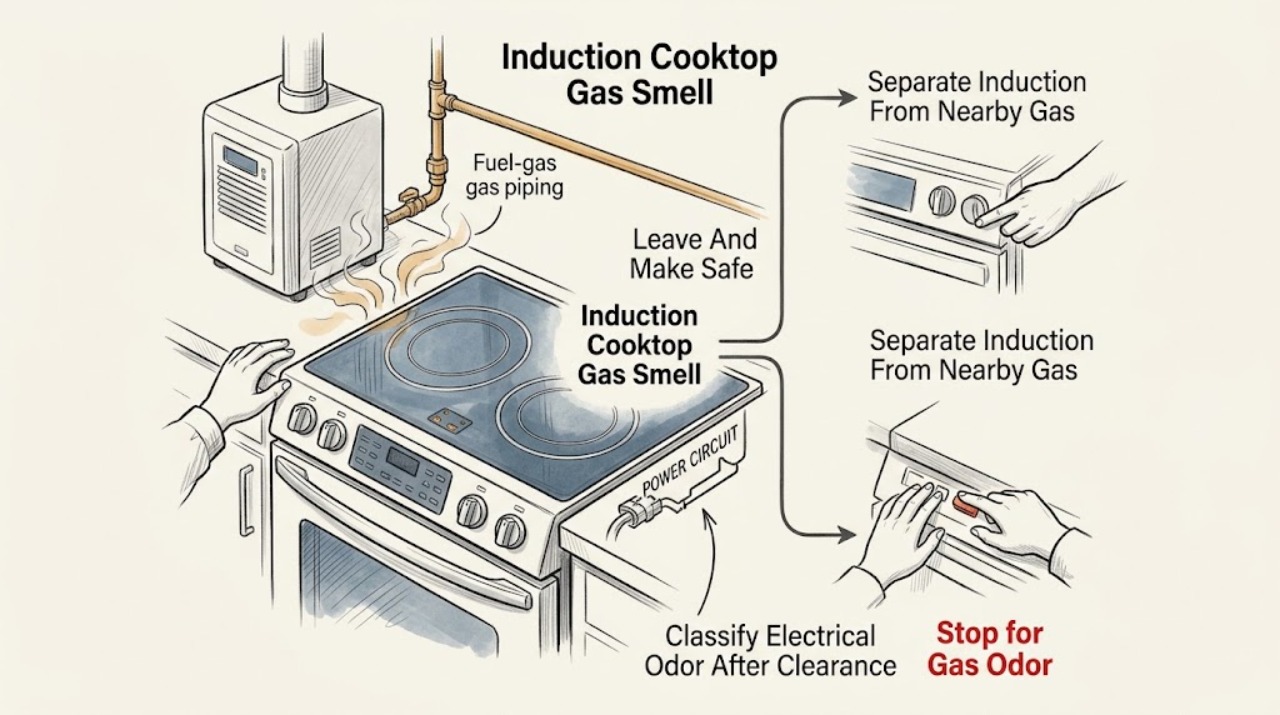
A pure induction cooktop does not burn or supply gas: it transfers electrical energy to compatible cookware. Therefore, a gas smell near an induction cooktop is not a normal induction cooking odor and may come from a nearby gas range, oven, heater, cylinder, connector, or building pipe. Treat it as a possible gas leak first: do not operate the cooktop, lights, switches, plugs, fans, or other electrical equipment; do not use a flame; leave immediately and contact the gas supplier or emergency services from a safe location. If the smell is instead a burning-electrical odor from the induction unit, or if there is smoke, arcing, a hot connection, liquid entry, cracked glass, or a trip, keep the unit off and arrange qualified electrical or appliance service. Do not move the appliance to inspect a gas connector and do not return until the responsible professional or authority says it is safe.
Work through in order
Diagnostic checks
Use only checks that match the exact appliance or system and its official guide.
-
Check 1
If you smell gas or hear hissing near the induction cooktop, stop cooking, do not touch the cooktop, switches, plugs, lights, fans, or controls, and leave the building immediately. Warn others while exiting without creating an ignition source.
Expected result: The odor is strong or spreading, a hissing sound is present, anyone feels unwell, or smoke, flame, or an alarm is present.
Next step: From a safe location outside, contact the gas supplier or local emergency services and follow their instructions. Do not re-enter until authorized.
Stop if: Do not use a flame, operate electrical equipment, test the cooktop, or attempt to locate or repair a leak.
Why this matters
Why: Any suspected fuel-gas release is an emergency even though an induction cooktop itself does not burn gas. Smoke, flame, or symptoms increase the urgency and rule out further observation indoors.
-
Check 2
Only after the gas supplier or emergency authority has declared the area safe, identify whether the home has a nearby gas oven, range, heater, cylinder, or exposed gas line close to the induction cooktop. Do not move the cooktop or pull it from the counter to inspect behind it.
Expected result: The smell is localized near another fuel appliance or line, no fuel appliance is nearby, the source cannot be located, or the odor returns after the area is cleared.
Next step: Leave gas equipment off until inspected and keep the induction unit off if its power area was exposed to fumes, heat, or an unsafe event. Use the gas supplier or a qualified gas professional for the fuel system.
Stop if: Do not turn gas back on, tighten a connector, move the appliance, or relight any fuel appliance yourself.
Why this matters
Why: A nearby fuel appliance or pipe becomes the gas-service path; the induction unit remains an electrical appliance and is not a gas burner. An unknown or recurring odor requires professional leak investigation, not a user test.
-
Check 3
If authorities have ruled out a gas leak and the odor was described as plastic, ozone, or burning electronics, keep the induction cooktop off and inspect only the visible cord, plug, outlet, and counter area from a dry position without opening anything.
Expected result: There are scorch marks, melted insulation, a hot or loose connection, liquid near the unit, smoke, arcing, a cracked surface, or no visible damage.
Next step: Isolate power only from a dry, safe location if doing so does not involve touching damaged equipment, then arrange licensed electrical or appliance service. Do not restart to see if the smell returns.
Stop if: Do not remove covers, probe terminals, use wet hands, or operate the cooktop after an electrical odor.
Why this matters
Why: Visible damage, liquid, smoke, arcing, or abnormal heat suggests an electrical or appliance hazard. No visible damage does not clear the internal high-voltage electronics or cooling system.
-
Check 4
When the cooktop is fully cool and confirmed safe to approach, inspect the intact glass and nearby cookware for spilled food, oil, melted plastic, foil, or a damaged pan coating. Look for cracks or liquid that may have entered a control or ventilation opening, but do not scrape or pour cleaner into openings.
Expected result: Residue is visibly on the pan or glass, plastic has melted, the glass is cracked, liquid entered the unit, or surfaces are clean but the odor persists.
Next step: Retire damaged cookware and clean only an intact cool surface with the exact manual method. For cracks, liquid entry, or persistent odor, keep the appliance off and request authorized service.
Stop if: Do not heat empty cookware to burn off residue, use a knife or abrasive, use steam or solvent, or cook on cracked glass.
Why this matters
Why: Food or cookware residue may explain a localized cooking odor. Melted material, a crack, or liquid entry can create a fire or shock risk. A clean surface with persistent odor keeps an internal appliance fault in view.
-
Check 5
If there is no gas or electrical emergency sign and the odor occurred after cooking, allow the cooktop to cool naturally while keeping vents clear. Note whether the internal fan runs as expected for the model and whether the smell is accompanied by an overheat indication or a zone that stays hot abnormally.
Expected result: The odor fades with cooling and is tied to food or a pan, the fan runs after cooking, the fan is absent or noisy, or the odor and heat persist while idle.
Next step: Use the exact manual for normal fan behavior. Keep the cooktop off and request service if the smell persists, the fan behaves abnormally, or the surface or controls remain unusually hot.
Stop if: Do not block vents, force cooling with liquid, remove covers, or perform a high-power retest.
Why this matters
Why: Residual heat and a cooling fan can be normal after induction cooking, while a persistent odor, fan fault, or abnormal heat suggests a cooling or electronic problem. Do not treat fan operation as proof that the appliance is safe after an electrical odor.
-
Check 6
If the control shows a code or the breaker opened after the smell, record the complete code, model, zone, and timing without repeatedly resetting power. Compare the code only with the exact model manual after the appliance is cool and the area is safe.
Expected result: The code names a sensor, fan, voltage, or communication condition, the breaker trips again, the code clears once, or the cooktop remains dark.
Next step: Leave the unit off and provide the code and event history to qualified appliance or electrical service. Do not use a reset to override a safety symptom.
Stop if: Do not reset repeatedly, alter the circuit, bypass thermal protection, or continue after smoke, arcing, or a hot connection.
Why this matters
Why: Codes can narrow a model-specific service path, but they do not prove a replaceable component. A recurring code, repeated trip, or persistent dark panel after an odor is a service condition.
-
Check 7
Before any return to use, give the qualified professional the odor description, location, gas-clearance result, cookware and residue details, model, code, breaker behavior, glass condition, and whether liquid or smoke was involved.
Expected result: The gas professional clears the nearby fuel system, an appliance technician confirms residue or cookware, an electrician confirms the circuit, or the source remains uncertain.
Next step: Return the appliance to service only when the responsible professional or authority has cleared the relevant hazard and the exact model instructions allow it.
Stop if: Do not reconnect, relight, or test the cooktop simply because the odor has temporarily faded.
Why this matters
Why: A gas smell near induction is usually a location and safety question rather than a burner repair. Electrical odor, liquid entry, cracked glass, and repeated trips require a separate appliance or electrical diagnosis. An uncertain source is not safe to self-clear.
Use your observations
Decision map
Find the observation that best matches what you see, then follow the next safe action.
-
PATH 01Safety boundary
What you see
Gas odor or hissing is present near the induction cooktop or anywhere in the building.
Do this next
Leave immediately without operating switches, lights, appliances, or other electrical equipment; contact the gas supplier or emergency services from a safe location.
Why this path and its safety boundary
Safety stop: Do not test the induction cooktop, search for the leak, move the appliance, or re-enter until cleared.
-
PATH 02Safety boundary
What you see
The odor is electrical or burning and there is smoke, fire, arcing, a hot connection, or a repeated trip.
Do this next
Turn the appliance off and isolate power only from a dry, safe location if that can be done without touching damaged equipment; use emergency or licensed electrical service.
Why this path and its safety boundary
Safety stop: Do not restart, open the unit, or reset the circuit repeatedly.
-
PATH 03Safety boundary
What you see
The glass is cracked or liquid has entered the induction cooktop.
Do this next
Keep it off and arrange authorized service; do not touch wet internal areas or cook on the cracked surface.
Why this path and its safety boundary
Safety stop: Do not wipe liquid into a break, seal a crack, or reconnect power.
-
PATH 04Safety boundary
What you see
The gas authority clears the immediate emergency but identifies a nearby gas appliance, cylinder, connector, or pipe as the likely source.
Do this next
Keep the fuel appliance off until qualified gas service inspects it; do not move or relight it yourself.
Why this path and its safety boundary
Safety stop: Do not turn gas back on or inspect a connector by moving the cooktop.
-
PATH 05Safety boundary
What you see
After a gas clearance, the odor is localized to food, oil, foil, melted plastic, or a damaged pan and disappears when cool and removed.
Do this next
Retire damaged cookware and clean the intact cool surface by the exact manual; stop if the odor returns from the appliance.
Why this path and its safety boundary
Safety stop: Do not heat suspect residue or cookware to test it.
-
PATH 06Safety boundary
What you see
The induction unit is new, the odor is slight, no smoke or abnormal heat is present, and it fades quickly.
Do this next
Follow the exact manual's initial cleaning and ventilation instructions and monitor; a lingering or returning odor requires service.
Why this path and its safety boundary
Safety stop: Do not perform repeated high-power burn-off tests or ignore an electrical smell.
-
PATH 07Safety boundary
What you see
The source is unknown, the smell returns while idle, or it persists after safe clearance and cool cleaning.
Do this next
Keep the cooktop off and request qualified appliance or electrical service with the complete event history.
Why this path and its safety boundary
Safety stop: Do not return to use because the odor temporarily stopped.
Helpful context
Understand the symptom
An induction cooktop cannot be the source of a burner gas flame
A pure induction cooktop heats suitable cookware through electromagnetic energy and has no gas burner or gas ignition path. A gas odor near it still matters because a neighboring gas appliance, a shared pipe, a cylinder, or a connector may be close to the cooktop. Do not conclude that the odor is harmless because the visible cooktop is induction. The first decision is evacuation and gas safety, not appliance testing.
Do not search for the leak or operate a switch
A suspected gas leak can be ignited by a switch, plug, motor, flame, or other source. CPSC guidance says to leave immediately and avoid lights and electrical equipment, while the gas supplier or emergency responders determine the next step. Do not move the cooktop to inspect a connector: moving an appliance can damage a gas connector, and an induction manual also warns not to touch the appliance or power cord during a gas leak.
Electrical odor is a separate but equally important stop path
A sharp plastic, ozone, or burning-electrical smell from the control area, underside, cord, or outlet without a gas odor can indicate an electrical or cooling fault. Smoke, arcing, excessive heat, liquid entry, cracked glass, or a tripped circuit must be treated as a safety event. Keep the unit off and use qualified service; the induction chassis can contain dangerous voltage even after controls appear dark.
Safety boundary
Stop conditions
- Gas odor, hissing, or suspected fuel leakage anywhere near the cooktop or building.
- Smoke, fire, electrical or plastic burning odor, sparks, arcing, or repeated breaker trips.
- Cracked glass, liquid entry, standing water near the connection, or a hot or damaged cord or outlet.
- Persistent overheating, fan failure, a returning fault code, or an odor that remains while the cooktop is idle.
- Any need to move the appliance, open the chassis, probe live parts, or bypass thermal or electrical protection.
Only after diagnosis
Potential parts
- induction cooktop cooling fan
Consider only after a qualified technician confirms a fan fault associated with persistent heat or an appliance odor after gas hazards are cleared.
Confirm the exact cooktop model and manufacturer fit information; gas odor alone does not identify an induction component. - induction cooktop control module
Consider only when authorized service confirms an electronic or power fault after external connections, residue, cookware, and nearby gas sources are ruled out.
Internal high-voltage work requires qualified service and exact model fit; do not select a module from an odor symptom alone. - induction cooktop glass surface
Consider only when authorized service confirms that a cracked or damaged glass surface is replaceable for the exact model.
Do not operate cracked glass or choose a visually similar panel; confirm model-specific fit through authorized service.
When checks do not resolve it
Need a professional?
For any suspected gas leak or hissing, leave immediately and contact the gas supplier or emergency services from a safe location; do not operate switches or test the cooktop., Arrange licensed electrical service for a burning-electrical odor, arcing, a scorched or hot connection, a damaged cord, or repeated breaker trips., Arrange authorized appliance service for smoke, liquid entry, cracked glass, persistent heat, fan trouble, a returning code, or an odor from the induction chassis., Use the exact model manual for initial odor, cleaning, ventilation, fan, and code behavior; generic induction advice cannot clear an internal fault., Do not return to use until the responsible professional or emergency authority has cleared the relevant gas or electrical hazard.
Common questions
FAQ
Can an induction cooktop itself leak gas?
A pure induction cooktop uses electricity and electromagnetic energy rather than a gas burner, so a gas smell is not a normal induction condition. A nearby fuel appliance, pipe, cylinder, or connector may still be involved; leave immediately and follow gas-emergency guidance.
What should I do first when I smell gas near an induction cooktop?
Do not operate the cooktop, lights, switches, plugs, fans, or other electrical equipment, and do not use a flame. Leave the building and contact the gas supplier or emergency services from a safe location.
Could a gas smell actually be an electrical burning smell?
It can be difficult to classify an odor indoors. Treat suspected gas as an emergency first. After the area is cleared by the responsible authority, keep the induction unit off for a plastic, ozone, or electrical burning odor and arrange qualified electrical or appliance service.
Should I move the induction cooktop to inspect a gas connector?
No. Do not move the appliance or inspect a connector yourself. Movement can damage a gas connector, and only the gas supplier or a qualified professional should investigate the fuel system.
Is a brief smell from a new induction cooktop normal?
A slight first-use odor from new materials can fade quickly, but it does not explain a gas odor. A lingering, worsening, smoky, electrical, or plastic odor requires the cooktop to remain off and qualified service.
Read the exact guide
Official sources
- Gas Appliance Connector SafetyU.S. Consumer Product Safety Commission · Government gas-leak emergency guidance, safe exit, electrical ignition avoidance, and connector handling
- Dacor Modernist Cooktops 36 Induction Cooktop User ManualDacor · Official induction cooktop safety guidance for gas leaks, smoke, burning smell, liquid entry, cracked glass, and high-voltage service
- Ranges and Cooktops - Odor From New CooktopGE Appliances · Manufacturer guidance distinguishing brief first-use cooktop odor from a lingering odor requiring service
- Humming or Crackling Noise on an Induction Cooktop - Product Help | WhirlpoolWhirlpool · Manufacturer induction-cooktop operating principles and cookware energy-transfer behavior
- HIPR36S Induction Range User ManualDacor · Official induction operation guidance for initial odor, cookware, cooling fan, heat, cleaning, and safe shutdown
Community feedback
Share a repair observation
Share a plain-text repair observation. Accepted observations are published automatically; this page may take a moment to update.