
On this page
Start here
Quick answer
Stop and classify the smell before cleaning or using the microwave again. If it smells like food, grease, fish, or burned popcorn and there is no sparking, smoke, or electrical odor, unplug before cleaning the cavity and turntable with the exact manual's mild, non-abrasive method; GE says baked-on odors can take several days to fade. For an over-the-range model that recirculates air, a grease-filled or shiny charcoal filter can trap cooking odors, but the filter is model-specific and must be accessed as the manual shows. A new GE microwave may have a temporary electrical-board or convection-heater smell during its first uses, but GE says service is recommended if it does not dissipate after multiple uses. If the smell is electrical or chemical, or is accompanied by arcing, smoke, a hot/damaged cord, or burning near the outlet, stop immediately, disconnect power only if safe, and arrange qualified service. Never open the microwave cabinet, defeat door interlocks, or run an empty oven to test an odor.
Before you begin
Safety first
- The owner may classify the odor, unplug before cleaning, clean accessible cavity/turntable surfaces, and inspect a model-approved charcoal-filter area with power disconnected. Qualified microwave service must handle the cabinet, high-voltage system, magnetron, capacitors, wiring, control, heater, door interlocks, seals, and live tests.
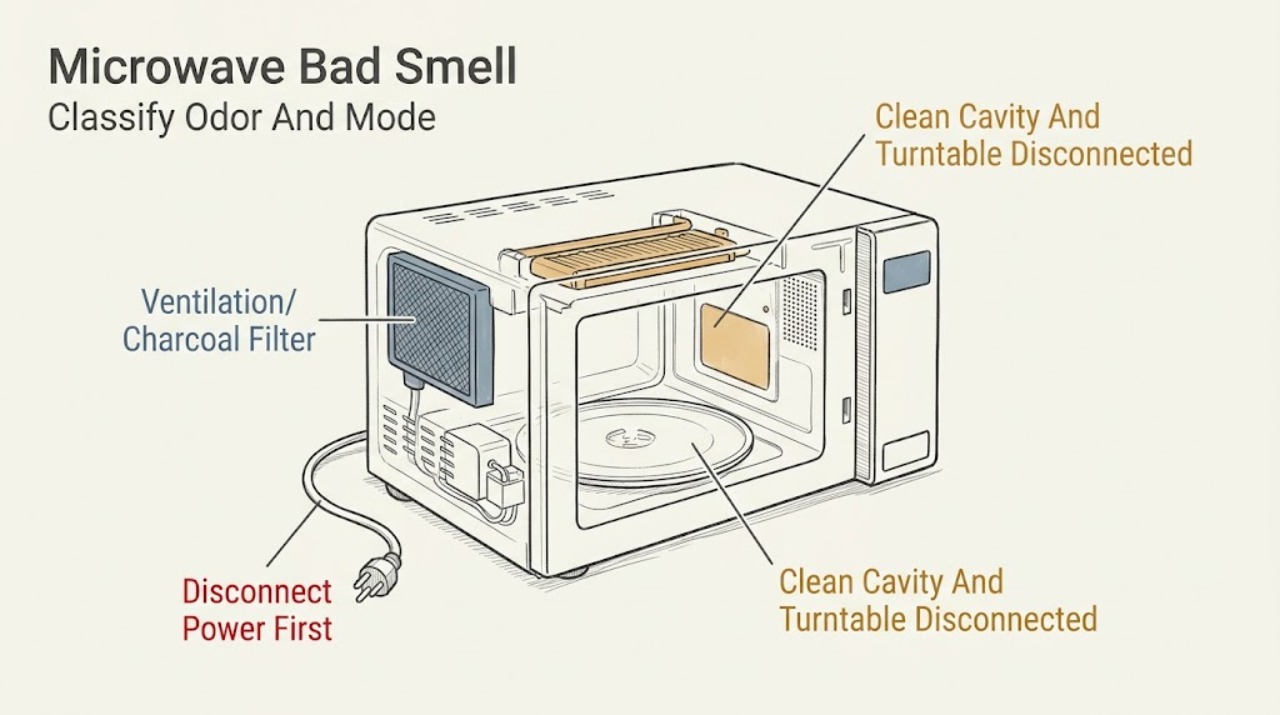
Work through in order
Diagnostic checks
Use only checks that match the exact appliance or system and its official guide.
-
Check 1
From outside the appliance, record the complete GE model number, whether it is countertop or over-the-range, whether the vent recirculates or exhausts outside, and which mode was running when the odor appeared. Describe the smell as food/grease, fish/burned food, new plastic/electrical, convection-heater/oily, or chemical/electrical. Note smoke, sparks, arcing, visible residue, and whether the smell occurs only with the vent fan.
Expected result: The smell is tied to a food spill, to the vent fan, to first-use convection/combination heating, or to ordinary microwave operation with electrical symptoms.
Next step: Use the matching branch and exact GE owner's manual. Do not run another cycle solely to reproduce an electrical or chemical smell.
Stop if: Stop immediately for arcing, smoke, sparks, a hot/damaged plug or cord, burning at the outlet, a damaged door/latch/seal, or an odor that is clearly electrical/chemical rather than food-related.
Why this matters
Why: Odor type and mode separate cavity cleaning, charcoal-filter loading, normal new-heater behavior, and a potentially unsafe internal/electrical fault. The exact model determines the safe cleaning and filter path.
-
Check 2
For a food or grease odor with no electrical warning, unplug the microwave before maintenance. Remove and clean only the model-approved turntable/support, wipe the cavity, ceiling, floor, door, and sealing surfaces with a soft damp cloth and mild non-abrasive cleaner, then dry thoroughly. Do not use abrasive pads, sharp tools, commercial oven cleaner, or large amounts of liquid.
Expected result: Spatters, grease, a burned-food deposit, or residue is visible and removable, or the cavity and turntable are clean but the odor remains.
Next step: Leave the door open for the manual-approved airing period while the microwave is unplugged. If the odor persists, continue to the filter/mode branch or arrange service; do not heat an odor-removal solution unless the exact model guidance and odor classification make it appropriate.
Stop if: Do not wet vents or controls, operate without the turntable/support if the manual requires them, or clean while the appliance is connected.
Why this matters
Why: GE attributes many persistent odors to food residue and recommends cavity cleaning and airing out. A clean cavity with a non-food odor shifts attention to the vent filter, new-heater behavior, or service rather than stronger chemicals.
-
Check 3
Only for an over-the-range microwave that recirculates kitchen air, inspect the accessible grease/charcoal-filter area with power disconnected and follow the exact installation manual for access. A filter that is filled with grease or has a uniformly shiny surface is a candidate for model-matched replacement; a vented-to-outside or countertop model does not use this same charcoal-filter path.
Expected result: The model recirculates and the charcoal filter is greasy/shiny, the filter is not present/applicable, or the odor is inside the cavity rather than in vented air.
Next step: Replace only the exact model's filter as the manual shows, and clean accessible grease as directed. If the filter is not the source or the odor returns, arrange service instead of removing the vent cover or fan housing.
Stop if: Do not install a generic filter by appearance, operate with a loose filter/vent cover, or reach into the fan, wiring, or cabinet.
Why this matters
Why: GE says recirculating over-the-range units need a model-specific charcoal filter and that heavy grease can trap previous cooking odors. The filter cannot explain sparks or a chemical odor from the appliance itself.
-
Check 4
If the microwave is new and the odor appeared only during the first few convection BAKE, ROAST, or combination cycles, compare the mode and timing with GE's odor guidance and the exact manual. Do not use this explanation for a countertop microwave's unrelated electrical odor, a recurring odor after multiple uses, smoke, arcing, or visible damage.
Expected result: The smell is a temporary new-appliance/electrical-board odor, a strong oily smell only during first-use convection/combination heating, or it persists beyond multiple uses or appears in ordinary microwave mode.
Next step: Follow the exact manual's first-use instructions only if there is no smoke, arcing, damage, or chemical odor. If the smell persists or changes, keep the oven disconnected and arrange qualified service.
Stop if: Do not operate repeatedly to force the smell away, run the cavity empty, defeat the door interlock, or remove the outer cover.
Why this matters
Why: GE says some new-machine or new-convection-heater smells can dissipate with regular use. Persistence or a non-food odor outside the documented new-use condition requires service rather than a DIY internal inspection.
-
Check 5
If the odor is electrical/chemical, follows arcing or smoke, comes from the plug or outlet, remains after food residue and a model-specific filter check, or cannot be localized safely, stop using the microwave. Record the model, mode, timing, odor description, visible damage, and any protection-device event for qualified service.
Expected result: A non-food odor returns, the outlet/cord is hot or damaged, there is smoke/sparking/arcing, the door/seal/interlock is damaged, or the unit needs cabinet access to diagnose.
Next step: Disconnect power only if doing so does not require touching a hot, wet, sparking, or damaged connection. Arrange qualified microwave service and electrical service for an outlet/cord hazard; do not recreate the event.
Stop if: Do not open the cabinet, probe capacitors or wiring, bypass interlocks, run an empty test, or continue use because the smell temporarily fades.
Why this matters
Why: GE treats non-food burning odors, especially electrical or chemical odors, as a reason to stop and have the microwave checked. The high-voltage and door-safety systems cannot be diagnosed safely by an owner from smell alone.
Use your observations
Decision map
Find the observation that best matches what you see, then follow the next safe action.
-
PATH 01Safety boundary
What you see
The odor matches food, grease, fish, or burned popcorn, and there is no arcing, smoke, electrical/chemical odor, or door damage.
Do this next
Unplug, clean the cavity and removable turntable parts with a mild non-abrasive method, dry thoroughly, and allow the door to air out while unused. If the odor persists after the cavity is clean, use the model-specific filter check or service path.
Why this path and its safety boundary
Why it matters: Cavity spatters, grease, or residue are more likely than an internal electrical fault; strong odors can persist for several days according to GE.
Safety stop: Do not use abrasive/oven cleaners, flood the cavity, or heat a deodorizing solution when the odor classification is uncertain.
-
PATH 02Safety boundary
What you see
An over-the-range GE microwave recirculates air, and the odor is strongest when the vent runs or the charcoal filter is visibly greasy/shiny.
Do this next
With power disconnected, replace the exact model's charcoal filter according to the owner's manual and clean only accessible grease. Persistent odor or any electrical symptom needs service.
Why this path and its safety boundary
Why it matters: GE says a grease-loaded, model-specific charcoal filter can trap previous cooking odors. This does not apply to every GE microwave or to a vented-outside installation.
Safety stop: Do not use an unverified filter, remove the fan housing, or investigate wiring behind the vent cover.
-
PATH 03Safety boundary
What you see
A new GE convection or combination microwave has a strong burning/oily smell only during its first few heating uses, without smoke, arcing, or visible damage.
Do this next
Follow the exact model's first-use instructions and stop if the odor does not dissipate after multiple uses. Persistent odor should be serviced.
Why this path and its safety boundary
Why it matters: GE says a new convection heater can produce a temporary smell that should go away with regular use. The condition is mode- and age-dependent, not a blanket explanation for all GE microwave odors.
Safety stop: Do not run an empty oven or keep operating when the smell is electrical/chemical, smoke appears, or the door/cord is damaged.
-
PATH 04Safety boundary
What you see
The smell is electrical or chemical, or is accompanied by arcing, sparks, smoke, hot/damaged cord or outlet, or a damaged door/interlock.
Do this next
Stop immediately, disconnect power only from a safe position, keep the microwave out of service, and arrange qualified appliance/electrical service.
Why this path and its safety boundary
Why it matters: GE treats this as an unsafe condition, not a cleaning problem. Metal, internal electrical faults, damaged safety components, or outlet issues may be involved, but the cause cannot be confirmed without qualified service.
Safety stop: Do not inspect behind covers, restart the microwave, test with metal, defeat interlocks, or touch a hot/sparking connection.
Helpful context
Understand the symptom
The smell itself is the first diagnostic clue
Food, grease, fish, and burned-popcorn odors usually point to residue in the cavity or a vent filter. An electrical or chemical smell, especially with arcing or smoke, is a stop condition. A temporary new-appliance smell can be model- and mode-specific, particularly on convection or combination units.
Vent type and heating mode change the remedy
Only recirculating over-the-range models use a charcoal odor filter for cooking fumes, and that filter is model-specific. Countertop microwaves do not inherit that filter path. Convection BAKE, ROAST, or combination modes can also create a temporary new-heater smell, which is different from an odor during ordinary microwave heating.
Do not trade odor removal for microwave safety
Clean only from a disconnected, cool appliance and keep liquids out of vents, controls, and the cabinet. Do not operate with a damaged door, hinge, latch, seal, or interlock. A persistent non-food odor belongs with qualified service rather than a cover-off inspection.
Only after diagnosis
Potential parts
- model-matched charcoal odor filter
Consider only when the unit is an over-the-range microwave that recirculates air and the filter is visibly grease-loaded or the exact model documentation identifies it as due for replacement.
GE says charcoal filters are model-specific; countertop and outside-vented configurations do not automatically use the same filter. - model-matched cavity or turntable component
Consider only when qualified support confirms a cracked, damaged, or missing model-specific removable part after the odor source is localized to that component.
Turntables, supports, cavity coatings, and model configurations vary; do not select a part from appearance or odor alone. - model-matched internal heating or electrical component
Consider only after qualified microwave service confirms an internal heater, control, wiring, or high-voltage diagnosis following an electrical/non-food odor.
A burning smell does not identify a safe replacement part; microwave cabinet and high-voltage repair are not owner-level work.
When checks do not resolve it
Need a professional?
Keep the GE microwave out of service and arrange qualified appliance service when an electrical or chemical odor occurs, arcing/smoke/sparks appear, the odor persists after cavity cleaning and an applicable model-specific charcoal-filter check, a new convection/combination odor does not dissipate after multiple uses, or the door, seal, latch, cord, outlet, or cabinet is damaged. Disconnect power only from a safe position and use electrical service for a hot/damaged outlet or cord. Do not open the cabinet, run empty tests, defeat interlocks, or probe high-voltage parts.
Safety scope: The owner may classify the odor, unplug before cleaning, clean accessible cavity/turntable surfaces, and inspect a model-approved charcoal-filter area with power disconnected. Qualified microwave service must handle the cabinet, high-voltage system, magnetron, capacitors, wiring, control, heater, door interlocks, seals, and live tests.
Common questions
FAQ
How do I remove a food smell from a GE microwave?
Unplug the microwave, clean the cavity and removable turntable parts with a soft cloth and mild non-abrasive cleaner, dry them, and allow the door to air out while unused. Strong fish or burned-popcorn odors can take several days. Do not use abrasive or oven cleaners.
When should I replace a GE over-the-range microwave charcoal filter?
Only when the model is an over-the-range unit that recirculates air and the exact manual/specifications call for that filter. GE says heavy grease or a uniformly shiny filter can indicate replacement; the correct filter is model-specific.
Is an electrical smell normal in a new GE microwave?
GE says a new microwave's electrical-board odor can be normal for the first few uses, and a strong burning/oily smell can occur during first-use convection or combination heating. If it persists after multiple uses, appears during ordinary microwave heating, or comes with smoke/arcing, stop and call service.
What if the GE microwave smells like burning but there is no visible smoke?
Treat a non-food electrical or chemical odor as a stop condition even without smoke. Stop the microwave, disconnect power only from a safe position, and arrange qualified service. Do not run an empty test or open the cabinet.
Can I open a GE microwave to find the source of an odor?
No. GE's microwave safety guidance says the oven should not be adjusted or repaired except by qualified service personnel and warns against operating with damaged doors or defeated interlocks. Limit owner checks to unplugged, accessible cleaning and model-approved filter access.
Read the exact guide
Official sources
- HELP US HELP YOU…GE Appliances · GE microwave safety instructions, door/interlock damage boundary, grounded power, and qualified repair requirement
- GE Appliances Service and SupportGE Appliances · GE appliance model support and qualified repair routing
- Over-the-Range Microwave - Charcoal Filter ReplacementGE Appliances · GE over-the-range recirculating microwave charcoal-filter applicability, grease condition, and model-specific replacement
- Parts & Accessories for PVM9215DKBBGE Appliances · GE Profile PVM9215DKBB over-the-range microwave identity and model-specific charcoal/grease filter parts
- Microwave - OdorsGE Appliances · GE microwave food, new-appliance, convection, charcoal/electrical, and persistent-odor guidance
Community feedback
Share a repair observation
Share a plain-text repair observation. Accepted observations are published automatically; this page may take a moment to update.