
On this page
Start here
Quick answer
If a Kenmore gas oven will not start, first stop if you smell gas, see smoke, or have sparking or repeated breaker trips. Otherwise confirm the model-specific start sequence, clock or control-lock state, and external power; then check only whether the home's gas appliances have supply. A gas oven that has power but does not begin an approved ignition sequence needs model-specific service, not repeated ignition attempts or internal gas work.
Before you begin
Safety first
- This is a gas appliance. Keep all diagnosis external and low risk. Never use the oven for room heating; carbon monoxide is odorless and colorless. The CPSC says only a qualified professional should inspect or replace a gas connector, and the range should not be moved for that inspection.
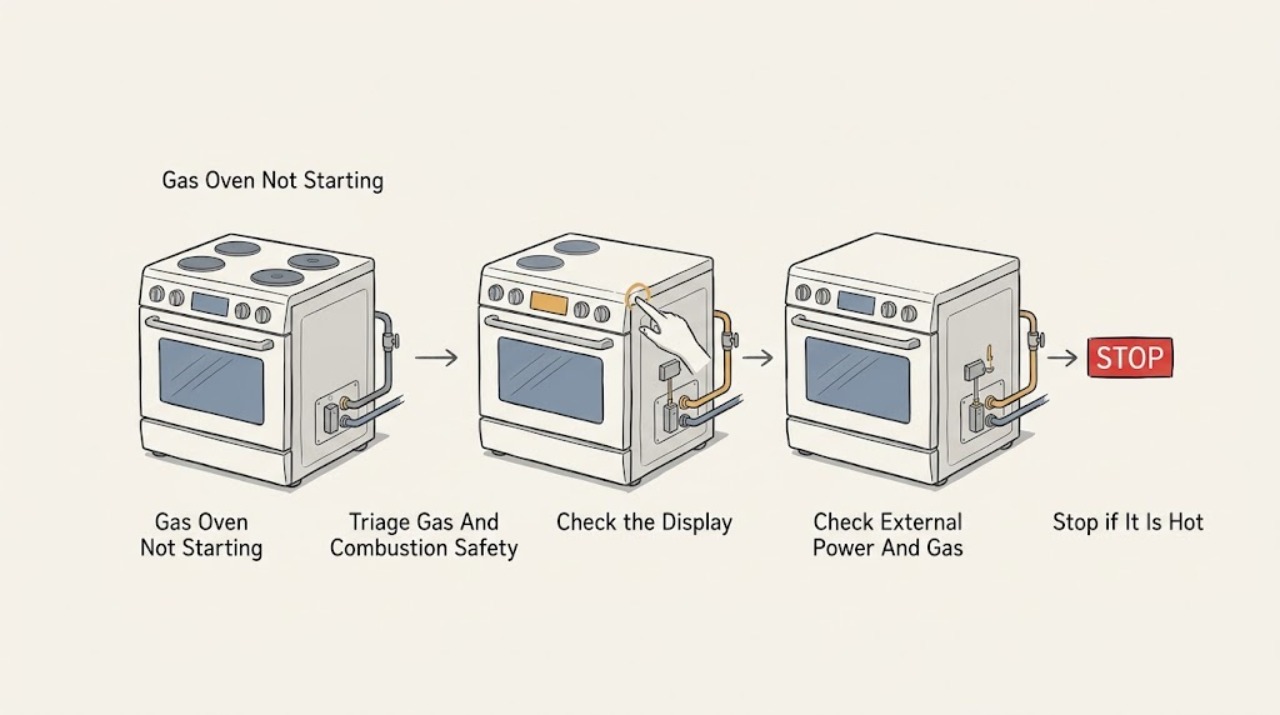
Work through in order
Diagnostic checks
Use only checks that match the exact appliance or system and its official guide.
-
Check 1
Before pressing Start again, notice whether there is a gas odor, smoke, soot, an unusual flame, a delayed whoosh, sparking outside the normal control sequence, or an active carbon-monoxide alarm.
Expected result: Any gas odor, smoke, abnormal flame, delayed ignition, alarm, or symptom of exposure is present; or the oven has no such warning signs.
Next step: If any warning sign is present, do not operate switches, phones, knobs, or flames inside the area; leave, then contact the gas supplier, emergency services, or a qualified professional from a safe location. If none is present, continue to the model and control-state check.
Stop if: Stop immediately for gas odor, smoke, abnormal flame, delayed ignition, carbon-monoxide alarm, or symptoms such as headache, dizziness, nausea, or shortness of breath.
Why this matters
Why: A warning sign can indicate combustion, gas-supply, fire, or carbon-monoxide risk and cannot be safely diagnosed by repeated starting attempts.
-
Check 2
Read the rating-label model number without moving the range, then compare the display and button response with that model’s Kenmore manual: check whether the display is lit, a clock or time must be set, Control Lock is shown, a delayed-start or self-clean mode is active, and the required Bake/temperature/Start sequence is being used.
Expected result: The display is blank, controls are locked or inactive, the clock or mode is incomplete, or the model manual shows a different start sequence; alternatively the display accepts the documented sequence.
Next step: If the manual identifies a low-risk unlock, clock, mode-cancel, or documented start step, perform that one time and observe the result. If the documented sequence is accepted but the oven still does not start, continue to the external supply check.
Stop if: Stop if the display shows a fault that the manual directs to service, if controls behave erratically, or if correcting the state would require opening the console or bypassing a lock.
Why this matters
Why: A no-start symptom can be a control-state or wrong-sequence issue rather than a failed gas component. Kenmore manuals are the authority for the specific model’s indicators and controls.
-
Check 3
Without moving the range or opening any panel, verify that the oven power cord is fully seated if accessible, the kitchen breaker or fuse is not tripped, and the outlet or nearby range controls show normal power. If another gas appliance is already being used normally, note that; do not turn on a burner solely as a gas test.
Expected result: The display and other controls are dead, the breaker has tripped, power is intermittent, other gas appliances also lack supply, or the external power and household gas supply appear normal.
Next step: If power is absent, restore only a clearly identified tripped breaker once with dry hands and no active fault signs; if it trips again, leave the appliance off and call an electrician or technician. If the household gas supply is also unavailable, contact the gas supplier. If both appear normal, continue to observe one model-approved start attempt.
Stop if: Stop for wet flooring, a hot or damaged cord, a burnt outlet, sparks, a gas odor, or a breaker that trips again; do not remove the range or test live wiring.
Why this matters
Why: A dead or unstable electrical supply can prevent controls and ignition from operating; a wider gas-supply issue is different from an oven-only fault. A tripped breaker can also signal an electrical fault and should not be repeatedly reset.
-
Check 4
With the oven empty and the area free of warning signs, follow the exact manual sequence once: select the documented Bake mode and temperature, press Start if the model requires it, and observe through the door or control display without reaching into the oven or removing a panel.
Expected result: The cycle begins and normal ignition activity follows; the display accepts the command but there is no ignition activity; the controls do not accept the command; or there is repeated clicking, a delayed whoosh, an abnormal flame, or gas odor.
Next step: If the cycle starts normally, monitor the temperature in the next action. If it accepts the command but never ignites, or will not accept the command after the manual sequence, turn it off and arrange service. For repeated clicking, delayed ignition, abnormal flame, or gas odor, stop and leave the area as described above.
Stop if: Do not repeat the attempt for a no-ignition condition, and stop immediately for gas odor, smoke, delayed ignition, abnormal flame, or electrical arcing.
Why this matters
Why: The result separates a start-command problem from an ignition or gas-delivery problem. Gas ovens use model-dependent ignition and safety controls; absence of a visible flame alone does not identify a replaceable part.
-
Check 5
If the cycle starts, observe whether the oven reaches and maintains the selected setting according to the model manual; note whether the oven remains cool, warms slowly, cycles normally but cooks unevenly, or shows a fault. Do not use an oven thermometer as permission to open the appliance or adjust gas components.
Expected result: The oven remains cold, warms but cannot maintain the setting, or reaches a stable cooking temperature; a code or unusual smell may also appear.
Next step: For a cold oven, stop using it and give the technician the exact model, selected mode, display behavior, and whether any ignition sound or flame was observed. For a temperature discrepancy without a safety warning, use only model-specific calibration guidance; if the door is visibly damaged or will not close, request service.
Stop if: Stop for smoke, gas odor, abnormal flame, severe overheating, a damaged door or glass, or repeated electrical trips.
Why this matters
Why: A cycle that starts but remains cold is a no-heat/ignition-path fault, while a stable cycle with poor results points toward temperature measurement, door sealing, or cooking conditions. A code or unsafe symptom takes priority over temperature testing.
-
Check 6
Prepare a service handoff if the exact manual sequence, safe external checks, and one approved start attempt do not restore operation; record the model number, display code or blank-display state, selected mode, breaker behavior, whether surface burners or other gas appliances work, and any sound or smell.
Expected result: The oven still will not start, or it starts only intermittently; alternatively, a documented low-risk control correction restored normal operation.
Next step: If unresolved, leave the oven off and use Kenmore Customer Care to locate the model manual, warranty, or repair path, or contact a qualified appliance technician. Do not move the range, bypass a safety switch, open the console, loosen a gas fitting, or substitute a part without model-specific verification.
Stop if: Stop all testing for gas odor, smoke, delayed ignition, abnormal flame, carbon-monoxide alarm or symptoms, sparks, damaged wiring, hot outlet, or repeated breaker trips; leave and seek emergency or qualified help from a safe location.
Why this matters
Why: Persistent no-start behavior after safe checks needs model-specific diagnosis of controls, ignition, valve, wiring, or supply by a qualified professional. A temporary restart is not proof that a gas or electrical fault is safe.
Use your observations
Decision map
Find the observation that best matches what you see, then follow the next safe action.
-
PATH 01Next step
What you see
Gas odor, smoke, soot, delayed ignition, abnormal flame, or a carbon-monoxide alarm or symptoms appear.
Do this next
Stop operating the appliance, leave immediately, and contact the gas supplier or emergency services from a safe location. Do not look for the leak or restart the oven.
-
PATH 02Next step
What you see
The display is blank, buttons do not respond, or a documented clock/lock/mode state blocks the command.
Do this next
Use the exact model manual for the clock, lock, cancellation, and start sequence. Check external power without opening the range; recurrent power loss needs professional service.
-
PATH 03Next step
What you see
The model-approved command is accepted but the oven does not ignite or remains cold.
Do this next
Turn the oven off and arrange qualified service for the model-specific ignition, gas, control, and safety path. Do not keep cycling the control or test live parts.
-
PATH 04Next step
What you see
The oven starts but stays cold, heats slowly, or does not hold the selected temperature.
Do this next
Stop using it if there is any unsafe symptom; otherwise record mode, setting, time, and display behavior and follow only the model’s calibration or service guidance.
Helpful context
Understand the symptom
What “not starting” means on a gas oven
A no-start complaint can mean several different states: the display is blank, the controls accept no input, a cycle was selected but never begins, the oven clicks without a flame, or the oven lights but never reaches cooking temperature. The safe diagnostic path separates those states before anyone looks at a burner. Kenmore publishes manuals by exact model number, and its range catalog includes multiple gas-range control designs, so a key sequence or lock indicator is not universal. Record the model number from the rating label and follow that model’s use-and-care instructions.
Gas and carbon-monoxide boundary
Do not use a gas oven as a room heater. Carbon monoxide cannot be seen or smelled, and symptoms such as headache, fatigue, nausea, dizziness, or shortness of breath require leaving the area and seeking urgent help. A gas smell, delayed ignition with a whoosh, abnormal flame, smoke, or a safety device that repeatedly trips is a stop condition. Do not move the range to inspect its connector; the Consumer Product Safety Commission says connector inspection or replacement belongs to a qualified professional.
How to use the observations
A blank display points toward the electrical supply or control path, while a lit display with no cycle response points toward mode, clock, lock, door, or control-state instructions. If a cycle starts but there is no expected ignition activity, the issue may be model-specific ignition control, gas delivery, or a fault that requires service. Do not remove panels, test live wiring, loosen gas fittings, bypass a door or safety switch, or replace a gas part based only on a symptom.
After a safe check
If the low-risk checks do not restore normal operation, stop with the range in a safe state and arrange Kenmore support or a qualified appliance technician. Have the exact model number, displayed code, what the display did, whether the surface burners work, and any unusual sound or smell ready for the service call. Do not keep restarting an oven that fails to ignite or repeatedly trips a breaker.
Safety boundary
Stop conditions
- Leave immediately and seek help from a safe location for gas odor, suspected leak, smoke, or a carbon-monoxide alarm or symptoms.
- Stop for delayed ignition, abnormal flame, sparking, damaged wiring, a hot outlet, repeated breaker trips, or severe overheating.
- Do not move the range, open panels, loosen gas fittings, bypass a lock or safety switch, or repeatedly attempt ignition.
Only after diagnosis
Potential parts
- oven ignition component
Consider only if a qualified diagnosis confirms the oven receives the required control and gas conditions but its model-specific ignition component fails.
Confirm the complete model number and the official fit information; do not order from the symptom alone. - oven control component
Consider only if the display or start-command diagnosis identifies a control fault after external power and lock or mode checks.
Control components vary by model and revision and require model-specific professional verification.
When checks do not resolve it
Need a professional?
Call a qualified appliance technician or Kenmore support when the oven remains unable to start after the model-specific control and external checks, when a breaker trips again, or when diagnosis would require opening the appliance, testing wiring, inspecting the gas path, moving the range, or replacing a gas or safety component.
Common questions
FAQ
Why is my Kenmore gas oven not starting even though the display is on?
Check the exact model’s clock, Control Lock, mode-cancel, and Bake/temperature/Start sequence first. If the command is accepted but ignition never begins, stop repeating attempts and arrange qualified service.
Can I test the gas supply by lighting a burner?
Do not light a burner solely as a test, especially if any gas odor or abnormal behavior is present. If other gas appliances are already operating normally, record that observation; otherwise contact the gas supplier for a supply concern.
Should I keep pressing Start if the oven clicks but does not light?
No. Repeated clicking, delayed ignition, a whoosh, unusual flame, smoke, or gas odor is a stop condition. Turn the appliance off if safe, leave the area for any gas concern, and obtain qualified help.
Is a blank oven display always a failed control board?
No. Check external power and the model manual’s documented clock or control behavior first. A breaker that trips again, a hot outlet, damaged cord, or intermittent power needs professional diagnosis rather than a control-board guess.
What information should I give the repair technician?
Provide the complete model number, whether the display is blank, what happens after the documented start sequence, the selected mode and temperature, breaker behavior, whether other gas appliances work, and any clicking, smell, smoke, or flame observation.
Read the exact guide
Official sources
- Protect Your Family from Carbon Monoxide PoisoningU.S. Consumer Product Safety Commission · Carbon-monoxide hazards and gas-oven safety
- Ranges | Cooking | KenmoreKenmore · Kenmore range product identity and gas-range model variation
- Customer Care & Support | Kenmore AppliancesKenmore · Kenmore warranty, manuals, safety, repairs, and customer care
- Energy Conservation Program: Energy Conservation Standards for Consumer Conventional Cooking ProductsU.S. Department of Energy · General conventional gas-oven construction and ignition-system context
- Find Your Manual | Kenmore Appliance Manuals & GuidesKenmore · Kenmore appliance manuals, including ovens and ranges
- Certain Older Gas Connectors May Be DangerousU.S. Consumer Product Safety Commission · Gas connector, suspected gas leak, and evacuation safety
Community feedback
Share a repair observation
Share a plain-text repair observation. Accepted observations are published automatically; this page may take a moment to update.