
On this page
Start here
Quick answer
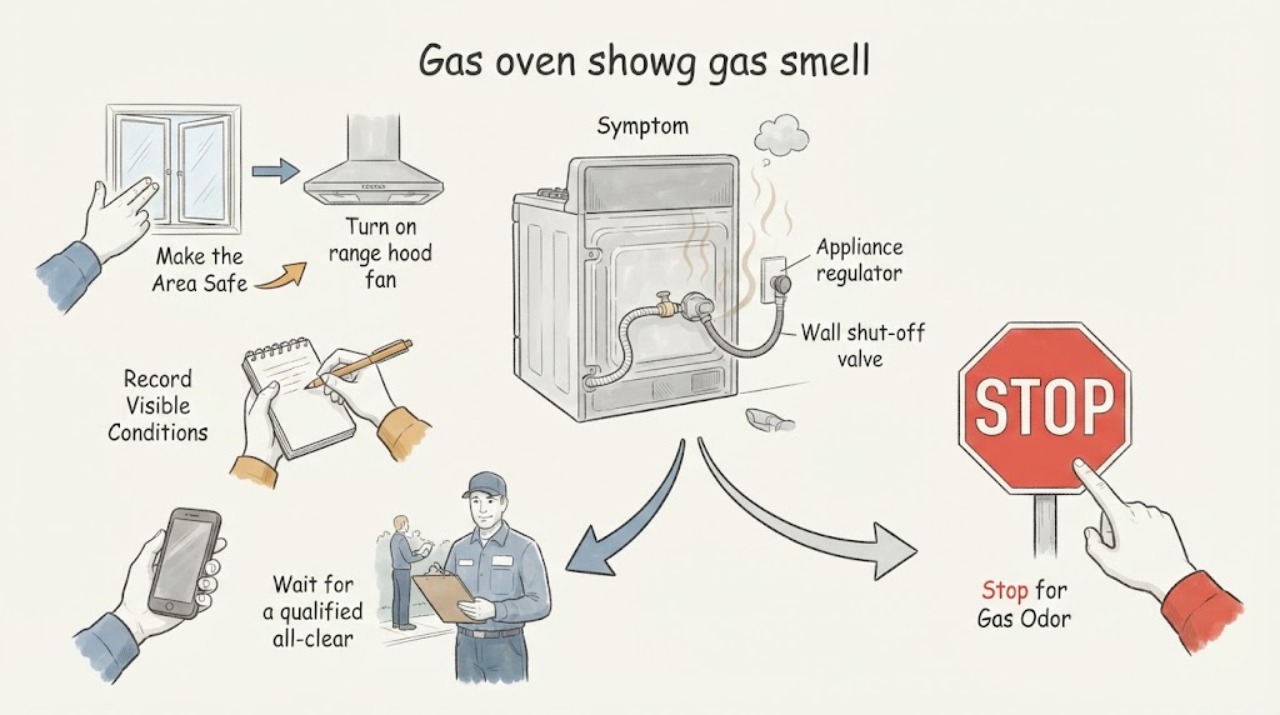
If you smell gas from a Kenmore gas oven or range now, do not troubleshoot the appliance. Do not light a flame, operate lights or electrical controls, use a phone inside, move the range, or try another ignition attempt. Leave the home immediately and contact the gas supplier or emergency services from outside or a neighbor's location. Do not re-enter until the appropriate authority says it is safe. Only after the area and appliance are declared safe should you record the model, fuel configuration, timing, and location of the odor from accessible areas without moving the appliance. A persistent smell, odor while the oven is off, delayed ignition, flare, smoke, or a smell that returns after shutoff needs qualified gas or appliance service; it is not a reason to replace an igniter or adjust a valve yourself.
Before you begin
Safety first
- Do not operate lights, electrical switches, phones, fans, flames, or the oven during an active odor; do not move the range, inspect or replace its connector, open panels, adjust valves or regulators, apply leak-detection fluid, bypass safety controls, or repeat ignition tests.
Work through in order
Diagnostic checks
Use only checks that match the exact appliance or system and its official guide.
-
If gas odor is present, leave before inspecting anything
If you smell gas now, stop using the Kenmore oven and do not operate the oven controls, lights, switches, plugs, fans, phones, or other electrical equipment inside. Do not light a match, smoke, create a flame, or move the range. Leave the home immediately and contact the gas supplier or emergency services from outside or a neighbor's location.
Expected result: The odor is present now, someone hears escaping gas, a gas alarm sounds, the oven has a flame or flare, or there is no current odor and the area has been cleared by the appropriate authority.
Next step: For active odor or suspected escape, stay out and follow the gas supplier, fire department, or emergency responder's instructions. Do not re-enter or restore operation until they say it is safe. Only after an all-clear may you continue with the external documentation steps below.
Stop if: Stop immediately and leave for gas odor, hissing, a gas alarm, flame outside the intended burner, flare, smoke, or signs of fire. Never return to the appliance to take a closer look.
Why this matters
Why: An active or suspected gas leak can ignite or cause an explosion. CPSC's emergency path takes priority over identifying an igniter, burner, valve, connector, or model-specific behavior.
-
Wait for a qualified all-clear before any model check
After leaving, wait for the gas supplier, fire department, or other appropriate responder to determine whether the home and appliance are safe. Do not ventilate by operating a fan or electrical switch from inside, and do not return simply because the odor fades. Treat a faded odor as unconfirmed, not repaired.
Expected result: The area is not cleared, the odor returns, the responder identifies a leak or unsafe appliance, or the area is cleared and the appliance is cool, intact, and odor-free.
Next step: Remain out until cleared. If cleared, do not start the oven; continue only with model identification and an external, no-movement inspection. If the appliance is declared unsafe, leave it isolated and arrange qualified repair or replacement guidance.
Stop if: Do not re-enter, switch on power, operate controls, or approach the range while gas odor, hissing, smoke, heat, or an unresolved responder warning remains.
Why this matters
Why: Gas can disperse below the level that a person notices while a leak or unsafe ignition condition remains. A genuine all-clear changes the task from emergency response to limited documentation; it does not prove the oven is serviceable.
-
Record the Kenmore model without moving the appliance
Only after an all-clear and with the appliance cool and odor-free, photograph the model and serial label from its normal accessible location, and note whether the product is a freestanding range, slide-in range, or wall oven with a separate cooktop. Use the Kenmore manual finder for that exact model. Do not pull the range forward, inspect the rear connector, remove a panel, or infer gas-system parts from the model family.
Expected result: The model and fuel configuration are clear; the label is inaccessible without moving the appliance; or the manual does not match the controls or installation.
Next step: Use the exact manual or ask qualified service to identify the appliance. If the label requires moving the range, stop and provide the visible information you have; do not move it for a home inspection.
Stop if: Do not move the range, bend or touch the gas connector, open a rear cover, or continue if gas odor returns, the housing is hot or damaged, or an unsafe condition is reported.
Why this matters
Why: Kenmore states that manuals are located by model number and that they cover ovens, ranges, and related appliances. CPSC warns that moving an appliance to inspect a gas connector can cause it to fail.
-
Document when and where the odor occurred
After clearance, write down whether the smell occurred while the oven was off, when a bake or broil cycle was selected, after ignition, after shutoff, near the oven door or vent, or throughout the room. Record whether a flame was ever visibly established according to the manual, whether there was a delay or flare, and whether the control or display behaved normally. Do not turn the oven on to recreate the event.
Expected result: The odor occurred while idle, returned after shutoff, was accompanied by delayed ignition or a flare, or was reported only once with no continuing odor and no damage.
Next step: Keep the oven unused and provide the full pattern to qualified gas or appliance service. Do not accept a brief or single event as permission to run another cycle unless the responsible qualified professional and exact manual establish a safe next step.
Stop if: Stop and leave again if odor returns, a flare or delayed ignition occurred, the burner did not establish a safe flame, smoke appears, or any control behaves unexpectedly.
Why this matters
Why: Timing helps a qualified technician separate supply or connector concerns from ignition, burner, valve, control, and ventilation concerns, but timing cannot prove that any path is safe. A gas smell without prompt safe ignition or an odor that persists after shutoff is a stop-use symptom.
-
Check only visible controls, door, and damage after clearance
With the area cleared, the oven cool, and no odor present, look from the front for a control left in an ignition or heating position, a damaged door or seal, visible scorching, a cracked panel, or a control display showing an unusual state. Follow the exact manual for any normal control position; do not reach into the burner area, remove the oven bottom, adjust a gas valve, or use leak-detection fluid.
Expected result: A visible control or door problem is present, the exterior shows heat or scorch damage, the control state is normal but the odor history is unexplained, or the appliance is not intact.
Next step: Do not operate a damaged or unexplained appliance. Photograph the safe visible condition and arrange qualified service; do not try to correct gas-system components yourself.
Stop if: Do not touch gas tubing, valves, burner ports, igniter wiring, or hot or damaged surfaces. Stop if odor, hissing, smoke, heat, or a flare returns.
Why this matters
Why: A visible obstruction or control state may explain a no-start symptom but cannot clear a gas odor. Scorching, damage, or an unexplained odor raises the service boundary to qualified gas and appliance diagnosis.
-
Use Kenmore's model resources and safety notices without restarting
From a safe location, use Kenmore's official manuals and customer-care pages to check the exact use-and-care, installation, safety, and recall information for the model. Record the manual's fuel type, ignition description, and service boundary. Do not use a generic video, parts listing, or another model's ignition sequence to decide that the odor is safe.
Expected result: The exact manual provides a model-specific warning or service instruction, a safety notice applies, the manual cannot be found, or the appliance identity remains uncertain.
Next step: Follow only a clearly applicable manual instruction that does not require operating a gas-smelling appliance. If the manual or safety notice does not resolve the event, leave the oven off and arrange qualified service.
Stop if: Do not restart for comparison, bypass a safety control, alter the gas supply, or continue after any returning odor, delayed ignition, flare, smoke, burning smell, or damage.
Why this matters
Why: Kenmore's manual finder is the authoritative route for model-specific operating and safety information, while generic procedures can mismatch the gas valve, igniter, controls, or installation. Missing model evidence is not permission to experiment.
-
Escalate the gas system and provide a complete service record
Before requesting service, compile the model and serial information, range or wall-oven configuration, natural-gas or propane designation if known, exact odor timing and location, whether the oven was on or off, flame and ignition observations, any delay or flare, responder findings, visible damage, and whether the smell returned. Do not remove parts or attempt a final ignition test.
Expected result: The odor persists or returns, the oven smells while off, ignition is delayed or fails, a flame is abnormal, the model manual cannot resolve the concern, or any gas, heat, smoke, electrical, or damage symptom remains.
Next step: Leave the oven unused and arrange qualified gas or appliance service. If gas odor returns before the visit, repeat the emergency response and contact the gas supplier or emergency services from outside.
Stop if: Do not operate, move, disassemble, adjust, leak-test, or relight the oven after odor, hissing, delayed ignition, flare, smoke, burning smell, abnormal heat, or damage.
Why this matters
Why: Gas odor can originate in the supply, connector, valve, igniter, burner, control, or installation, and these systems require qualified diagnosis. A part name inferred from an odor is not a safe repair decision.
Use your observations
Decision map
Find the observation that best matches what you see, then follow the next safe action.
-
PATH 01Next step
What you see
Gas odor or hissing is present, a gas alarm sounds, or a flame, flare, or smoke is observed
Do this next
Leave immediately. Do not use lights, switches, phones, flames, or the appliance inside. Contact the gas supplier or emergency services from outside or a neighbor's location and do not re-enter until cleared.
-
PATH 02Next step
What you see
The home or appliance has not been cleared by the appropriate gas, fire, or emergency responder
Do this next
Remain out and do not inspect, ventilate with electrical equipment, move the range, or restore operation. Follow the responder's instructions.
-
PATH 03Next step
What you see
The odor occurred while the oven was off, returned after shutoff, or remains after ignition
Do this next
Treat it as a stop-use fault, repeat the emergency path if it returns, and arrange qualified gas or appliance service. Do not restart to compare.
-
PATH 04Next step
What you see
The oven has delayed ignition, a flare, no prompt safe flame, an abnormal flame, or gas odor during an ignition attempt
Do this next
Turn no further controls and do not retry. Leave the area if odor is present and arrange qualified gas or appliance service from a safe location.
-
PATH 05Next step
What you see
The area is cleared, the oven is cool and odor-free, and only model identification or a plainly visible external condition remains
Do this next
Use the exact Kenmore manual without moving the appliance, then stop if it does not clearly resolve the concern. Never inspect or adjust the connector, valve, burner, or igniter as a home repair.
-
PATH 06Next step
What you see
Scorching, cracked glass, heat damage, damaged controls, damaged cord, or water near electrical parts is visible
Do this next
Do not operate or touch the damaged area. Arrange qualified appliance and, when applicable, electrical or gas service.
-
PATH 07Next step
What you see
The odor returns, the manual does not match the model, or the event remains unexplained after the safe external record
Do this next
Leave the oven unused and request qualified gas or appliance service with the model, fuel type, odor timing, ignition result, and responder information.
Helpful context
Understand the symptom
Gas odor is an emergency branch, not a normal repair test
The first decision is whether the odor is present now or whether a qualified responder has already cleared the area. If the smell is present, leave immediately and avoid anything that could create a spark or flame. A gas oven that smells while starting, after the controls are turned off, or while idle should not be repeatedly tested. Even if the oven eventually lights, the odor pattern must be reported to qualified gas or appliance service.
Do not move a Kenmore range to inspect the connector
CPSC warns that moving an appliance, even slightly, can cause an older weakened gas connector to fail. Do not pull a range out, bend a connector, remove a rear panel, apply leak-detection liquid, or adjust a valve as a home check. After an all-clear, limit yourself to the model label, controls, door, and other plainly accessible areas; leave gas-system diagnosis to qualified professionals.
When checks do not resolve it
Need a professional?
For an active or returning gas smell, leave and contact the gas supplier or emergency services from outside. After an all-clear, keep the Kenmore oven unused and arrange qualified gas or appliance service for any odor history, delayed ignition, abnormal flame, damage, or unresolved model-specific concern.
Safety scope: Do not operate lights, electrical switches, phones, fans, flames, or the oven during an active odor; do not move the range, inspect or replace its connector, open panels, adjust valves or regulators, apply leak-detection fluid, bypass safety controls, or repeat ignition tests.
Have this ready
- Provide the exact Kenmore model and serial information if safely accessible, range or wall-oven configuration, fuel designation, odor timing and location, whether the controls were on or off, ignition and flame observations, any delay or flare, visible damage, responder findings, and whether the odor returned. Do not include a phone number in the appliance record; use the gas supplier or emergency service's current official contact route from a safe location.
Common questions
FAQ
What should I do if my Kenmore gas oven smells like gas right now?
Leave the home immediately. Do not use the oven, lights, switches, phones, fans, or flames inside, and do not move the range. Contact the gas supplier or emergency services from outside or a neighbor's location. Do not re-enter until the appropriate responder says it is safe.
Is a small gas smell when a Kenmore oven starts normal?
Do not assume it is normal or keep testing it. A gas odor during starting, delayed ignition, a flare, an odor after shutoff, or an odor while the oven is off should be treated as a stop-use concern. Leave if odor is present, obtain an all-clear, and have qualified gas or appliance service evaluate the exact model.
Can I pull my Kenmore range out to check the gas line?
No. CPSC warns that moving an appliance, even slightly, can cause an older weakened gas connector to fail. Do not pull the range, bend the connector, or remove a rear panel. After an all-clear, identify the model from an accessible label and have a qualified professional inspect the gas connection.
What information should I give the Kenmore repair technician?
Give the model and serial information if safely accessible, fuel type, range or wall-oven configuration, exact timing and location of the odor, whether the controls were on or off, flame and ignition observations, any delay or flare, visible damage, responder findings, and whether the odor returned. Do not restart the oven to collect more data.
Where do I find the manual for my Kenmore gas oven?
Use Kenmore's official manual finder and enter the model number exactly as shown on the appliance. The model manual is the correct source for fuel configuration, controls, installation requirements, and model-specific safety information. If the label cannot be reached without moving the range, do not move it; ask qualified service to identify it.
Read the exact guide
Official sources
- Kenmore ManualsKenmore · Kenmore appliances; exact manual and regional model must be confirmed
- Certain Older Gas Connectors May Be DangerousU.S. Consumer Product Safety Commission · General household gas-appliance safety; follow local gas supplier and emergency responder instructions
- Customer Care & SupportKenmore · Kenmore appliances; use the exact product and current safety information
Community feedback
Share a repair observation
Share a plain-text repair observation. Accepted observations are published automatically; this page may take a moment to update.