
On this page
Start here
Quick answer
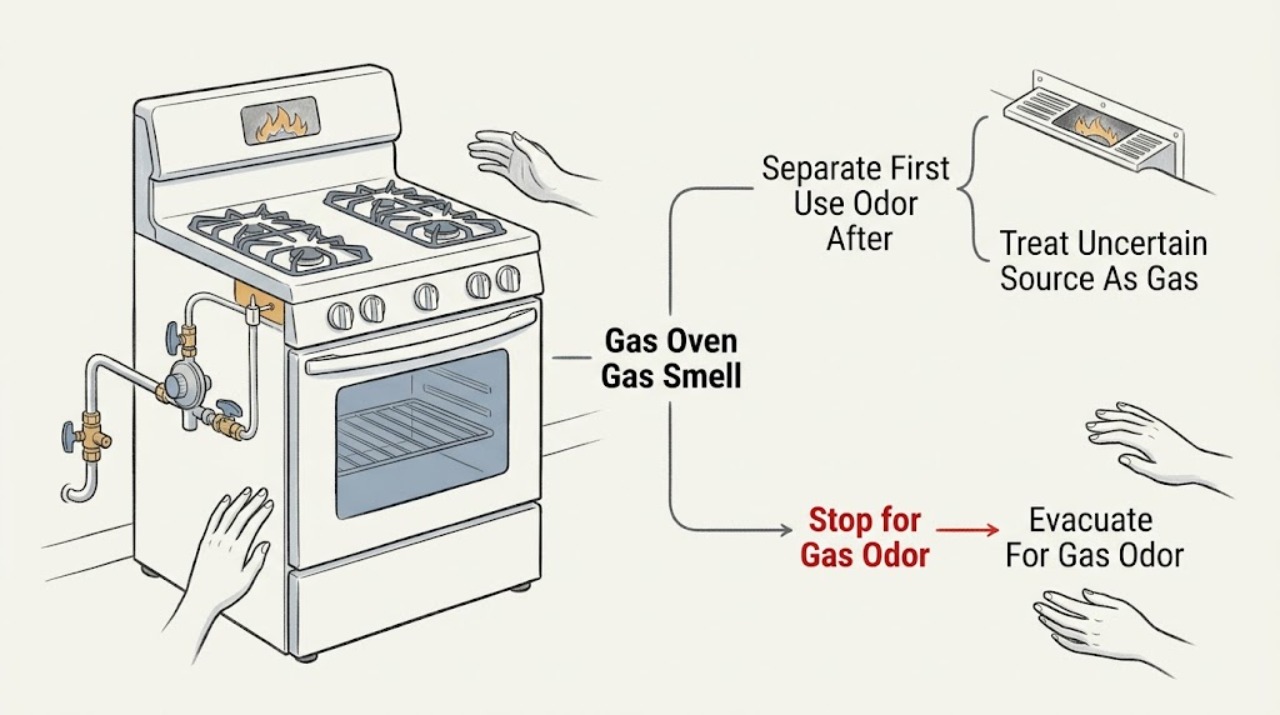
If you smell gas from a Maytag gas oven or range, do not light any appliance, touch electrical switches, use a phone inside, or continue an ignition test. Leave the building and contact the gas supplier from a neighbor's phone or another safe location; if the supplier cannot be reached, contact the fire department. Treat the smell as a gas emergency when the source or strength is uncertain. Do not slide the range, adjust a regulator, inspect a line for leaks, or disassemble the oven. A slight odor or smoke from a brand-new oven can come from manufacturing materials, but that explanation does not override a raw-gas smell, persistent odor, hissing, delayed ignition, abnormal flame, smoke, or symptoms of carbon-monoxide exposure. Once the gas supplier or emergency responder says the area is safe, use the exact Maytag model manual and a qualified gas-appliance technician to determine whether the cause is a valve, regulator, igniter, burner, connection, installation, or a non-gas odor source.
Before you begin
Safety first
- This article supports emergency evacuation and safe documentation only, plus a cool, accessible visual check after qualified clearance. Do not operate switches in a gas-smelling area, ignite, leak-test, move a hard-piped range, adjust gas parts, open panels, or dismantle the oven.
Work through in order
Diagnostic checks
Use only checks that match the exact appliance or system and its official guide.
-
Check 1
If a gas-like odor is present, stop operating the Maytag range or oven immediately, warn others without creating an ignition source, and leave the building by a safe route.
Expected result: Record whether the odor is strong or persistent, whether anyone hears hissing, whether flames or smoking materials are present, and whether anyone has headache, dizziness, nausea, confusion, or breathing difficulty.
Next step: From a neighbor's phone or another safe location, contact the gas supplier and follow its instructions. If the supplier cannot be reached, contact the fire department; use emergency medical help for symptoms.
Stop if: Do not light any appliance, touch electrical switches, use a phone in the building, smoke, search for the leak, or re-enter until qualified responders say it is safe.
Why this matters
Why: An unexplained or persistent gas odor can indicate a fuel-gas release; symptoms or hissing increase urgency. This is not a situation for a burner, oven, light switch, thermostat, or phone inside the building.
-
Check 2
If you cannot confidently distinguish fuel gas from a cooking, cleaner, plastic, or first-use odor, do not run the oven or use the smell as a reason to perform another ignition attempt; leave and use the gas-emergency path.
Expected result: Record whether the odor is present with the appliance off, occurs only around ignition, disappears outside the kitchen, returns after ventilation, or has an uncertain source.
Next step: Have the gas supplier or qualified service provider clear the area and appliance. Once safe, provide the timing and odor description to the technician rather than trying to reproduce it.
Stop if: Do not sniff near burners or fittings, spray a leak detector, use a flame, operate the controls, or re-enter solely to locate the odor.
Why this matters
Why: An uncertain source cannot safely be cleared by home testing. Maytag's normal first-use explanation applies only to a small, temporary new-oven odor; it does not clear a raw-gas-like or recurring smell.
-
Check 3
Only after the gas supplier or emergency responder has cleared the area and no fuel-gas odor remains, record whether the oven is newly installed or being used for the first time and whether all shipping materials have been removed, without starting a new heat cycle until the exact Maytag instructions and technician guidance permit it.
Expected result: Record a small temporary manufacturing odor or smoke that occurred only during initial use, or a gas-like, persistent, worsening, or unexplained odor.
Next step: For a clearly documented first-use odor, follow the exact model's ventilation and first-use instructions after clearance. For any uncertainty or recurrence, stop and arrange qualified Maytag gas-appliance service.
Stop if: Do not run a first-use or self-clean cycle to see whether a gas smell disappears, leave birds or sensitive occupants exposed, or continue if smoke, abnormal flame, or fuel odor returns.
Why this matters
Why: Maytag says a small first-use odor or smoke can come from new parts, insulation, protective coating, or shipping tape. A raw-gas smell, recurrence after the first-use procedure, or odor with flame or ignition abnormality is not explained by that guidance.
-
Check 4
After the area is safe, give the technician a written record of whether the odor occurred when the oven was off, during preheat, during Bake or Broil, after shutdown, while a cooktop burner was in use, or after a recent installation or reconnection.
Expected result: Record the exact control state, whether the flame or igniter was visible only when safe and documented, the odor duration, any whoosh or pop, and whether the cooktop or oven was affected.
Next step: Share the record, model and serial label, installation history, and any gas-supplier incident number with Maytag service; do not operate the appliance to obtain a better description.
Stop if: Do not relight the oven, hold a control open, remove burner parts, move the range, or attempt to reproduce a delayed ignition or odor.
Why this matters
Why: Timing can help a qualified technician distinguish a supply or valve issue, ignition or burner condition, installation or regulator issue, and a non-gas first-use odor. It does not make it safe to repeat the event.
-
Check 5
From a safe location, photograph the Maytag model and serial label and retrieve the exact owner's manual and installation instructions; confirm whether the appliance is configured for natural gas or LP without changing any setting.
Expected result: Record the model, fuel configuration if clearly labeled, recent installation or reconnection, and whether the documentation identifies a regulator or appliance shut-off arrangement.
Next step: Give the identity and documents to a qualified Maytag servicer or gas supplier for inspection; keep the appliance off until the odor source is cleared.
Stop if: Do not slide the range to reach a rear valve, open a regulator, adjust pressure, disconnect a line, or convert between gas types.
Why this matters
Why: Maytag states that instructions, regulator setup, and supply requirements are model and installation dependent. A generic gas-oven page cannot establish that a particular valve, conversion, or pressure condition is correct.
-
Check 6
Only after the area is cleared and the appliance is cool, inspect the oven cavity and visible door or vent area for spilled food, packaging, foil or liner, cleaner residue, or other material that could create a non-gas odor; do not reach into burner, igniter, regulator, or gas-line areas.
Expected result: Record a clearly identified food or packaging residue, a foil or liner that could trap heat or debris, a clean cavity, or an odor source that remains unexplained.
Next step: Remove only loose, cool, plainly visible non-gas residue as the manual permits. If odor persists, stop and use qualified service rather than increasing heat or using a cleaning cycle as a test.
Stop if: Do not clean hot surfaces, scrape the burner, move the gasket, block vents, use flammable cleaners, or continue when fuel odor, smoke, or abnormal heat is present.
Why this matters
Why: Maytag says packaging, manufacturing residue, heavy soil, or foil covering can contribute to first-use or cooking odors. These observations do not clear fuel gas, electrical burning, smoke, or an unexplained recurring smell.
-
Check 7
Leave the main gas valve, regulator shut-off, flexible connector, burner, igniter, and oven controls untouched and arrange qualified inspection when the odor followed installation, reconnection, a move, a conversion, or an unexplained ignition event.
Expected result: Record whether the odor began after installation or reconnection, whether the cooktop works while the oven does not, whether ignition is delayed, and whether any valve or connection has been disturbed.
Next step: Provide the installation history and symptom timing to the gas supplier or qualified Maytag servicer and keep the appliance out of use until cleared.
Stop if: Do not slide a hard-piped range, adjust a regulator, loosen a connector, manually ignite, bypass an igniter, or use a flame or spray to locate a leak.
Why this matters
Why: Maytag identifies trapped air after reconnection, gas supply and regulator setup, and an electrical ground path as installation-dependent considerations. Moving or adjusting the gas path can create a leak or alter safe operation.
-
Check 8
Once emergency gas response is complete, submit the exact model, odor timing, fuel type, installation history, visible observations, and any responder instructions to Maytag or a qualified gas-appliance technician.
Expected result: Record whether the odor was cleared, whether the appliance was tagged or isolated, whether the gas supplier found a supply issue, and whether a qualified technician identified an appliance-side cause.
Next step: Follow the gas supplier's and technician's instructions, and do not use the oven or cooktop until the responsible qualified party authorizes operation.
Stop if: Do not perform another ignition test, replace a gas component, open the appliance, or treat a temporary odor reduction as a repair.
Why this matters
Why: Gas valve, regulator, igniter, burner, connector, grounding, combustion, and installation faults cannot be safely distinguished by smell alone. A cleared odor does not prove the appliance is safe to operate without inspection when the appliance may be involved.
Use your observations
Decision map
Find the observation that best matches what you see, then follow the next safe action.
-
PATH 01Safety boundary
What you see
A raw-gas-like odor is present, the source is uncertain, the odor occurs while the appliance is off, or there is hissing, delayed ignition, abnormal flame, smoke, or symptoms.
Do this next
Do not light an appliance, touch electrical switches, or use a phone in the building. Leave immediately and contact the gas supplier from a neighbor's phone or another safe location; if unreachable, contact the fire department and use emergency medical help for symptoms.
Why this path and its safety boundary
Why it matters: Treat the condition as a possible fuel-gas emergency rather than a routine oven odor.
Safety stop: Do not re-enter to locate the leak, operate the range, test ignition, shut or open a valve if doing so requires entering the hazard, or return until responders clear the area.
-
PATH 02Safety boundary
What you see
Qualified responders have cleared the area, there is no fuel-gas odor, and the appliance is clearly new with a small temporary odor or smoke during initial use.
Do this next
Follow only the exact Maytag first-use and ventilation instructions after clearance, remove packaging as directed, and keep sensitive birds in a separate well-ventilated room.
Why this path and its safety boundary
Why it matters: Maytag says new parts, insulation, protective coating, or shipping materials can cause a limited first-use odor that should dissipate.
Safety stop: Stop if the odor is raw-gas-like, persists or worsens, returns after the documented first-use procedure, or comes with abnormal flame, smoke, heat, or ignition.
-
PATH 03Safety boundary
What you see
A slight odor occurs only during normal cooktop use, with no odor when off, no delayed ignition, no abnormal flame, and no other hazard.
Do this next
Do not transfer that limited cooktop guidance to the oven. If the smell is from the oven, recurs, or cannot be confidently limited to normal cooktop operation, stop and request gas-appliance service.
Why this path and its safety boundary
Why it matters: Maytag notes that a slight odor can sometimes be noticed while using a gas cooktop, but an odor when not in use or an unexplained odor requires the emergency response.
Safety stop: Do not keep operating to compare smells, ignite another burner, adjust caps or valves, or dismiss a gas odor while the appliance is off.
-
PATH 04Safety boundary
What you see
The odor began after installation, movement, gas reconnection, fuel conversion, or work near the range.
Do this next
Keep the appliance off and give the gas supplier or qualified installer the model, fuel type, work history, and odor timing for inspection.
Why this path and its safety boundary
Why it matters: Supply, regulator, connector, trapped air, grounding, or installation configuration may be involved and cannot be safely confirmed by home testing.
Safety stop: Do not move a hard-piped range, adjust the regulator, loosen a connector, or try to purge air by repeatedly igniting burners.
-
PATH 05Safety boundary
What you see
The gas supplier or responder has cleared the area, the oven is cool, and a clearly visible food, packaging, cleaner, or foil-related residue explains a one-time non-gas odor.
Do this next
Remove only cool, loose, visible residue as the exact Maytag manual allows and request service if the odor remains or returns.
Why this path and its safety boundary
Why it matters: A visible residue can create an oven odor, but it does not rule out fuel gas if the smell was raw-gas-like, recurring, or present while off.
Safety stop: Do not use high heat or self-cleaning to test the smell, block vents, disturb the gasket, or clean hot surfaces.
-
PATH 06Safety boundary
What you see
The odor returns after clearance, is present during an oven cycle, accompanies delayed ignition or abnormal flame, or has no confirmed non-gas explanation.
Do this next
Keep the appliance out of use and arrange a qualified Maytag gas-appliance inspection; report any renewed gas odor to the gas supplier or emergency service first.
Why this path and its safety boundary
Why it matters: An appliance-side gas, ignition, combustion, valve, regulator, connector, or electrical fault remains possible.
Safety stop: Do not repeat ignition, adjust gas parts, open the cabinet, or operate until the responsible qualified party clears it.
-
PATH 07Safety boundary
What you see
The model, fuel type, odor source, or safe procedure is uncertain, or the gas supplier and technician need appliance history.
Do this next
Provide the model and serial label, manual, installation or reconnection history, odor timing, control state, visible signs, and emergency response record to Maytag service.
Why this path and its safety boundary
Why it matters: Maytag documentation and installation requirements are model-specific; generic advice cannot establish safe gas operation.
Safety stop: Do not guess at a gas conversion, regulator position, part, or ignition procedure.
Helpful context
Understand the symptom
A gas-like smell is a safety decision before it is a repair diagnosis
The first question is not which part to replace; it is whether fuel gas may be present. Maytag's gas-range guidance gives the same immediate response for an unexplained odor: do not create an ignition source or operate electrical switches in the building, leave, and contact the gas supplier or fire department from a safe location. If you are unsure whether the smell is gas, act as though it is until qualified responders clear the area.
Do not confuse new-oven odor with fuel-gas odor
Maytag says a small amount of odor or smoke during first use can come from new parts, insulation, protective manufacturing coatings, or shipping materials and should dissipate after initial use. That is a separate, qualified explanation for a new appliance. A rotten-egg or raw-gas smell, an odor while the oven is off, recurrence, hissing, delayed ignition, abnormal flame, or smoke that is not clearly first-use residue requires the gas-emergency response rather than another bake or ignition attempt.
Gas supply and ignition work belong to qualified service
A Maytag gas oven needs both a correct gas supply and an electrical ground path for ignition. Maytag's troubleshooting pages identify the main gas valve, regulator shut-off, power connection, and igniter as installation or service considerations, but checking a valve behind or under a range can require moving a heavy appliance or disturbing a gas connection. Do not move or adjust those parts yourself when gas odor is involved.
Safety boundary
Stop conditions
- If gas is smelled, do not light any appliance, touch electrical switches, use a phone inside, smoke, search for a leak, or repeat ignition. Leave and contact the gas supplier from a safe location; contact the fire department if the supplier cannot be reached.
- Treat a raw-gas-like, persistent, unexplained, or off-cycle odor as an emergency even if the odor is faint or the oven appears to work.
- Do not slide a hard-piped range, open or adjust a gas regulator, loosen a connector, alter a fuel conversion, manually ignite a burner, or bypass an igniter.
- Do not use a bake, broil, self-clean, flame, spray, or other test to locate or dismiss a gas odor. Do not re-enter until qualified responders clear the area.
- Stop for delayed ignition, abnormal flame, smoke, burning or electrical odor, hot controls, damaged parts, suspected carbon-monoxide exposure, or an odor that returns after a first-use or residue explanation.
Only after diagnosis
Potential parts
- oven gas valve or regulator component
Consider this category only after a qualified gas-appliance technician confirms a valve or regulator fault following the emergency response and model-specific inspection.
Confirm the exact Maytag model, fuel configuration, and qualified installation requirements; never adjust or replace gas components as a home test. - oven igniter or burner assembly
Consider this category only when a qualified technician diagnoses delayed ignition, failed ignition, abnormal flame, or burner performance after ruling out supply and installation issues.
Match the exact model and fuel setup; do not manually ignite, bypass the igniter, or order from odor alone. - gas connector or supply component
Consider this category only when the gas supplier or qualified installer confirms a connector or supply-side fault, especially after installation, movement, reconnection, or conversion.
Gas-supply work must follow local code and qualified installation requirements; do not move or disconnect the range yourself.
When checks do not resolve it
Need a professional?
Use the gas supplier or emergency service immediately for a gas-like odor, hissing, strong or persistent smell, delayed ignition, abnormal flame, smoke, or symptoms. After the area is cleared, arrange qualified Maytag gas-appliance service for any recurrence, unexplained odor, installation or reconnection history, regulator or connector question, ignition problem, or diagnosis that would require moving the range, accessing gas parts, opening the cabinet, or testing combustion.
Safety scope: This article supports emergency evacuation and safe documentation only, plus a cool, accessible visual check after qualified clearance. Do not operate switches in a gas-smelling area, ignite, leak-test, move a hard-piped range, adjust gas parts, open panels, or dismantle the oven.
Common questions
FAQ
What should I do first if my Maytag gas oven smells like gas?
Do not light an appliance, touch electrical switches, use a phone inside, or continue ignition. Leave the building and contact the gas supplier from a neighbor's phone or another safe location; if the supplier cannot be reached, contact the fire department.
Can a new Maytag oven have an odor?
Maytag says a small temporary odor or smoke during first use can come from new parts, insulation, protective coating, or shipping materials. That does not clear a raw-gas-like, persistent, off-cycle, hissing, delayed-ignition, or abnormal-flame smell; use the gas-emergency response for those signs.
Is a slight smell during gas-cooktop use normal?
Maytag notes that a slight odor can sometimes occur during cooktop use. Do not transfer that limited guidance to an unexplained oven odor, an odor while the appliance is off, or any recurring smell. When uncertain, stop, leave, and contact the gas supplier.
Can I check the Maytag oven regulator or gas line myself?
No. Do not slide a hard-piped range, adjust a regulator, loosen a connector, or search for a leak, especially when gas odor is involved. Maytag treats gas supply, regulator, grounding, and installation as qualified service matters.
When can I use the Maytag gas oven again?
Do not use it after an unexplained or recurring gas odor until the gas supplier, emergency responder, qualified installer, or Maytag servicer has cleared the area and authorized operation. A temporary reduction in smell is not proof that the appliance is safe.
Read the exact guide
Official sources
- How to Check the Gas Regulator Shut-Off Valve on an OvenMaytag Product Help · Official Maytag installation-support guidance; a gas odor or uncertain hard-piped connection requires qualified service rather than owner movement.
- Cleaning and Maintenance for RangeMaytag Product Help · Official Maytag range-care guidance; it does not replace gas-emergency instructions or exact model documentation.
- Odors and Smells of Newly Installed Range or OvenMaytag Product Help · Official Maytag guidance for newly installed ranges and ovens; it does not clear a raw-gas-like or recurring odor.
- Odors or SmellsMaytag Product Help · Official Maytag Product Help guidance for gas cooktops; the gas-odor emergency instructions also inform a Maytag gas oven or range when the source is uncertain.
- GAS RANGE Use & Care GuideMaytag · Official Maytag gas-range owner's manual for the documented range family; exact installed model manual controls.
- Oven Not Working - GasMaytag Product Help · Official Maytag Product Help guidance for gas ranges and ovens; exact model installation instructions control.
Community feedback
Share a repair observation
Share a plain-text repair observation. Accepted observations are published automatically; this page may take a moment to update.