
On this page
Start here
Quick answer
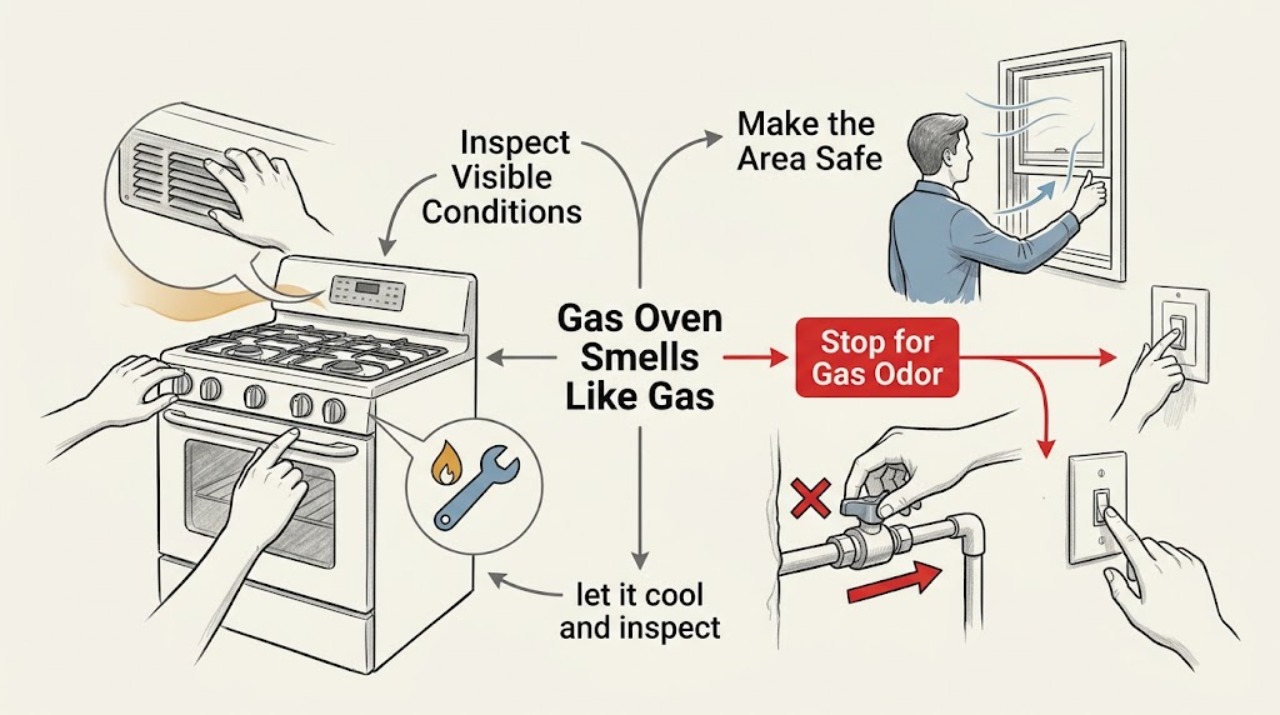
If an Amana gas oven produces a persistent gas or rotten-egg smell, smells when it is off, or you hear hissing or feel unwell, stop troubleshooting: do not light an appliance, touch electrical switches, use a phone inside, or try to find the leak. Leave the building and call the gas supplier or fire department from outside. Amana says to first make sure no surface burner was accidentally left on; if the odor remains, treat it as a gas-safety event. A brief faint odor at ignition or a new-oven manufacturing smell can have different explanations, but never relight the oven to test that theory. Only after the odor is completely gone and no leak is suspected should you check for packaging, foil or food residue with the appliance cool and follow the exact model instructions. Do not remove panels, adjust a regulator, test a gas connector, replace an igniter or bypass a safety device yourself.
Before you begin
Safety first
- Do not light an appliance, operate electrical switches or phones inside during a suspected leak, move the range to inspect its connector, open panels, adjust a regulator, test for leaks with a flame, replace gas components, bypass an igniter or safety device, or relight to reproduce the smell. Leave and contact the gas supplier or fire department from outside.
Work through in order
Diagnostic checks
Use only checks that match the exact appliance or system and its official guide.
-
Check 1
Stop using the Amana gas oven and classify the odor without touching controls: is it a strong or persistent gas/rotten-egg smell, present while the oven is off, accompanied by hissing or symptoms, or only a brief odor during ignition or a non-gas smell from a new appliance?
Expected result: The gas odor persists, occurs while off, or comes with hissing, dizziness, headache or nausea; alternatively it has fully disappeared and was limited to a first-use or brief ignition event.
Next step: For any ongoing or suspected gas leak, leave immediately and call the gas supplier or fire department from outside. Do not relight the oven to reproduce a brief smell. Continue only with the non-gas-odor branch when the area is clear and no leak is suspected.
Stop if: Do not touch an electrical switch, use a phone inside, light a match, start the oven, or investigate the connector, regulator or burner when gas may be present.
Why this matters
Why: Persistent/off- state odor or physical symptoms can indicate a gas leak and override all appliance troubleshooting. A fully disappeared first-use odor is a different branch, but timing alone does not prove that it was harmless gas ignition.
-
Check 2
Only if the odor has completely cleared and it is safe to look at the front of the appliance, verify visually that every surface-burner knob and the oven control are fully off. Do not move the range or turn a knob on to test it.
Expected result: A surface burner was left partially on, all visible controls are off, or the odor returns while checking.
Next step: If a knob was on, ventilate only as directed by the gas supplier and do not relight until the area is confirmed safe. If all knobs were off or the smell returns, leave the building and contact the gas supplier or fire department from outside.
Stop if: Stop immediately for any renewed gas smell, hissing, symptoms, or uncertainty about whether the knob is fully off. Do not attempt to shut an inaccessible supply valve or move the appliance.
Why this matters
Why: Amana identifies an accidentally turned-on surface burner as a possible source when gas is smelled while the cooktop is not intentionally in use. If all controls are off or the odor returns, the source is not resolved and could involve the appliance or gas line.
-
Check 3
If there is no current gas odor and the oven is newly installed or newly used, let it cool and inspect only the oven cavity for shipping packaging, foil or a visible food spill. Do not line the oven bottom with foil or operate a cycle if the smell was gas-like or unexplained.
Expected result: Packaging, foil or trapped residue is present; the oven is new and the odor was a non-gas manufacturing smell; or nothing visible explains the odor.
Next step: For a confirmed new-oven odor with no gas concern, remove packaging and follow the exact Amana model instructions for a first-use empty cycle and ventilation. For unexplained or recurring odor, stop using the oven and arrange qualified service.
Stop if: Do not run a self-clean or empty bake cycle to mask a gas smell, do not use foil to catch spills, and do not continue if any gas odor returns.
Why this matters
Why: Amana says new parts, insulation, protective coating and shipping tape can create a temporary first-use odor, while foil can trap spills and debris and interfere with airflow or combustion. Nothing visible, a recurring odor, or an odor that smells like gas should not be treated as a cleaning problem.
-
Check 4
After the oven is confirmed safe and only during an already intended, model-approved use, note whether any odor is a brief faint whiff at ignition, persists through preheating, appears when the oven is off, or is accompanied by delayed ignition, unusual flame, soot or hissing. Do not repeat an ignition solely as a test.
Expected result: The odor is brief and never returns, persists beyond ignition, appears while off, or occurs with delayed ignition, abnormal flame, soot or hissing.
Next step: Do not use the oven again if the odor persists, ignition is delayed, the flame is abnormal, or soot/hissing appears. Provide the technician with the model, fuel type, timing, symptoms and any recent installation or conversion work.
Stop if: Never remove a burner cover or oven panel, adjust the regulator, test a connector with a flame or liquid, bypass an igniter or safety valve, or relight after a failed ignition.
Why this matters
Why: Whirlpool describes a brief faint ignition whiff as a possible event, but a persistent/off odor or delayed ignition can point to a fault or gas leak. Yellow/sooting flames and supply or regulator questions require model-specific professional assessment, not a generic adjustment.
-
Check 5
Before service, collect information from a safe location: Amana model number, Natural Gas or LP fuel type if known, whether the odor occurred with the oven off or during ignition, whether the cooktop works normally, any error or delayed ignition, and whether the appliance was recently installed, moved or converted.
Expected result: The technician has a clear symptom timeline and model/fuel information, or the fuel type, installation history or odor source is unknown.
Next step: Give the details to a qualified appliance technician or the gas supplier and follow their instructions. Keep the oven out of service until they say it is safe.
Stop if: Do not move the range to inspect the gas connector, open access panels, perform a pressure test, or substitute a part based only on a symptom description.
Why this matters
Why: These details determine which installation instructions and combustion checks apply. Unknown fuel or installation information increases the risk of a wrong adjustment, so it is not a reason to experiment with the appliance.
Use your observations
Decision map
Find the observation that best matches what you see, then follow the next safe action.
-
PATH 01Next step
What you see
Gas or rotten-egg odor persists, is present while the oven is off, or is accompanied by hissing or illness.
Do this next
Treat it as a possible gas leak: leave immediately, do not operate switches or electronics inside, and call the gas supplier or fire department from outside. Do not return to troubleshoot until cleared.
-
PATH 02Next step
What you see
The odor has cleared and a surface-burner knob was accidentally left on.
Do this next
Do not relight or use the appliance as a test. Follow the gas supplier's safety instructions; a returning odor or any uncertainty sends the situation back to the gas-leak branch.
-
PATH 03Next step
What you see
The oven is new and the odor is a temporary non-gas smell, with packaging or foil as a possible contributor and no suspected leak.
Do this next
With the oven cool, remove packaging and do not use foil liners. Follow the exact model's first-use instructions and ventilation guidance; stop if the smell becomes gas-like or persists.
-
PATH 04Next step
What you see
The smell is brief at ignition but repeats, lasts through preheating, or appears with delayed ignition, abnormal flame or soot.
Do this next
Stop using the oven and arrange qualified service. A delayed or failed igniter and fuel/regulator or combustion issues require model-specific professional diagnosis.
-
PATH 05Next step
What you see
No gas odor is present, but the source is unexplained or any gas component, connector or regulator may be involved.
Do this next
Do not open or move the appliance. Keep it out of service and provide the model, fuel type and symptom timeline to a qualified appliance technician or gas supplier.
Helpful context
Understand the symptom
First decide whether this is a gas emergency
The safest split is not between different oven parts; it is between a suspected gas leak and a non-gas oven odor. A smell while the oven is off, a strong or persistent rotten-egg odor, hissing, dizziness or a smell that remains after visible controls are off should end the diagnosis. Leave without operating switches or phones inside and contact the gas supplier or fire department from outside. Do not stay to identify the leaking component.
New-oven odor is a separate, tightly limited branch
Amana says a small amount of smoke or odor during the first uses of a new oven can come from heated new parts, insulation, protective coating or shipping tape. That does not make a gas smell safe to ignore. Only when there has never been a suspected gas odor and the cavity is cool should you remove packaging and check for foil or trapped food residue according to the exact manual.
Gas components are a professional boundary
The igniter, burner, gas valve, regulator, connector and combustion path can require model-specific testing. A delayed ignition can leave unburned gas near the burner, but a homeowner should not open panels, adjust pressure or replace a gas component to prove that diagnosis. Record the symptom and fuel type for a qualified appliance technician after the area is safe.
Only after diagnosis
Potential parts
- oven igniter
Consider only after a qualified technician confirms delayed or failed ignition and identifies the igniter as the cause; a gas odor by itself does not identify this part.
Confirm the exact Amana model, fuel configuration and manufacturer fit information before any replacement; gas and ignition work should be performed by a qualified professional. - gas valve or burner assembly
Consider only after professional diagnosis of persistent burner ignition, flame or gas-control symptoms; do not infer a valve or burner fault from smell alone.
Verify exact model, fuel type, approved installation procedure and fitment with Amana documentation and a qualified technician; never adjust or bypass a gas safety control.
When checks do not resolve it
Need a professional?
Call the gas supplier or fire department from outside immediately for a persistent or unexplained gas odor, hissing or symptoms. Arrange qualified appliance service for repeated ignition odor, delayed ignition, abnormal flame, soot, a suspected igniter or gas-control fault, or any odor that cannot be confirmed as a temporary non-gas new-oven smell.
Safety scope: Do not light an appliance, operate electrical switches or phones inside during a suspected leak, move the range to inspect its connector, open panels, adjust a regulator, test for leaks with a flame, replace gas components, bypass an igniter or safety device, or relight to reproduce the smell. Leave and contact the gas supplier or fire department from outside.
Common questions
FAQ
Is it normal for an Amana gas oven to smell like gas?
A brief faint odor around ignition can occur, and Amana says temporary odor or smoke from a new oven can come from new parts and shipping materials. A strong, persistent, unexplained or off-state gas odor is not a normal break-in symptom; leave and contact the gas supplier or fire department from outside.
What should I do if I smell gas when the Amana oven is off?
Do not light anything, touch an electrical switch or use a phone inside. Leave the building and call the gas supplier or fire department from outside. Do not stay to identify whether the oven, a surface burner or the supply line is leaking.
Could a dirty oven or foil cause an odor?
Food residue or foil can create non-gas odors, and Amana warns that foil can trap debris and interfere with airflow or combustion. Do not clean or run a cycle until any gas-smell concern is ruled out; never use foil as an oven-bottom liner.
Can I replace the Amana gas oven igniter myself?
Do not use a gas smell as a reason to replace a part yourself. A damaged igniter may delay ignition, but identifying and replacing it requires model-specific diagnosis and safe gas-appliance work by a qualified professional.
Read the exact guide
Official sources
- Odors or SmellsAmana Product Help · Amana gas-cooking-appliance odor, fuel and burner guidance
- Why Does My Oven Smell Like Gas?Whirlpool · Whirlpool manufacturer guidance on gas-oven odors, ignition, suspected leaks and igniter service boundary
- Range Troubleshooting: Cleaning, Maintenance and OdorsAmana · Amana gas-range odor and safe response guidance
- Odors and Smells of Newly Installed Range or OvenAmana Product Help · Amana newly installed oven odor and first-use guidance
Community feedback
Share a repair observation
Share a plain-text repair observation. Accepted observations are published automatically; this page may take a moment to update.